

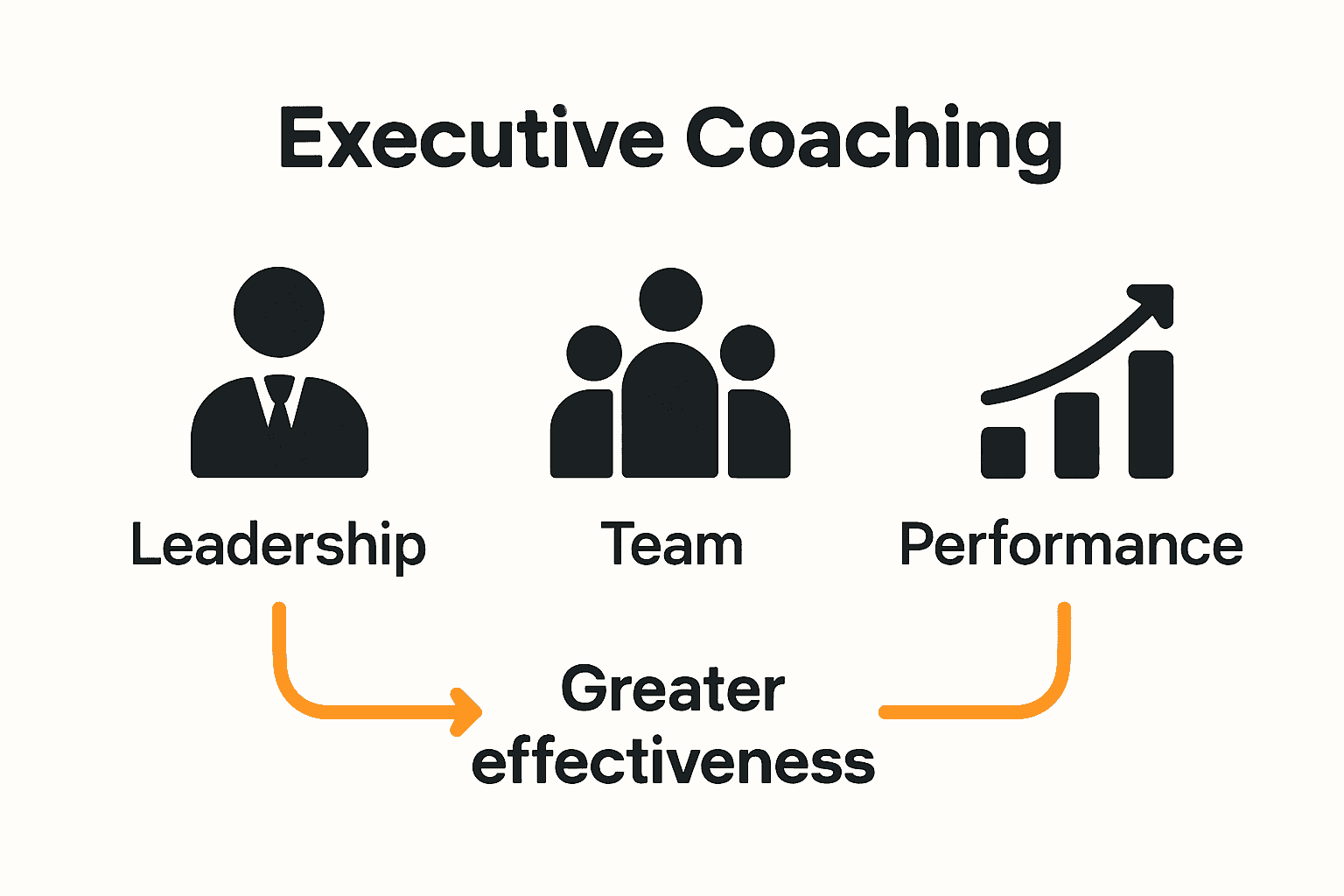
Nearly 70 percent of executives say coaching improved their work performance or communication skills. This type of personal development is gaining attention because leadership demands are higher than ever and effective growth strategies can shape entire organizations. By understanding executive coaching and its many forms, readers can see how targeted support transforms individual leaders, teams, and business outcomes.
Key Takeaways
| Point | Details |
|---|---|
| Executive Coaching Definition | A personalized development strategy focusing on enhancing leadership potential and organizational performance through partnership with coaches. |
| Types of Coaching | Varied coaching types target specific growth areas like leadership development, performance improvement, and conflict resolution, ensuring tailored support for individual needs. |
| Methodologies | Successful executive coaching combines facilitative and goal-oriented techniques, promoting both self-discovery and structured action planning for impactful results. |
| Investment Considerations | Organizations should carefully assess coaching costs and ROI, ensuring alignment with strategic goals and managing expectations for sustainable impact. |
Table of Contents
- Defining Executive Coaching And Its Purpose
- Different Types Of Executive Coaching Services
- Core Processes And Methodologies Used
- Benefits And Applications In Modern Organizations
- Assessing Costs, ROI, And Key Pitfalls
Defining Executive Coaching and Its Purpose
Executive coaching is a strategic, personalized development approach designed to unlock human potential in professional environments. Business leadership coaching represents a targeted intervention where a professional coach partners with organizational leaders to enhance performance, self-awareness, and transformational growth.
According to research from the International Coaching Federation, executive coaching is fundamentally about “partnering with clients in a thought-provoking and creative process to inspire personal and professional potential.” The core objectives of this collaborative relationship include:
- Improving individual leadership capabilities
- Developing strategic thinking skills
- Enhancing organizational performance
- Facilitating personal and professional transformation
Understanding Why Coaching Works reveals that executive coaching is more than traditional training. It’s an intimate, goal-oriented relationship where coaches help leaders navigate complex professional challenges through structured dialogue, self-reflection, and actionable strategies. The process typically involves:
- Identifying specific performance objectives
- Creating personalized development plans
- Implementing targeted interventions
- Measuring progress and adjusting approaches
At its essence, executive coaching empowers leaders to unlock their intrinsic potential, bridging the gap between current performance and desired professional outcomes.
Different Types of Executive Coaching Services
Executive coaching isn’t a one-size-fits-all solution. Understanding the Role of Coaching in Business reveals that organizations and individuals can benefit from specialized coaching approaches tailored to specific developmental needs. Coaching services range from targeted interventions addressing precise challenges to comprehensive developmental frameworks.
According to research from Performance Ninja, multiple executive coaching types exist, each designed to address unique professional growth dimensions:
- Leadership Development Coaching: Enhances strategic thinking and interpersonal leadership skills
- Transitional Coaching: Supports leaders navigating role changes or organizational shifts
- Performance Coaching: Focuses on improving measurable professional outputs and productivity
- Behavioral Coaching: Targets emotional intelligence and sustainable habit transformation
Additional specialized coaching types include:
- Team Coaching: Improving collective performance and group dynamics
- Career Coaching: Guiding professional trajectory and career progression
- Strategic Coaching: Developing long-term organizational and personal strategic capabilities
- Innovation Coaching: Stimulating creative problem-solving and breakthrough thinking
- Conflict Resolution Coaching: Addressing interpersonal challenges and communication barriers
The diversity of coaching services underscores the nuanced approach required in professional development. Each type offers a unique lens for personal and organizational growth, enabling leaders to address specific challenges and unlock their full potential.

Here’s a comparison of common types of executive coaching services:
| Coaching Type | Main Focus | Typical Outcomes |
|---|---|---|
| Leadership Development | Strategic thinking Interpersonal skills |
Enhanced leadership Better decision-making |
| Transitional | Role transitions Organizational change |
Smoother transitions Increased adaptability |
| Performance | Measurable output Productivity |
Improved results Higher efficiency |
| Behavioral | Emotional intelligence Habits |
Stronger self-regulation Sustainable habits |
| Team | Group dynamics Collective goals |
Improved collaboration Stronger team results |
| Career | Professional trajectory Career planning |
Clarity Career progression |
| Strategic | Long-term planning Vision development |
Better priorities Stronger foresight |
| Innovation | Creativity Breakthrough thinking |
More ideas Innovative solutions |
| Conflict Resolution | Communication Problem-solving |
Resolved disputes Healthier work climate |
Core Processes and Methodologies Used
Executive coaching methodologies represent sophisticated approaches designed to unlock individual and organizational potential. Coaching Techniques Explained highlights the nuanced strategies professional coaches employ to drive meaningful transformation.
According to research from the Frontiers in Psychology journal, two primary approaches dominate the coaching landscape. The first approach emphasizes a facilitation process rooted in positive psychology, characterized by:
- Active listening techniques
- Socratic questioning methods
- Appreciative inquiry strategies
- Insight generation practices
This approach focuses on enabling self-discovery, helping clients uncover their intrinsic capabilities and potential through reflective dialogue and thoughtful exploration.
The second methodology concentrates on goal-oriented outcomes, utilizing:
- Structured action planning
- Robust accountability mechanisms
- Strength-based coaching frameworks
- Cognitive-behavioral intervention techniques
This results-driven approach prioritizes measurable behavioral change, systematically guiding clients toward predefined performance objectives. Coaches employing this method work closely with clients to design clear roadmaps, establish concrete milestones, and implement strategic interventions that translate insights into tangible professional growth.
Ultimately, successful executive coaching integrates elements from both methodological approaches, creating a dynamic, personalized development experience that balances deep psychological understanding with practical, actionable strategies.
Benefits and Applications in Modern Organizations
Executive coaching has emerged as a transformative strategy for organizational development, offering targeted interventions that drive meaningful professional growth. Understanding the Role of Coaching in Business reveals the comprehensive impact of these strategic development approaches.
According to meta-analytic research, executive coaching demonstrates significant positive effects across cognitive, affective, and behavioral dimensions. The individual-level outcomes are particularly compelling, with notable enhancements in leadership-critical characteristics:
- Improved strategic thinking capabilities
- Enhanced emotional intelligence
- Stronger leadership presence
- Better conflict resolution skills
Modern organizations leverage executive coaching across multiple critical domains, including:
- Leadership development and succession planning
- High-potential talent nurturing
- Performance enhancement and remediation
- Managing complex organizational transitions
- Supporting diversity and inclusion initiatives
Research from industrial-organizational psychology highlights specific applications such as:
- Onboarding new executive leadership
- Facilitating merger and acquisition adaptations
- Developing executive influence and strategic communication
- Supporting career progression strategies
The profound impact extends beyond individual development, creating ripple effects that strengthen organizational culture, improve team dynamics, and drive sustainable performance improvements. By investing in targeted coaching interventions, organizations can unlock latent potential, cultivate adaptive leadership, and create more resilient, innovative professional ecosystems.
Assessing Costs, ROI, and Key Pitfalls
Executive coaching investments require careful financial scrutiny and strategic evaluation. Understanding What is Risk Assessment provides critical insights into navigating the complex landscape of coaching expenditures and potential organizational returns.
Critical perspectives highlight significant challenges in measuring coaching return on investment (ROI). According to research, several key concerns emerge that organizations must carefully consider:
- Lack of rigorous empirical evidence
- Questions about long-term impact sustainability
- High per-session financial costs
- Potential for outcomes to fade over time
Typical executive coaching engagements can range from $500 to $5,000 per session, with comprehensive programs potentially costing between $15,000 and $50,000 annually. This significant financial investment demands a structured approach to assessment:
- Establish clear, measurable performance benchmarks
- Implement comprehensive pre and post-coaching evaluations
- Track both quantitative and qualitative organizational improvements
- Monitor individual and team performance metrics
Key pitfalls organizations should be aware of include:
- Unrealistic expectations of immediate transformation
- Insufficient alignment between coaching objectives and organizational goals
- Lack of executive leadership commitment
- Inadequate follow-up and sustained support mechanisms
Successful executive coaching requires a nuanced approach that balances financial investment with strategic organizational development, ensuring that coaching interventions deliver tangible, sustainable value beyond initial engagement.
Ready to Experience Transformational Executive Coaching?
You have just discovered how executive coaching can boost leadership, drive personal and organizational growth, and deliver real results. Still, the path to measurable transformation may feel overwhelming. Struggling to align individualized coaching with your business goals or facing uncertainty about investing resources for lasting impact is common, but there are proven solutions. Explore how specialized approaches discussed in our Agile Coaching Archives can help you move beyond generic advice by leveraging targeted strategies, robust accountability, and real-world expertise.

Let Tariq Juneja guide your next step. Visit https://tariqjuneja.com to discover programs that break through common barriers and create sustainable change. Do not wait until the next leadership hurdle slows you down. Act now and schedule your free consultation or download exclusive resources tailored to your executive journey.
Frequently Asked Questions
What is executive coaching?
Executive coaching is a strategic, personalized development approach where a professional coach partners with organizational leaders to enhance their performance, self-awareness, and transformational growth.
What are the key objectives of executive coaching?
The core objectives include improving individual leadership capabilities, developing strategic thinking skills, enhancing organizational performance, and facilitating personal and professional transformation.
What are the different types of executive coaching services?
Types of executive coaching services include leadership development coaching, transitional coaching, performance coaching, behavioral coaching, team coaching, career coaching, strategic coaching, innovation coaching, and conflict resolution coaching.
How is the effectiveness of executive coaching measured?
Effectiveness is typically measured through pre and post-coaching evaluations, tracking quantitative and qualitative improvements in performance metrics, and establishing clear, measurable performance benchmarks.