

Every mid-level IT manager in a global telecommunications company knows the pressure that comes with fast-changing technical demands and high expectations from leadership. The challenge of keeping teams productive while managing stress is always present. Professional coaching offers a path to real improvement, with one-on-one interventions proven to strengthen leadership identity, resilience, and psychological well-being. Discover how targeted coaching approaches can transform not only your team’s performance, but also your own effectiveness in today’s competitive technology environment.
Table of Contents
- Defining Professional Coaching and Its Impact
- Types of Coaching Relevant to IT Managers
- How Coaching Drives Team Productivity
- Reducing Stress Through Transformational Coaching
- Measuring ROI and Common Pitfalls
Key Takeaways
| Point | Details |
|---|---|
| Impact of Professional Coaching | Professional coaching enhances leadership identity, psychological well-being, and emotional intelligence, contributing to overall organizational performance. |
| Coaching Types for IT Managers | Various coaching modalities such as Executive, Managerial, and Digital Coaching cater to the specific challenges faced by IT leaders. |
| Driving Team Productivity | Coaching improves team dynamics and productivity through performance alignment, skill development, and fostering a culture of accountability. |
| Measuring Coaching ROI | Effective ROI assessment requires a multidimensional approach that includes behavioral change, psychological impact, and employee engagement metrics. |
Defining Professional Coaching and Its Impact
Professional coaching represents a strategic developmental approach designed specifically for leaders seeking transformative personal and professional growth. Unlike traditional training programs, coaching focuses on individualized, one-on-one interventions that address unique leadership challenges within complex organizational environments.
Recent research demonstrates that professional leadership coaching delivers substantial benefits across multiple dimensions of leadership effectiveness. The coaching process supports:
- Enhanced leadership identity and self-concept
- Improved psychological well-being
- Stronger sense of professional purpose
- Increased resilience in challenging work contexts
- Better emotional intelligence and interpersonal skills
Coaching leadership style (CLS) represents a sophisticated approach that goes beyond traditional management techniques. By emphasizing employee motivation, psychological safety, and organizational adaptability, CLS enables leaders to navigate increasingly complex technological and workforce landscapes.
Professional coaching transforms individual potential into measurable organizational performance.
The core methodology of professional coaching involves structured dialogue, powerful questioning techniques, and personalized developmental strategies. Coaches work collaboratively with leaders to:
- Identify specific performance objectives
- Uncover hidden personal and professional barriers
- Design targeted intervention strategies
- Create accountability mechanisms
- Monitor continuous improvement
Pro tip: When selecting a professional coach, prioritize practitioners with demonstrated experience in your specific industry and leadership context.
Types of Coaching Relevant to IT Managers
Telecom IT leaders have access to multiple coaching modalities designed to address the unique challenges of technological leadership. Workplace coaching encompasses several specialized approaches tailored to different organizational needs and individual development stages.
The primary coaching types relevant for IT managers include:
- Executive Coaching: Targeted at senior technology leaders seeking strategic transformation
- Managerial Coaching: Focused on direct skill development and team leadership capabilities
- Peer Coaching: Collaborative learning approach among technology professionals
- Digital Coaching: Technology-enabled remote coaching interventions
- Technical Leadership Coaching: Specifically designed for IT management contexts
Each coaching type offers distinct advantages for technology professionals. Managerial coaching, for instance, enables direct skill transfer and personalized performance improvement, while digital coaching provides flexible learning opportunities across distributed technological teams.

Here’s a summary of coaching types and their strategic focus for IT managers:
| Coaching Type | Primary Focus | Typical Application |
|---|---|---|
| Executive Coaching | Strategic transformation | Senior IT leadership |
| Managerial Coaching | Direct skill enhancement | Mid-level technology managers |
| Peer Coaching | Collaborative problem solving | Cross-functional IT teams |
| Digital Coaching | Remote learning and development | Distributed workforce and global teams |
| Technical Leadership | Advanced IT management principles | Specialized IT leaders |
Technology leadership demands continuous adaptation and personalized developmental strategies.
The evolution of coaching methodologies reflects the dynamic nature of IT environments. Modern coaching approaches integrate:
- Technological skill enhancement
- Emotional intelligence development
- Strategic thinking frameworks
- Change management techniques
- Innovation leadership principles
Pro tip: Select a coaching approach that aligns closely with your specific technological domain and current career development objectives.
How Coaching Drives Team Productivity
Coaching has emerged as a powerful mechanism for transforming team dynamics and accelerating performance in technology-driven organizations. Coaching directly influences team productivity by unlocking individual potential and creating a collaborative, high-performance workplace culture.
The key productivity drivers facilitated by coaching include:
- Performance Alignment: Synchronizing individual goals with organizational objectives
- Skill Development: Targeted enhancement of technical and interpersonal capabilities
- Communication Improvement: Breaking down interdepartmental barriers
- Accountability Culture: Establishing clear expectations and performance metrics
- Continuous Learning: Creating an environment of ongoing professional growth
Organizational transformation occurs through systematic coaching interventions that address both individual and collective performance challenges. By providing personalized development strategies, coaches help IT teams navigate complex technological landscapes while maintaining high productivity standards.
Coaching transforms individual potential into collective organizational excellence.
The productivity enhancement process typically involves:
- Comprehensive performance assessment
- Individualized development planning
- Regular progress tracking
- Feedback and adaptive strategy refinement
- Continuous skill optimization
Pro tip: Implement quarterly coaching check-ins to maintain momentum and track tangible performance improvements across your technology teams.
Reducing Stress Through Transformational Coaching
Technology leaders in telecommunications face unprecedented workplace stress, making stress management coaching a critical intervention for maintaining professional effectiveness and personal well-being. Transformational coaching provides a strategic approach to addressing both psychological and physiological stress responses in high-pressure IT environments.
Key stress reduction strategies in coaching include:
- Cognitive Reframing: Changing perspective on workplace challenges
- Emotional Regulation: Developing resilience and emotional intelligence
- Performance Boundary Setting: Establishing healthy work-life integration
- Mindfulness Techniques: Implementing meditation and breathing exercises
- Systemic Stress Analysis: Identifying root causes of organizational tension
Organizational resilience emerges when leaders learn to navigate complex technological landscapes while maintaining mental equilibrium. By providing personalized interventions, coaches help IT professionals develop robust coping mechanisms that transform stress from a debilitating force into a catalyst for growth and innovation.
Stress is not the enemy; ineffective stress management is the real challenge.
The comprehensive stress reduction process typically involves:
- Comprehensive stress assessment
- Individual stress response mapping
- Targeted intervention strategy development
- Skill-building workshops
- Continuous progress monitoring
Pro tip: Implement a weekly 15-minute mindfulness practice to systematically reduce accumulated workplace stress and enhance overall cognitive resilience.
Measuring ROI and Common Pitfalls
Measuring the return on investment (ROI) for coaching requires a sophisticated approach that goes beyond simplistic financial calculations. Coaching ROI studies demonstrate complex measurement challenges that demand nuanced, multi-dimensional evaluation strategies for telecom IT leadership development.
Key ROI measurement dimensions include:
- Behavioral Change Metrics: Observable shifts in leadership performance
- Psychological Impact Assessment: Improvements in stress management and resilience
- Financial Performance Indicators: Direct and indirect organizational benefits
- Employee Engagement Scores: Quantifiable team productivity enhancements
- Strategic Alignment Evaluation: Coaching outcomes matching organizational goals
Comprehensive ROI tracking requires a holistic approach that integrates quantitative and qualitative data points. Telecom IT leaders must move beyond traditional measurement frameworks to capture the subtle yet significant transformations generated through targeted coaching interventions.
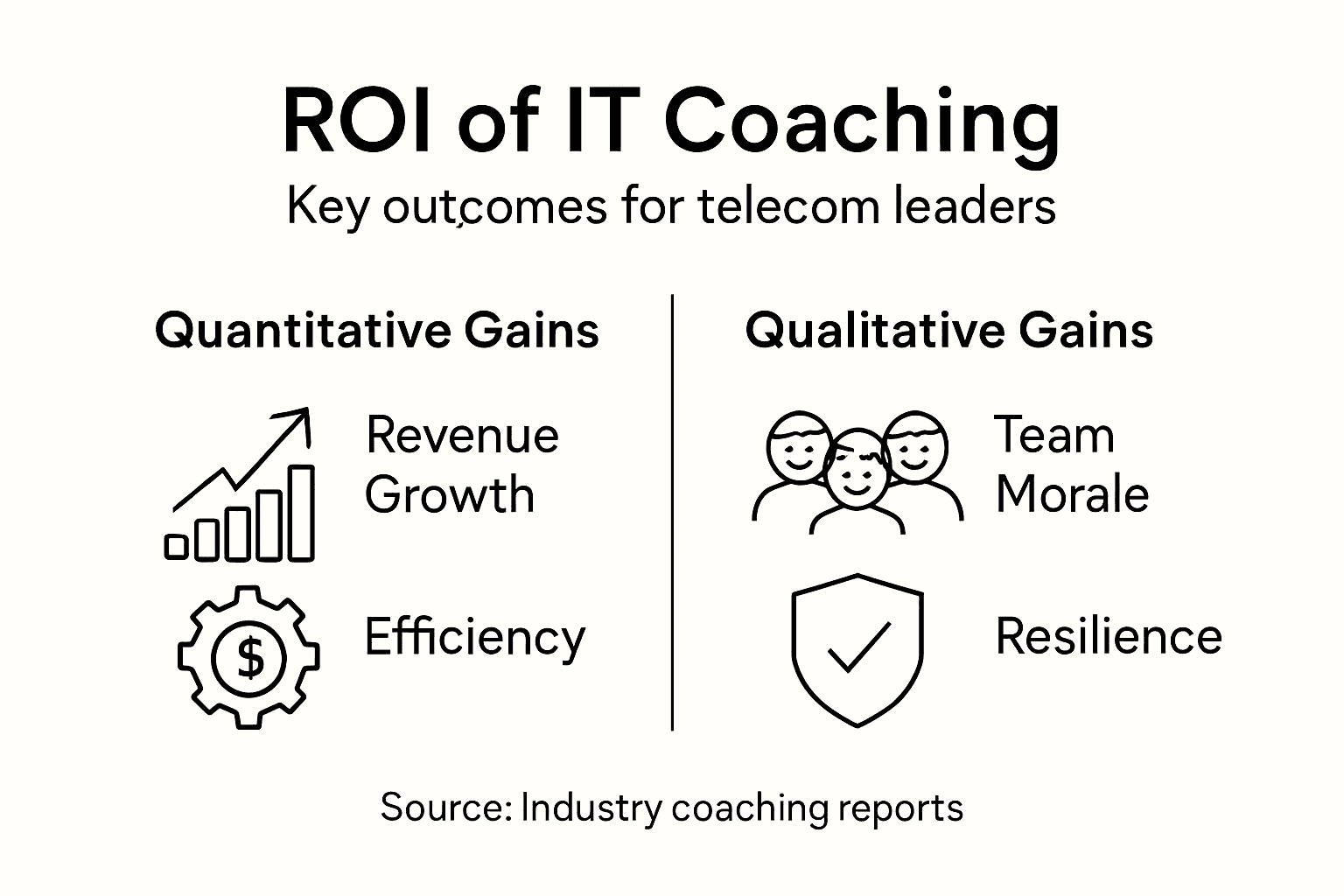
The following table compares ROI measurement approaches for IT coaching programs:
| ROI Dimension | Data Source Example | Business Impact Insight |
|---|---|---|
| Behavioral Change | Performance reviews | Improved leadership practices |
| Psychological Impact | Employee surveys | Enhanced workforce resilience |
| Financial Indicators | Budget analysis | Increased team productivity |
| Engagement Scores | HR analytics | Higher employee retention |
| Strategic Alignment | Executive feedback | Alignment with business goals |
Effective ROI measurement transforms coaching from an expense to a strategic investment.
The systematic ROI assessment process typically involves:
- Establishing clear baseline performance metrics
- Defining specific coaching objectives
- Implementing robust tracking mechanisms
- Collecting multi-source feedback
- Conducting periodic comprehensive evaluations
Pro tip: Develop a standardized coaching impact scorecard that captures both tangible financial outcomes and intangible leadership development indicators.
Unlock the Full Potential of Telecom IT Leadership with Transformational Coaching
Telecom IT leaders face unique challenges such as high-stress environments, fast-paced technological change, and the need for strategic transformation. This article highlights the critical impact of professional coaching on enhancing leadership effectiveness, boosting team productivity, and managing workplace stress. If you are looking to align your personal growth with your organization’s goals and navigate complex IT landscapes confidently, personalized coaching can be your key to breakthrough results.
Discover proven coaching strategies that focus on performance alignment, emotional resilience, and continuous learning. At Tariq Juneja, we specialize in transformational change that empowers technology leaders through tailored coaching programs. Whether you want to deepen your leadership skills with agile methodologies through our Agile Coaching Archives or master effective change execution by exploring insights from our Change Management Archives, our resources are designed for your success.

Take control of your leadership journey today. Visit Tariq Juneja to book a free consultation and start transforming stress into strength, unlock team potential, and achieve lasting organizational excellence.
Frequently Asked Questions
Why is investing in coaching important for telecom IT leaders?
Investing in coaching enhances leadership effectiveness, emotional intelligence, and resilience, enabling telecom IT leaders to navigate complex technological demands and foster a high-performance workplace culture.
What types of coaching are particularly beneficial for IT managers?
IT managers can benefit from various coaching types, including executive coaching for strategic transformation, managerial coaching for skill enhancement, and digital coaching for remote learning opportunities.
How can coaching improve team productivity in technology-driven organizations?
Coaching improves team productivity by aligning individual goals with organizational objectives, enhancing skills, improving communication, and fostering a culture of accountability and continuous learning.
What strategies are used in coaching to manage stress in IT leadership roles?
Coaching strategies for stress management include cognitive reframing, emotional regulation techniques, performance boundary setting, mindfulness practices, and systemic stress analysis to identify root causes and build resilience.