

A coaching mindset is transforming the way people grow at work. Teams with coaching-focused leaders see employee engagement rates jump up to 21 percent compared to traditional management styles. That might sound like a soft skill left for motivational posters. The real surprise is that this mindset is fueling some of the biggest leaps in organizational performance and innovation right now.
Table of Contents
- Defining A Coaching Mindset: Key Characteristics
- The Importance Of A Coaching Mindset In Leadership
- Core Principles Behind A Coaching Mindset
- How A Coaching Mindset Transforms Team Dynamics
Quick Summary
| Takeaway | Explanation |
|---|---|
| Foster a Growth Environment | Create spaces that encourage continuous learning and individual empowerment. |
| Embrace Curiosity Over Judgment | Focus on asking open-ended questions that promote reflection and self-discovery. |
| Transform Leadership Approach | Shift from directive management to a coaching mindset for better engagement. |
| Encourage Team Collaboration | Promote shared problem-solving to unlock team potential and innovation. |
| Value Individual Insights | Recognize personal insights as essential to growth, rather than relying on external feedback. |
Defining a Coaching Mindset: Key Characteristics
A coaching mindset represents a transformative approach to personal and professional development that goes beyond traditional instruction or management techniques. It is fundamentally about creating an environment of growth, empowerment, and continuous learning. Explore more about mindset coaching to understand its comprehensive impact.
The Philosophical Foundation
At its core, a coaching mindset is rooted in the belief that individuals possess inherent potential and capacity for growth. Unlike traditional hierarchical approaches, this perspective views people not as passive recipients of direction, but as active participants in their own development. The key philosophical underpinnings include:
- Believing in human potential and capacity for change
- Recognizing that learning is a continuous, dynamic process
- Understanding that personal insights are more powerful than external directives
Research from Harvard Business Review suggests that this approach fundamentally shifts organizational dynamics by creating more collaborative, supportive environments.
Core Characteristics of a Coaching Mindset
A coaching mindset is characterized by several distinctive traits that differentiate it from traditional management or teaching approaches. These characteristics include:
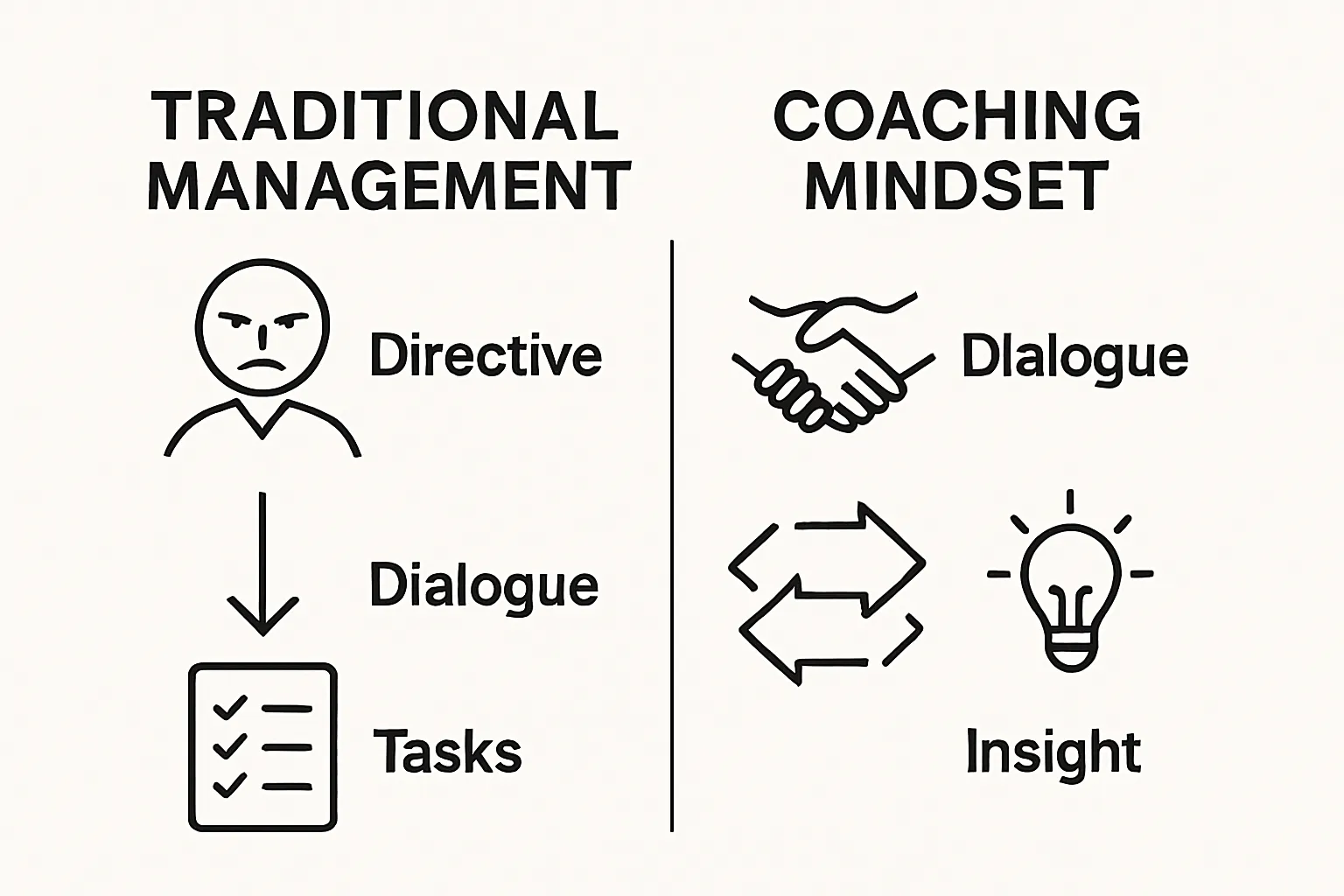
- Curiosity: Asking powerful, open-ended questions that provoke reflection and self-discovery
- Non Judgmental Listening: Creating safe spaces where individuals can explore their thoughts without fear of criticism
- Empowerment: Focusing on enabling individuals to find their own solutions rather than providing direct answers
- Growth Orientation: Viewing challenges as opportunities for learning and development
The ultimate goal of a coaching mindset is not to solve problems for others, but to equip them with the skills, confidence, and perspective to navigate challenges independently. This approach transforms interactions from transactional to transformational, fostering deeper personal and professional growth.
The following table summarizes the core characteristics that define a coaching mindset, providing clear distinctions to help readers recognize and apply each trait effectively.
| Characteristic | Description |
|---|---|
| Curiosity | Asking powerful, open-ended questions that provoke reflection and self-discovery |
| Non-Judgmental Listening | Creating safe spaces where individuals can explore their thoughts without fear of criticism |
| Empowerment | Enabling individuals to find their own solutions instead of providing direct answers |
| Growth Orientation | Viewing challenges as opportunities for learning and development |
| Transformational Approach | Focusing on equipping others to navigate challenges independently rather than solving problems |

The Importance of a Coaching Mindset in Leadership
Leadership in the modern organizational landscape demands more than traditional command and control approaches. A coaching mindset has emerged as a critical leadership strategy that transforms organizational culture, employee engagement, and overall performance. Learn about coaching for productivity to understand its transformative potential.
Transforming Organizational Culture
A coaching mindset fundamentally reshapes how leaders interact with their teams. Instead of viewing employees as resources to be managed, leaders with a coaching approach see team members as unique individuals with untapped potential. This perspective creates an environment of psychological safety, trust, and continuous learning.
Research from Gallup indicates that organizations with leaders who adopt a coaching mindset experience significantly higher levels of employee engagement and productivity. The key differences include:
- Replacing directive instructions with collaborative problem solving
- Emphasizing personal growth over mere performance metrics
- Creating opportunities for self reflection and independent thinking
Leadership Impact and Organizational Performance
A coaching mindset is not just a soft skill but a strategic leadership approach with measurable business outcomes. Leaders who embrace this approach demonstrate several critical capabilities:
- Empowerment: Enabling team members to discover their own solutions
- Active Listening: Creating spaces for genuine dialogue and understanding
- Developmental Focus: Investing in long term personal and professional growth
- Adaptive Leadership: Responding flexibly to complex organizational challenges
By prioritizing individual potential and creating supportive environments, leaders with a coaching mindset unlock unprecedented levels of team performance and organizational resilience.
This table compares the coaching mindset and traditional management styles, highlighting key distinctions in approach and outcomes within a work environment.
| Aspect | Coaching Mindset | Traditional Management |
|---|---|---|
| Leadership Approach | Collaborative, supportive, growth-focused | Directive, hierarchical, control-driven |
| Employee Engagement | Significantly increased (up to 21% higher) | Typically lower due to directive instructions |
| Communication Style | Open dialogue, active listening, curiosity | Top-down directives, limited discussion |
| Problem Solving | Collaborative, empowering team members to find solutions | Manager-driven, leader provides answers |
| Focus | Personal growth, continuous learning | Achieving set performance metrics |
| Team Dynamics | Psychological safety, trust, collective intelligence | Resource management, limited team autonomy |
| The ultimate goal is not just achieving immediate targets, but developing a workforce capable of continuous innovation and self directed growth. |
Core Principles Behind a Coaching Mindset
A coaching mindset is anchored in profound philosophical and psychological principles that elevate human potential and transform interpersonal dynamics. Explore our comprehensive coaching process overview to gain deeper insights into these transformative approaches.
Foundational Psychological Principles
At its essence, a coaching mindset operates on fundamental beliefs about human capacity, learning, and personal development. Unlike traditional approaches that assume limitations, this perspective recognizes individuals as inherently capable of growth, self direction, and continuous improvement.
Research from Harvard Business Review highlights that the most effective coaching approaches are grounded in understanding individual strengths rather than fixing perceived weaknesses. The core psychological principles include:
- Recognizing individual agency and self determination
- Understanding that personal insights are more powerful than external directives
- Believing in the brain’s neuroplasticity and capacity for change
Principles of Human Potential and Growth
A coaching mindset embraces several critical principles that distinguish it from traditional developmental frameworks:
- Curiosity Over Judgment: Prioritizing exploration and understanding instead of immediate evaluation
- Empowerment Through Questions: Using powerful inquiries that stimulate self reflection
Key Growth Principles:
- Personal development is a continuous, nonlinear journey
- Challenges are opportunities for learning and transformation
- Individual potential is not fixed but dynamically expandable
The fundamental goal is creating an environment where individuals feel supported, understood, and motivated to unlock their inherent capabilities. By embracing these principles, coaches and leaders can facilitate profound personal and professional transformations that extend far beyond conventional performance metrics.
How a Coaching Mindset Transforms Team Dynamics
A coaching mindset fundamentally reimagines team interactions, shifting from traditional hierarchical structures to collaborative, empowering environments. Learn more about transformative coaching techniques to understand this profound organizational shift.
Redefining Interpersonal Communication
Traditional team dynamics often revolve around top down directives and performance management. A coaching mindset disrupts this model by creating spaces of genuine dialogue, mutual respect, and collaborative problem solving. Teams begin to view challenges not as obstacles, but as collective opportunities for growth and innovation.
Research from MIT Sloan Management Review demonstrates that teams operating with a coaching mindset experience significantly higher levels of psychological safety, trust, and intrinsic motivation. Key transformational elements include:
- Replacing criticism with constructive feedback
- Encouraging open dialogue and diverse perspectives
- Valuing individual contributions over standardized performance metrics
Cultivating Collective Intelligence
A coaching mindset transforms team dynamics by unlocking collective potential through several critical mechanisms:
- Collaborative Problem Solving: Shifting from individual competition to shared intellectual exploration
- Mutual Learning: Creating environments where every team member can teach and learn
- Adaptive Thinking: Developing team resilience through continuous reflection and adjustment
By embracing a coaching approach, teams move beyond mere task completion to becoming dynamic, self organizing systems capable of navigating complex organizational challenges. The ultimate goal is creating an ecosystem where individual growth directly contributes to collective success, turning traditional team structures into powerful engines of innovation and continuous improvement.
Ready to Put a Coaching Mindset Into Action?
If you feel stuck in old habits or notice your team struggling to collaborate and grow, now is the moment to experience real improvement. The article highlighted how a coaching mindset can ignite lasting change, nurture growth, and transform team dynamics. If you want to break away from ineffective routines and empower both yourself and your team, you are not alone. Many professionals and organizations share these challenges. Explore the Agile Coaching Archives for more insight and stories about how a coaching approach can foster adaptability and innovation.

Do not let the opportunity for transformation pass you by. Connect with https://tariqjuneja.com today to discover tailored coaching programs by Tariq Juneja that drive personal and professional development. If your goals include stronger leadership, sustainable change, and measurable results, take the next step and explore our life coaching solutions or book a free consultation now. True growth starts with a single decision. Make yours count today.
Frequently Asked Questions
What is a coaching mindset?
A coaching mindset is an approach to personal and professional development that focuses on empowering individuals to discover their own solutions and potential through supportive dialogue and inquiry.
How does a coaching mindset differ from traditional management?
Unlike traditional management, which often relies on directive instructions and hierarchical structures, a coaching mindset emphasizes collaboration, curiosity, and continuous learning, allowing individuals to take an active role in their own development.
What are the key characteristics of a coaching mindset?
The key characteristics of a coaching mindset include curiosity, non-judgmental listening, empowerment, and a growth orientation, focusing on helping individuals navigate challenges independently.
Why is a coaching mindset important for effective leadership?
A coaching mindset is important for effective leadership because it transforms organizational culture, enhances employee engagement, and boosts overall performance by creating supportive environments where team members can thrive.
Recommended
- What is Mindset Coaching? Understanding Its Impact – Tariq Juneja
- What is Transformative Coaching? Understanding Its Impact – Tariq Juneja
- Understanding Coaching for Productivity: Key Concepts Explained – Tariq Juneja
- Understanding the Coaching Process Overview for Growth – Tariq Juneja
- How to Boost Team Morale: 5 Psychology-Backed Strategies – Hoop Mentality