

Coaching for entrepreneurs is shaping how business owners face challenges and develop both professionally and personally. A recent study found that coaching can dramatically improve psychological capital such as confidence, hope, and resilience. Sounds like just another business trend, right? Actually, coaching stands out because it bridges the psychological and practical gaps that no traditional training ever tackles.
Table of Contents
- What Is Coaching For Entrepreneurs?
- Why Coaching Matters In Entrepreneurship
- How Coaching Works To Enhance Business Skills
- Key Concepts And Approaches In Entrepreneurial Coaching
Quick Summary
| Takeaway | Explanation |
|---|---|
| Coaching supports personalized growth. | Tailored coaching helps entrepreneurs develop unique skills and strategies for their individual journeys. |
| Integrates psychological support with business skills. | Coaching combines emotional intelligence and practical tactics to enhance overall entrepreneurial performance. |
| Promotes accountability and reflection. | Structured sessions encourage entrepreneurs to take responsibility for their growth and assess their progress regularly. |
| Addresses psychological barriers to success. | Coaching helps overcome issues like self-doubt and stress that hinder entrepreneurial effectiveness. |
| Utilizes diverse methodologies for skill enhancement. | Various coaching techniques adapt to individual needs, ensuring effective personal development and learning. |
What is Coaching for Entrepreneurs?
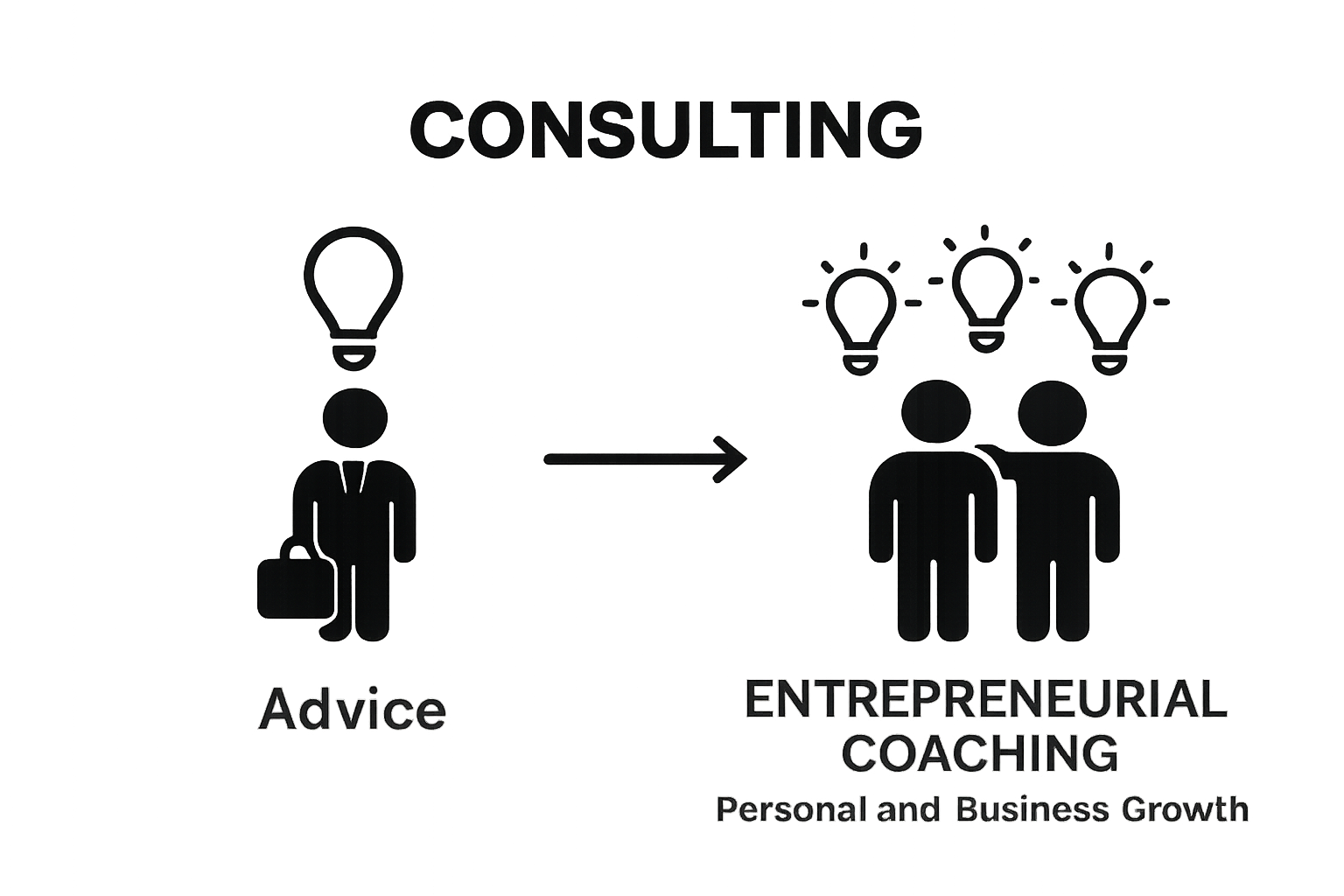
Coaching for entrepreneurs represents a specialized professional development approach designed to support business owners in achieving their strategic objectives and personal growth. Unlike traditional consulting or mentoring, entrepreneurial coaching focuses on creating personalized pathways for individual business leaders to unlock their potential and navigate complex business challenges.
To help you distinguish entrepreneurial coaching from other common forms of business support, the following table summarizes key differences in focus and approach.
| Support Type | Focus Area | Approach | Outcome |
|---|---|---|---|
| Entrepreneurial Coaching | Personalized growth, psychological support | Collaborative, goal-oriented sessions | Holistic personal and professional development |
| Mentoring | Sharing experience, advice | Informal guidance, role modeling | Knowledge transfer, inspiration |
| Consulting | Problem-solving, business solutions | Expert analysis, recommendations | Specific operational improvements |
| Training | Skill acquisition | Structured curriculum, group instruction | Technical or professional skill upgrades |
The Core Purpose of Entrepreneurial Coaching
At its fundamental level, coaching for entrepreneurs is a collaborative, goal-oriented process that helps business owners develop critical skills, enhance decision-making capabilities, and overcome professional obstacles. Explore our guide on understanding the coaching process to gain deeper insights into this transformative approach.
The methodology centers on several key principles:
- Providing personalized strategic guidance
- Developing self-awareness and emotional intelligence
- Creating actionable strategies for business growth
- Addressing psychological barriers to success
According to research from the International Journal of Entrepreneurial Behavior & Research, entrepreneurial coaching goes beyond traditional skill training by integrating psychological support with practical business development techniques.
How Entrepreneurial Coaching Works
Entrepreneurial coaching typically involves structured one-on-one sessions where a professional coach works directly with a business owner. These interactions are designed to:
- Identify individual strengths and potential limitations
- Develop targeted strategies for personal and professional growth
- Create accountability mechanisms
- Provide objective perspectives on business challenges
The coaching process is highly personalized, recognizing that each entrepreneur’s journey is unique.
Coaches utilize various assessment tools, reflective techniques, and strategic frameworks to help business owners gain clarity, build confidence, and make more informed decisions in their entrepreneurial endeavors.
Why Coaching Matters in Entrepreneurship
Entrepreneurship is a complex journey fraught with challenges that demand more than traditional business skills. Coaching has emerged as a critical resource for entrepreneurs seeking to navigate the intricate landscape of business ownership and personal development. Understanding the transformative power of coaching can be the difference between mere survival and extraordinary success.
Bridging Psychological and Professional Gaps
Coaching addresses the multifaceted challenges entrepreneurs face by providing comprehensive support that extends beyond conventional business advice. Learn more about the role of coaching in business growth to understand its profound impact. The psychological dimensions of entrepreneurship often create significant barriers that traditional training methods cannot effectively resolve.
The following table outlines the main psychological barriers faced by entrepreneurs and how coaching addresses each challenge.
| Psychological Challenge | Impact on Entrepreneurs | How Coaching Helps |
|---|---|---|
| Stress Management | Difficulty coping with business pressure | Teaches resilience and coping strategies |
| Self-Doubt & Imposter Syndrome | Undermines confidence and action | Builds confidence and self-awareness |
| Resilience in Setbacks | Discourages persistence after failures | Encourages perseverance and optimism |
| Motivation During Challenges | Leads to fatigue and decreased drive | Supports motivation and goal focus |
Key psychological challenges that coaching helps entrepreneurs overcome include:
- Managing intense personal and professional stress
- Overcoming self-doubt and imposter syndrome
- Developing resilience in the face of repeated setbacks
- Maintaining motivation during challenging business cycles
According to research published in Frontiers in Psychology, coaching interventions significantly improve entrepreneurs’ psychological capital, including confidence, hope, and resilience.
Strategic Advantage through Personalized Guidance
Entrepreneurial coaching provides a strategic advantage by offering personalized guidance tailored to individual business contexts. Unlike generic business advice, coaching recognizes that each entrepreneur’s journey is unique and requires a customized approach.
The strategic benefits of entrepreneurial coaching include:
- Accelerated learning and skill development
- Enhanced decision-making capabilities
- Objective external perspective on business challenges
- Structured accountability for personal and professional goals
By combining psychological support with practical business strategies, coaching empowers entrepreneurs to break through limitations, unlock their potential, and create sustainable pathways to success.
How Coaching Works to Enhance Business Skills
Coaching is a sophisticated process designed to systematically transform an entrepreneur’s capabilities through targeted skill development and personal growth strategies. The methodology goes far beyond traditional training, focusing on holistic improvement and individualized performance enhancement.
Skill Development through Targeted Interventions
Explore our comprehensive guide on coaching techniques to understand the nuanced approaches coaches employ. The skill enhancement process involves creating customized frameworks that address specific entrepreneurial challenges and potential growth areas.
Key skill development mechanisms include:
- Identifying individual performance gaps
- Designing personalized learning pathways
- Implementing practical skill-building exercises
- Providing continuous feedback and reflection opportunities
According to research published on ResearchGate, coaching interventions significantly improve entrepreneurs’ problem-solving abilities, creativity, and personal initiative.
Psychological and Practical Skill Integration
Entrepreneurial coaching uniquely combines psychological insights with practical business skill development. This approach recognizes that professional growth is intrinsically linked to personal mindset and emotional intelligence.
Critical skill enhancement areas typically include:
- Strategic thinking and decision-making
- Emotional resilience and stress management
- Communication and leadership capabilities
- Adaptability and innovation mindset
Coaches utilize sophisticated assessment tools, reflective techniques, and strategic frameworks to help entrepreneurs develop a comprehensive skill set that transcends traditional business training. By addressing both psychological barriers and practical competencies, coaching creates a transformative learning environment that empowers entrepreneurs to unlock their full potential and achieve sustainable business success.

Key Concepts and Approaches in Entrepreneurial Coaching
Entrepreneurial coaching represents a sophisticated discipline that combines psychological insights, strategic thinking, and personalized development methodologies. The field goes beyond traditional business consulting by creating holistic frameworks that address both professional capabilities and personal growth.
Theoretical Foundations of Coaching Approaches
Learn about setting up a coaching business for entrepreneurs to understand the nuanced professional landscape. Entrepreneurial coaching draws from multiple theoretical disciplines, integrating insights from psychology, organizational behavior, adult learning theory, and leadership development.
Key theoretical foundations include:
To illustrate the major theoretical foundations supporting entrepreneurial coaching, the following table summarizes each foundation and its relevance to coaching practice.
| Theoretical Foundation | Description | Relevance to Entrepreneurial Coaching |
|---|---|---|
| Cognitive-Behavioral Change Models | Focus on changing thought patterns and behaviors | Addresses mindset and adaptive strategies |
| Constructivist Learning Principles | Emphasizes learning through experience | Fosters reflective practice and growth |
| Transformational Leadership Theories | Develops leadership through vision and influence | Cultivates entrepreneurial leadership skills |
| Emotional Intelligence Frameworks | Enhances self-awareness and emotional control | Supports resilience and interpersonal skills |
- Cognitive-behavioral change models
- Constructivist learning principles
- Transformational leadership theories
- Emotional intelligence frameworks
According to systematic research published on ResearchGate, entrepreneurial coaching addresses critical dimensions such as opportunity exploration, resource mobilization, and reflective entrepreneurial practice.
Practical Coaching Methodologies
Entrepreneurial coaching methodologies are characterized by their adaptive and context-specific nature. Coaches employ diverse techniques tailored to individual entrepreneur’s unique challenges, psychological profiles, and business environments.
Core coaching methodologies encompass:
- Socratic questioning techniques
- Goal-oriented performance mapping
- Narrative and reflective practice
- Strength-based developmental approaches
These methodologies aim to create transformative learning experiences that empower entrepreneurs to develop self-awareness, enhance decision-making skills, and cultivate resilience in complex business landscapes. By integrating psychological support with strategic business guidance, entrepreneurial coaching provides a comprehensive approach to professional development that transcends traditional training models.
Step Into Clarity on Your Entrepreneurial Journey
Are you feeling stuck with complex business decisions or overwhelmed by the psychological hurdles of entrepreneurship? If the challenges described in our guide resonate with you—like managing stress, boosting resilience, or finding personalized guidance—you are not alone. The path of an entrepreneur is filled with unique demands. That is why our specialized support and proven techniques, inspired by the principles of Agile Coaching, are designed to help you grow faster and smarter.

Take action now and experience real progress. Book your personalized discovery session directly at https://tariqjuneja.com. If you are seeking fresh strategies and effective support to overcome professional and emotional barriers, this is your opportunity to move forward with confidence. Start your tailored coaching journey today—discover what transformational change can look like for you.
Frequently Asked Questions
What is the purpose of coaching for entrepreneurs?
Coaching for entrepreneurs aims to provide personalized strategic guidance and support to help business owners achieve their goals, develop critical skills, and address personal and professional challenges.
How does entrepreneurial coaching work?
Entrepreneurial coaching typically involves structured one-on-one sessions where a professional coach works with the entrepreneur to identify strengths and limitations, develop strategies for growth, and create accountability mechanisms.
What are the key benefits of coaching for entrepreneurs?
The key benefits include enhanced decision-making capabilities, accelerated skill development, improved emotional resilience, and tailored strategies for overcoming business challenges.
How can coaching improve an entrepreneur’s skills?
Coaching enhances skills through targeted interventions focused on identifying performance gaps, designing personalized learning pathways, integrating psychological insights with practical strategies, and providing continuous feedback and reflection opportunities.
Recommended
- How to Set Up a Coaching Business for Young Entrepreneurs – Tariq Juneja
- Understanding the Role of Coaching in Business Growth – Tariq Juneja
- Understanding the Coaching Process Overview for Growth – Tariq Juneja
- How to coach yourself to be a Champion in business and life. – Tariq Juneja
- Ultimate Guide to Life Coaching: Why Hire a Life Coach? | Navigating Through Quicksand