

More than 60 percent of American IT managers report difficulty leading teams through rapid organizational change. In high-pressure technology environments, balancing technical demands with people management feels daunting. Individual leadership coaching gives mid-level managers the personalized strategies needed to tackle everyday challenges, foster strong team productivity, and adapt confidently to evolving business requirements.
Table of Contents
- Defining Individual Leadership Coaching For It Managers
- Key Coaching Models And Approaches Explained
- Essential Skills Developed Through Coaching
- How Individual Coaching Drives Team Productivity
- Common Mistakes And Best Practices For Success
Key Takeaways
| Point | Details |
|---|---|
| Individual Leadership Coaching | Targets the unique challenges faced by IT managers, emphasizing personalized strategies for professional growth. |
| Coaching Models | Incorporates various models like Solution-Focused, Transformational, and Authentic Leadership Coaching for tailored development. |
| Skill Development | Enhances essential skills such as Emotional Intelligence, Strategic Thinking, and Communication for effective team leadership. |
| Common Pitfalls | Avoids misaligned expectations and emphasizes the importance of a long-term, compatible coaching relationship for success. |
Defining Individual Leadership Coaching for IT Managers
Individual leadership coaching represents a targeted, personalized approach to professional development specifically designed for IT managers seeking transformational growth. Unlike generic management training, this approach focuses on addressing unique leadership challenges within technology-driven environments. Leadership development research highlights coaching as a critical mechanism for supporting sustained behavior change and enhancing managerial effectiveness.
At its core, individual leadership coaching involves one-on-one collaborative sessions between a professional coach and an IT manager, designed to unlock professional potential, improve leadership capabilities, and address specific organizational challenges. This highly personalized process goes beyond traditional training by providing tailored strategies that align with an individual’s unique strengths, communication style, and professional context. Coaches work closely with IT managers to identify performance barriers, develop strategic thinking skills, and create actionable plans for professional advancement.
The coaching process typically encompasses several key dimensions critical for IT management transformation. These include enhancing emotional intelligence, improving team communication, developing strategic decision-making skills, and building resilience in rapidly changing technological landscapes. By focusing on individual growth rather than generic leadership principles, coaching enables IT managers to develop nuanced leadership approaches that reflect their personal leadership philosophy and organizational needs.
Pro tip: Schedule a preliminary self-assessment before starting leadership coaching to identify your most critical professional development areas and maximize the coaching experience’s effectiveness.
Key Coaching Models and Approaches Explained
Leadership coaching encompasses several sophisticated models designed to address the complex challenges faced by IT managers. Contemporary research highlights coaching as a co-creative process that goes beyond traditional training by fostering deep personal and professional transformation. The most effective approaches recognize that IT leadership requires adaptive thinking and continuous skill development in rapidly evolving technological landscapes.
Three primary coaching models stand out as particularly relevant for IT managers. Solution-Focused Coaching emphasizes identifying actionable strategies to overcome specific challenges, helping managers develop pragmatic approaches to team leadership and technological problem-solving. Transformational Coaching takes a more holistic approach, focusing on fundamental shifts in leadership perspective and personal growth. Authentic Leadership Coaching centers on helping managers develop a genuine leadership style that aligns personal values with organizational objectives, supported by research demonstrating its impact on leadership effectiveness.
Each coaching model brings unique strengths to IT leadership development. Solution-focused approaches excel at addressing immediate performance challenges, transformational models drive deeper personal change, and authentic leadership coaching helps managers develop a consistent and genuine leadership approach. The most effective coaching strategies integrate elements from multiple models, creating a customized approach that addresses the specific needs of individual IT managers and their organizational contexts.
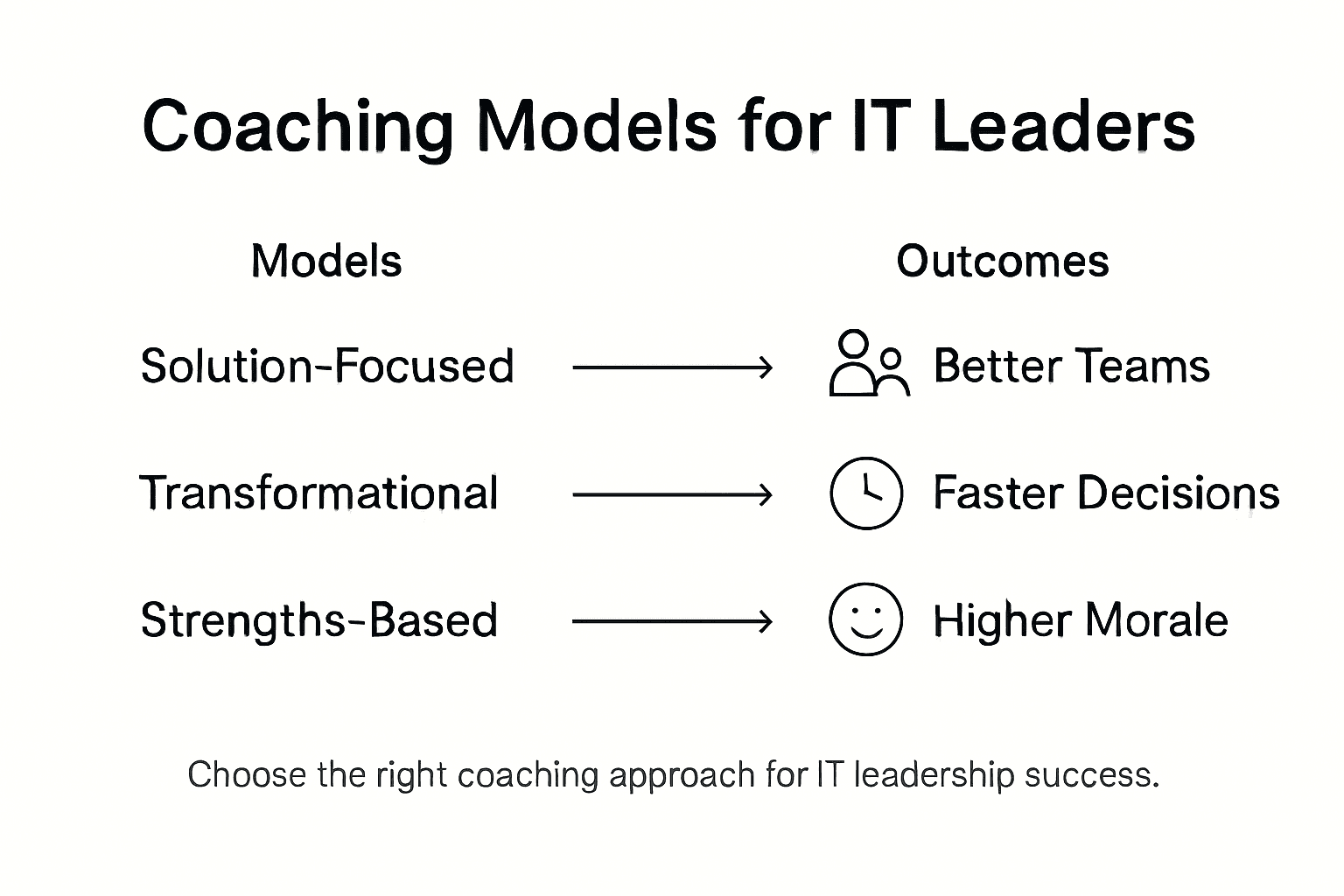
Here’s a comparison of three key leadership coaching models for IT managers:
| Coaching Model | Core Focus | Best For | Example Impact |
|---|---|---|---|
| Solution-Focused | Actionable problem solving | Immediate team challenges | Rapid improvement in workflow |
| Transformational | Personal and leadership mindset | Long-term leadership growth | Improved resilience and adaptability |
| Authentic Leadership | Alignment of values and style | Sustainable team engagement | Higher trust and team loyalty |
Pro tip: Conduct a comprehensive self-assessment to identify your primary leadership challenges and select a coaching approach that most closely aligns with your specific professional development goals.
Essential Skills Developed Through Coaching
Individual leadership coaching serves as a powerful catalyst for developing critical professional skills uniquely tailored to IT managers’ complex work environments. Communication skills coaching emerges as a fundamental area of skill development, enabling managers to transform their interpersonal interactions, team dynamics, and strategic communication approaches. These targeted coaching interventions help IT leaders bridge communication gaps, enhance collaborative capabilities, and create more transparent and effective workplace interactions.
Emotional Intelligence stands out as a pivotal skill set developed through leadership coaching. Managers learn to navigate complex team dynamics, understand nuanced interpersonal interactions, and develop heightened self-awareness that directly impacts team performance. Key emotional intelligence skills include self-regulation, empathy, motivation management, and the ability to read and respond to subtle organizational communication patterns. Coaches work methodically to help IT managers recognize emotional triggers, develop resilience, and create more supportive leadership environments.

Strategic thinking and adaptive problem-solving represent another critical skill cluster enhanced through individual coaching. IT managers develop advanced capabilities to analyze complex technological challenges, anticipate potential obstacles, and create innovative solutions. This includes developing systematic approaches to decision making, learning to balance technical expertise with broader organizational goals, and cultivating a forward-thinking mindset that can quickly adapt to rapidly changing technological landscapes. Coaches guide managers in developing frameworks for critical analysis, strategic planning, and proactive leadership.
Summary of essential skills IT managers gain through individualized coaching:
| Skill Area | Coaching Contribution | Organizational Benefit |
|---|---|---|
| Emotional Intelligence | Heightened empathy, self-regulation | Smoother team relations, less conflict |
| Strategic Thinking | Systematic and innovative decisions | Proactive solutions, better planning |
| Communication | Improved clarity and active listening | Stronger team collaboration |
Pro tip: Maintain a professional development journal to track your coaching progress, documenting specific skills learned, challenges overcome, and measurable improvements in your leadership approach.
How Individual Coaching Drives Team Productivity
Individual leadership coaching has emerged as a transformative approach to enhancing team productivity, particularly in complex technological environments. Research demonstrates that coaching leadership fosters significant improvements in work engagement and performance, creating ripple effects that extend far beyond individual skill development. IT managers who engage in targeted coaching learn to create empowering team environments that naturally boost collaborative potential and organizational effectiveness.
Team Dynamics Transformation represents a critical outcome of individual coaching. Managers develop advanced capabilities to recognize and address team communication barriers, create psychological safety, and establish clear performance expectations. This process involves helping leaders understand their unique leadership style, identifying potential blind spots, and developing strategies to create more inclusive and responsive team structures. By focusing on individual growth, coaches help managers build more resilient, adaptive, and high-performing teams that can navigate complex technological challenges with greater agility.
The productivity impact of individual coaching extends to multiple organizational levels. Coaches help IT managers develop systematic approaches to performance management, goal setting, and team motivation. This includes teaching advanced techniques for delegating effectively, providing constructive feedback, and creating alignment between individual team member strengths and organizational objectives. The result is a more cohesive, motivated, and strategically focused team that can consistently deliver high-quality technological solutions and adapt quickly to changing business requirements.
Pro tip: Implement quarterly team feedback sessions to assess the tangible impacts of your leadership coaching, tracking specific improvements in team communication, collaboration, and overall performance metrics.
Common Mistakes and Best Practices for Success
Individual leadership coaching for IT managers is fraught with potential pitfalls that can significantly undermine its effectiveness. Leadership mentoring research warns against viewing coaching as a directive advice-giving process, highlighting the critical importance of understanding the nuanced dynamics of effective coaching relationships. Many IT managers mistakenly approach coaching as a quick fix or prescriptive solution, failing to recognize the collaborative and introspective nature of genuine professional development.
Common Mistakes in Leadership Coaching include misaligning expectations, treating coaching as a remedial intervention, and lacking clear, measurable objectives. IT managers often struggle with vulnerability, viewing coaching as a sign of weakness rather than a strategic approach to professional growth. Another significant error is selecting a coach without considering personal chemistry and alignment with specific technological leadership challenges. Coaches who lack deep understanding of IT management nuances cannot provide truly transformative guidance, leading to superficial and ineffective coaching experiences.
Best practices for successful leadership coaching demand a holistic and strategic approach. Effective coaching requires establishing clear, measurable goals, maintaining consistent communication, and creating a structured accountability framework. IT managers should seek coaches with proven experience in technological leadership contexts, prioritize coaches who understand the unique challenges of managing technical teams, and commit to a long-term developmental process. Successful coaching engagements involve active participation, openness to feedback, willingness to challenge existing leadership paradigms, and a commitment to continuous personal and professional growth.
Pro tip: Conduct a comprehensive self-assessment before engaging a coach, identifying specific leadership challenges and desired outcomes to ensure a targeted and impactful coaching experience.
Elevate Your IT Leadership with Tailored Coaching Solutions
Are you ready to overcome the unique challenges of IT management through focused, individual leadership coaching? This article highlights the importance of personalized growth strategies that build emotional intelligence, strategic thinking, and authentic leadership. These skills help you break performance barriers, enhance team communication, and boost productivity in fast-paced technological settings. If you want to transform your leadership approach and create lasting change within your team, explore expert coaching that aligns perfectly with your professional goals.

Discover how Agile Coaching Archives – Tariq Juneja can support your journey by integrating adaptive leadership techniques with proven agile practices. Learn effective methods for managing change through the Change Management Archives – Tariq Juneja and strengthen your personal leadership style with insights from Life Coaching Archives – Tariq Juneja. Visit https://tariqjuneja.com now to book a free consultation and start transforming your leadership skills with tailored coaching that drives measurable results.
Frequently Asked Questions
What is individual leadership coaching for IT managers?
Individual leadership coaching for IT managers is a personalized approach to professional development aimed at enhancing leadership skills, addressing unique challenges within technology-driven environments, and fostering transformational growth through one-on-one sessions with a professional coach.
How does coaching benefit IT managers in their leadership roles?
Coaching enhances crucial skills such as emotional intelligence, communication, and strategic thinking. It helps IT managers overcome performance barriers, build stronger teams, and create adaptive solutions for complex technological challenges.
What are the key coaching models used in individual leadership coaching?
The main coaching models include Solution-Focused Coaching (which addresses immediate performance challenges), Transformational Coaching (which promotes holistic personal growth), and Authentic Leadership Coaching (which aligns personal values with leadership style). Each model offers unique benefits tailored to the needs of IT managers.
What common mistakes should IT managers avoid when seeking leadership coaching?
Common mistakes include misaligning expectations, treating coaching as remedial, and neglecting personal chemistry with the coach. Effective coaching requires setting clear goals, maintaining communication, and finding a coach experienced in IT leadership challenges.
Recommended
- Management Coach Impact: Unlocking Leadership Growth – Tariq Juneja
- Management Coaching: Everything You Need to Know – Tariq Juneja
- Leadership Coaching Services: Driving Transformational Impact – Tariq Juneja
- What Is Leadership Coaching? Complete Overview – Tariq Juneja
- Tipos de liderazgo empresarial: comprensión y explicación | Itcons.app
- Employee Retention Solutions | Reduce Turnover | OpenElevator
- Ledarskap är avgörande för arbetsmiljön och lönsamhet.