

Over 60 percent of American professionals admit they often feel swamped by endless to-do lists and unclear targets. Staying productive in a world filled with distractions is tougher than ever, especially when work and personal life blend together. Gaining clarity on your true goals, organizing tasks, and making smarter use of technology can help you break this cycle, turning overwhelming days into focused progress you can actually measure.
Table of Contents
- Step 1: Clarify Your Productivity Goals
- Step 2: Organize Tasks And Prioritize Effectively
- Step 3: Implement Focused Work Techniques
- Step 4: Leverage Tools And Automate Routine Tasks
- Step 5: Track Results And Adjust Continuously
Quick Summary
| Key Point | Explanation |
|---|---|
| 1. Set Clear Productivity Goals | Define specific, measurable, achievable, relevant, and time-bound (SMART) goals to clarify your objectives and motivate progress. |
| 2. Organize and Prioritize Tasks | Use the ABC prioritization method to categorize tasks based on their importance and urgency, helping to focus on critical work. |
| 3. Implement Focused Work Techniques | Establish concentration strategies like eliminating distractions and using the Pomodoro method to maintain high focus during work sessions. |
| 4. Leverage Digital Tools for Efficiency | Identify repetitive tasks and utilize task management applications to automate workflows, reducing manual effort and enhancing productivity. |
| 5. Track Progress and Adjust Regularly | Conduct weekly and monthly reviews to monitor productivity metrics and adjust strategies to foster continuous improvement and personal growth. |
Step 1: Clarify Your Productivity Goals
Transforming your productivity starts with creating crystal clear objectives that provide meaningful direction. The University of Toronto Scarborough recommends using SMART goals to ensure your goals are specific, measurable, achievable, relevant, and time-bound.
Begin by asking yourself targeted questions: What exactly do you want to accomplish? Why is this goal important? What specific outcomes will signal success? Break down complex goals into smaller, actionable steps that feel manageable and motivating. For instance, instead of a vague goal like “be more productive,” specify “complete two major research reports within the next four weeks by dedicating two uninterrupted hours each morning to focused writing.”
A powerful productivity strategy involves concentrating on a few critical tasks daily, ensuring you prioritize activities that drive meaningful progress. Remember that clarity transforms overwhelming objectives into achievable milestones. Your next step will involve designing a systematic approach to track and measure these goals.

Step 2: Organize Tasks and Prioritize Effectively
Mastering task organization is crucial for maximizing your productivity and achieving your goals. Time management techniques like the ABC prioritization method can transform how you approach your daily workload, allowing you to focus on what truly matters.
Start by creating a comprehensive task list and categorizing your activities based on their importance and urgency. Assign priority levels to each task using a simple system: A tasks are critical and require immediate attention, B tasks are important but not time sensitive, and C tasks are low priority activities that can be completed when time permits. This approach helps you allocate your energy strategically, ensuring that you tackle the most significant work first. For example, a critical work presentation would be an A task, while responding to routine emails might be a C task.
Consider using digital tools or physical planners that allow you to visualize your tasks and track progress. Some professionals find success with time blocking techniques, where specific time slots are dedicated to particular types of work. The key is finding a system that works for your unique workflow and helps you maintain focus and momentum. By consistently applying these prioritization strategies, you will gradually build more effective work habits and feel more in control of your professional responsibilities.
Step 3: Implement Focused Work Techniques
Transforming your productivity requires developing powerful concentration strategies that minimize distractions and maximize your mental energy. Researchers recommend eliminating unnecessary notifications as a critical first step in creating an environment conducive to deep work.
Begin by establishing clear boundaries for your work sessions. Set specific and measurable goals for each work block, ensuring you have a concrete target to drive your focus. Break your timelines into manageable milestones that prevent last-minute rushes and maintain work quality. Consider implementing techniques like the Pomodoro method, where you work intensely for 25-minute intervals followed by short 5-minute breaks. This approach helps maintain high concentration levels while preventing mental fatigue.
Experiment with different focused work environments and strategies to discover what works best for you. Some professionals find success with noise-canceling headphones, while others prefer complete silence. Track your productivity and energy levels during different times of day to identify your peak performance windows. By consistently practicing these focused work techniques, you will gradually build mental discipline and transform your approach to complex tasks.
Step 4: Leverage Tools and Automate Routine Tasks
Streamlining your workflow requires strategic use of digital tools that can dramatically reduce manual effort and increase overall productivity. Researchers recommend using specialized task management applications like Todoist and OmniFocus to create structured task lists and improve organizational efficiency.
Start by identifying repetitive tasks in your daily workflow that consume significant time and mental energy. Digital tools such as Google Calendar and Trello can help you systematically track and automate project management activities with minimal manual intervention. Look for opportunities to set up automated workflows like email filtering, scheduling reminders, recurring task templates, and integrations between different productivity platforms. These strategies can help you reduce cognitive load and redirect your mental resources toward more complex and creative work.
Remember that technology should enhance your productivity, not complicate it. Experiment with different tools and platforms, but avoid becoming overwhelmed by too many systems. Select 2-3 core tools that integrate well and genuinely improve your workflow. Regularly review and adjust your automation strategies to ensure they continue serving your evolving professional needs.
Step 5: Track Results and Adjust Continuously
Successful productivity strategies require ongoing assessment and strategic refinement. The University of Toronto Scarborough emphasizes the critical importance of establishing checkpoints to monitor your progress and make necessary adjustments throughout your performance journey.
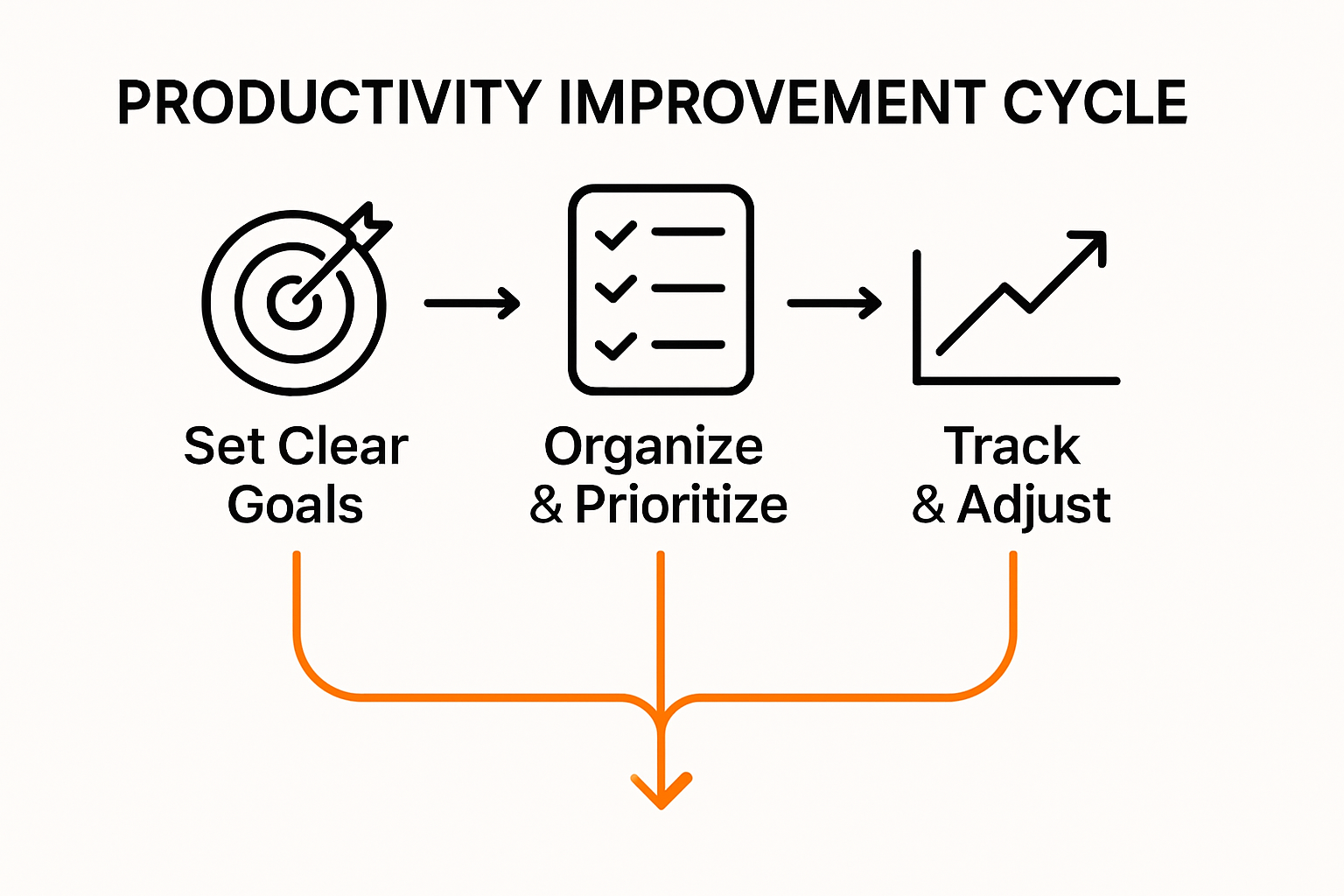
Implement a systematic tracking approach by creating weekly and monthly review sessions where you analyze your productivity metrics. Monitoring your achievements helps you understand which techniques and timeframes work best for your unique workflow. Use objective measurements like completed tasks, time spent on priority activities, and qualitative assessments of your energy and focus levels. Pay attention to patterns that emerge and be willing to experiment with different strategies when certain approaches are not delivering the desired results.
Remain flexible and compassionate with yourself during this continuous improvement process. Productivity is not about perfection but consistent progress. Celebrate your wins, learn from less successful periods, and view each adjustment as an opportunity for growth. By maintaining a curious and adaptive mindset, you will gradually develop a personalized productivity system that evolves alongside your professional goals.
Unlock Lasting Productivity with Expert Guidance
If you find yourself struggling to set clear goals, prioritize tasks effectively, or maintain focus during work sessions then you are not alone Many professionals face these exact challenges highlighted in this article Transforming your productivity requires more than just strategies it demands a tailored approach that addresses your unique workflow and mindset This is where expert coaching can make all the difference
Discover how agile coaching and transformational change techniques can accelerate your progress Agile Coaching Archives – Tariq Juneja offers practical insights into building sustainable productivity through refined focus and adaptive workflows

Take control of your productivity journey today by partnering with a coach who understands the nuances of personal and professional change Explore proven methods and unlock your full potential at Tariq Juneja Learn more about Change Management Archives – Tariq Juneja to embrace continuous improvement in your habits and work environment Book a free consultation now to start working smarter and experience transformational results
Frequently Asked Questions
How can I set effective productivity goals?
To set effective productivity goals, use the SMART criteria: make them Specific, Measurable, Achievable, Relevant, and Time-bound. For instance, change “be more productive” to “complete two major reports within four weeks by dedicating two hours each morning to writing.”
What are some effective methods for organizing and prioritizing tasks?
You can organize and prioritize tasks by creating a comprehensive task list and categorizing them using the ABC method. Label tasks as A (urgent), B (important but not urgent), or C (low priority) to strategically focus on high-impact activities first.
What focused work techniques can help me minimize distractions?
To minimize distractions, implement techniques like setting specific work boundaries and using methods such as the Pomodoro technique, which involves working intensely for 25 minutes followed by a 5-minute break. Experiment with your environment and track your productivity to determine what settings work best for maintaining focus.
How can I use digital tools to automate routine tasks?
Identify repetitive tasks in your workflow and use digital tools to automate them, such as setting up email filters or scheduling recurring tasks. Aim to reduce manual effort and cognitive load, allowing you to focus more on complex work, which could improve your efficiency by 20% over several weeks.
Why is it important to track my productivity results?
Tracking your productivity results is crucial because it helps you assess what’s working and what isn’t. Set up weekly review sessions to analyze your completed tasks and time spent, adjusting strategies as needed to ensure continuous improvement in your productivity habits.
Recommended
- How to Boost Employee Productivity for Lasting Results – Tariq Juneja
- How to Improve Employee Productivity: Boost Performance Effectively – Tariq Juneja
- How to Improve Productivity in the Workplace Effectively – Tariq Juneja
- 7 Productivity Hacks Every Leader and Coach Should Know – Tariq Juneja
- 7 Creative Workspace Ideas to Boost Productivity and Focus – Projector Display
- The Science of Microbreaks – STOMART.CO.UK