

Most American entrepreneurs start their journey with high hopes, yet more than half struggle to translate vision into lasting business success. With misconceptions swirling around entrepreneur coaching, many overlook its real value and mistakenly expect quick, one-size-fits-all fixes. Unpacking the differences between coaching and traditional consulting not only reveals the power of a personalized approach but also helps ambitious leaders unlock authentic personal and professional growth.
Table of Contents
- Defining Entrepreneur Coaching Services And Misconceptions
- Types Of Entrepreneur Coaching Programs Explained
- How Entrepreneur Coaching Drives Transformation
- Essential Skills And Qualifications For Effective Coaches
- Costs, Risks, And Common Pitfalls To Avoid
Key Takeaways
| Point | Details |
|---|---|
| Entrepreneur Coaching Explained | Entrepreneur coaching fosters individual growth by helping business leaders navigate complex challenges and develop Entrepreneurial Self-Efficacy (ESE). |
| Types of Coaching Programs | Various coaching programs cater to different stages of business, focusing on skill enhancement, mentorship, and industry-specific guidance. |
| Transformation Through Coaching | Coaching drives transformation by addressing psychological barriers, enhancing strategic skills, and optimizing holistic performance. |
| Essential Skills for Coaches | Effective entrepreneurial coaches require a blend of cognitive capabilities, emotional intelligence, and professional competencies to guide individuals successfully. |
Defining Entrepreneur Coaching Services and Misconceptions
Entrepreneur coaching represents a sophisticated approach to professional development that goes far beyond traditional business consulting. Entrepreneurial coaching is a pedagogical tool designed to foster individual growth through personalized, reflective strategies that bridge theoretical knowledge with practical application.
At its core, entrepreneur coaching helps business leaders navigate complex, often ambiguous professional landscapes. Unlike generic consulting models, this approach focuses on developing Entrepreneurial Self-Efficacy (ESE) – empowering individuals to confidently tackle open-ended challenges and make strategic decisions under uncertainty. Emerging AI technologies are now being developed to scaffold both novice entrepreneurs and mentors, highlighting the evolving nature of this transformative practice.
Common misconceptions about entrepreneur coaching frequently undermine its true potential. Many professionals mistakenly view coaching as a one-size-fits-all solution or a quick fix for business challenges. In reality, effective coaching is a nuanced, personalized process that requires deep understanding of individual strengths, strategic thinking patterns, and unique organizational contexts. Key differentiators include:
- Customized approach tailored to specific entrepreneurial goals
- Focus on personal development alongside business strategy
- Emphasis on reflective learning and actionable insights
- Long-term capability building rather than short-term problem solving
Successful entrepreneur coaching transcends traditional mentorship by creating a collaborative partnership that challenges existing mental frameworks, encourages innovative thinking, and provides structured support for sustainable professional growth.
Types of Entrepreneur Coaching Programs Explained
Entrepreneur coaching programs offer diverse approaches tailored to different stages of business development and individual learning needs. The Founder Institute provides a structured 14-week part-time program specifically designed for new and early-stage entrepreneurs seeking comprehensive guidance in developing business ideas and forming companies.
These coaching programs typically fall into several distinct categories, each addressing unique entrepreneurial challenges and objectives. Professional development programs focus on skill enhancement, while strategic mentorship initiatives provide personalized guidance from experienced business leaders. Micro-MBA programs represent an innovative outcomes-based approach, offering classroom sessions combined with proactive mentoring to teach fundamental business skills, particularly beneficial for entrepreneurs in emerging markets.
Key types of entrepreneur coaching programs include:
- Startup Acceleration Programs
- Intensive short-term coaching
- Rapid business concept development
- Networking and investor connections
- Executive Leadership Coaching
- Advanced strategic planning
- Personal leadership skill enhancement
- Organizational transformation strategies
- Industry-Specific Coaching
- Targeted guidance for specific sectors
- Deep understanding of industry challenges
- Specialized technical and strategic insights
Successful entrepreneur coaching programs recognize that one-size-fits-all approaches rarely work. Instead, they provide flexible, personalized experiences that adapt to individual entrepreneur’s unique strengths, weaknesses, and professional aspirations.
How Entrepreneur Coaching Drives Transformation
Entrepreneur coaching fundamentally transforms professional trajectories by addressing deep-seated psychological and strategic barriers that traditional training approaches often overlook. Advanced human-AI coaching systems now proactively scaffold both novice and mentor thinking, enabling more nuanced, emotionally intelligent interactions that accelerate personal and professional growth.

Entrepreneurial coaching addresses critical limitations in traditional education models by fostering Entrepreneurial Self-Efficacy (ESE) through personalized, reflective methodologies. This approach goes beyond mere skill acquisition, focusing on developing robust mental frameworks that empower entrepreneurs to navigate complex business landscapes with confidence and strategic insight.
The transformation driven by entrepreneur coaching manifests through several key mechanisms:
- Mindset Reconstruction
- Challenging limiting belief systems
- Developing growth-oriented perspectives
- Cultivating resilience and adaptability
- Strategic Skill Development
- Advanced problem-solving techniques
- Emotional intelligence enhancement
- Decision-making under uncertainty
- Holistic Performance Optimization
- Integrating personal and professional development
- Creating alignment between core values and business objectives
- Sustainable leadership skill building
Ultimately, entrepreneur coaching represents a powerful catalyst for profound personal and professional metamorphosis, transforming potential into tangible success through targeted, individualized guidance and strategic interventional approaches.
Essential Skills and Qualifications for Effective Coaches
Entrepreneurial coaching demands a sophisticated skill set that transcends traditional consulting approaches. Coaches must develop exceptional capabilities for navigating open-ended, ill-defined problems, requiring advanced strategic thinking and nuanced interpersonal intelligence that enables transformative professional guidance.
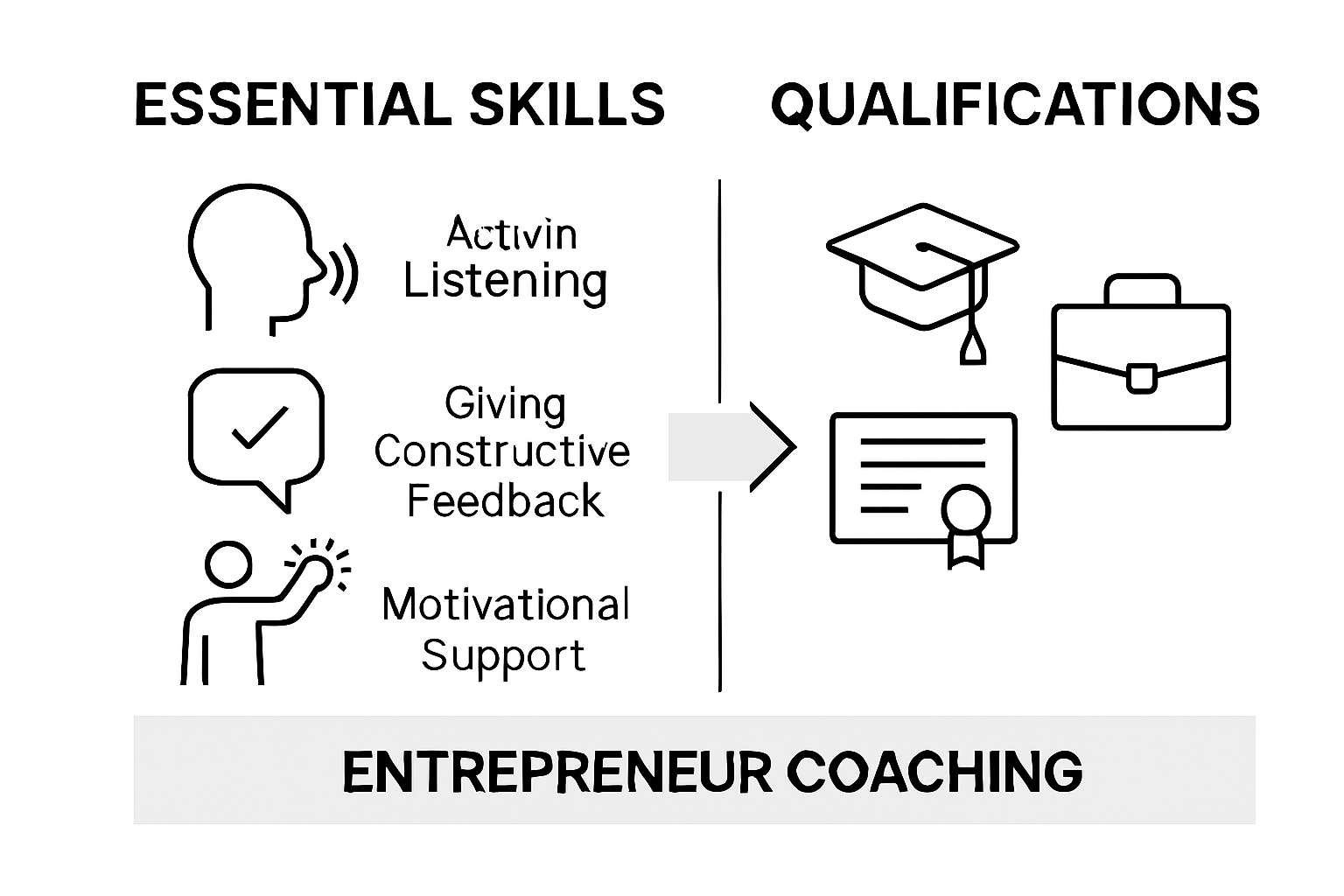
Grounded in Social Cognitive Theory and Experiential Learning Theory, effective coaches must cultivate Entrepreneurial Self-Efficacy (ESE) through personalized, action-oriented methodologies. This requires a deep understanding of psychological frameworks that support individual growth and strategic decision-making under complex, uncertain conditions.
Key essential skills for high-performing entrepreneurial coaches include:
- Cognitive Capabilities
- Advanced strategic problem-solving
- Critical thinking and assumption challenging
- Risk identification and mitigation strategies
- Emotional Intelligence
- Deep empathy and active listening
- Adaptive communication techniques
- Psychological resilience and self-awareness
- Professional Competencies
- Comprehensive business knowledge
- Cross-industry strategic insights
- Proven track record of professional transformation
Qualification requirements typically encompass advanced academic credentials, substantial professional experience, specialized coaching certifications, and demonstrated success in guiding entrepreneurial growth and personal development.
Costs, Risks, and Common Pitfalls to Avoid
Entrepreneur coaching represents a significant investment in professional development, with both tangible financial costs and potential strategic risks that require careful navigation. Emerging AI technologies introduce additional complexity by surfacing key tensions around trust, misdiagnosis, and technological expectations, demanding a nuanced approach to implementation and integration.
Bridging the critical gap between theoretical instruction and practical application remains a fundamental challenge in entrepreneurial coaching. Potential risks include misaligned expectations, insufficient personalization, and ineffective strategy translation that can ultimately undermine the coaching relationship and organizational objectives.
Common pitfalls entrepreneurs and coaches must proactively address include:
- Financial Risks
- High upfront coaching investment
- Unclear return on investment metrics
- Potential misalignment of coaching expenses with business outcomes
- Strategic Implementation Challenges
- Resistance to personalized feedback
- Inadequate commitment to recommended changes
- Difficulty translating coaching insights into actionable strategies
- Psychological and Emotional Barriers
- Defensive reactions to critical feedback
- Fear of vulnerability and personal transformation
- Entrenched limiting belief systems
Successful entrepreneur coaching requires transparent communication, realistic goal setting, continuous performance evaluation, and a mutual commitment to growth that transcends traditional consulting models.
Unlock Your Leadership Potential with Transformational Entrepreneur Coaching
Entrepreneur coaching is more than just advice it is a tailored journey that rebuilds mindsets and sharpens strategic skills to overcome complex business challenges. If you are seeking to boost your entrepreneurial self-efficacy and navigate uncertainty with confidence this is the time to take action. Our coaching approach addresses the core struggles highlighted in the article including mindset reconstruction and holistic performance optimization to empower lasting growth.
Explore how Agile Coaching Archives – Tariq Juneja and Change Management Archives – Tariq Juneja deliver personalized strategies that transform leadership and business growth.

Discover the next step in your entrepreneurial journey at https://tariqjuneja.com by booking a free consultation today. Embrace tailored coaching that equips you to turn potential into tangible success with expert guidance designed for your unique challenges and aspirations.
Frequently Asked Questions
What is entrepreneur coaching?
Entrepreneur coaching is a personalized approach to professional development that focuses on enhancing individual entrepreneurial skills and self-efficacy, helping business leaders navigate complex challenges and make strategic decisions.
How does entrepreneur coaching differ from traditional business consulting?
Unlike traditional business consulting, entrepreneur coaching emphasizes personal development, reflective learning, and long-term capability building rather than merely providing solutions for immediate business problems.
What types of entrepreneur coaching programs are available?
There are various types of entrepreneur coaching programs, including startup acceleration programs, executive leadership coaching, and industry-specific coaching, each tailored to address different entrepreneurial challenges and goals.
What are the essential skills of an effective entrepreneur coach?
An effective entrepreneur coach should possess advanced strategic problem-solving skills, high emotional intelligence, robust business knowledge, and a proven track record in personal and professional transformation.