

Nearly 60 percent of companies that invest in professional coaching report higher employee engagement and improved leadership effectiveness. With workplace challenges growing more complex every year, organizations need fresh strategies that drive real change and measurable results. Corporate coaching delivers personalized growth through science-backed guidance, blending individualized assessments with targeted skill-building to create stronger, more adaptive teams ready for today’s demands.
Table of Contents
- Defining Corporate Coaching And Its Core Concepts
- Major Types Of Corporate Coaching Programs
- Key Elements And Benefits For Organizations
- Process, Methodologies, And Measurable Outcomes
- Common Mistakes And How To Avoid Them
Key Takeaways
| Point | Details |
|---|---|
| Personalization is Key | Corporate coaching should focus on individualized assessments and development plans to address specific organizational needs. |
| Diverse Program Types | Various coaching programs target different skill sets, from business skills to leadership training, enhancing overall workforce capabilities. |
| Continuous Evaluation | Implementing regular feedback and measurable performance metrics is essential for tracking the effectiveness of coaching initiatives. |
| Strategic Alignment | Coaching should align with organizational strategies and goals to ensure meaningful outcomes and development pathways. |
Defining Corporate Coaching and Its Core Concepts
Corporate coaching represents a strategic approach to professional development designed to unlock an individual’s and organization’s potential through targeted, science-based interventions. According to research from Harvard’s Professional Development Center, this discipline integrates principles from neuroscience, human development, and advanced leadership theories to create transformative learning experiences.
At its core, corporate coaching focuses on bridging performance gaps by providing personalized guidance that enhances leadership capabilities, emotional intelligence, and strategic thinking. Key elements of this approach include:
- Individualized assessment of professional strengths and development areas
- One-on-one strategic conversations with experienced coaches
- Data-driven strategies for personal and organizational growth
- Systematic approach to skill enhancement and behavioral modification
Corporate coaching goes beyond traditional training by creating customized development pathways. Instead of generic instruction, coaches work closely with executives and managers to design targeted interventions that address specific challenges. Learn more in our comprehensive guide to executive coaching, which explores the nuanced techniques professional coaches use to drive meaningful professional transformation.
The ultimate goal of corporate coaching is to cultivate high-performance cultures where continuous learning, adaptability, and personal accountability become ingrained organizational values. By investing in individual potential, companies can create more resilient, innovative, and engaged professional environments.
Major Types of Corporate Coaching Programs
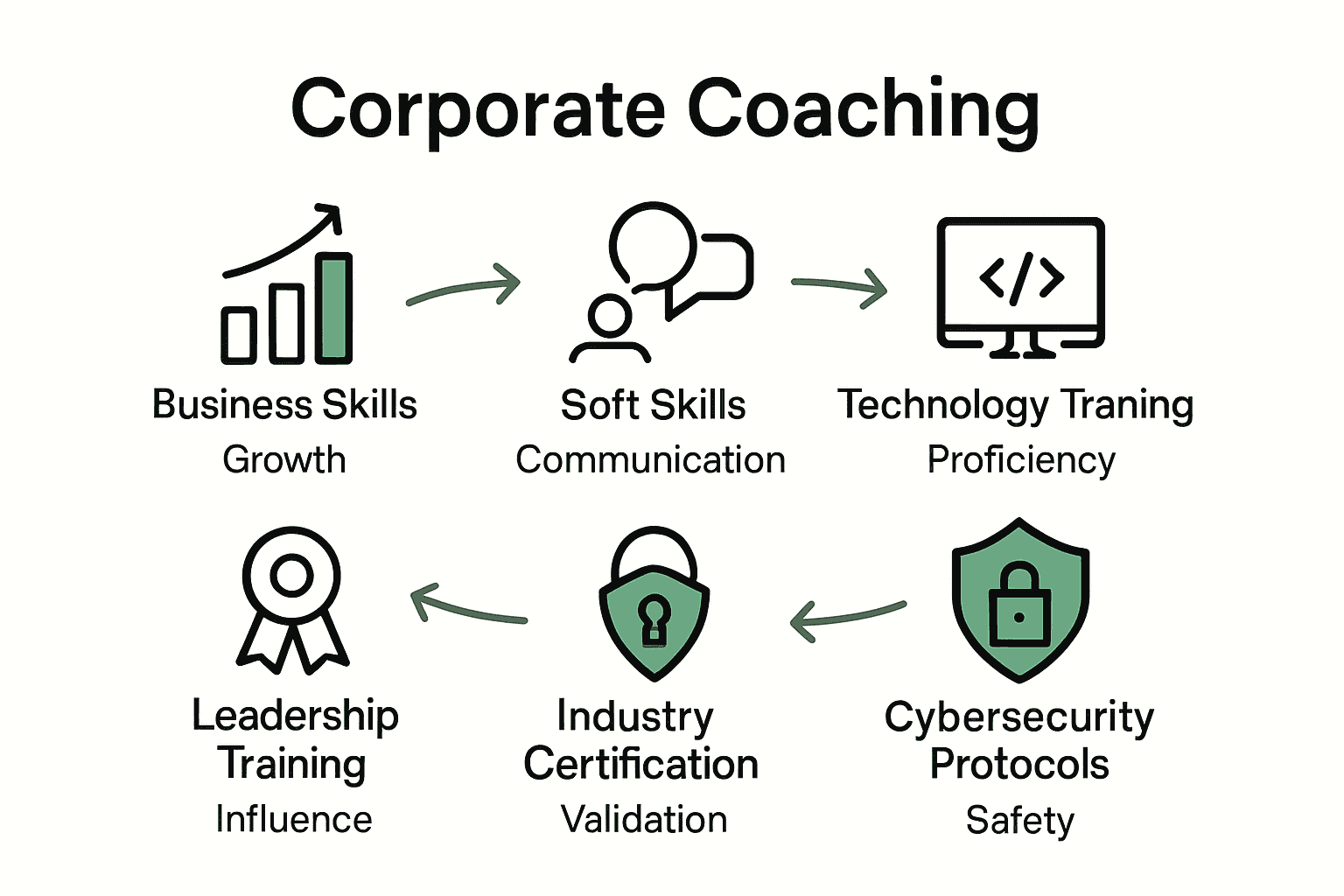
Corporate coaching programs represent diverse strategic interventions designed to enhance professional capabilities across multiple organizational dimensions. According to research from the University of South Florida’s Continuing Education department, these programs typically encompass six critical training domains that address comprehensive workforce development needs.
The primary types of corporate coaching programs include:
Here’s a summary of the primary types of corporate coaching programs:
| Program Type | Focus Area | Key Outcomes |
|---|---|---|
| Business Skills | Core professional competencies | Improved communication, stronger negotiation efficient project management |
| Soft Skills | Emotional intelligence, leadership communication |
Enhanced leadership, better team relationships |
| Technology Training | Digital skills, technology proficiency |
Up-to-date technical knowledge adaptability to tech change |
| Cybersecurity Protocols | Security awareness, risk management |
Reduced security incidents stronger data protection |
| Industry Certification | Professional credentials specialized qualifications |
Greater expertise career advancement |
| Leadership Training | Strategic thinking, decision-making |
Elevated management skills organizational growth |
- Business Skills Training: Focusing on core professional competencies like communication, negotiation, and project management
- Soft Skills Development: Enhancing emotional intelligence, leadership communication, and interpersonal relationship management
- Technology Training: Updating workforce digital skills and technological proficiency
- Cybersecurity Protocols: Teaching critical security awareness and risk management strategies
- Industry Certification: Providing specialized credentials and professional qualifications
- Leadership Training: Developing strategic thinking, decision-making, and organizational management capabilities
Dive deeper into coaching techniques and their organizational impact to understand how these targeted programs create measurable professional transformation. Each coaching type is strategically designed to address specific performance gaps, enabling organizations to build adaptable, skilled, and resilient professional ecosystems.
By implementing these diverse coaching programs, companies can create holistic development pathways that not only enhance individual skills but also align professional growth with broader organizational objectives. The result is a more engaged, competent, and high-performing workforce prepared to navigate complex business challenges.

Key Elements and Benefits for Organizations
Corporate coaching represents a strategic approach to organizational development that delivers transformative results through targeted, personalized interventions. According to research from the National Institutes of Health Leadership Services, these coaching programs provide individualized support that directly impacts organizational performance and employee effectiveness.
The key elements of successful corporate coaching programs include:
- Personalized Assessment: Comprehensive evaluation of individual and team capabilities
- Tailored Development Plans: Customized strategies addressing specific performance objectives
- Continuous Feedback Mechanisms: Regular progress tracking and adaptive coaching approaches
- Skill Transfer Strategies: Translating coaching insights into practical workplace applications
- Measurable Performance Metrics: Quantifiable indicators of professional growth and organizational impact
Explore how business transformation drives organizational change to understand the broader context of strategic coaching initiatives. The benefits extend far beyond individual skill development, creating a ripple effect of enhanced organizational capabilities.
By investing in corporate coaching, organizations unlock significant advantages: improved leadership effectiveness, increased employee engagement, enhanced problem-solving capabilities, and a more adaptive workforce. These programs ultimately create a culture of continuous learning and professional growth, positioning companies to navigate complex business challenges with agility and strategic insight.
Process, Methodologies, and Measurable Outcomes
Corporate coaching involves a sophisticated, structured approach to professional development that systematically transforms individual and organizational potential. According to research from Harvard’s Professional Development Center, the coaching process encompasses carefully designed engagements that leverage multiple learning methodologies to drive meaningful performance improvements.
The core methodological framework of corporate coaching typically includes:
- Assessment Phase: Comprehensive diagnostic tools to identify individual and organizational strengths and development opportunities
- Experiential Learning: Hands-on, interactive approaches that allow participants to practice and internalize new skills
- Case Study Analysis: Examining real-world scenarios to develop strategic thinking and problem-solving capabilities
- Lecture-Based Instruction: Structured knowledge transfer from experienced coaches and industry experts
- Reflective Practice: Systematic self-evaluation and continuous improvement techniques
Explore our guide on understanding performance metrics to gain deeper insights into how coaching outcomes are measured and validated. The most effective coaching programs integrate multiple methodological approaches, creating a holistic development experience that goes beyond traditional training models.
Measurable outcomes are the ultimate proof of corporate coaching’s value, with organizations typically tracking improvements in leadership effectiveness, team performance, employee engagement, and overall organizational agility. By implementing rigorous measurement frameworks, companies can transform coaching from a subjective intervention to a data-driven strategy for continuous professional growth and organizational excellence.
Common Mistakes and How to Avoid Them
Corporate coaching demands precision and strategic alignment to deliver meaningful results. According to the Institute of Coaching, many organizations inadvertently undermine their coaching initiatives by failing to establish clear objectives and misaligning programs with broader business strategies.
The most prevalent mistakes in corporate coaching include:
- Lack of Clear Objectives: Implementing coaching without specific, measurable goals
- Misalignment with Organizational Strategy: Treating coaching as an isolated intervention
- Insufficient Accountability Structures: Failing to create mechanisms for tracking coaching impact
- One-Size-Fits-All Approach: Applying generic coaching methodologies across diverse teams
- Neglecting Ongoing Evaluation: Treating coaching as a one-time event rather than a continuous process
Learn more about understanding why coaching works to develop more effective coaching strategies. Organizations can mitigate these challenges by implementing rigorous goal-setting frameworks and maintaining continuous dialogue between coaches, participants, and leadership.
Successful coaching programs require a holistic approach that integrates individual development with organizational objectives. By establishing clear accountability mechanisms, customizing coaching interventions, and creating robust measurement systems, companies can transform potential pitfalls into opportunities for meaningful professional growth and organizational development.
Unlock Your Organization’s Potential with Expert Corporate Coaching
Feeling overwhelmed by misaligned coaching efforts or stagnant leadership growth It is time to embrace a strategic, personalized approach that delivers measurable results. The article highlights how corporate coaching targets key challenges like performance gaps and lack of continuous feedback by using tailored development plans and data-driven methodologies. These insights reflect the core elements that can transform your team into a high-performing, agile force.
Discover proven solutions in Agile Coaching Archives – Tariq Juneja where agile principles meet effective coaching strategies to accelerate change and innovation.

Take action now to avoid common coaching pitfalls and create a culture of continuous growth. Visit https://tariqjuneja.com to explore customized coaching programs that increase leadership effectiveness and employee engagement. Begin your journey to transformational change by connecting with expert guidance and unlock the full potential of your workforce today. Learn more also about Change Management Archives – Tariq Juneja to integrate coaching with strategic organizational change.
Frequently Asked Questions
What is corporate coaching?
Corporate coaching is a strategic approach to professional development focused on unlocking individual and organizational potential through personalized guidance and science-based interventions.
What are the main types of corporate coaching programs?
The main types include Business Skills Training, Soft Skills Development, Technology Training, Cybersecurity Protocols, Industry Certification, and Leadership Training, each designed to target specific performance gaps and enhance professional capabilities.
What are the key benefits of corporate coaching for organizations?
The key benefits include improved leadership effectiveness, increased employee engagement, enhanced problem-solving capabilities, and fostering a culture of continuous learning, ultimately creating a more resilient and innovative workforce.
How are the outcomes of corporate coaching measured?
Outcomes are measured through a framework that tracks improvements in leadership effectiveness, team performance, employee engagement, and overall organizational agility, ensuring a data-driven approach to evaluating coaching impact.