

Most technology executives underestimate the impact of leadership coaching in shaping organizational agility. With over 60 percent of American companies investing in coaching programs to remain competitive during rapid change, mid-level leaders worldwide face growing pressure to guide teams through uncertainty. This article reveals how tailored coaching can amplify your decision-making, strengthen team resilience, and unlock pathways for innovation in turbulent environments.
Table of Contents
- What Is Coaching for Leaders and Why It Matters
- Key Coaching Models for Leadership Transformation
- Agile Leadership and Team Adaptability
- Practical Benefits and Common Challenges
- How to Choose and Engage a Leadership Coach
Key Takeaways
| Point | Details |
|---|---|
| Leadership Coaching Enhances Growth | Leadership coaching empowers executives to unlock potential, improve decision-making, and foster organizational change. |
| Effective Models Support Transformation | Utilizing models like GROW and Transformational Coaching can tailor approaches to leadership challenges and enhance team dynamics. |
| Agility is Key | Agile leadership promotes adaptability in teams, encouraging a culture of continuous learning and psychological safety. |
| Strategic Coach Selection is Crucial | Choosing a coach with industry expertise and a compatible approach can significantly influence leadership effectiveness and outcomes. |
What Is Coaching for Leaders and Why It Matters
Leadership coaching represents a strategic approach to professional development that empowers executives to transform their leadership capabilities and drive organizational change. Unlike traditional training models, coaching focuses on personalized growth, helping leaders unlock their potential through targeted guidance and reflective practices. Emerging research on coaching leadership reveals its critical role in enhancing employee motivation and organizational adaptability.
At its core, coaching for leaders is an intentional partnership between a professional coach and an executive designed to accelerate professional growth, improve decision-making skills, and develop advanced leadership competencies. This collaborative process involves deep dialogue, self-reflection, and practical skill-building aimed at addressing specific leadership challenges. Coaches work closely with leaders to identify strengths, overcome performance barriers, and create actionable strategies for personal and organizational transformation.
The significance of leadership coaching extends far beyond individual development. Systematic reviews of coaching interventions demonstrate its profound impact on organizational culture, showing how targeted coaching can reshape leadership approaches, enhance team dynamics, and drive strategic innovation. By providing leaders with personalized support and advanced developmental tools, coaching helps organizations navigate complex business environments, build resilient leadership pipelines, and maintain competitive advantage.
Pro tip: Select a leadership coach who has demonstrable experience in your specific industry and understands the unique challenges of your organizational context.
Key Coaching Models for Leadership Transformation
Leadership coaching models provide structured frameworks that enable executives to navigate complex organizational challenges and drive transformational change. Integrative coaching models emphasize the critical importance of understanding how different approaches can systematically support leadership development across diverse professional contexts.
Several prominent coaching models have emerged as powerful tools for leadership transformation. The GROW model (Goal, Reality, Options, Will) offers a straightforward approach to goal setting and problem solving, while the Situational Leadership model provides flexibility in adapting coaching styles to individual team member needs. The Transformational Coaching model focuses on deeper personal and professional growth, encouraging leaders to explore underlying beliefs, values, and potential barriers to performance. Coaching leadership approaches demonstrate how these models can enhance motivation, emotional intelligence, and organizational resilience.

Successful implementation of coaching models requires a holistic understanding of organizational dynamics and individual leadership potential. Effective coaches blend multiple models, tailoring their approach to specific leadership contexts, organizational cultures, and individual developmental needs. This adaptive strategy ensures that coaching interventions are not just theoretical exercises but practical pathways to meaningful personal and professional transformation.
Pro tip: When selecting a coaching model, prioritize flexibility and alignment with your specific leadership challenges and organizational culture.
Here’s a comparison of key leadership coaching models and their organizational impact:
| Model | Main Focus | Organizational Benefit | Typical Usage Scenario |
|---|---|---|---|
| GROW | Goal setting and problem solving | Improves structured decision-making | Performance challenges |
| Situational Leadership | Adaptive coaching based on team needs | Boosts team flexibility and engagement | Varied team skill levels |
| Transformational | Values-driven personal and professional growth | Fosters deep change and innovation | Major change initiatives |
| Integrative | Blends multiple approaches for context | Tailors solutions for complex organizations | Diverse leadership environments |
Agile Leadership and Team Adaptability
Agile leadership represents a dynamic approach to organizational management that prioritizes flexibility, continuous learning, and rapid response to changing environments. Leadership agility frameworks provide comprehensive strategies for leaders to develop competencies that enable teams to navigate complex and unpredictable business landscapes effectively.
The core of agile leadership lies in creating psychological safety and fostering an environment of continuous improvement. Servant leadership principles demonstrate that effective leaders cultivate team adaptability through empathetic communication, active listening, and a coaching mindset. This approach transforms traditional hierarchical structures into collaborative ecosystems where team members feel empowered to innovate, take calculated risks, and respond quickly to emerging challenges.
Successful agile leaders understand that adaptability is not just about implementing methodologies, but about cultivating a mindset of resilience and continuous learning. They develop teams that can pivot rapidly, break down complex problems into manageable components, and maintain high performance under varying conditions. This requires a holistic approach that balances strategic vision with tactical flexibility, enabling organizations to stay competitive in rapidly evolving markets.
Pro tip: Develop your team’s adaptability by creating regular opportunities for reflection, learning, and cross-functional collaboration.
Practical Benefits and Common Challenges
Leadership coaching offers transformative potential for organizations, with significant impacts on leadership effectiveness that extend far beyond traditional training approaches. The practical benefits include enhanced employee motivation, improved decision-making capabilities, and increased organizational adaptability. Leaders who engage in coaching develop deeper self-awareness, more nuanced communication skills, and a greater capacity to navigate complex workplace dynamics.
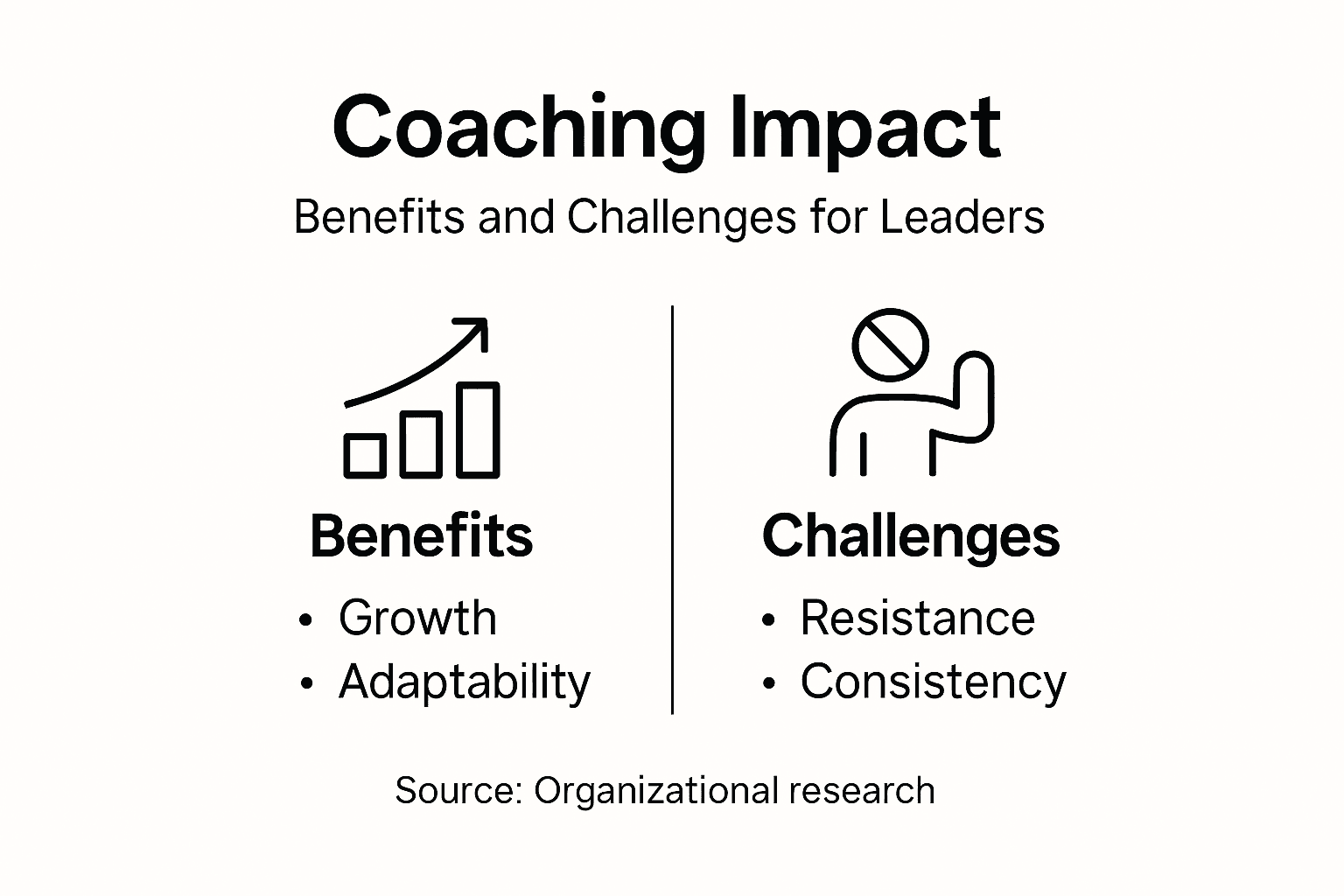
However, implementing coaching strategies is not without challenges. Empirical research on leadership coaching reveals critical obstacles such as time constraints, potential resistance to change, and the complexity of sustaining long-term behavioral transformation. Organizations must invest significant resources in creating a supportive infrastructure that enables continuous learning and provides leaders with the necessary tools and psychological safety to experiment with new leadership approaches.
The most successful coaching interventions recognize that transformation is a multifaceted process requiring commitment from both individual leaders and organizational systems. This means developing comprehensive support mechanisms, creating feedback loops, and establishing clear metrics to track progress and impact. Leaders must be willing to embrace vulnerability, challenge existing mental models, and commit to ongoing personal and professional development.
Pro tip: Design a structured coaching program with clear milestones, regular check-ins, and measurable outcomes to maximize organizational learning and individual growth.
Below is a summary of leadership coaching benefits versus common implementation challenges:
| Area | Major Benefit | Common Challenge | Solution Approach |
|---|---|---|---|
| Employee Motivation | Increased engagement and morale | Time constraints for coaching | Scheduled sessions and prioritization |
| Leadership Skills | Enhanced decision-making and self-awareness | Resistance to change | Transparent communication and buy-in |
| Team Adaptability | Stronger resilience in shifting environments | Sustaining transformation | Continuous feedback and support |
How to Choose and Engage a Leadership Coach
Selecting the right leadership coach requires a strategic approach that goes beyond surface-level credentials. Effective coaching intervention strategies emphasize the critical importance of alignment between the coach’s expertise and the specific leadership challenges an organization faces. Potential clients should conduct thorough assessments that evaluate a coach’s experience, methodological approach, industry knowledge, and proven track record of driving meaningful leadership transformation.
The engagement process involves multiple critical considerations. Prospective leaders should schedule initial consultations to assess chemistry, communication style, and philosophical alignment. This involves exploring the coach’s background, understanding their coaching philosophy, reviewing case studies of previous leadership interventions, and discussing specific organizational goals. Key evaluation criteria include the coach’s ability to ask probing questions, demonstrate empathy, provide actionable insights, and create customized development strategies that address unique leadership dynamics.
Successful coaching relationships are built on transparency, mutual respect, and clear expectations. Leaders should establish precise coaching contracts that outline specific objectives, measurement criteria, confidentiality protocols, and expected outcomes. This includes defining the scope of coaching sessions, establishing regular progress reviews, identifying key performance indicators, and creating mechanisms for ongoing feedback and adjustment. The most effective coaching partnerships create a collaborative environment that balances supportive guidance with robust accountability.
Pro tip: Request detailed references and case studies from potential coaches, focusing on concrete leadership transformation outcomes rather than generic testimonials.
Unlock Agile Leadership Potential with Expert Coaching
Are you ready to overcome common leadership challenges like resistance to change and sustaining transformation? Coaching for leaders focused on agile principles provides a powerful path to enhance team adaptability, boost motivation, and drive lasting organizational growth. By embracing proven coaching models and fostering a mindset of continuous learning, you can accelerate your leadership impact and navigate complex business environments with confidence.
Explore tailored strategies and actionable insights through Agile Coaching Archives – Tariq Juneja and discover how to implement transformational leadership approaches that resonate with your unique challenges. At https://tariqjuneja.com, you will find expert guidance and programs designed to help you increase productivity, reduce stress, and lead change effectively.

Take the next step toward mastering agile transformation in your organization by booking a free consultation or accessing powerful resources today. Empower yourself with coaching that drives measurable growth and creates resilient leadership capable of thriving in every situation. Visit Change Management Archives – Tariq Juneja for complementary insights and start your leadership transformation now.
Frequently Asked Questions
What is leadership coaching?
Leadership coaching is a strategic approach to professional development that focuses on empowering executives to enhance their leadership capabilities and drive organizational change through personalized growth and targeted guidance.
How does coaching benefit leaders and organizations?
Coaching enhances employee motivation, improves decision-making skills, and increases organizational adaptability, which can lead to a more resilient and effective leadership pipeline.
What coaching models are commonly used for leadership transformation?
Common coaching models include the GROW model, which focuses on goal setting, the Situational Leadership model for adaptive coaching, and the Transformational Coaching model that encourages personal and professional growth.
What challenges might organizations face when implementing leadership coaching?
Organizations may encounter challenges such as time constraints for coaching, resistance to change, and difficulties in sustaining long-term behavioral transformation. It’s essential to create a supportive infrastructure to address these obstacles.