

Every technology manager knows the pressure that comes with leading teams through unpredictable change and constant innovation. As the demand for adaptive leadership grows, personal coaching for tech managers has emerged as a direct, impactful way to refine leadership skills and manage stress. This approach offers tailored support to help you overcome complex workplace challenges, unlock your potential, and respond confidently to transformation in the fast-paced world of technology.
Table of Contents
- Defining Personal Coaching For Tech Managers
- Key Variations: Executive, Agile, And Life Coaching
- How Coaching Drives Leadership And Team Success
- Managing Stress And Embracing Change Through Coaching
- Roi, Pitfalls, And When Coaching Falls Short
Key Takeaways
| Point | Details |
|---|---|
| Personal Coaching Effectiveness | Tailored coaching enhances leadership capabilities uniquely suited for technology managers’ challenges. |
| Diverse Coaching Approaches | Different coaching types—Executive, Agile, and Life—each serve specific developmental needs for tech managers. |
| Role of Organizational Support | A strong coaching culture is essential for maximizing the benefits of coaching interventions. |
| Investment in Coaching | The ROI of coaching extends beyond financial metrics, focusing on leadership, team dynamics, and personal growth. |
Defining Personal Coaching for Tech Managers
Personal coaching represents a strategic professional development approach specifically designed to enhance leadership capabilities for technology managers. In the rapidly evolving tech industry, workplace coaching interventions have emerged as powerful tools for driving individual and organizational performance.
At its core, personal coaching for tech managers involves a tailored, one-on-one developmental relationship focused on addressing unique professional challenges. Unlike generic management training, this approach offers customized support that helps technology leaders navigate complex workplace dynamics, improve communication skills, and develop strategic thinking capabilities.
Key characteristics of personal coaching for tech managers include:
- Individualized assessment of leadership strengths and development areas
- Targeted skill enhancement in technical communication and strategic planning
- Confidential, supportive environment for professional growth
- Data-driven feedback mechanisms to track progress
- Adaptive learning strategies aligned with specific technological contexts
Organizational coaching cultures play a critical role in supporting these developmental relationships. Coaching frameworks help define intervention strategies and measurable outcomes, ensuring that personal coaching delivers tangible benefits for tech managers and their teams.
Pro tip: Schedule quarterly personal coaching sessions to maintain consistent professional development momentum and address emerging leadership challenges proactively.
Key Variations: Executive, Agile, and Life Coaching
Technology managers have access to multiple coaching approaches, each designed to address specific professional development needs. Digital coaching platforms have expanded the accessibility and diversity of coaching interventions, enabling targeted support for tech professionals.
Three primary coaching variations serve distinct purposes for tech managers:
- Executive Coaching: Focuses on high-level leadership development, strategic thinking, and organizational influence
- Agile Coaching: Emphasizes team process improvement, methodology adoption, and adaptive workflow strategies
- Life Coaching: Addresses personal growth, work-life balance, and holistic professional development
Each coaching type brings unique methodologies to support tech managers’ complex professional landscapes. Leadership competency enhancement remains the common thread connecting these approaches, with nuanced strategies tailored to specific developmental objectives.
Executive coaching typically targets senior technology leaders, helping them develop advanced decision-making skills and organizational strategic capabilities. Agile coaching, by contrast, concentrates on team dynamics, process optimization, and implementing iterative workflow methodologies critical in tech environments. Life coaching provides a more holistic approach, supporting personal resilience, stress management, and overall professional well-being.

Here’s a comparison of primary coaching variations available for tech managers:
| Coaching Type | Target Audience | Main Focus | Sample Outcome |
|---|---|---|---|
| Executive Coaching | Senior technology leaders | Strategic leadership growth | Enhanced decision-making |
| Agile Coaching | Team leads, scrum masters | Process improvement, agility | Faster workflow adaptation |
| Life Coaching | Individual managers | Personal development, balance | Improved stress resilience |
Tech managers benefit most when they strategically combine different coaching approaches to create a comprehensive personal development strategy.
Pro tip: Assess your current professional challenges and select a coaching approach that directly addresses your most pressing developmental needs.
How Coaching Drives Leadership and Team Success
Coaching has transformed from a peripheral professional development tool to a critical strategy for driving leadership effectiveness and team performance. Coaching leadership styles have emerged as powerful mechanisms for enhancing organizational adaptability and team engagement in technology environments.
Key ways coaching drives leadership and team success include:
- Enhanced Psychological Safety: Creates environments where team members feel comfortable taking risks
- Improved Communication: Develops more transparent and effective interaction patterns
- Increased Emotional Intelligence: Helps leaders understand and respond to team dynamics
- Strategic Skill Development: Focuses on targeted competency growth
- Performance Optimization: Aligns individual capabilities with organizational objectives
Leadership transformation strategies demonstrate that coaching is not just about individual improvement but about creating systemic organizational change. By providing credible feedback and promoting continuous learning, tech managers can develop more resilient, innovative, and high-performing teams.
Effective coaching transforms leadership from a hierarchical model to a collaborative, adaptive approach that empowers team members and drives collective success.
Pro tip: Implement quarterly coaching check-ins to maintain consistent team development and identify emerging leadership potential.
Managing Stress and Embracing Change Through Coaching
Technology managers face unprecedented challenges in navigating rapid organizational transformations and workplace complexity. Digital coaching interventions have emerged as powerful strategies for building resilience and managing professional stress in dynamic tech environments.
Key stress management approaches through coaching include:
- Emotional Regulation Techniques: Developing strategies to handle high-pressure situations
- Mindset Flexibility: Creating adaptive mental frameworks for change
- Resilience Building: Constructing psychological safety nets
- Communication Skills: Enhancing interpersonal effectiveness during transitions
- Self-Awareness Development: Understanding personal stress triggers and response patterns
Workplace stress management strategies demonstrate that coaching provides tech managers with structured methodologies to transform challenging circumstances into opportunities for growth. By offering personalized support, coaches help leaders develop robust coping mechanisms that extend beyond temporary solutions.
Effective coaching transforms stress from a destructive force into a catalyst for personal and professional development.
Pro tip: Schedule monthly reflection sessions with a professional coach to proactively identify and address emerging stress patterns before they become overwhelming.
ROI, Pitfalls, and When Coaching Falls Short
Personal coaching represents a significant investment for technology managers, demanding careful evaluation of its potential returns and potential limitations. Workplace coaching outcomes demonstrate that success depends on multiple interconnected factors beyond simple financial metrics.
Common pitfalls that can undermine coaching effectiveness include:
- Misaligned Expectations: Unclear or unrealistic performance goals
- Poor Coach-Coachee Compatibility: Lack of genuine interpersonal connection
- Insufficient Organizational Support: Minimal commitment from leadership
- Inadequate Measurement Frameworks: Absence of concrete performance indicators
- Mandatory Participation: Coaching implemented as a punitive or compliance-driven intervention
The return on investment for coaching is not solely financial but multidimensional. Successful coaching interventions create tangible improvements in leadership capabilities, team dynamics, and individual performance, transforming potential organizational challenges into strategic opportunities.
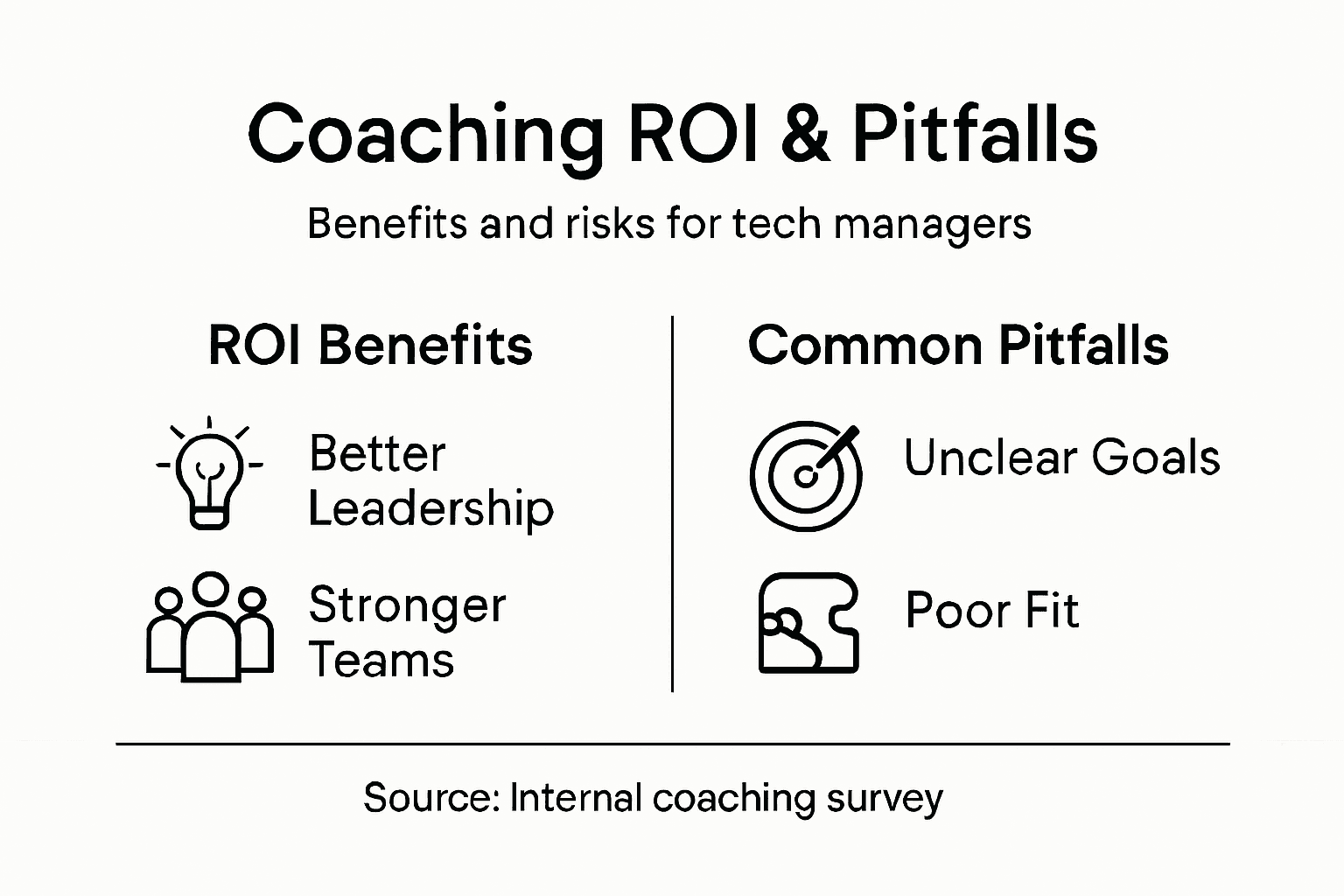
Below is a summary of common coaching pitfalls and recommendations to maximize ROI:
| Pitfall | Business Impact | Mitigation Strategy |
|---|---|---|
| Misaligned expectations | Unmet goals, wasted investment | Set clear, shared objectives |
| Poor coach-coachee compatibility | Reduced progress, disengagement | Prioritize fit during selection |
| Insufficient organizational support | Limited results, low adoption | Gain leadership buy-in early |
| Lack of measurement framework | Inability to prove value | Define key performance indicators |
Effective coaching requires a symbiotic relationship between individual growth, team development, and organizational objectives.
Pro tip: Conduct a comprehensive pre-coaching assessment to establish clear, measurable objectives and ensure alignment between individual development goals and organizational strategies.
Unlock Your Leadership Potential with Personalized Coaching
Navigating the complex challenges of technology management requires more than just technical expertise. As highlighted in the article, personal coaching offers tailored support to overcome leadership hurdles like stress management, strategic thinking, and team communication. If you are seeking to enhance your leadership skills and drive transformational change within your organization, exploring specialized coaching approaches such as Agile Coaching Archives – Tariq Juneja or Life Coaching Archives – Tariq Juneja can be the game changer you need.

Take the next step to increase your productivity, reduce stress, and embrace change with expert guidance. Visit https://tariqjuneja.com now to discover how personalized coaching programs can transform your professional journey. Book a free consultation today and start building resilient leadership for tomorrow.
Frequently Asked Questions
What is personal coaching for tech managers?
Personal coaching for tech managers is a tailored developmental relationship focused on enhancing leadership capabilities and addressing unique professional challenges within the technology industry.
How does coaching benefit technology managers?
Coaching helps tech managers improve communication skills, develop strategic thinking, enhance emotional intelligence, and create a supportive environment for professional growth.
What are the different types of coaching available for tech managers?
The primary types of coaching for tech managers include executive coaching, agile coaching, and life coaching, each focusing on distinct developmental needs ranging from leadership growth to team dynamics and personal development.
What are common pitfalls to avoid in coaching?
Common pitfalls include misaligned expectations, poor coach-coachee compatibility, insufficient organizational support, lack of measurement frameworks, and mandatory participation. Addressing these issues early can maximize the effectiveness of coaching.
Recommended
- Purpose Life Coaching: Transform Productivity in Tech – Tariq Juneja
- Individual Leadership Coaching: Transforming IT Management – Tariq Juneja
- Coaching Mindset Explained: Driving Change in Tech Teams – Tariq Juneja
- Why Coaching Matters for Transformational IT Leaders – Tariq Juneja
- Cybersecurity for Senior Leaders: Governance & Training