

Over 60 percent of adults believe intelligence is set at birth, yet decades of research show our brains can change and adapt throughout life. The way we think about our own abilities impacts every decision, challenge, and achievement. When you understand what mindset truly means and clear up common misunderstandings, you start opening doors to resilience, growth, and real performance gains.
Table of Contents
- Mindset Defined: Core Concepts And Myths
- Types Of Mindset: Fixed Versus Growth
- Mindset’s Impact On Change And Performance
- Cultivating The Right Mindset For Success
- Common Pitfalls And How To Overcome Them
Key Takeaways
| Point | Details |
|---|---|
| Mindset Types | Understanding fixed and growth mindsets is crucial as they influence learning, resilience, and overall performance. |
| Transformational Potential | Cultivating a growth mindset can lead to significant personal and professional development by viewing challenges as opportunities for growth. |
| Overcoming Barriers | Recognizing and addressing common pitfalls, such as negative self-talk and imposter syndrome, is essential for sustaining a growth-oriented mindset. |
| Actionable Strategies | Embrace challenges, seek constructive feedback, and develop a consistent learning practice to foster a growth mindset effectively. |
Mindset Defined: Core Concepts and Myths
A mindset represents the collection of beliefs, attitudes, and perspectives that fundamentally shape how individuals approach challenges, interpret experiences, and respond to life’s opportunities. According to groundbreaking research by Stanford University, psychologist Carol Dweck identified two primary mindset frameworks that dramatically influence personal and professional development: fixed and growth mindsets.
In a fixed mindset, individuals perceive intelligence and talent as static, immutable characteristics. People operating with this perspective tend to avoid challenges, fear failure, and believe their inherent capabilities are predetermined. Conversely, a growth mindset represents a transformative approach where individuals view abilities as developable through dedicated effort, strategic learning, and persistent practice. Central Washington University emphasizes that this perspective involves believing in one’s potential to expand skills through hard work and deliberate practice.
Common myths about mindset often perpetuate limiting beliefs. Many people mistakenly assume that intelligence is fixed, talents are predetermined, and personal potential is unchangeable. These misconceptions can create psychological barriers that prevent individuals from pursuing growth opportunities. In reality, neuroscience demonstrates remarkable brain plasticity, showing that learning, adaptation, and skill development are continuous processes. By understanding and cultivating a growth mindset, professionals can unlock unprecedented personal transformation, enhanced resilience, and expanded capabilities.
Key distinctions between fixed and growth mindsets include:
- Approach to challenges: Fixed mindset avoids; Growth mindset embraces
- Response to failure: Fixed mindset sees as permanent; Growth mindset views as learning opportunity
- Learning perspective: Fixed mindset believes abilities are static; Growth mindset sees potential for continuous improvement
- Effort interpretation: Fixed mindset considers effort unnecessary if talent is lacking; Growth mindset sees effort as the primary path to mastery
Types of Mindset: Fixed Versus Growth
Understanding the nuanced differences between fixed and growth mindsets reveals profound implications for personal and professional development. Clemson University’s Academic Success Center highlights a critical distinction: individuals with a fixed mindset feel compelled to prove their intelligence and avoid mistakes, while those embracing a growth mindset view challenges as opportunities for learning and improvement.
In a fixed mindset, people perceive their abilities as static and predetermined. They often become defensive when faced with challenges, interpreting potential failures as direct reflections of their inherent worth. WDFCSS explains that this perspective leads individuals to avoid challenges and feel threatened by others’ success. Conversely, those with a growth mindset demonstrate remarkable resilience, viewing setbacks as natural steps in the learning process and drawing inspiration from the achievements of others.
The psychological impact of these mindset types extends far beyond individual performance. People with a fixed mindset often create self-imposed limitations, believing their talents are unchangeable. They might say things like “I’m just not good at math” or “I don’t have a creative bone in my body.” Growth mindset practitioners, however, approach such statements as opportunities for development, understanding that skills can be cultivated through dedicated practice, strategic learning, and persistent effort.

Key characteristics that distinguish these mindsets include:
Here’s a side-by-side comparison of Fixed and Growth Mindsets:
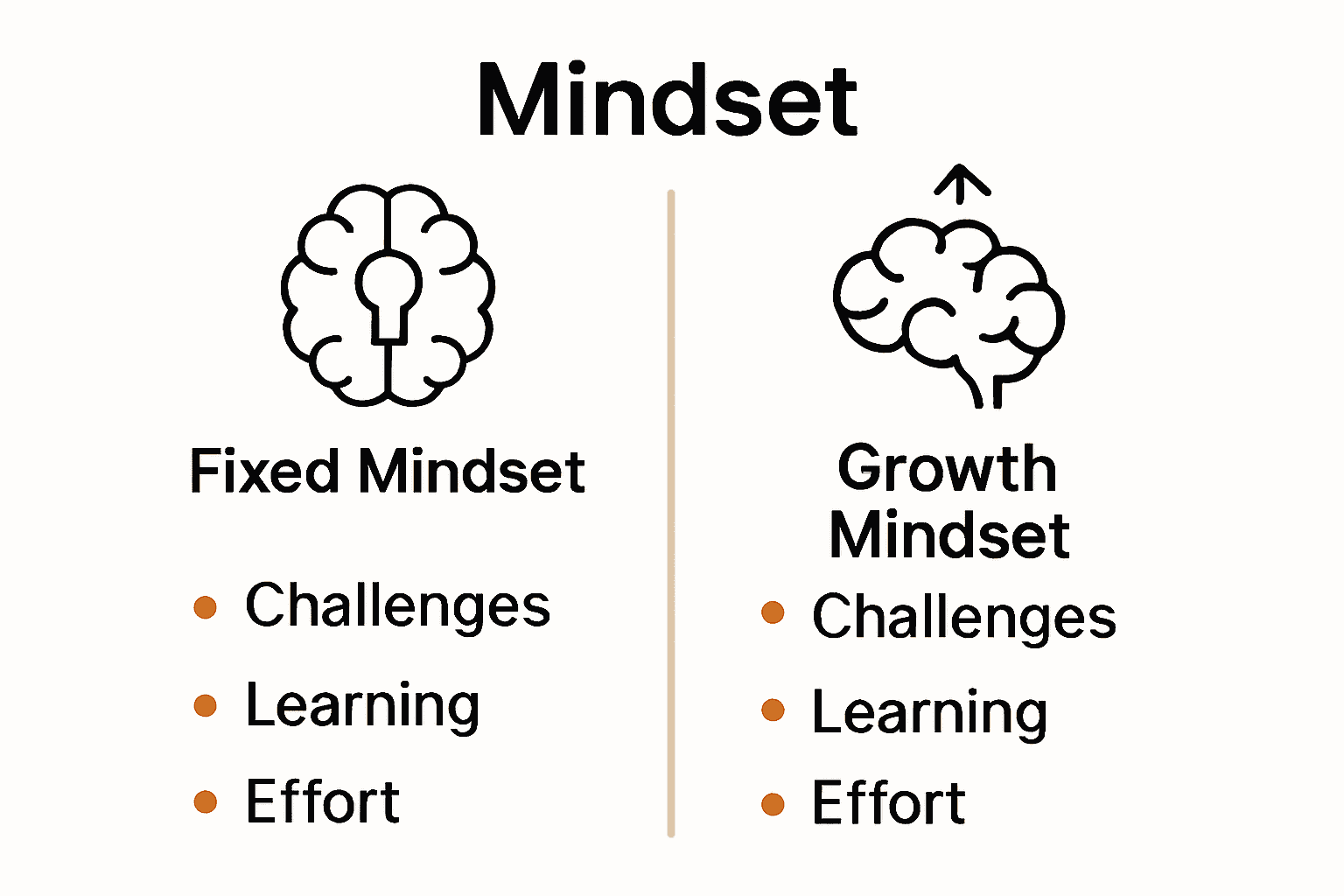
| Key Aspect | Fixed Mindset | Growth Mindset |
|---|---|---|
| Belief About Abilities | Intelligence and talent are static | Abilities can be developed |
| Approach to Challenges | Avoids obstacles | Embraces challenges |
| Response to Failure | Views as permanent setback | Sees as learning opportunity |
| Effort Interpretation | Effort is pointless if not talented | Effort is the path to mastery |
| Response to Criticism | Defensive or ignores feedback | Uses feedback to improve |
| View of Others’ Success | Feels threatened | Feels inspired and motivated |
- Attitude toward challenges: Fixed mindset avoids; Growth mindset embraces
- Perception of effort: Fixed mindset sees effort as fruitless; Growth mindset views effort as essential for improvement
- Response to criticism: Fixed mindset becomes defensive; Growth mindset uses feedback constructively
- Inspiration from others: Fixed mindset feels threatened; Growth mindset finds motivation and learning opportunities
Mindset’s Impact on Change and Performance
Mindset fundamentally transforms how individuals approach challenges, adapt to change, and ultimately achieve performance breakthroughs. Stanford University’s Gender Research Center reveals that a growth mindset enables individuals to thrive during challenging times by fostering remarkable resilience and a genuine willingness to learn from mistakes.
Professionals with a growth mindset demonstrate extraordinary capacity for navigating organizational transformations and personal development trajectories. Central Washington University’s Learning Commons highlights that individuals embracing this perspective are substantially more likely to persist through complex challenges, viewing obstacles as opportunities for skill enhancement rather than insurmountable barriers.
The performance implications of mindset extend far beyond individual achievements. Organizations populated by growth-minded professionals experience enhanced innovation, increased adaptability, and more robust problem-solving capabilities. Employees who approach challenges with curiosity and openness can transform potential setbacks into strategic learning experiences, creating a culture of continuous improvement and intellectual agility.
Key performance differentiators between fixed and growth mindsets include:
- Adaptability: Growth mindset adapts quickly; Fixed mindset resists change
- Learning approach: Growth mindset sees challenges as opportunities; Fixed mindset perceives challenges as threats
- Feedback reception: Growth mindset welcomes constructive criticism; Fixed mindset becomes defensive
- Problem-solving: Growth mindset generates multiple solutions; Fixed mindset limits potential approaches
To fully leverage mindset’s transformative potential, learn more about mindset coaching and discover strategies for cultivating a growth-oriented perspective in professional environments.
Cultivating the Right Mindset for Success
Mindset transformation represents a deliberate and strategic journey of personal development that requires intentional practice and self-awareness. Clemson University’s Academic Success Center suggests that developing a growth mindset involves embracing challenges, viewing effort as a fundamental path to mastery, and learning constructively from criticism.
Successful mindset cultivation demands consistent mental reframing and deliberate cognitive strategies. Individuals must learn to interrupt negative thought patterns, challenge self-limiting beliefs, and develop a more expansive perspective on personal potential. This process involves recognizing automatic responses, understanding their origins, and consciously choosing alternative interpretations that support growth and resilience.
WDFCSS emphasizes that fostering a growth mindset requires believing in the capacity to develop intelligence and talents through dedicated effort and continuous learning. This approach transforms obstacles from insurmountable barriers into opportunities for skill enhancement and personal evolution, creating a powerful framework for sustained professional and personal success.
Practical strategies for cultivating a growth mindset include:
- Embrace challenges as learning opportunities
- Replace self-criticism with constructive self-reflection
- Celebrate effort and progress, not just end results
- Seek feedback as a tool for improvement
- Develop curiosity and a love for continuous learning
Learn how to coach yourself to be a champion and unlock your full potential through strategic mindset development.
Common Pitfalls and How to Overcome Them
Mindset transformation is rarely a straightforward journey, and recognizing potential obstacles is crucial for sustained personal growth. Central Washington University’s Learning Commons identifies several common pitfalls associated with a fixed mindset, including the tendency to avoid challenges and give up easily when confronted with initial difficulties.
One of the most significant mental barriers individuals encounter is the imposter syndrome – a persistent belief that one’s achievements are undeserved and that eventual failure is inevitable. This psychological trap often leads professionals to self-sabotage, preventing them from taking calculated risks or pursuing ambitious goals. By understanding that skills can be developed and intelligence is not a fixed trait, individuals can begin to dismantle these self-imposed limitations.
Clemson University’s Academic Success Center emphasizes that many individuals with a fixed mindset feel compelled to prove their intelligence and avoid mistakes at all costs. This defensive approach creates a significant barrier to learning and personal development. Overcoming this requires a fundamental shift in perspective – viewing challenges as opportunities for growth rather than threats to one’s perceived competence.
Key strategies for overcoming mindset pitfalls include:
- Recognize and challenge negative self-talk
- Reframe failures as learning experiences
- Embrace vulnerability and admit knowledge gaps
- Cultivate curiosity over perfectionism
- Develop a consistent learning practice
Learn how to set goals for lasting success and transform these insights into actionable personal development strategies.
Unlock Lasting Transformation by Shifting Your Mindset Today
Struggling with self-limiting beliefs or feeling stuck because challenges seem overwhelming? This guide on mindset matters highlights key hurdles like avoiding failure, battling imposter syndrome, and resisting change that could be holding you back from real growth. By embracing a growth mindset, you can transform setbacks into powerful learning moments and unlock your true potential.

Take control over your personal and professional development by exploring proven coaching strategies tailored for your journey. Dive deeper into effective mindset shifts with insights from the Life Coaching Archives – Tariq Juneja and learn how to navigate change through expert guidance in the Change Management Archives – Tariq Juneja. Ready to start your transformation? Visit https://tariqjuneja.com now to discover coaching programs designed to increase your resilience, boost productivity, and help you thrive in every area of your life.
Frequently Asked Questions
What is the difference between a fixed mindset and a growth mindset?
A fixed mindset views intelligence and talents as static traits, while a growth mindset sees abilities as developable through effort and learning.
How can I cultivate a growth mindset?
Cultivating a growth mindset involves embracing challenges, welcoming feedback, celebrating effort, and developing a love for continuous learning.
What are some common pitfalls of a fixed mindset?
Common pitfalls include avoiding challenges, self-sabotage through imposter syndrome, and viewing failures as permanent setbacks, preventing personal growth.
How does mindset impact performance in the workplace?
A growth mindset enhances adaptability, fosters innovation, and encourages problem-solving, leading to improved performance and a culture of continuous improvement.
Recommended
- What is Mindset Coaching? Understanding Its Impact – Tariq Juneja
- What is a Coaching Mindset? Understanding Its Impact – Tariq Juneja
- What is Transformative Coaching? Understanding Its Impact – Tariq Juneja
- Understanding Why Embrace Change for Business Growth – Tariq Juneja
- Zo ontwikkel je een groeimindset – Ondernemers Plaza Online
- Power of Positive Thinking: Complete Essential Guide – Omnia Radiation Balancer