

Sorting out what really counts as business coaching can be confusing for IT managers leading agile teams. With business coaching rapidly rising as a go-to performance intervention, lingering misconceptions and blurred boundaries often leave organizations guessing about its true value and methods. This guide cuts through unclear definitions, addresses persistent myths, and outlines how business coaching is a professional relationship that unlocks team potential through structured conversation and actionable goals—equipping you to make smarter choices that elevate your agile team’s results.
Table of Contents
- Defining Business Coaching And Common Myths
- Types Of Business Coaching For Agile Teams
- Core Benefits: Productivity, Leadership, And Growth
- Essential Qualifications And Coaching Approaches
- Cost, Roi, And Hidden Risks To Consider
Key Takeaways
| Point | Details |
|---|---|
| Business Coaching vs. Other Roles | Business coaching focuses on unlocking potential and accountability, distinct from consulting, therapy, or training. Ensure clarity on the coaching definition and methodology when hiring. |
| Types of Coaching for Agile Teams | Various coaching types exist, including executive, leadership, team, and agile coaching, tailored to specific needs and outcomes in organizations. Match the coaching type to address actual bottlenecks. |
| Measurable Impact of Coaching | Investment in business coaching translates to enhanced productivity, leadership development, and organizational growth, supported by tangible metrics like turnover and revenue improvement. Define clear success metrics at the outset. |
| Selecting a Qualified Coach | Look for coaches with credentials, relevant experience, and a commitment to ongoing development to avoid hidden risks and ensure effective coaching. Conduct reference checks tailored to your context. |
Defining Business Coaching and Common Myths
Business coaching is fundamentally different from training, consulting, or therapy, yet these distinctions often blur in practice. At its core, business coaching is a professional relationship where a trained coach partners with you to unlock your potential, improve performance, and achieve specific goals. For IT managers navigating agile transformations, this means having someone who understands your world, asks the right questions, and holds you accountable without telling you what to do. The coach’s role is to draw out solutions from within you rather than impose them from outside.
The confusion around what constitutes real business coaching stems partly from the field’s rapid expansion. Workplace coaching has dramatically increased as a performance-enhancing intervention over the past decade, yet empirical research and standardized definitions have lagged behind adoption rates. This creates a landscape where anyone can claim to be a coach without formal training, credentials, or a clear methodology. The result? Organizations invest in coaching relationships that lack real structure, measurable outcomes, or evidence-based practices. You might hire someone labeled a “coach” who actually operates like a consultant (giving advice), a therapist (digging into personal trauma), or a trainer (delivering predetermined content). None of these approaches constitute actual coaching.
Several persistent myths cloud your decision-making when considering coaching for your team or yourself. The first myth suggests coaching is only for underperformers or those in crisis. In reality, high-performing managers benefit enormously from coaching to break through plateaus, develop leadership presence, or navigate complex organizational transitions. Another widespread misconception is that coaching requires long-term, expensive engagements stretching over years. Focused coaching around specific agile adoption challenges, sprint retrospective improvements, or team conflict resolution can deliver results in 3 to 6 months with 10 to 15 sessions. Perhaps the most damaging myth assumes coaching works through motivation and inspiration talks. Authentic business coaching operates through structured conversations, behavioral accountability, and concrete action steps tied to measurable outcomes. The distinction matters because the lack of universally agreed definitions around coaching creates ambiguity in foundational elements, interventions, and outcomes, making it harder to identify what actually works.
Pro tip: When evaluating a potential coach, ask specifically how they define coaching, what framework or methodology they use, what credentials they hold, and how they measure success—not whether they seem inspirational or available immediately.
Types of Business Coaching for Agile Teams
Not all coaching works the same way, and the type you choose depends heavily on what your team actually needs right now. Business coaching encompasses various forms tailored to different contexts, including executive coaching, leadership coaching, team coaching, and agile coaching. For IT managers leading agile transformations, understanding these distinctions matters because each type targets different outcomes and operates through different mechanisms. Executive coaching typically focuses on senior leaders navigating organizational strategy and board-level visibility. Leadership coaching helps mid-level managers like yourself develop presence, decision-making capability, and emotional intelligence under pressure. Team coaching addresses group dynamics, communication patterns, and collective performance. Agile coaching, however, is uniquely positioned to integrate agile principles directly into how your team works, thinks, and improves continuously.
Agile coaching stands apart because it doesn’t just develop individuals in isolation. Agile coaching focuses on facilitating mindset shifts, implementing agile practices, and supporting team autonomy as a collective unit. When you bring in an agile coach, you’re investing in someone who understands sprint planning, retrospectives, backlog refinement, and the specific friction points your team encounters when adopting agile methodologies. They work with your entire team simultaneously, not just coaching individual members and hoping the improvements somehow translate to better collaboration. An agile coach asks your team challenging questions during retrospectives, helps you identify why velocity plateaus at certain points, and guides you through the cultural shifts required for true agile adoption. This differs sharply from a general business coach who might help a manager improve delegation skills but never directly observe or influence sprint dynamics.
The choice between these coaching types often depends on your specific pain point. If your challenge is individual manager performance, leadership coaching makes sense. If the issue is organizational strategy at the executive level, executive coaching serves that purpose. But if your struggle centers on team delivery speed, quality of collaboration, continuous process improvement, or moving from waterfall thinking to agile mindsets, agile coaching delivers more targeted results because it operates within the actual context where your work happens. Many organizations make the mistake of hiring a general business coach when they need someone who understands ceremonies like daily standups, the psychology of psychological safety in retrospectives, and how sprint commitments create accountability.
Consider also that these coaching types aren’t mutually exclusive. Some organizations use leadership coaching for the manager and agile coaching for the team working together. Others combine executive coaching with agile coaching when transforming their entire operating model. The key is matching the coaching type to where your actual bottleneck exists.
Here’s a quick comparison of popular business coaching types for agile IT teams:
| Coaching Type | Typical Focus Area | Key Mechanism | Best Fit For |
|---|---|---|---|
| Executive Coaching | Strategy and vision | One-on-one, board-level support | Senior leaders |
| Leadership Coaching | Manager growth and influence | Individual skill development | Mid-level managers |
| Team Coaching | Group dynamics and collaboration | Facilitate across team processes | Agile or project teams |
| Agile Coaching | Agile practice adoption and mindset | Direct work with agile ceremonies | Teams transitioning to agile |
Pro tip: Before hiring an agile coach, ask them to observe one of your sprints without coaching anything first, then discuss what specific agile practices or mindset shifts they see as the highest leverage opportunities for your particular team.
Core Benefits: Productivity, Leadership, and Growth
When you invest in business coaching, you’re not paying for someone to attend meetings or observe your processes passively. You’re investing in measurable shifts that translate directly to your bottom line. Business coaching in organizations significantly improves productivity, leadership skills, and organizational growth. For IT managers specifically, this means faster sprint velocity, higher quality code reviews, reduced burnout on your team, and more strategic thinking from yourself. The research backs this up with tangible numbers. Organizations that commit to coaching interventions report increased revenues and sustainable business growth, with both individual and team coaching contributing to enhanced skills and motivation across the board.

Productivity gains are the most visible benefit you’ll see first. When a coach works with your team on sprint ceremonies, decision-making velocity, or how backlog prioritization happens, you’re removing friction from the actual work. A team that can make decisions 30 percent faster in retrospectives creates more time for shipping features. A manager who understands how to give feedback without derailing psychological safety sees team members contribute more ideas during standups. An IT manager who recognizes when scope creep is happening and can push back confidently saves your team from burning out mid-sprint. Leadership coaching enhances leader effectiveness by promoting authentic and change-oriented behaviors, which directly correlates with improvements in productivity and organizational growth. You become the kind of leader who people actually want to follow, not the one they tolerate. That shift in how your team experiences you compounds month after month.
The growth benefit extends beyond your team’s current capacity. Coaching develops your ability to think strategically about technical debt, architectural decisions, and talent development. You start asking better questions instead of providing quick answers. Your team learns to solve problems independently rather than waiting for direction. You see patterns in why certain sprints go sideways and address root causes instead of symptoms. You identify high potential engineers and create development paths for them. These aren’t one-time improvements. They’re structural changes that compound as your team matures. An IT manager who receives coaching often becomes the kind of leader who naturally develops other leaders, creating a multiplier effect across the organization.
The practical impact shows up in turnover rates, promotion rates, and organizational credibility. Teams with coached managers stay longer. Engineers grow faster into senior roles. Your organization gains a reputation for developing talent, which attracts better candidates. When you move to a larger role, you leave behind a stronger team because you built intentionally rather than just managing day-to-day.
To help clarify the business impact of coaching, here is a summary of measurable benefits organizations often see:
| Benefit Area | Example Metric | Positive Organizational Impact |
|---|---|---|
| Productivity | Sprint velocity change | Faster delivery of features |
| Leadership | Promotion rate increase | More leaders, better team engagement |
| Retention | Turnover rate reduction | Lower hiring costs, stable teams |
| Growth | Revenue improvement | Sustainable scaling and talent pipelines |
Pro tip: Before starting coaching, define three specific productivity or leadership metrics you want to improve in the next six months, then check against them quarterly so you can quantify the real business impact coaching delivers.
Essential Qualifications and Coaching Approaches
Not every person calling themselves a coach has actually earned the right to that title. When you’re evaluating potential coaches, credentials matter because they signal whether someone understands evidence-based coaching versus relying on intuition or charisma. Effective business coaching requires formal qualifications, training, and adherence to evidence-based coaching approaches. Professional coaching certifications emphasize competencies such as communication, ethics, goal-setting, and feedback mechanisms. Look for coaches with credentials from recognized bodies like the International Coach Federation, which requires specific training hours, supervised coaching practice, and demonstrated competency assessments. An agile coach should additionally have hands-on agile experience, not just coaching credentials. They’ve actually run sprints, facilitated retrospectives that went sideways, and learned how to course-correct in real time. This matters because certifications prove they know coaching as a discipline, but agile experience proves they understand your specific context.
Coaching approaches vary significantly depending on the coach’s training and philosophy. Some coaches use solution-focused coaching, which means they help you identify what’s already working and expand from there rather than dwelling on problems. Others employ cognitive-behavioral techniques, helping you examine thought patterns that limit your leadership. Agile coaches might blend directive approaches (giving guidance when your team is stuck on implementation) with non-directive facilitation (asking powerful questions so your team discovers solutions). The best coaches match their approach to what you actually need right now. When your team is overwhelmed and needs structure, a more directive coach provides clarity. Once your team stabilizes, a facilitative approach builds autonomy and problem-solving capability. A coach who only operates one way fits some situations but not others.
The specific coaching methodologies and behaviors critical for sustained success require continual development from the coach. Coaching is not something you learn once and stop improving. The best coaches stay current with research, participate in peer consultation groups, and refine their approach based on what works with real clients in real situations. When you interview a potential coach, ask about their ongoing development. How do they stay sharp? Who do they work with when they hit their own limitations? Do they have peer coaches they consult with regularly? Their answers reveal whether they’re genuinely committed to excellence or just collecting clients.
Beyond credentials and approaches, fit matters enormously. A highly credentialed coach who doesn’t understand your organizational context wastes everyone’s time. A coach who’s coached three hundred organizations but never worked in your industry may miss nuances that matter. The best coaching relationship combines strong credentials, evidence-based approaches, relevant experience, and genuine rapport where you feel heard and challenged appropriately.
Pro tip: Ask potential coaches for references from IT managers or agile leaders specifically, and actually call those references to ask whether the coach adapted their approach to their unique context or used the same playbook for everyone.
Cost, ROI, and Hidden Risks to Consider
Business coaching is not free, and pretending otherwise sets you up for disappointment. Costs vary significantly depending on coaching type and scope. Executive coaching typically runs between $200 to $400 per hour. Team coaching and agile coaching usually cost between $150 to $300 per hour. Some coaches charge flat fees for engagements spanning three to six months, ranging from $5,000 to $25,000 depending on depth and organizational size. For a mid-level IT manager considering personal coaching alongside agile coaching for your team, budget somewhere between $15,000 and $40,000 over six months if you’re serious about measurable results. That’s real money. The question is whether the returns justify the investment.
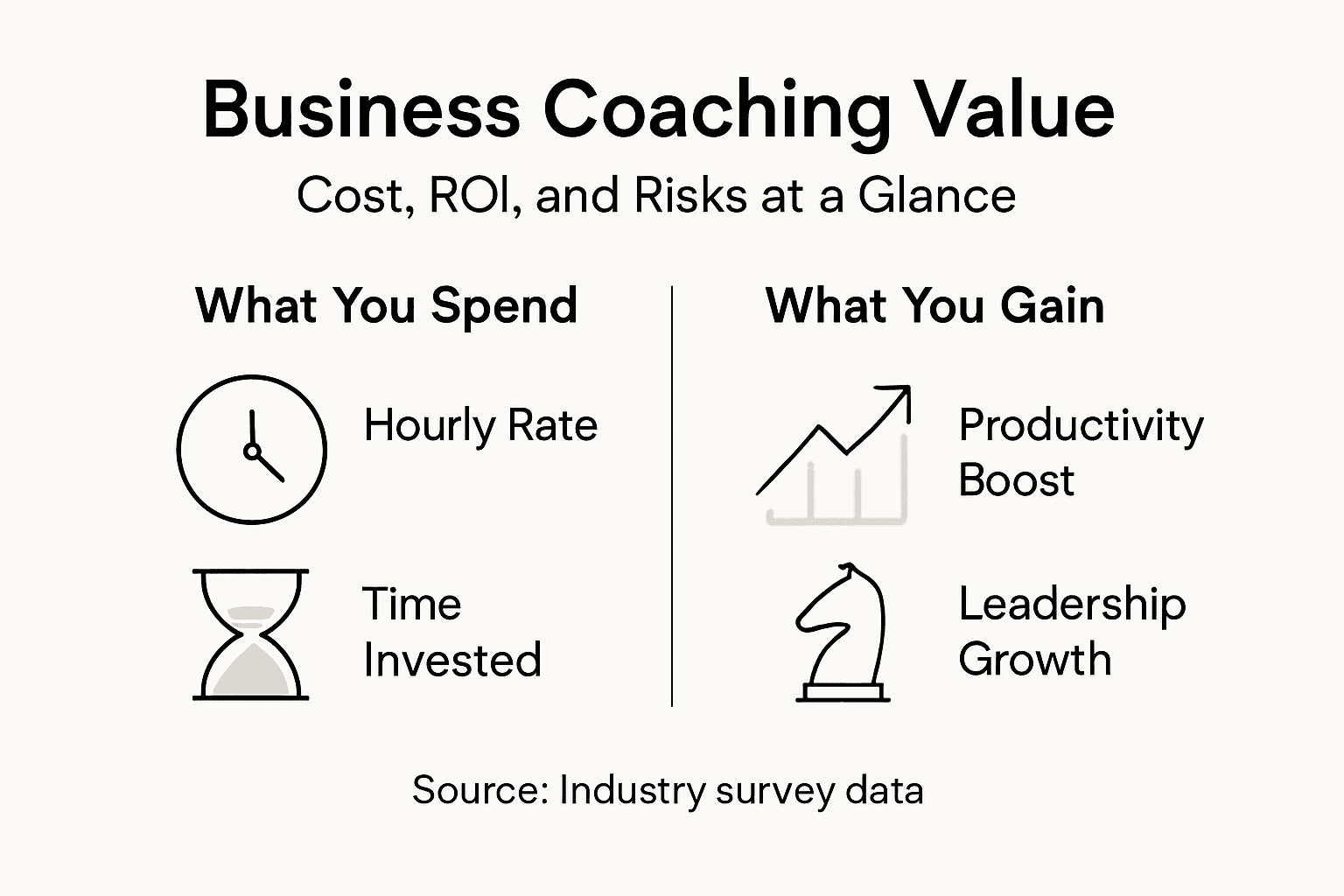
Calculating ROI from coaching requires honest assessment of what changed as a direct result of the coaching relationship. Evaluating the impact and return on investment of business coaching involves analyzing perceptions of management practice changes and attributing improvements specifically to coaching interventions. Here’s what this means practically: if your team’s sprint velocity increases by 20 percent, you can measure that. If turnover on your team drops from 25 percent annually to 8 percent, you can calculate the cost savings from reduced hiring and onboarding. If you move from a reactive, crisis-driven management style to proactive strategic planning, that translates into fewer emergency meetings and more intentional decisions. A typical well-designed coaching engagement returns three to five dollars for every dollar spent, though this varies by organization and coaching quality. The challenge is distinguishing between improvements that genuinely came from coaching versus improvements that would have happened anyway.
Hidden risks lurk beneath the surface when organizations don’t approach coaching strategically. Business coaching carries hidden risks such as inadequate coach qualifications, misaligned objectives, and unmeasured outcomes that can significantly reduce ROI. You might hire a coach with impressive credentials who never aligns their work with your organization’s actual strategic priorities. Your team might show short-term improvement in how they run retrospectives, but no lasting behavioral change because the coach didn’t address underlying mindset shifts. You might measure all the wrong metrics, tracking things that sound good in reports but don’t reflect real business impact. Another risk: inconsistent coaching quality where the coach delivers one approach in month one and something entirely different in month three because they lack structure or follow-through. Perhaps the biggest hidden risk is relying solely on subjective assessments. Your team feels better about working together after coaching, but actual sprint metrics stayed flat. That’s data that should trigger investigation, not satisfaction.
Mitigate these risks by starting with absolute clarity about what success looks like before you hire any coach. Define three to five specific, measurable outcomes you want to achieve. Build regular check-ins into the coaching contract where you review progress against those metrics. Ask potential coaches explicitly how they would measure success and whether they’re comfortable with independent evaluation of their impact. Insist on alignment between coaching objectives and your organization’s strategic goals. A coach working on team communication skills but ignoring your critical need to reduce technical debt isn’t serving your actual business need, even if communication improves.
Pro tip: Request a trial engagement of two to three coaching sessions before committing to a full contract, then assess whether the coach’s style fits your team’s culture and whether you see early indicators of the specific changes you’re aiming for.
Unlock Agile Success with Expert Coaching
Struggling with agile transformations or hitting productivity plateaus? This article highlights how targeted business coaching, especially agile coaching, helps IT managers and their teams break through challenges such as sprint velocity plateaus, team collaboration issues, and leadership growth. If you want to turn these common roadblocks into stepping stones for real, measurable success, professional guidance is essential.
Discover proven approaches that integrate agile mindset shifts and practical coaching techniques tailored to your unique context. Visit the Agile Coaching Archives – Tariq Juneja to explore insights and strategies that align with the core benefits of coaching outlined here.
Take the first step to unlock your team’s full potential and transform your leadership impact. Visit https://tariqjuneja.com to learn how Tariq Juneja’s expert coaching can accelerate your agile journey with measurable outcomes. Explore Change Management Archives – Tariq Juneja for broader organizational shifts, and experience personalized coaching that drives real transformation. Book your free consultation today and start seeing the difference coaching can make.
Frequently Asked Questions
What is business coaching and how does it differ from consulting or training?
Business coaching is a professional relationship where a trained coach partners with individuals or teams to unlock potential, improve performance, and achieve specific goals. Unlike consulting or training, which often involve advice or predetermined solutions, coaching focuses on drawing out solutions from within the individual or team.
How can coaching benefit high-performing managers in agile environments?
High-performing managers can benefit from coaching by breaking through performance plateaus, enhancing leadership presence, and effectively navigating complex organizational changes during agile transformations. Coaching enables them to develop better decision-making capabilities and improve team collaboration.
What types of coaching are most effective for agile teams?
For agile teams, effective coaching types include agile coaching, team coaching, leadership coaching, and executive coaching. Each type targets different needs, with agile coaching focusing on implementing agile practices and facilitating mindset shifts, while leadership coaching develops individual managers and executive coaching concentrates on strategic vision.
What should I look for in a business coach for my agile team?
When looking for a business coach, consider their qualifications and relevant experience, especially in agile methodologies. Inquire about their coaching approach, how they measure success, and seek references from others in similar roles to ensure they align with your unique organizational context.