

Over 80 percent of organizations now invest in leadership coaching to develop their top talent and boost performance. With workplaces facing constant change and rising expectations, mastering the art of effective leadership has never been more critical. Leadership coaching provides individuals and teams with personalized strategies that build self-awareness, strengthen decision-making, and shape dynamic organizational cultures, giving leaders the clarity and confidence to drive real results.
Table of Contents
- Defining Leadership Coaching and Core Concepts
- Types of Leadership Coaching Approaches Explained
- Essential Skills and Qualities of a Leadership Coach
- Typical Process and Stages in Leadership Coaching
- Transformational Benefits for Individuals and Teams
- Common Mistakes and Challenges to Avoid
Key Takeaways
| Point | Details |
|---|---|
| Transformative Nature of Leadership Coaching | Leadership coaching enhances personal and organizational performance through personalized guidance and emotional intelligence development. |
| Diverse Coaching Approaches | Various coaching models, such as solution-focused and transformational coaching, are tailored to meet specific leadership needs. |
| Essential Skills of Coaches | Effective leadership coaches exemplify high emotional intelligence, active listening, and adaptability to support leaders’ growth. |
| Common Challenges | Misaligned expectations and insufficient commitment can hinder coaching success, necessitating clear objectives and ongoing support. |
Defining Leadership Coaching and Core Concepts
Leadership coaching is a transformative professional development approach designed to help individuals unlock their leadership potential and drive organizational performance. At its core, leadership coaching represents a strategic partnership between a skilled coach and a leader, focused on enhancing personal effectiveness, professional growth, and organizational impact. According to research from academic.oup.com, leadership coaching integrates various theoretical frameworks to support leaders in developing critical skills and insights.
The fundamental objective of leadership coaching goes beyond traditional training methods by providing personalized, one-on-one guidance that addresses specific leadership challenges. Research from arxiv.org highlights the critical role of emotional intelligence as a key component in effective leadership development. This approach helps leaders:
- Enhance self-awareness and emotional regulation
- Develop more effective communication strategies
- Build stronger team dynamics
- Improve decision-making capabilities
- Navigate complex organizational challenges
Leadership coaching is not a one-size-fits-all solution but a nuanced, adaptive process tailored to individual leadership styles and organizational contexts. Learn more in our personal leadership coaching guide to understand how customized coaching interventions can dramatically transform leadership effectiveness. Coaches work closely with leaders to identify strengths, address potential limitations, and create actionable strategies for professional growth, ultimately driving both individual performance and broader organizational success.
Types of Leadership Coaching Approaches Explained
Leadership coaching encompasses diverse methodological approaches designed to address unique organizational and individual leadership challenges. According to batdacademy.com, multiple coaching models have emerged to support leaders in developing sophisticated professional capabilities. These approaches are not one-size-fits-all but strategically tailored to specific leadership contexts and developmental needs.
Key leadership coaching approaches include:
- Solution-Focused Coaching: Concentrates on identifying and implementing practical solutions rather than dwelling on problems
- Transformational Coaching: Focuses on profound personal and professional metamorphosis
- Performance Coaching: Targets specific performance improvement objectives
- Developmental Coaching: Emphasizes long-term skill enhancement and career progression
- Strengths-Based Coaching: Leverages individual talents and inherent capabilities
Explore our comprehensive guide to executive coaching to understand how these approaches can be strategically implemented. Each coaching methodology offers unique mechanisms for driving leadership growth, with skilled coaches selecting and adapting techniques based on individual leader profiles, organizational culture, and specific developmental goals. The ultimate aim remains consistent: empowering leaders to unlock their full potential, enhance organizational performance, and create sustainable professional transformation.

Essential Skills and Qualities of a Leadership Coach
Leadership coaching demands a sophisticated blend of interpersonal skills, psychological insight, and professional expertise. Research from arxiv.org emphasizes that emotional intelligence stands as a foundational competency for effective coaches, highlighting the critical importance of self-awareness and empathy in guiding leadership development.
Key essential skills and qualities of exceptional leadership coaches include:
- Deep Emotional Intelligence: Ability to perceive, understand, and navigate complex emotional landscapes
- Active Listening: Profound capacity to hear underlying messages and unspoken organizational dynamics
- Strategic Questioning: Skill in crafting insightful questions that provoke meaningful reflection
- Adaptability: Flexibility to customize coaching approaches for diverse leadership contexts
- Psychological Acumen: Understanding of human behavior and organizational psychology
Learn more about coaching techniques in our comprehensive guide, which explores the nuanced skills required for transformational leadership coaching. According to academic.oup.com, effective leadership coaches must transcend traditional mentoring by providing targeted, strategic interventions that challenge leaders to expand their potential. They serve not just as advisors, but as catalysts for profound personal and professional transformation, helping leaders develop self-awareness, overcome limiting beliefs, and unlock their most authentic leadership capabilities.
Typical Process and Stages in Leadership Coaching
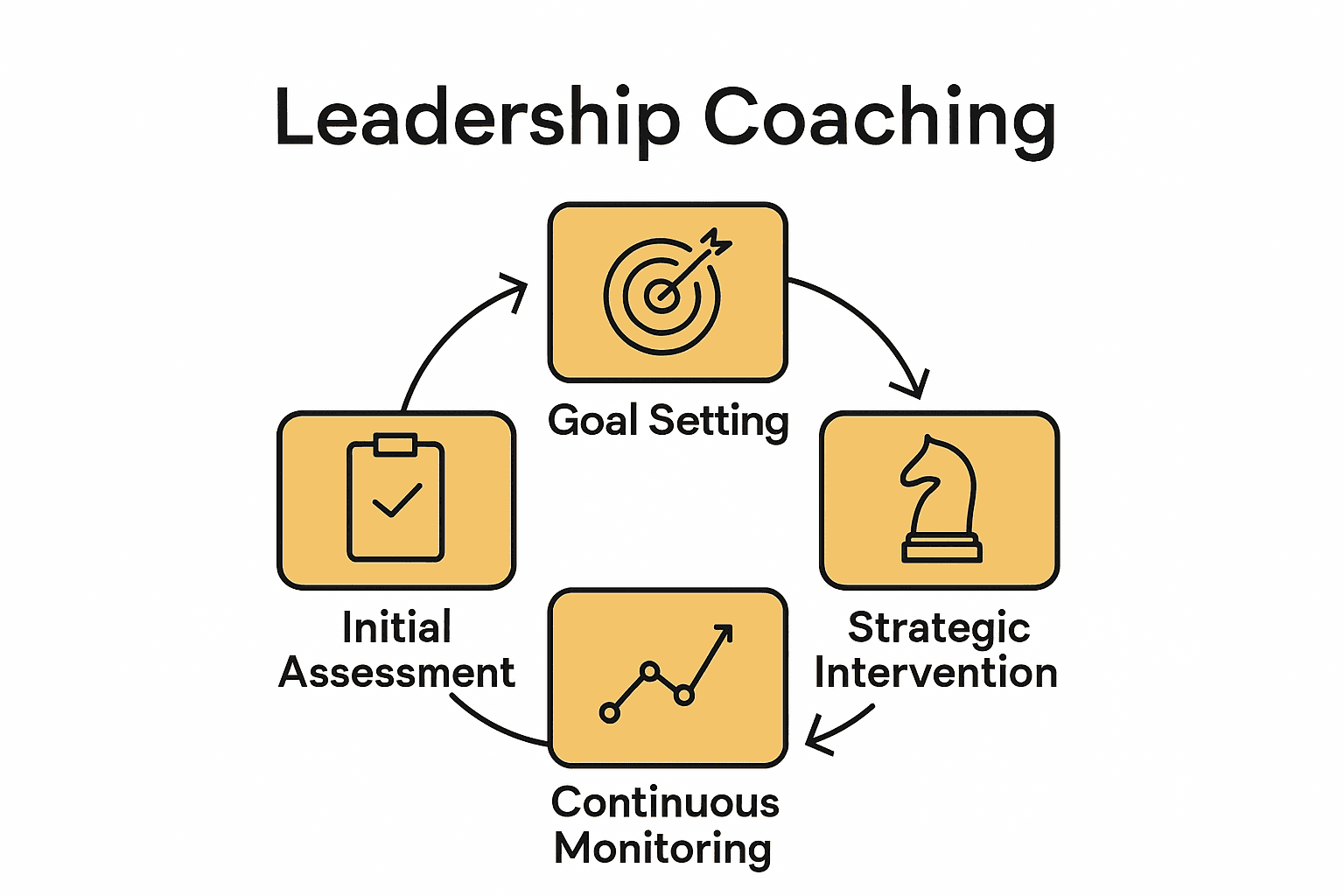
Leadership coaching follows a structured yet dynamic process designed to facilitate meaningful professional transformation. According to batdacademy.com, the coaching journey typically encompasses several interconnected stages that enable comprehensive personal and organizational development.
The typical leadership coaching process can be broken down into key stages:
-
Initial Assessment
- Comprehensive evaluation of current leadership capabilities
- Identification of strengths and potential development areas
- Establishment of clear, measurable coaching objectives
-
Goal Setting
- Co-creation of specific, actionable leadership development goals
- Alignment of individual aspirations with organizational strategy
- Defining metrics for tracking progress and success
-
Strategic Intervention
- Customized coaching techniques and interventions
- Regular feedback and reflective practices
- Skill-building exercises and challenging assignments
-
Continuous Monitoring
- Periodic performance reviews
- Adaptive coaching approach based on emerging insights
- Ongoing support and recalibration of developmental strategies
Explore our comprehensive guide to understanding the coaching process to gain deeper insights into how these stages interconnect. Each stage is designed to be flexible, recognizing that leadership development is a nuanced, non-linear journey. The ultimate goal remains consistent: empowering leaders to unlock their potential, overcome limiting beliefs, and drive meaningful personal and organizational transformation through targeted, strategic coaching interventions.
Transformational Benefits for Individuals and Teams
Leadership coaching offers profound transformational benefits that extend far beyond individual skill development, creating ripple effects throughout entire organizational ecosystems. Research from arxiv.org reveals strong correlations between enhanced emotional intelligence and key leadership traits, demonstrating how targeted coaching interventions can dramatically improve team dynamics and organizational performance.
Transformational benefits manifest across multiple dimensions:
For Individuals:
- Increased self-awareness and emotional intelligence
- Enhanced personal leadership capabilities
- Improved confidence and professional resilience
- More effective communication and interpersonal skills
- Accelerated career progression
For Teams:
- Stronger collaborative environments
- Improved conflict resolution mechanisms
- Enhanced collective problem-solving capabilities
- More aligned and motivated team dynamics
- Increased organizational adaptability
Explore our transformative coaching insights guide to understand the deeper psychological mechanisms driving these changes. The true power of leadership coaching lies not just in individual growth, but in its ability to create systemic improvements that cascade through organizational structures, fundamentally reshaping how teams communicate, collaborate, and achieve collective goals. By investing in leadership coaching, organizations unlock potential at both individual and collective levels, creating more agile, resilient, and high-performing professional environments.
Common Mistakes and Challenges to Avoid
Leadership coaching is a nuanced process fraught with potential pitfalls that can significantly undermine its effectiveness. According to ace.edu, navigating the complex terrain between coaching and leadership requires careful strategic consideration to avoid common operational challenges.
Critical mistakes and challenges in leadership coaching include:
-
Misaligned Expectations
- Unclear coaching objectives
- Unrealistic performance timelines
- Mismatched coaching style with leader’s learning preferences
-
Insufficient Commitment
- Lack of genuine organizational support
- Inconsistent engagement from leadership
- Treating coaching as a one-time event rather than ongoing development
-
Inadequate Measurement
- Poor definition of success metrics
- Inability to quantify coaching impact
- Neglecting qualitative behavioral changes
-
Communication Breakdowns
- Ineffective feedback mechanisms
- Resistance to vulnerable conversations
- Avoiding difficult performance discussions
Learn more about effective coaching strategies in our comprehensive guide, which explores how to overcome these challenges. As reported by ccl.org, selecting the appropriate coaching approach is crucial. Successful leadership coaching demands a sophisticated balance between challenging leaders and providing supportive, constructive guidance that empowers genuine personal and professional transformation.
Unlock Your Leadership Potential with Expert Coaching
Leadership coaching can transform the way you lead by addressing the specific challenges of enhancing emotional intelligence, improving communication, and developing strategic decision-making skills. If you are feeling stuck or overwhelmed by the complexities of leadership growth, personalized coaching can help you break through those barriers and build stronger, more agile teams with lasting impact.
Discover how targeted coaching approaches like those outlined in this overview can empower you to lead confidently and adapt to change effectively. Explore the insights and strategies found in our Agile Coaching Archives – Tariq Juneja to see real examples of transformational change in leadership and organizational performance.
Take the first step toward profound professional transformation by visiting Tariq Juneja’s website. Gain access to tailored coaching programs and resources designed to help you increase productivity, reduce stress, and embrace change. For a more personal journey, browse our Life Coaching Archives – Tariq Juneja and start your path toward sustainable leadership growth today.
Frequently Asked Questions
What is the primary goal of leadership coaching?
Leadership coaching primarily aims to enhance personal effectiveness, professional growth, and organizational impact by providing personalized, one-on-one guidance tailored to specific leadership challenges.
What are the key skills and qualities a leadership coach should have?
Essential skills of a leadership coach include deep emotional intelligence, active listening, strategic questioning, adaptability, and psychological acumen, all of which contribute to effective coaching and leadership development.
What are some common approaches in leadership coaching?
Common approaches in leadership coaching include solution-focused coaching, transformational coaching, performance coaching, developmental coaching, and strengths-based coaching, each designed to address unique leadership challenges.
How does leadership coaching benefit teams and organizations?
Leadership coaching benefits teams and organizations by improving team dynamics, enhancing collaboration, resolving conflicts, increasing adaptability, and ultimately driving better organizational performance.