

Tech teams often achieve technical milestones, yet misaligned values and clashing motivations can quietly derail collaboration and progress. In fast-paced global IT environments, strengthening alignment around shared values becomes a powerful driver for solving conflicts and uniting diverse talent. By embracing values coaching, mid-level leaders gain practical methods for bridging differences, building resilient teams, and connecting personal motivations to broader organizational goals.
Table of Contents
- Defining Values Coaching for Tech Teams
- Types of Values Coaching Approaches
- Applying Values Coaching in Global IT Environments
- Essential Steps in the Values Coaching Process
- Risks, Limitations, and Common Mistakes
Key Takeaways
| Point | Details |
|---|---|
| Values Coaching Enhances Team Dynamics | Values coaching aligns individual motivations with organizational goals, fostering collaboration and improved performance in tech teams. |
| Diverse Coaching Approaches Are Essential | Different coaching methods meet unique challenges, including developmental, goal-oriented, and transformational coaching tailored for tech environments. |
| Global Considerations Are Crucial | In global IT settings, adapting coaching to cultural diversity and communication differences is key to maintaining team cohesion. |
| Continuous Alignment Is Necessary | Regular reassessment of values ensures ongoing alignment and adaptability within dynamic professional environments. |
Defining Values Coaching for Tech Teams
Values coaching represents a strategic approach designed specifically to align team dynamics, individual motivations, and organizational objectives within technology environments. At its core, this practice focuses on helping tech professionals understand, articulate, and operationalize their core professional values to enhance team performance and collaboration.
The emergence of values coaching stems from recognizing that technical teams require more than traditional performance management. Workplace coaching transforms organizational cultures by promoting deeper understanding of individual and collective motivations. For tech teams, this means moving beyond technical skills to cultivate a shared value system that drives innovation and collective achievement.
Key characteristics of values coaching in tech environments include:
- Facilitating self-awareness among team members
- Identifying individual and team value frameworks
- Creating alignment between personal motivations and organizational goals
- Developing communication strategies that respect diverse perspectives
- Enhancing emotional intelligence and interpersonal dynamics
The process typically involves structured conversations, assessment tools, and reflective exercises designed to uncover underlying beliefs and potential misalignments. Coaching interventions help tech professionals recognize how their personal values intersect with team and organizational objectives, creating a more cohesive and high-performing work environment.
Pro tip: Schedule quarterly values alignment workshops to consistently calibrate team motivations and organizational expectations.
Types of Values Coaching Approaches
Values coaching encompasses several distinct approaches tailored to meet the unique needs of technology teams and organizational environments. Organizational coaching frameworks reveal multiple strategies for aligning individual motivations with collective objectives, each designed to address specific developmental challenges.
The primary types of values coaching approaches include:
- Developmental Coaching: Focuses on long-term personal and professional growth
- Goal-Oriented Coaching: Emphasizes specific performance and achievement targets
- Transformational Coaching: Targets fundamental belief systems and deep-seated behavioral patterns
- Reflective Coaching: Promotes self-awareness and introspective understanding
- Systems Coaching: Addresses team and organizational dynamics holistically
Each approach offers unique benefits for tech professionals. Developmental coaching helps individuals identify their core values and align them with career trajectories, while goal-oriented coaching provides structured pathways for achieving specific professional milestones. Transformational coaching goes deeper, challenging existing mental frameworks and supporting profound personal and professional metamorphosis.
Here’s a side-by-side overview of key values coaching approaches for tech teams:
| Coaching Approach | Focus Area | Typical Use Case |
|---|---|---|
| Developmental Coaching | Long-term growth | Career planning and progression |
| Goal-Oriented Coaching | Performance and achievement targets | Delivering on project milestones |
| Transformational Coaching | Deep-seated beliefs and behaviors | Overcoming major personal obstacles |
| Reflective Coaching | Self-awareness and introspection | Enhancing emotional intelligence |
| Systems Coaching | Team/organizational dynamics | Improving cross-functional collaboration |
Technology teams particularly benefit from systems coaching, which examines how individual values interact with team dynamics and organizational culture. This approach recognizes that values are not isolated constructs but interconnected elements that shape collaborative performance and innovation.

Pro tip: Rotate between different coaching approaches to maintain team engagement and address evolving professional development needs.
Applying Values Coaching in Global IT Environments
Global IT environments present unique challenges that demand sophisticated values coaching approaches. Digital transformation leadership strategies highlight the critical importance of adaptive coaching methodologies that transcend geographic and cultural boundaries, enabling teams to maintain cohesion and performance across diverse settings.
Key considerations for implementing values coaching in global IT contexts include:
- Recognizing cultural diversity and communication differences
- Developing flexible coaching frameworks
- Creating psychological safety across distributed teams
- Addressing language and communication barriers
- Implementing virtual and hybrid coaching modalities
Successful values coaching in global IT environments requires a nuanced understanding of cross-cultural dynamics. Virtual coaching techniques have emerged as powerful tools for connecting distributed teams, allowing organizations to maintain consistent value alignment despite physical separation. These approaches leverage technology to create meaningful interactions that bridge geographic and cultural gaps.
Technology professionals benefit from coaching models that emphasize contextual adaptability and emotional intelligence. By tailoring coaching strategies to individual team member backgrounds and organizational contexts, leaders can create more inclusive, responsive development environments that support innovation and collaboration across global teams.
Pro tip: Develop multilingual coaching resources and leverage translation technologies to ensure coaching effectiveness across diverse global teams.
Essential Steps in the Values Coaching Process
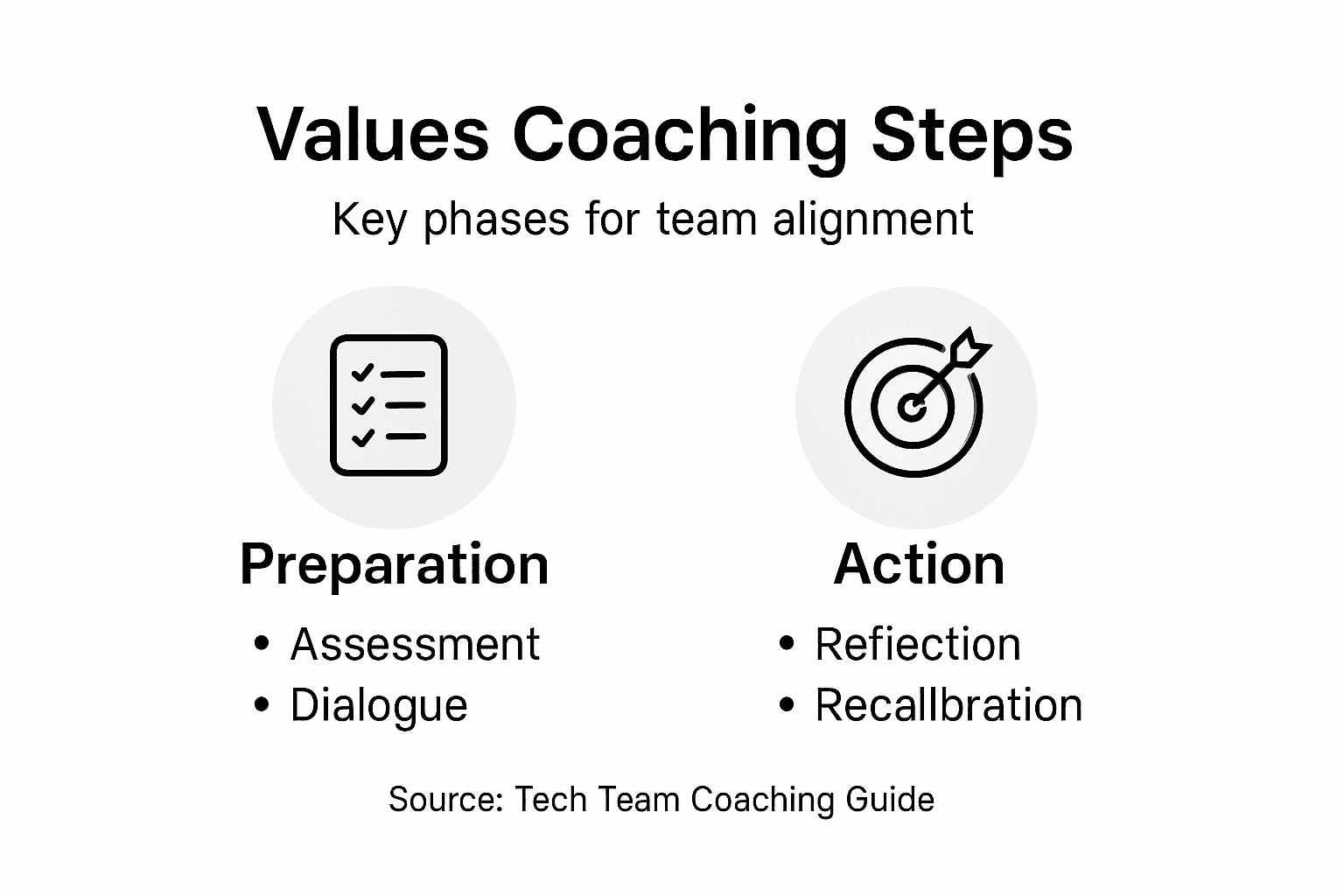
Values coaching follows a structured methodology designed to help individuals and teams align their personal and professional motivations. Values coaching theories emphasize the critical importance of understanding and integrating individual and organizational values to drive meaningful behavioral change and performance improvement.
The essential steps in the values coaching process include:
-
Initial Values Assessment
- Conduct comprehensive personal value mapping
- Identify core individual and organizational values
- Explore potential misalignments
-
Reflective Exploration
- Deep dive into value origins and impacts
- Understand how values shape current behaviors
- Challenge existing belief systems
-
Alignment Strategy Development
- Create targeted development goals
- Design interventions addressing value gaps
- Establish measurable behavioral outcomes
Reflective dialogue forms the cornerstone of effective values coaching, enabling participants to gain profound insights into their underlying motivations and potential areas for growth. The process requires coaches to create a psychologically safe environment that encourages honest self-examination and constructive personal development.
Successful values coaching transcends simple goal-setting by fostering deep personal transformation. By helping individuals understand the intrinsic connections between their values, behaviors, and professional performance, coaches can unlock unprecedented levels of personal and organizational potential.
Pro tip: Implement quarterly values reassessment sessions to ensure continuous alignment and adaptability in dynamic professional environments.
Risks, Limitations, and Common Mistakes
Values coaching, while powerful, is not without potential pitfalls and challenges. Coaching practice limitations reveal critical areas where coaches and organizations must exercise caution to prevent ineffective or potentially harmful interventions.
Common risks and limitations in values coaching include:
-
Organizational Resistance
- Entrenched cultural barriers
- Leadership skepticism
- Insufficient commitment to change
-
Coaching Process Vulnerabilities
- Superficial goal setting
- Lack of genuine self-reflection
- Potential reinforcement of existing power dynamics
-
Ethical and Professional Challenges
- Boundary violations
- Unclear coaching contracts
- Role confusion
- Potential manipulation of participant vulnerabilities
Boundary management represents a critical concern in values coaching. Coaches must maintain professional distance while creating a psychologically safe environment that encourages genuine exploration and transformation. The risk of imposing personal agendas or becoming overly directive can undermine the coaching relationship’s integrity and effectiveness.
Consider these common challenges and how to address them in values coaching initiatives:
| Challenge | Potential Impact | Practical Mitigation Strategy |
|---|---|---|
| Leadership skepticism | Slow adoption or pushback | Educate leaders on business benefits |
| Superficial goal setting | Lack of sustained change | Emphasize meaningful self-reflection |
| Boundary violations | Trust breakdown | Establish clear coaching contracts |
| Power dynamic issues | Reduced team openness | Foster neutral, inclusive coaching environments |
Successful values coaching demands continuous professional development, rigorous ethical standards, and a deep commitment to supporting participants’ authentic growth. Coaches must remain vigilant about potential blind spots, power dynamics, and the complex emotional landscapes they navigate.
Pro tip: Implement regular supervision and peer review processes to identify potential coaching practice limitations and maintain high ethical standards.
Unlock Team Alignment and Drive Lasting Transformation with Expert Coaching
Struggling to align your tech team’s core values with organizational goals can stall innovation and collaboration. This article highlights critical challenges like recognizing individual motivations, developing shared value systems, and overcoming cultural barriers. At Tariq Juneja, we understand how essential values coaching is for creating high-performing teams able to adapt and excel. Our tailored Agile Coaching Archives – Tariq Juneja and Change Management Archives – Tariq Juneja provide proven strategies to bridge these gaps effectively.
Take the first step to unlock your team’s full potential today by exploring how transformational values coaching can realign your team’s energy and objectives. Visit Tariq Juneja to book a free consultation and access resources crafted to boost alignment, increase productivity, and foster meaningful change.
Frequently Asked Questions
What is values coaching for tech teams?
Values coaching for tech teams is a strategic approach designed to align individual motivations and team dynamics with organizational objectives, enhancing performance and collaboration.
How does values coaching differ from traditional coaching methods?
Values coaching focuses specifically on understanding and operationalizing core professional values, whereas traditional coaching methods may emphasize performance metrics and skill development without addressing underlying values.
What are the main benefits of values coaching in organizations?
The main benefits include improved team alignment, enhanced emotional intelligence, better communication, and a shared value system, which collectively drive innovation and high performance in tech environments.
What steps are involved in the values coaching process?
The values coaching process typically involves an initial values assessment, reflective exploration of values, and alignment strategy development to create targeted goals and establish outcomes for personal and team growth.