

Tight deadlines and shifting priorities can leave even experienced IT teams in leading global tech firms feeling drained and disconnected. For mid-level managers, the challenge is not just meeting targets but fostering sustainable productivity and lowering stress. Through agile coaching, organizations gain structured guidance that builds stronger team dynamics, nurtures trust, and empowers individuals to surpass previous limits. This overview highlights how personalized coaching strategies and agile principles work together to drive measurable progress while reducing day-to-day pressures.
Table of Contents
- Defining Unlocking Potential Coaching Methods
- Key Distinctions In Agile Coaching Approaches
- Core Elements That Foster Team Productivity
- Real-World Applications In Tech Environments
- Common Pitfalls And Success Strategies
Key Takeaways
| Point | Details |
|---|---|
| Focus on Personalization | Unlocking potential coaching emphasizes personalized strategies to enhance individual capabilities and emotional intelligence. |
| Agile Coaching Requires Flexibility | Successful agile coaching integrates both technical skills and psychological understanding to foster team dynamics and adaptability. |
| Prioritize Psychological Safety | Establishing an environment of psychological safety is crucial for allowing team members to share ideas and innovate without fear. |
| Beware of Common Pitfalls | Effective coaching must address systemic barriers to change rather than just adopting superficial agile practices. |
Defining Unlocking Potential Coaching Methods
Unlocking potential coaching represents a sophisticated strategy for transforming individual and team performance through personalized, strategic guidance. At its core, this approach focuses on identifying latent capabilities and developing targeted interventions that enable professionals to transcend existing limitations. Targeted coaching interventions are designed to enhance emotional intelligence, social skills, and professional capabilities.
Effective coaching methods typically involve comprehensive assessment frameworks that map an individual’s current skill landscape and potential growth trajectories. These approaches integrate psychological insights, performance metrics, and personalized development strategies. Research indicates that successful coaching programs often require sustained engagement – specifically, at least 12 hours of interaction over a 4-week period, preferably facilitated by professional coaches with deep expertise in organizational development.
Key components of unlocking potential coaching include goal setting, self-awareness cultivation, skill gap identification, and continuous feedback mechanisms. Coaches work closely with individuals to design actionable strategies that translate insights into measurable performance improvements. This might involve techniques such as reflective questioning, scenario planning, skill-building exercises, and structured mentorship designed to progressively expand an individual’s professional capabilities.
Pro tip: Create a personalized development roadmap with specific, measurable milestones that track your progression and maintain accountability throughout the coaching journey.
Key Distinctions in Agile Coaching Approaches
Agile coaching represents a nuanced discipline that goes far beyond traditional management approaches, focusing on transforming organizational culture and team dynamics. Systematic mapping studies reveal that agile coaching encompasses multiple interconnected stances including mentoring, teaching, facilitating, and direct coaching, each serving a unique purpose in driving organizational agility.
The core distinctions between different agile coaching approaches lie in their specific methodological focuses and intervention strategies. While some coaches concentrate on practical skill development, others prioritize cultural transformation and systemic change. Key responsibilities typically include guiding teams through adoption challenges, resolving organizational resistance, and implementing adaptive frameworks that enable continuous improvement. Professional agile coaches must demonstrate exceptional skills in leadership, communication, technical understanding, and change management to effectively navigate complex organizational landscapes.
Successful agile coaching requires a multidimensional approach that integrates technical expertise with deep psychological understanding. Coaches must be adept at recognizing individual and team dynamics, designing customized interventions, and creating environments that support collaborative learning. This involves utilizing techniques such as reflective questioning, scenario planning, skill-building workshops, and structured feedback mechanisms to progressively enhance team capabilities and organizational resilience.
Pro tip: Develop a flexible coaching toolkit that allows you to seamlessly transition between different coaching stances based on specific team needs and organizational contexts.
Here’s a comparison of unlocking potential coaching and agile coaching approaches:
| Aspect | Unlocking Potential Coaching | Agile Coaching Approaches |
|---|---|---|
| Primary Focus | Individual growth and capability | Team dynamics and agility |
| Key Techniques | Reflective questioning, mentorship | Facilitation, teaching, mentoring |
| Measurement | Personal milestones, skill mapping | Continuous improvement metrics |
| Typical Duration | At least 12 hours over 4 weeks | Ongoing, often project-based |
Core Elements That Foster Team Productivity
Team productivity is a complex ecosystem of interconnected dynamics that require strategic alignment and intentional cultivation. Agile teamwork effectiveness hinges on critical coordinating mechanisms such as shared mental models, robust communication channels, and deep mutual trust that enable teams to transcend traditional performance boundaries.

Key elements driving team productivity include developing a strong foundation of psychological safety, establishing clear performance expectations, and creating meaningful work contexts. These components work synergistically to unlock team potential. Shared leadership emerges as a crucial factor, where team members collectively take responsibility for outcomes, distribute decision-making power, and support each other’s professional growth. High-performing teams demonstrate exceptional adaptability, maintain open peer feedback loops, and cultivate redundant skill sets that allow seamless collaboration during complex projects.
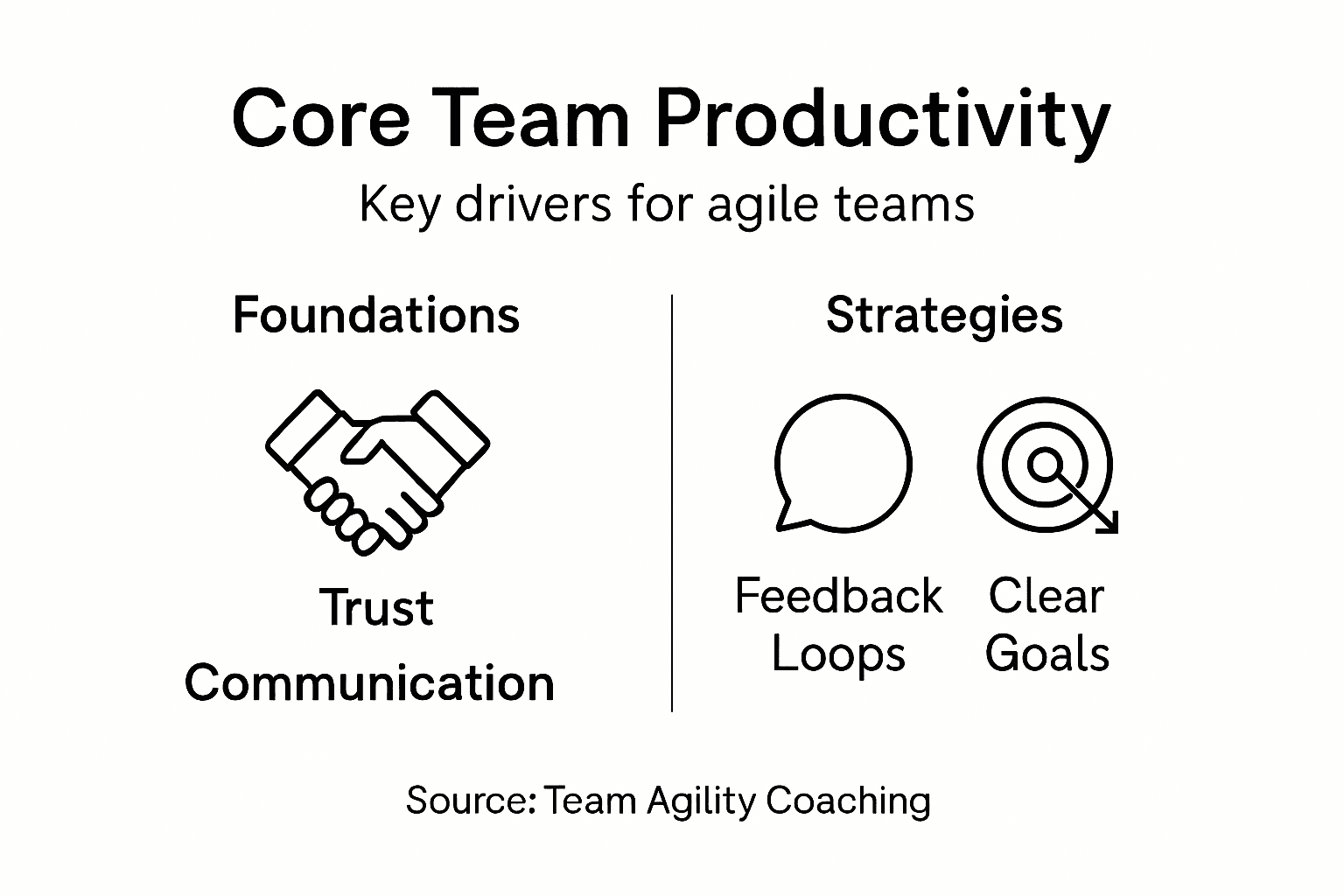
Successful teams intentionally design communication protocols and collaborative frameworks that maximize individual strengths while maintaining collective alignment. This involves creating transparent goal-setting processes, developing structured yet flexible workflow mechanisms, and fostering an environment that encourages innovation and calculated risk-taking. Team members must feel empowered to contribute ideas, challenge existing approaches, and continuously learn from both successes and setbacks.
Pro tip: Create monthly retrospective sessions where team members can openly discuss performance challenges, celebrate wins, and collaboratively design improvement strategies.
The following table summarizes strategies for sustaining high team productivity:
| Productivity Driver | Implementation Strategy | Expected Impact |
|---|---|---|
| Psychological Safety | Foster openness and idea sharing | Boosts innovation and trust |
| Shared Leadership | Rotate decision-making responsibilities | Increases adaptability |
| Feedback Mechanisms | Schedule peer review and retrospectives | Supports continuous learning |
| Skill Redundancy | Cross-train for critical roles | Ensures project resilience |
Real-World Applications in Tech Environments
Tech organizations are increasingly leveraging agile coaching to drive transformational change and enhance team performance. Real-world agile success stories demonstrate how strategic coaching interventions can fundamentally reshape organizational capabilities, accelerate product delivery, and foster innovation across complex technological ecosystems.
Specific case studies reveal nuanced applications of agile coaching in diverse tech environments. Large technology companies like Microsoft have successfully implemented coaching strategies that restructure team dynamics, empower collaborative decision-making, and create more responsive organizational structures. These interventions typically involve comprehensive approaches that go beyond traditional management techniques, focusing on developing adaptive team capabilities, enhancing communication protocols, and creating environments that support continuous learning and rapid innovation.
Effective agile coaching in tech environments requires a multifaceted approach that addresses both technical and human elements of organizational performance. Coaches work to align team objectives with broader strategic goals, develop individual and collective capabilities, and create robust feedback mechanisms that enable continuous improvement. This involves designing customized intervention strategies that recognize the unique challenges of technology-driven organizations, such as rapid technological changes, complex project requirements, and the need for constant skill adaptation.
Pro tip: Implement quarterly skills mapping sessions to identify individual team member strengths and create targeted development pathways that align with organizational growth objectives.
Common Pitfalls and Success Strategies
Unlocking potential coaching requires a nuanced understanding of the complex challenges that can derail organizational transformation efforts. Agile transformation pitfalls reveal that many organizations stumble by treating agile methodologies as a universal solution without considering their unique contextual requirements. Successful coaching demands a sophisticated approach that goes beyond generic implementation strategies.
Critical pitfalls often emerge from fundamental misunderstandings about organizational change. Many teams fall into traps such as superficial adoption of agile practices, insufficient training, and lack of genuine leadership commitment. These challenges manifest through resistance to cultural shifts, inadequate communication channels, and a failure to develop the underlying mindset necessary for true agility. Effective coaching requires deep diagnostic skills to identify these systemic barriers and design targeted interventions that address root causes rather than surface-level symptoms.
Successful coaching strategies involve creating comprehensive transformation roadmaps that blend technical skill development with cultural adaptation. This means developing customized approaches that recognize each organization’s unique dynamics, implementing robust training programs, and establishing continuous feedback mechanisms. Coaches must work closely with leadership to model agile behaviors, create psychological safety for experimentation, and build adaptive capabilities that extend beyond temporary process improvements.
Pro tip: Conduct periodic organizational agility assessments that measure both technical implementation and cultural readiness, using insights to fine-tune coaching interventions.
Unlock Your Team’s True Agility with Expert Coaching
Are you facing challenges in unlocking hidden potential within your team or struggling to drive lasting agility in your organization The article highlighted key pain points such as overcoming resistance to change building psychological safety and creating continuous feedback loops that foster growth These are common hurdles that can slow down transformation efforts and stall productivity improvements
At Tariq Juneja, we specialize in helping professionals and organizations overcome these exact challenges through proven agile coaching methods and transformational change strategies With a focus on developing personalized roadmaps and fostering shared leadership we empower teams to boost adaptability and sustain performance improvements Discover practical approaches to drive real results by exploring our Agile Coaching Archives – Tariq Juneja and learn how targeted coaching interventions can create measurable milestones and lasting impact
Take the first step to unlock your team’s full potential and accelerate transformation outcomes Visit https://tariqjuneja.com today to book your free consultation and access valuable resources that will guide your journey toward sustained agility and success
Frequently Asked Questions
What is unlocking potential coaching?
Unlocking potential coaching is a tailored approach focused on enhancing individual and team performance by identifying hidden capabilities and developing targeted strategies for professional growth.
How does agile coaching differ from traditional coaching approaches?
Agile coaching emphasizes team dynamics and cultural transformation, utilizing a variety of techniques such as mentoring and facilitating to drive organizational agility, unlike traditional coaching which often focuses solely on individual performance.
What are the key elements that drive team productivity?
Key elements include psychological safety, shared leadership, continuous feedback mechanisms, and skill redundancy among team members, all contributing to improved collaboration and innovation.
How can organizations avoid common pitfalls in agile transformations?
Organizations can avoid pitfalls by understanding their specific contextual needs, implementing robust training programs, fostering genuine leadership commitment, and continuously assessing their agility readiness to fine-tune coaching efforts.
Recommended
- Coaching for Leaders: Driving Agile Transformation – Tariq Juneja
- Coaching Mindset Explained: Driving Change in Tech Teams – Tariq Juneja
- Coaching Pitfalls Explained: Prevent Team Failure – Tariq Juneja
- Why Hire a Business Coach: Unlocking Agile Success – Tariq Juneja
- Role of Coaching in Organisations – Enhancing Workplace Wellbeing
- INUSUAL | Qué es liderazgo ágil y cómo transforma equipos