

Risk assessment sounds like a dry checklist for compliance. But more than 30 percent of organizations with strong risk processes are actually far more likely to finish complex projects successfully. That number might seem small until you realize it can be the difference between project failure and millions in operational losses.
Table of Contents
- Defining Risk Assessment: What It Is And Its Purpose
- The Importance Of Risk Assessment In Business And It
- Key Components Of The Risk Assessment Process
- How Risk Assessment Works: Methodologies And Techniques
- Real-World Applications Of Risk Assessment In Telecommunications
Quick Summary
| Takeaway | Explanation |
|---|---|
| Risk assessment identifies potential threats. | It systematically recognizes and documents risks that may impact objectives within various contexts. |
| Effective risk assessment enhances decision-making. | By analyzing risks, organizations can make informed choices and allocate resources effectively to overcome challenges. |
| Robust frameworks improve organizational performance. | Companies with mature risk management processes can reduce financial losses and enhance adaptability by 25%. |
| Risk assessment supports cybersecurity efforts. | It helps identify data breaches and infrastructure vulnerabilities, ensuring protection against evolving technological threats. |
| Continuous monitoring is essential for resilience. | Regular evaluation of risks allows organizations to remain flexible and responsive to changes in their environment. |
Defining Risk Assessment: What It Is and Its Purpose
Risk assessment represents a systematic process of identifying, analyzing, and evaluating potential threats or uncertainties that could negatively impact an organization, project, or individual’s objectives. By understanding what is risk assessment, professionals across various industries can proactively manage potential challenges and develop strategic mitigation strategies.
To help readers quickly grasp the components of risk assessment, here is a table summarizing the core elements and their purposes in the process.
| Component | Description | Purpose |
|---|---|---|
| Identification | Recognizing and documenting potential risks | Ensures awareness of all relevant threats |
| Analysis | Evaluating likelihood and potential impact of identified risks | Determines which risks need to be prioritized |
| Evaluation | Assessing significance and prioritizing response strategies | Supports strategic decision making for mitigation |
Core Components of Risk Assessment
At its fundamental level, risk assessment encompasses three primary elements that work together to create a comprehensive understanding of potential vulnerabilities. These elements include:
- Identification: Recognizing and documenting potential risks that might emerge in a specific context or environment
- Analysis: Evaluating the likelihood and potential impact of identified risks
- Evaluation: Determining the significance of risks and prioritizing response strategies
Professionals utilize this structured approach to transform abstract potential challenges into measurable and manageable components. According to the National Institute of Standards and Technology (NIST), risk assessment provides organizations with a strategic framework for understanding complex potential threats.
Purpose and Strategic Significance
The primary purpose of risk assessment extends beyond mere problem detection. It serves as a critical strategic tool that enables organizations and individuals to:
- Anticipate potential obstacles before they materialize
- Allocate resources more effectively
- Make informed decision making based on comprehensive risk understanding
- Develop proactive prevention and mitigation strategies
Risk assessment is not about eliminating all risks but about understanding them sufficiently to make intelligent choices. Research from the Project Management Institute indicates that organizations with robust risk assessment processes are 30% more likely to successfully complete complex projects.
By transforming uncertainty into a structured evaluation process, risk assessment empowers professionals to navigate complex environments with greater confidence and strategic insight. Whether applied in business, technology, healthcare, or personal planning, this systematic approach provides a powerful framework for understanding and managing potential challenges.
The Importance of Risk Assessment in Business and IT
Risk assessment plays a pivotal role in modern business and technology environments, serving as a critical mechanism for organizational resilience and strategic planning. By systematically understanding potential threats and vulnerabilities, companies can develop proactive strategies that protect their assets, reputation, and long term sustainability.
Strategic Impact on Business Performance
In the complex landscape of business operations, risk assessment provides organizations with a strategic advantage. Companies that implement comprehensive risk management frameworks can significantly reduce potential financial losses and operational disruptions. According to research from McKinsey & Company, organizations with mature risk assessment processes can improve their overall performance by up to 25%.
The strategic benefits of effective risk assessment include:
- Identifying potential financial vulnerabilities before they escalate
- Creating robust contingency planning mechanisms
- Enhancing decision making through comprehensive threat analysis
- Improving organizational adaptability and responsiveness
Technology and Cybersecurity Implications
In the digital era, risk assessment becomes even more critical for IT environments. Explore our guide on test cases and automation strategies to understand how systematic evaluation can enhance technological resilience. Cybersecurity threats continue to evolve rapidly, making risk assessment an essential defensive strategy.
Technology organizations must consider multiple dimensions of risk, including:
- Potential data breach scenarios
- Infrastructure vulnerabilities
- Emerging technological threats
- Compliance and regulatory risks
Risk assessment in IT is not just about prevention but about creating adaptive and intelligent technological ecosystems. By continuously monitoring and analyzing potential risks, organizations can develop more robust, secure, and responsive technological infrastructures that can withstand complex challenges.
Key Components of the Risk Assessment Process
The risk assessment process is a structured methodology that enables organizations to systematically identify, analyze, and manage potential risks. By breaking down this complex procedure into discrete, manageable components, professionals can create comprehensive strategies for mitigating potential threats and vulnerabilities.
Risk Identification Stage
Risk identification represents the foundational phase of the entire assessment process. During this critical initial stage, organizations meticulously examine their operational environment to uncover potential risks across various domains. According to the International Organization for Standardization (ISO), this stage involves systematic exploration of potential sources of risk through structured techniques.
Effective risk identification typically involves:
- Comprehensive documentation of potential risk sources
- Engagement with stakeholders across different organizational levels
- Review of historical data and previous risk incidents
- Utilization of specialized risk identification tools and frameworks
Risk Analysis and Evaluation
Once risks are identified, the next crucial component involves detailed analysis and evaluation. This stage transforms abstract potential threats into measurable and quantifiable insights. Professionals employ various analytical techniques to determine the potential impact and likelihood of identified risks.
Key considerations during risk analysis include:
- Calculating potential financial implications
- Assessing probability of risk occurrence
- Determining potential severity of identified risks
- Ranking risks based on their strategic significance
Risk evaluation goes beyond simple numerical calculations, requiring nuanced understanding of organizational context and strategic objectives. By developing a comprehensive perspective, organizations can prioritize their risk mitigation efforts more effectively.
The risk assessment process represents a dynamic and iterative approach to organizational resilience. Through systematic identification, thorough analysis, and strategic evaluation, professionals can transform uncertainty into actionable intelligence, enabling more informed and proactive decision making.
How Risk Assessment Works: Methodologies and Techniques
Risk assessment methodologies provide structured frameworks that transform abstract potential threats into systematic, measurable evaluations. These approaches enable organizations to move beyond intuitive guesswork and develop precise, data driven strategies for managing uncertainties across various operational domains.
Qualitative and Quantitative Approaches
Organizations employ two primary risk assessment methodologies: qualitative and quantitative techniques. Each approach offers unique insights and complements the other in creating comprehensive risk understanding.
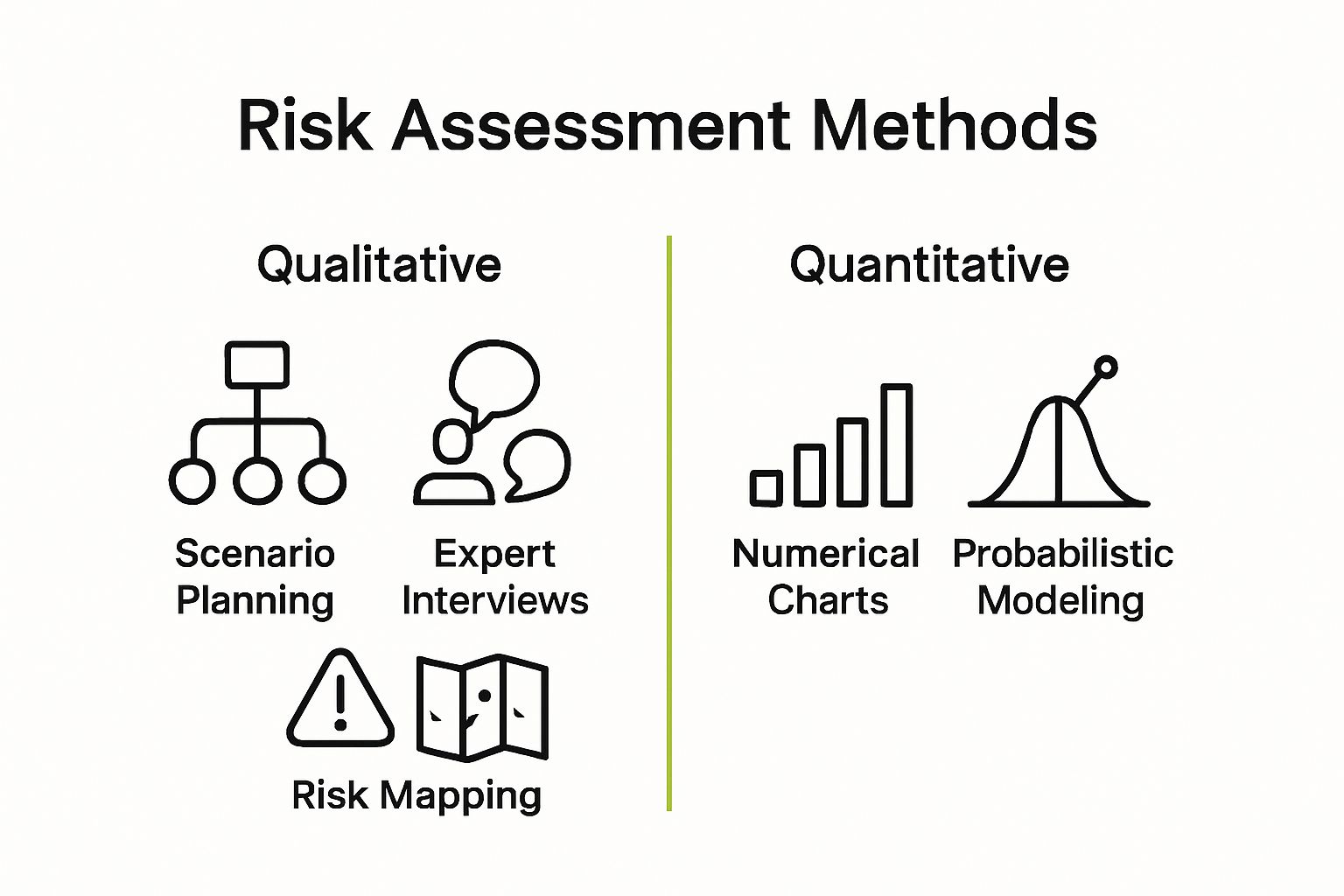 Qualitative methods focus on descriptive assessments, while quantitative techniques introduce numerical precision to risk evaluation.
Qualitative risk assessment techniques typically include:
Below is a table comparing the key features, methods, and outcomes of qualitative and quantitative risk assessment approaches to clarify their differences.
| Approach | Methods/Techniques | Nature of Data | Typical Outcomes |
|---|---|---|---|
| Qualitative | Scenario planning, expert interviews, risk mapping, stakeholder analysis | Descriptive, subjective | Nuanced risk understanding, visual representation, prioritization |
| Quantitative | Statistical analysis, probabilistic modeling, financial impact calculations | Numeric, objective | Measurable risk scores, probability estimates, cost quantification |
- Scenario planning and expert interviews
- Risk mapping and visual representation
- Stakeholder perception analysis
- Descriptive risk categorization
According to the National Institute of Standards and Technology (NIST), these methodologies help organizations develop nuanced understandings of potential risks beyond simple numerical calculations.
Advanced Risk Evaluation Frameworks
Modern risk assessment techniques leverage sophisticated frameworks that integrate multiple evaluation perspectives. These advanced approaches recognize that risk is not a static concept but a dynamic interplay of various organizational factors.
Key advanced risk evaluation strategies include:
- Probabilistic risk modeling
- Complex systems analysis
- Machine learning predictive risk assessment
- Integrated risk management platforms
Technological advancements have revolutionized risk assessment methodologies, enabling more precise, real time, and adaptive approaches to understanding potential organizational vulnerabilities. By combining human expertise with advanced computational techniques, professionals can develop more resilient and proactive risk management strategies.
Real-World Applications of Risk Assessment in Telecommunications
Telecommunications represents a complex technological ecosystem where risk assessment plays a critical role in maintaining network integrity, protecting customer data, and ensuring continuous service delivery. The dynamic nature of telecommunications infrastructure demands sophisticated and proactive risk management strategies that can adapt to rapidly evolving technological landscapes.
Network Security and Infrastructure Protection
Telecommunications companies face unprecedented challenges in maintaining robust network security. Risk assessment in this domain focuses on identifying and mitigating potential vulnerabilities that could compromise network performance, data integrity, and customer privacy. According to research from Deloitte, telecommunications organizations invest significantly in advanced risk assessment technologies to protect their critical infrastructure.
Key network security risk assessment strategies include:
- Continuous network vulnerability scanning
- Threat intelligence monitoring
- Advanced persistent threat detection
- Predictive security modeling
Regulatory Compliance and Data Protection
Telecommunications organizations operate within stringent regulatory frameworks that demand comprehensive risk assessment approaches. These frameworks require detailed documentation and proactive management of potential risks related to customer data, privacy, and network security.
Critical compliance risk assessment considerations encompass:
- Personal data protection protocols
- International data transfer regulations
- Cybersecurity standard adherence
- Incident response and reporting mechanisms
Risk assessment in telecommunications transcends technical considerations, representing a holistic approach to organizational resilience. By integrating advanced technological solutions with comprehensive strategic frameworks, telecommunications companies can develop adaptive and intelligent risk management ecosystems that protect both technological infrastructure and customer interests.

Ready to Transform Uncertainty into Opportunity?
If the complexity and unpredictability of risk assessment keeps you up at night, you’re not alone. Many leaders struggle to turn potential vulnerabilities into clear, confident action. Understanding and evaluating risk is only the beginning. Real change only happens when you turn those insights into strategic growth and resilience. This is exactly where Tariq Juneja’s coaching and consulting delivers value.

Discover how you can turn risk analysis into a powerful engine for transformation. Partner with Tariq to build a custom strategy that aligns with your unique business or personal goals. Explore our expert-led coaching programs to boost your confidence and build skills for sustainable change. Learn from real-world client success stories and take your first step toward a more resilient future right now. Visit https://tariqjuneja.com and book your free consultation today.
Frequently Asked Questions
What is risk assessment?
Risk assessment is a systematic process that involves identifying, analyzing, and evaluating potential threats or uncertainties that could negatively impact an organization or individual’s objectives.
Why is risk assessment important in business?
Risk assessment is important in business because it helps organizations anticipate potential obstacles, allocate resources effectively, enhance decision-making, and develop proactive strategies to mitigate risks, thereby improving overall performance.
What are the core components of the risk assessment process?
The core components of the risk assessment process include risk identification, risk analysis, and risk evaluation, each playing a crucial role in understanding and managing potential vulnerabilities.
How does risk assessment benefit cybersecurity in IT environments?
In IT environments, risk assessment benefits cybersecurity by identifying vulnerabilities, assessing potential data breach scenarios, and ensuring compliance with regulatory requirements, which collectively help in creating robust, secure technological infrastructures.