
Business owners are always searching for ways to get more done in less time. Turns out, research shows that structured time management coaching can dramatically increase organizational efficiency and personal performance. Most people think time management is just about making better to-do lists or working longer hours, but the real edge comes from rewiring how you approach every minute of your day.
Table of Contents
- What Is Time Management Coaching And Its Purpose?
- Why Time Management Coaching Matters For Business Success
- How Time Management Coaching Works: The Theoretical Framework
- Key Concepts Of Time Management Coaching Explained
- Practical Applications Of Time Management Coaching In Real Life
Quick Summary
| Takeaway | Explanation |
|---|---|
| Time management coaching enhances productivity. | Coaches help personalize strategies for effective time use tailored to individual goals and challenges. |
| Identify and prioritize crucial tasks. | Focus on activities that only the business owner can handle to maximize overall efficiency. |
| Leverage technology for greater efficiency. | Utilize project management software and analytics tools to streamline workflows and enhance productivity. |
| Develop sustainable productivity habits. | Establish routines and mental strategies to maintain focus and prevent burnout. |
| Create systems for accountability and improvement. | Implement performance tracking systems for ongoing assessment and adjustment to stay on track with goals. |
What is Time Management Coaching and Its Purpose?
Time management coaching represents a strategic professional service designed specifically for business owners seeking to optimize their productivity and efficiency. Unlike generic productivity advice, this specialized coaching focuses on creating personalized systems and strategies tailored to an individual entrepreneur’s unique workflow, challenges, and business objectives.
Defining Time Management Coaching
Time management coaching is a targeted professional intervention where an experienced coach works directly with business owners to analyze their current time utilization, identify bottlenecks, and develop customized strategies for enhanced productivity. According to research from Everett Community College’s Corporate & Continuing Education Center, effective time management for business owners involves three critical components:
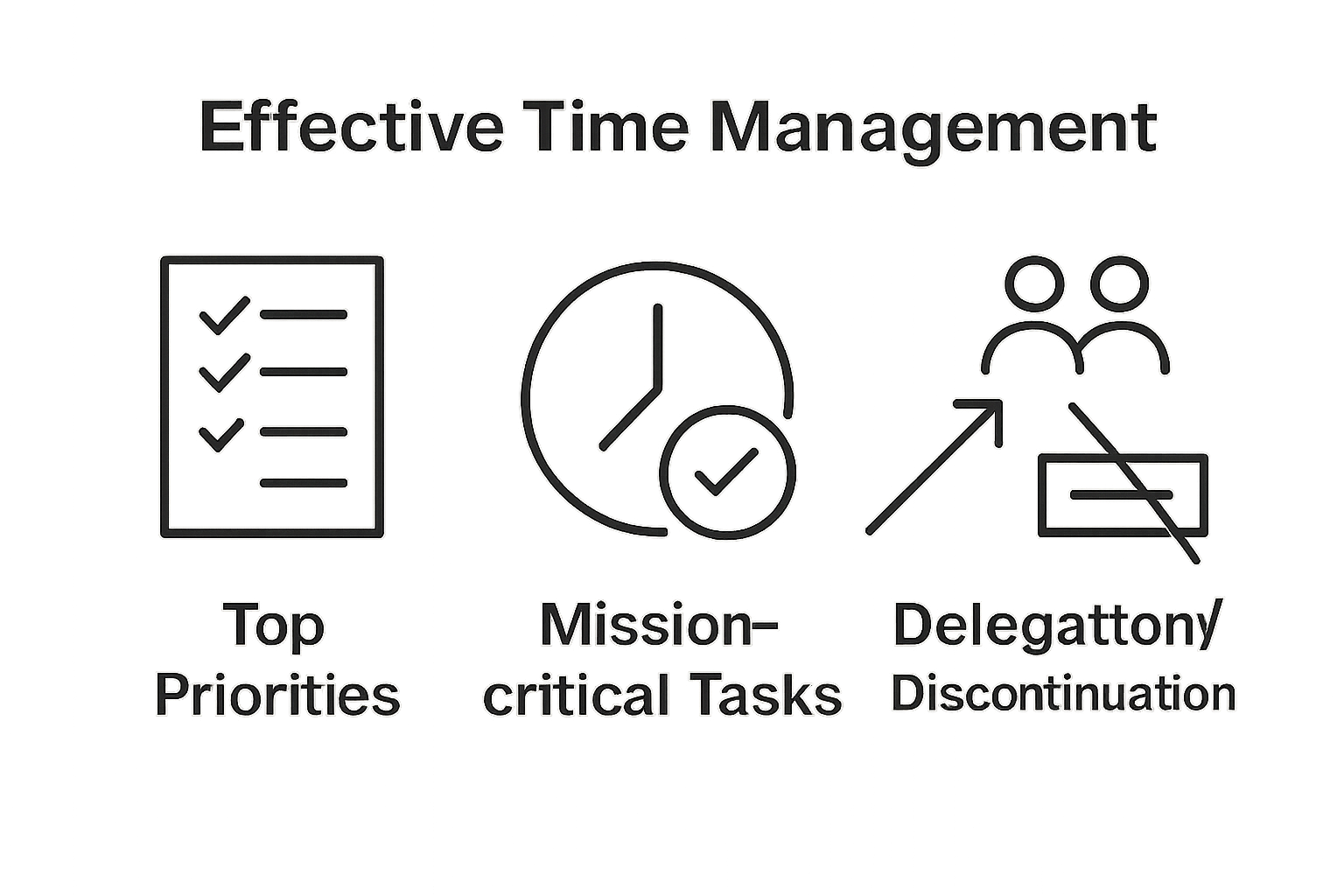
- Identifying top priorities that only the business owner can handle
- Allocating significant time and energy to mission-critical tasks
- Strategically delegating or discontinuing less essential activities
The Core Purpose of Time Management Coaching
The fundamental purpose of time management coaching extends beyond simply creating schedules. It aims to transform how business owners perceive, plan, and execute their professional responsibilities. Coaches help entrepreneurs develop a strategic approach to time that aligns with their business goals, personal strengths, and long-term vision.
Businesses benefit from time management coaching through improved operational efficiency, reduced stress, and more focused leadership.
The following table summarizes the core components of effective time management coaching and briefly describes each role within the coaching process.
| Core Component | Description |
|---|---|
| Identifying Top Priorities | Determining which tasks only the business owner can handle |
| Allocating Time to Key Tasks | Focusing energy and hours on mission-critical responsibilities |
| Delegating/Discontinuing Tasks | Assigning or stopping less essential activities to improve efficiency |
| Task Prioritization Systems | Creating structured methods to consistently rank tasks by importance |
| Sustainable Productivity Habits | Building long-lasting routines that maintain performance and well-being |
| Accountability Mechanisms | Setting up feedback systems to ensure steady progress and improvement |
- Recognize and eliminate time-wasting activities
- Create robust systems for task prioritization
- Develop sustainable productivity habits
- Balance professional responsibilities with personal well-being
Successful time management coaching empowers business owners to reclaim control over their schedules, make intentional choices about their time, and ultimately drive more meaningful business results. The process is not about working harder, but working smarter with a clear, strategic approach to daily operations and long-term planning.
Why Time Management Coaching Matters for Business Success
Time management coaching has emerged as a critical strategy for business owners seeking sustainable growth and competitive advantage. This specialized intervention goes far beyond traditional productivity techniques by addressing the complex psychological and strategic challenges entrepreneurs face in managing their professional lives.
The Economic Impact of Effective Time Management
Business success is intrinsically linked to how effectively leaders allocate and utilize their time. Research from the American Psychological Association demonstrates that strategic time management interventions significantly improve organizational efficiency and individual performance. By helping business owners optimize their workflow, time management coaching delivers tangible economic benefits:
- Reducing operational inefficiencies
- Minimizing time spent on non-strategic activities
- Increasing overall business productivity
- Lowering stress-related productivity losses
Psychological Foundations of Time Management Coaching
Successful time management is not merely about scheduling but understanding the psychological mechanisms that drive productivity. Time management coaching addresses underlying behavioral patterns that hinder professional performance. Coaches help business owners develop:
- Self-awareness about personal productivity cycles
- Emotional intelligence in managing work-related stress
- Cognitive strategies for maintaining focus
- Resilience against burnout and professional overwhelm
Strategic Advantages for Business Growth
Time management coaching provides business owners with a structured approach to scaling their enterprises. By creating systematic processes for task management, entrepreneurs can transition from being overwhelmed by daily operations to becoming strategic leaders. This approach enables business owners to:
- Invest more time in high-value strategic planning
- Develop robust systems for team management
- Create space for innovation and creative problem-solving
- Maintain a sustainable work-life balance
Ultimately, time management coaching is not a luxury but a strategic necessity for modern business owners. It represents an investment in personal and professional development that yields exponential returns through improved decision-making, increased productivity, and enhanced business performance.
How Time Management Coaching Works: The Theoretical Framework
Time management coaching operates on a sophisticated theoretical framework that integrates psychological, behavioral, and strategic principles to help business owners transform their approach to productivity and personal effectiveness. This approach goes beyond simple scheduling techniques, delving into the complex mechanisms of human performance and organizational behavior.
Conceptual Foundations of Time Management
According to the Collaborative for Teaching and Learning, time management is fundamentally about organizing and planning how to divide time between specific activities to enhance efficiency and reduce stress. The theoretical framework of time management coaching rests on several core principles:
- Understanding individual cognitive patterns
- Identifying personal productivity rhythms
- Developing strategic decision-making processes
- Creating adaptive time allocation strategies
Psychological Mechanisms of Coaching Intervention
Time management coaches employ a multidimensional approach that addresses the psychological barriers preventing effective time utilization. This involves exploring the underlying cognitive and emotional factors that influence how business owners perceive and manage their time. The coaching process typically involves:
- Diagnostic assessment of current time management practices
- Uncovering unconscious time-wasting behaviors
- Developing personalized productivity frameworks
- Building mental resilience and focus strategies
Strategic Decision-Making and Time Allocation
The coaching framework integrates advanced decision-making models that help business owners categorize and prioritize tasks based on strategic importance. By adopting a structured approach to time management, entrepreneurs can:
- Distinguish between urgent and important tasks
- Create hierarchical systems of task prioritization
- Develop proactive rather than reactive work strategies
- Implement systematic approaches to workflow management
Ultimately, the theoretical framework of time management coaching is about empowering business owners to become architects of their own productivity. It transforms time from a constraint into a strategic resource, enabling entrepreneurs to align their daily actions with their long-term business vision and personal goals.
Key Concepts of Time Management Coaching Explained
Time management coaching represents a sophisticated approach to professional development that goes beyond traditional productivity methods. It incorporates psychological insights, strategic planning, and personalized intervention to help business owners transform their approach to work and time utilization.
Core Psychological Foundations
According to the American Psychological Association, time management coaching is grounded in critical psychological principles that address how professionals perceive and interact with time. These foundational concepts include:
- Developing profound self-awareness about personal productivity patterns
- Understanding individual cognitive barriers to effective time management
- Recognizing emotional triggers that disrupt focused work
- Cultivating mental strategies for sustained concentration
Strategic Goal-Setting and Prioritization
Effective time management coaching centers on transforming how business owners conceptualize and approach their professional objectives. This involves creating robust frameworks for goal setting and task prioritization that align with broader business strategies. Coaches help entrepreneurs:
- Distinguish between urgent and truly important tasks
- Develop hierarchical systems of task management
- Create actionable and measurable performance indicators
- Design flexible yet structured workflow processes
Accountability and Performance Monitoring
The final critical concept in time management coaching involves establishing consistent accountability mechanisms. Unlike generic productivity advice, coaching provides a structured approach to tracking progress, identifying improvement areas, and maintaining momentum. Business owners learn to:
- Implement regular self-assessment techniques
- Create transparent performance tracking systems
- Develop adaptive strategies for continuous improvement
- Build resilience against productivity setbacks
Time management coaching is not about creating rigid schedules but developing a dynamic, personalized approach to professional effectiveness. By integrating psychological insights with strategic planning, business owners can transform their relationship with time, turning it from a constraint into a powerful tool for achieving their most ambitious business goals.

Practical Applications of Time Management Coaching in Real Life
Time management coaching transitions from theoretical concepts to tangible strategies that business owners can immediately implement in their professional lives. This practical approach transforms abstract principles into actionable techniques that drive meaningful productivity and business growth.
Workflow Optimization Strategies
According to Maryville University’s Effective Time Management Course, practical time management coaching focuses on creating personalized systems that match individual business needs. These strategies involve:
- Mapping current time allocation across business activities
- Identifying productivity bottlenecks and inefficient processes
- Developing customized task management frameworks
- Creating realistic, achievable performance benchmarks
Technology and Tools Integration
Modern time management coaching emphasizes strategic technology adoption to enhance productivity. Coaches help business owners leverage digital tools and platforms that streamline workflow, automate repetitive tasks, and provide real-time performance insights. This integration includes:
- Selecting appropriate project management software
- Implementing communication platforms that reduce time waste
- Using analytics tools to track productivity metrics
- Developing digital systems for task delegation and tracking
Personal Performance and Habit Formation
Beyond technological solutions, time management coaching addresses the psychological aspects of productivity. Coaches work closely with business owners to develop sustainable personal habits that support long-term professional success. This approach involves:
- Creating morning and evening routines that enhance focus
- Developing mental strategies for maintaining concentration
- Building resilience against procrastination and burnout
- Establishing healthy boundaries between work and personal life
Time management coaching bridges the gap between theoretical knowledge and practical implementation.
This table compares the three main practical applications of time management coaching, highlighting their distinct focus areas and primary outcomes for business owners.
| Application Area | Focus | Primary Benefit |
|---|---|---|
| Workflow Optimization Strategies | Mapping activities, identifying bottlenecks | Improved task efficiency and performance |
| Technology and Tools Integration | Leveraging digital tools for productivity | Streamlined processes, automated task tracking |
| Personal Performance and Habits | Building routines and mental strategies | Enhanced concentration, reduced burnout |
Take Control of Your Time and Lead With Confidence
Feeling overwhelmed by endless to-do lists and unfocused workdays? If you recognize bottlenecks, wasted hours, or burnout creeping into your business life, you are not alone. Many business owners struggle to turn productivity theories into real results, even after learning about personalized time management systems and accountability strategies. If you want to break free from these cycles and advance your leadership skills, our solutions can help. Explore practical resources in our Change Management category to see how shifting your mindset can transform your entire approach to business.

Ready to experience the benefits of time management coaching personalized for your business goals? Book your discovery session now and take the first step toward higher efficiency, reduced stress, and sustainable success. Let us help you move from information to action today.
Frequently Asked Questions
What is time management coaching?
Time management coaching is a specialized professional service that helps business owners optimize their productivity by creating personalized systems and strategies tailored to their unique workflows and challenges.
How does time management coaching benefit business owners?
Time management coaching enhances operational efficiency, reduces stress, and fosters focused leadership by helping entrepreneurs recognize time-wasting activities, prioritize tasks, and develop sustainable productivity habits.
What are the core components of effective time management coaching?
Effective time management coaching involves identifying top priorities, allocating significant time to mission-critical tasks, and strategically delegating or discontinuing less essential activities to optimize overall performance.
How can time management coaching improve a business’s economic impact?
By optimizing workflow and reducing operational inefficiencies, time management coaching can lead to increased productivity, minimizing time spent on non-strategic activities, and ultimately enhancing the economic performance of the business.
Recommended
- Change Management Archives – Tariq Juneja
- post 2 – Tariq Juneja
- A post – Tariq Juneja