

Business coaching has become a powerful tool for driving change in companies big and small. People often focus on the advice and goal setting, but that is just the start. The real surprise is that coaching can increase individual performance by as much as 35 percent, which opens a window to results many leaders never imagined possible. What actually makes this approach so effective lies in its blend of psychology, strategy, and personal growth that goes well beyond standard training.
Table of Contents
- Defining Coaching And Its Purpose In Business
- The Importance Of Coaching In Enhancing Productivity
- Key Theoretical Foundations Of Coaching And Performance
- Practical Applications Of Coaching In The Workplace
- Real-World Examples Of Coaching Impacting Productivity
Quick Summary
| Takeaway | Explanation |
|---|---|
| Business coaching enhances performance. | It helps individuals and organizations reach their full potential through personalized strategies. |
| Coaching focuses on goal clarity. | By establishing measurable objectives, coaching aligns personal development with organizational goals. |
| Effective coaching improves productivity significantly. | Research shows coaching interventions can increase individual performance by up to 35%. |
| Coaching creates ongoing skill development. | It establishes frameworks for continuous learning and self-reflection, leading to lasting improvements. |
| Tailored coaching addresses unique challenges. | Each coaching engagement is customized to the participant’s strengths and organizational context. |
Defining Coaching and Its Purpose in Business
Business coaching represents a strategic partnership designed to unlock professional potential and drive organizational performance. Our comprehensive guide on coaching for entrepreneurs reveals the transformative power of targeted professional development.
The Essence of Business Coaching
At its core, business coaching is a collaborative process where a trained professional works directly with business leaders, managers, and entrepreneurs to enhance their skills, clarify goals, and develop actionable strategies for success. Unlike traditional consulting, coaching focuses on drawing out existing capabilities rather than providing prescriptive solutions.
Key Characteristics of Effective Business Coaching
Successful business coaching encompasses several critical elements that distinguish it from other professional development approaches:
- Personalized Approach: Every coaching engagement is uniquely tailored to the individual’s specific challenges, strengths, and organizational context
- Performance-Oriented: The primary objective is measurable improvement in professional effectiveness and organizational outcomes
- Continuous Learning: Coaching establishes a framework for ongoing skill development and self-reflection
Research from Harvard Business Review indicates that effective coaching goes beyond simple advice giving. It involves deep listening, powerful questioning, and creating accountability frameworks that enable professionals to discover their own solutions.
The role of coaching in productivity extends far beyond traditional training models. By focusing on individual potential and systemic barriers, coaches help professionals develop more robust problem-solving skills, enhance emotional intelligence, and create sustainable performance improvements.
Professional coaches serve as strategic partners who facilitate personal and organizational transformation, helping leaders navigate complex challenges with greater clarity and confidence.
The Importance of Coaching in Enhancing Productivity
Coaching for productivity represents a sophisticated approach to professional development that directly impacts organizational performance and individual potential. Productivity is not merely about working harder but working smarter with strategic guidance and intentional skill development.
Psychological and Performance Foundations
Coaching addresses productivity challenges by understanding human motivation and cognitive barriers. Professional coaches help individuals identify unconscious patterns that limit performance, creating targeted interventions that unlock potential. Research from McKinsey demonstrates that effective coaching can improve individual performance by up to 35% through personalized development strategies.
Key Mechanisms of Productivity Enhancement
Professional coaching drives productivity through several critical mechanisms:
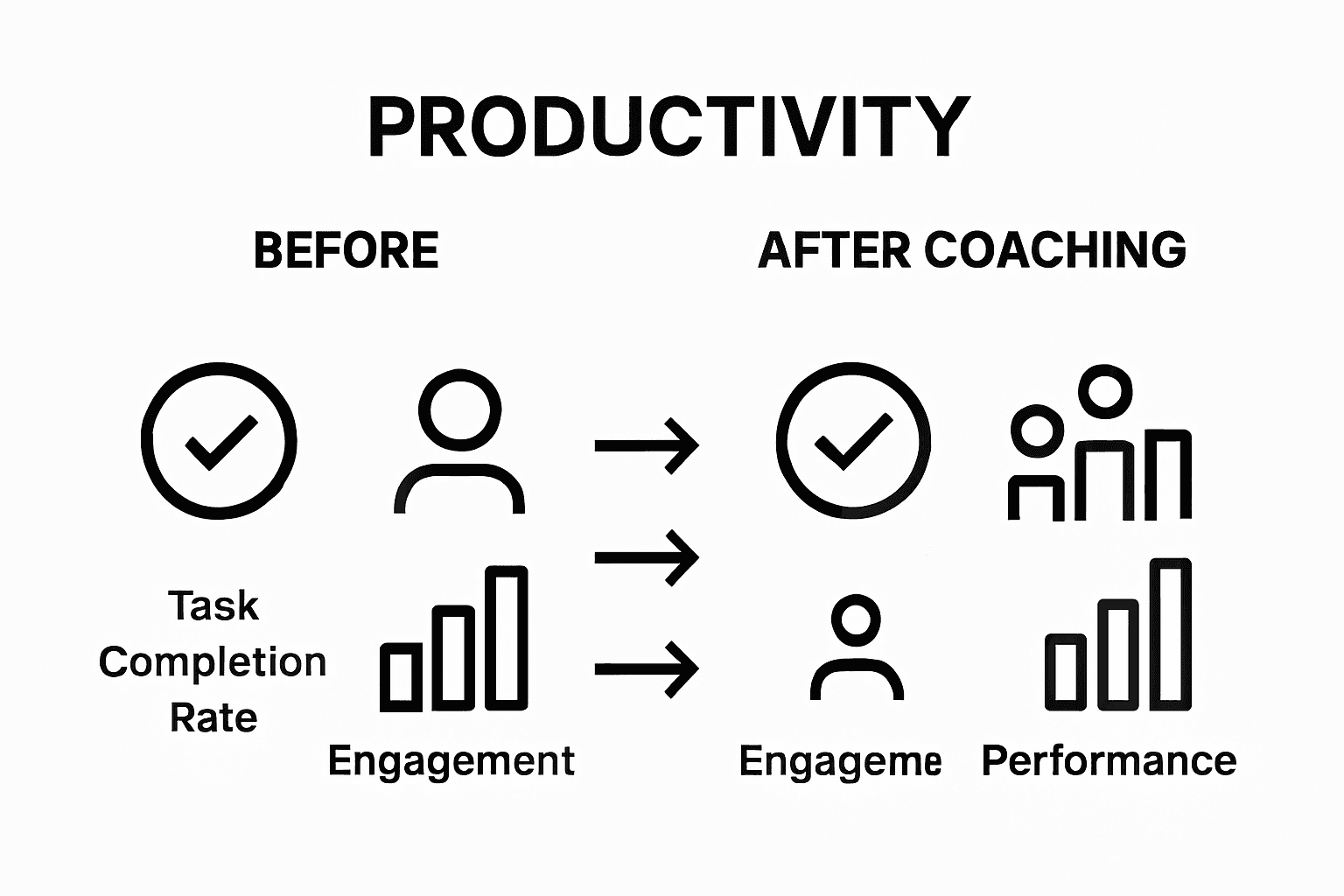
- Goal Clarity: Coaches help professionals establish precise, measurable objectives that align with broader organizational strategies
- Performance Monitoring: Regular accountability check-ins ensure consistent progress and timely course corrections
- Skill Development: Targeted skill enhancement focuses on removing specific performance bottlenecks
Moreover, coaching transcends traditional training by creating a holistic approach to professional growth. Coaches work closely with individuals to develop adaptive mindsets, emotional intelligence, and strategic thinking capabilities that directly translate into enhanced workplace performance.
By addressing both psychological and practical dimensions of productivity, coaching provides a comprehensive framework for sustainable professional development. The individualized nature of coaching means that interventions are precisely calibrated to each professional’s unique strengths, challenges, and potential.
Key Theoretical Foundations of Coaching and Performance
Understanding the coaching process overview reveals complex psychological and organizational dynamics that underpin professional development strategies. Theoretical foundations provide critical insights into how coaching transforms individual and collective performance.
Psychological Motivation Theories
Central to coaching effectiveness are motivational theories that explain human behavior and performance. Self-determination theory highlights three fundamental psychological needs: autonomy, competence, and relatedness. These needs drive intrinsic motivation and sustainable performance improvements. Research from the Journal of Applied Psychology demonstrates that coaching interventions addressing these core psychological needs can significantly enhance workplace engagement and productivity.
Performance Development Frameworks
Coaching integrates multiple theoretical perspectives to create comprehensive performance development strategies:
- Goal-Setting Theory: Establishes clear, specific, and challenging objectives that drive individual motivation
- Social Cognitive Theory: Emphasizes learning through observation, personal agency, and environmental interactions
- Experiential Learning Theory: Focuses on transformative learning through reflection and practical experience
These theoretical frameworks provide a robust understanding of how professional development occurs. They recognize that performance is not simply about acquiring skills but about creating holistic environments that support continuous growth and personal transformation.
The following table summarizes the key theoretical frameworks that underpin coaching and performance development, highlighting their core focus and role within business coaching.
| Theory | Core Focus | Role in Coaching |
|---|---|---|
| Goal-Setting Theory | Clear, specific, and challenging objectives | Drives motivation and sets precise outcomes |
| Social Cognitive Theory | Learning via observation and environment | Builds personal agency and adaptive strategies |
| Experiential Learning Theory | Learning through reflection and experience | Promotes transformational change via active engagement |
| Self-Determination Theory | Autonomy, competence, and relatedness | Enhances intrinsic motivation for sustainable results |
Moreover, coaching transcends traditional training by acknowledging the complex interplay between individual psychology, organizational culture, and performance dynamics. By understanding these theoretical foundations, coaches can design targeted interventions that address both conscious and unconscious barriers to professional excellence.
Practical Applications of Coaching in the Workplace
Coaching techniques explained transform abstract theoretical concepts into tangible workplace strategies that drive organizational performance. Successful coaching implementations require nuanced approaches tailored to specific professional contexts and individual developmental needs.
Strategic Performance Intervention Approaches
Workplace coaching encompasses multiple intervention strategies designed to address complex organizational challenges. Research from the International Coaching Psychology Review indicates that targeted coaching interventions can dramatically improve leadership effectiveness, team dynamics, and individual professional capabilities.
Core Workplace Coaching Applications
Professional coaches deploy various methodologies to enhance workplace performance:
- Leadership Development: Preparing emerging and existing leaders to navigate complex organizational challenges
- Performance Management: Creating personalized improvement strategies for individual and team productivity
- Change Management: Supporting professionals through organizational transitions and strategic transformations
These applications go beyond traditional training models by providing individualized, context-specific support. Coaches work closely with professionals to identify potential barriers, develop adaptive strategies, and create sustainable performance improvement frameworks.
This table organizes the main applications of coaching in the workplace, presenting the focus area and core benefit for each type of intervention mentioned in the article.
| Coaching Application | Area of Focus | Core Benefit |
|---|---|---|
| Leadership Development | Preparing leaders | Enhances strategic thinking and adaptive skills |
| Performance Management | Individual and team productivity | Creates actionable improvement strategies |
| Change Management | Navigating transitions | Supports adaptation during organizational change |
Moreover, workplace coaching recognizes that professional growth is a dynamic, continuous process. By offering personalized guidance, feedback, and strategic interventions, coaches help professionals develop resilience, emotional intelligence, and strategic thinking capabilities that extend far beyond immediate performance metrics.
Real-World Examples of Coaching Impacting Productivity
Understanding time management coaching provides concrete insights into how professional guidance transforms workplace performance across various industries and organizational contexts.
Organizational Performance Transformation
Research from Gallup demonstrates that strategic coaching interventions can produce remarkable productivity improvements. A global technology company implemented a comprehensive manager-led coaching program that resulted in a 12% increase in team productivity and significant reductions in employee turnover within a single year.
Sector-Specific Coaching Implementations
Different professional sectors showcase unique coaching applications that drive performance enhancement:
- Technology Sector: Accelerating innovation through leadership development and adaptive thinking strategies
- Healthcare Industry: Improving patient care quality by enhancing professional resilience and communication skills
- Financial Services: Developing strategic decision making and emotional intelligence among managers and executives
These real-world examples illustrate that coaching is not a generic intervention but a sophisticated, context-specific approach to professional development. By addressing individual psychological patterns and organizational dynamics, coaches create targeted strategies that unlock human potential.

Moreover, successful coaching implementations recognize that productivity is a complex interplay of personal motivation, skill development, and systemic organizational support. Coaches serve as strategic partners who help professionals navigate challenges, overcome performance barriers, and create sustainable pathways for continuous improvement.
Ready to Unlock Real Productivity with Expert Coaching?
Are you frustrated by stalled performance or unclear goals at work? If you found the theories and real-world examples in this article compelling, imagine the progress you could make with a tailored coaching solution. Whether you are struggling with complex team dynamics, ongoing change, or simply need a smarter way to develop your skills, our Agile Coaching insights connect powerful strategies with your specific needs.
Do not let uncertainty hold back your growth. Discover how a personalized coaching approach at Tariq Juneja can target your biggest productivity challenges. Book a discovery session now and see how focused coaching can transform your outcomes. Start today and experience measurable progress.
Frequently Asked Questions
What is the purpose of business coaching in productivity?
Business coaching aims to unlock professional potential, enhance individual skills, and drive organizational performance, ultimately leading to improved productivity.
How does coaching improve individual performance?
Coaching enhances individual performance by providing personalized development strategies that address psychological barriers and establish clear, measurable goals.
What are the key mechanisms through which coaching boosts productivity?
Coaching boosts productivity by establishing goal clarity, monitoring performance, and focusing on targeted skill development to remove bottlenecks in performance.
How does coaching differ from traditional training programs?
Unlike traditional training, coaching is a personalized, collaborative process that focuses on drawing out existing capabilities and creating accountability, rather than providing generic solutions.
Recommended
- Understanding Coaching for Productivity: Key Concepts Explained – Tariq Juneja
- Understanding the Coaching Process Overview for Growth – Tariq Juneja
- Understanding Time Management Coaching for Business Owners – Tariq Juneja
- Coaching Techniques Explained: Understanding Their Impact – Tariq Juneja
- Coachning på arbetsplatsen handlar om att stödja och utveckla anställda