

More than 50 percent of organizations report a surge in employee motivation when leaders embrace transformational leadership principles. This approach is changing the way teams interact, solve problems, and pursue ambitious goals. If you want to understand what sets truly inspiring leaders apart, you need a clear explanation of the foundational principles that make transformational leadership so effective and how they shape real-world results.
Table of Contents
- Defining Transformational Leadership Principles
- Core Attributes And Key Behaviors
- Major Types And Variations Explained
- Benefits And Real-World Impact
- Comparing Transformational With Other Styles
- Common Pitfalls And How To Avoid Them
Key Takeaways
| Point | Details |
|---|---|
| Transformational Leadership Principles | Emphasizes inspiring and motivating teams through idealized influence, inspirational motivation, intellectual stimulation, and individualized consideration. |
| Core Attributes and Behaviors | These leaders create an empowering environment that enhances commitment, performance, and fosters continuous learning. |
| Comparison with Other Leadership Styles | Distinctly different from transactional and laissez-faire styles, focusing on intrinsic motivation and personal growth. |
| Common Challenges | Leaders should be aware of potential pitfalls like over-idealization and emotional burnout to effectively implement transformational practices. |
Defining Transformational Leadership Principles
Transformational leadership represents a dynamic approach to organizational management where leaders drive profound change by inspiring and motivating their teams beyond traditional leadership paradigms. According to Wikipedia, this leadership style focuses on inspiring followers to achieve exceptional outcomes by aligning group goals with individual interests.
At its core, transformational leadership involves four critical principles that distinguish it from conventional management approaches:
- Idealized Influence: Leaders act as role models, demonstrating high ethical standards and building trust through personal credibility
- Inspirational Motivation: Creating a compelling shared vision that energizes and engages team members
- Intellectual Stimulation: Encouraging innovation, critical thinking, and challenging existing assumptions
- Individualized Consideration: Providing personalized support and mentorship tailored to each team member’s unique developmental needs
In practice, transformational leaders go beyond traditional transactional leadership models by focusing on long-term organizational growth and individual employee development. RHCLA highlights that these leaders actively foster a culture of continuous improvement, inspiring team members to transcend their current performance levels and embrace personal and professional growth. By creating an environment of psychological safety and mutual respect, transformational leaders unlock unprecedented potential within their teams.

Core Attributes and Key Behaviors
Transformational leadership is distinguished by a set of distinctive attributes and behaviors that fundamentally differentiate it from traditional leadership approaches. Wikipedia reveals that these leaders exhibit four critical behaviors that collectively enhance follower commitment, performance, and organizational loyalty through creating a supportive and empowering work environment.
These core behaviors can be systematically unpacked:
- Inspirational Motivation: Articulating a compelling vision that generates enthusiasm and collective purpose
- Idealized Influence: Establishing credibility through personal example and demonstrating ethical conduct
- Intellectual Stimulation: Challenging existing paradigms and encouraging innovative thinking
- Individualized Consideration: Recognizing and nurturing each team member’s unique potential and developmental trajectory
According to RHCLA, these attributes work synergistically to create an environment where team members feel genuinely valued and empowered. By prioritizing personal growth alongside organizational objectives, transformational leaders cultivate a dynamic ecosystem of continuous learning and mutual respect. This approach transcends traditional management techniques by focusing on holistic team development, where individual potential is seen as intrinsically linked to collective success.
Major Types and Variations Explained
Transformational leadership is not a monolithic concept, but a dynamic framework with multiple interpretational nuances. Wikipedia outlines a comprehensive leadership model that categorizes leadership styles into three distinct approaches: transformational, transactional, and laissez-faire leadership, each representing a unique approach to organizational management.
These leadership variations can be characterized as follows:
Here’s a comparison of major leadership styles discussed:
| Attribute | Transformational | Transactional | Laissez-Faire |
|---|---|---|---|
| Main Focus | Inspiring vision Personal growth |
Rewards and compliance Task management |
Minimal direction Maximum autonomy |
| Leader’s Role | Motivator and coach | Supervisor and evaluator | Passive overseer |
| Motivation Source | Intrinsic Shared vision |
Extrinsic Rewards |
Self-motivation |
| Employee Involvement | High Collaborative |
Moderate Directive |
Low Independent |
| Change Management | Embraces innovation | Maintains status quo | Rarely initiates change |
- Transformational Leadership: Focuses on inspiring and motivating followers through visionary guidance
- Transactional Leadership: Emphasizes structured tasks, clear expectations, and reward-based performance management
- Laissez-Faire Leadership: Represents a hands-off approach where leaders provide minimal direct intervention
According to James MacGregor Burns, who originally introduced these leadership concepts, transformational leadership distinguishes itself by aiming to elevate followers’ motivations and values. Unlike transactional leadership, which operates on an exchange-based model of rewards and compliance, transformational leadership seeks to inspire profound personal and organizational transformation.
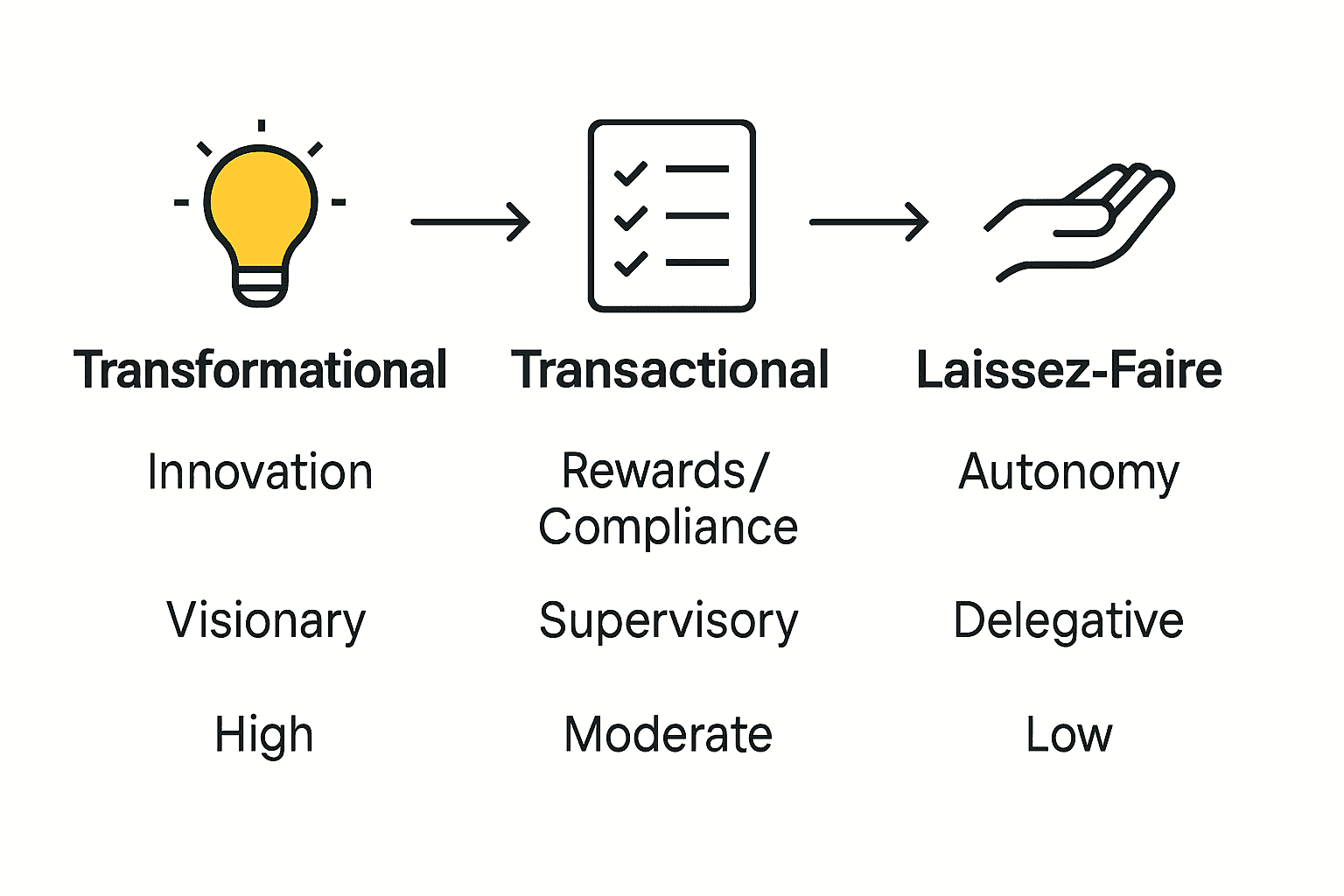 This approach goes beyond mere task completion, focusing instead on developing intrinsic motivation, fostering personal growth, and creating a shared vision that transcends immediate organizational objectives.
Benefits and Real-World Impact
Transformational leadership transcends traditional management approaches by delivering tangible, far-reaching benefits across diverse organizational contexts. Its impact extends well beyond simple performance metrics, fundamentally reshaping organizational culture and individual potential.
The real-world implications of transformational leadership are profound and multifaceted:
- Enhanced Team Performance: Dramatically improves collaboration and collective productivity
- Organizational Adaptability: Creates more flexible, innovative organizational structures
- Employee Engagement: Significantly increases intrinsic motivation and job satisfaction
- Cultural Transformation: Builds trust, respect, and a shared sense of purpose
RHCLA demonstrates that in higher education, this leadership approach directly contributes to improved student success, positive institutional change, and faculty development. Moreover, ArXiv research in the construction industry reveals that transformational leadership positively influences team processes, mediating meaningful changes in team dynamics and substantially improving project outcomes. By prioritizing human potential and creating psychologically safe environments, transformational leaders unlock unprecedented levels of individual and collective performance, bridging the gap between organizational objectives and personal growth.
Comparing Transformational With Other Styles
Leadership styles represent distinct approaches to guiding and motivating teams, each with unique characteristics and outcomes. Wikipedia outlines the Full Range Leadership Model, which provides a comprehensive framework for understanding these different approaches, highlighting the nuanced differences between transformational, transactional, and laissez-faire leadership styles.
Key distinctions between leadership approaches include:
- Transformational Leadership: Focuses on inspiring and elevating team members’ intrinsic motivations
- Transactional Leadership: Emphasizes structured exchanges, clear rewards, and compliance
- Laissez-Faire Leadership: Characterized by minimal intervention and maximum individual autonomy
According to James MacGregor Burns, the fundamental difference lies in motivation and approach. While transactional leadership operates on a straightforward exchange model of rewards and tasks, transformational leadership seeks to fundamentally transform followers’ perspectives, values, and potential. This approach goes beyond simple task completion, instead aiming to create a profound psychological and motivational shift that enables individuals to transcend their perceived limitations and contribute more meaningfully to organizational goals. By focusing on personal growth, shared vision, and intrinsic motivation, transformational leaders create an environment where team members are not just performing tasks, but actively engaged in continuous personal and collective development.
Common Pitfalls and How to Avoid Them
Transformational leadership, while powerful, is not without its challenges. Leaders must navigate complex interpersonal dynamics and organizational constraints to effectively implement this approach. ArXiv research highlights critical areas where transformational leadership can potentially falter, emphasizing the need for strategic self-awareness and continuous improvement.
Common pitfalls that leaders must proactively address include:
- Over-Idealization: Becoming too visionary without practical implementation strategies
- Emotional Burnout: Neglecting personal energy management while inspiring others
- Unbalanced Delegation: Failing to distribute responsibilities effectively
- Communication Gaps: Not maintaining transparent and consistent dialogue
ArXiv research in software management underscores that effective transformational leadership requires more than inspirational rhetoric. Successful leaders must prioritize clear communication channels, develop robust delegation practices, and create environments that balance individual autonomy with collective accountability. By recognizing potential vulnerabilities in their leadership approach, transformational leaders can develop adaptive strategies that mitigate risks, foster team resilience, and maintain the delicate balance between inspiring vision and pragmatic execution.
Unlock the Power of Transformational Leadership in Your Organization
Feeling overwhelmed by the challenge of inspiring real change while still managing day-to-day tasks Is your team lacking motivation or does innovation seem out of reach The article highlights key transformational leadership principles like inspirational motivation and individualized consideration that can elevate your team’s performance and boost engagement. But knowing these concepts is just the first step Transformational leadership requires a trusted guide to help turn vision into real impact.

Discover how expert coaching can help you avoid common pitfalls such as over-idealization and communication gaps while strengthening your ability to motivate and empower others. Visit Tariq Juneja’s consulting platform for actionable strategies in agile coaching and business transformation. Explore success stories and coaching programs designed to increase productivity and reduce stress. Take the first step toward building a culture that embraces change and unlocks the full potential of your team with professional transformational coaching. Start your journey today and schedule your free consultation now.
Frequently Asked Questions
What is transformational leadership?
Transformational leadership is a leadership style that focuses on inspiring and motivating team members to exceed their own interests for the greater good of the organization. It is characterized by four key principles: idealized influence, inspirational motivation, intellectual stimulation, and individualized consideration.
How does transformational leadership differ from transactional leadership?
Transformational leadership aims to elevate and inspire followers through vision and personal growth, while transactional leadership focuses on structured tasks, compliance, and rewards. The former seeks intrinsic motivation, whereas the latter relies on extrinsic incentives.
What are the benefits of transformational leadership in organizations?
Transformational leadership enhances team performance, increases employee engagement, fosters organizational adaptability, and contributes to cultural transformation. It promotes trust, collaboration, and a shared sense of purpose among team members, leading to overall positive outcomes.
What are common challenges in implementing transformational leadership?
Common challenges include over-idealization without practical strategies, emotional burnout from inspiring others, unbalanced delegation of responsibilities, and communication gaps. Leaders must proactively address these issues to maintain the effectiveness of their approach.
Recommended
- Business Transformation: Everything You Need to Know – Tariq Juneja
- What is Transformative Coaching? Understanding Its Impact – Tariq Juneja
- Personal Leadership Coaching: Everything You Need to Know – Tariq Juneja
- What is a Coaching Mindset? Understanding Its Impact – Tariq Juneja
- Tipos de liderazgo empresarial: comprensión y explicación | Itcons.app
- INUSUAL | Liderazgo Transformacional: La clave para liderar equipos