

Over 80 percent of American IT managers in multinational corporations report that poor time management is a leading source of team stress and missed deadlines. As global projects accelerate and demands multiply, mastering modern time management is no longer just a personal skill. This guide shows practical strategies and actionable concepts to help you create structured workflows, reduce chaos, and drive team productivity in any international setting.
Table of Contents
- Core Concepts of Time Management Today
- Essential Time Management Strategies for IT
- Tools and Techniques for Multinational Teams
- Common Pitfalls and How to Avoid Them
- Impact of Time Management on Productivity and Stress
Key Takeaways
| Point | Details |
|---|---|
| Core Components of Time Management | Master planning, goal-setting, prioritization, and task organization to boost productivity. |
| Adaptability in Approaches | Move beyond rigid schedules to flexible systems that cater to personal work styles and energy levels. |
| Importance of Prioritization | Use tools like the Eisenhower Matrix to distinguish urgent tasks from important ones. |
| Mental Well-Being | Effective time management reduces stress and enhances decision-making, improving overall workplace culture. |
Core Concepts of Time Management Today
Time management represents a strategic approach to optimizing personal and professional productivity in an increasingly complex global workplace. Contemporary research synthesizing time management practices reveals four fundamental components that professionals must master: planning, goal-setting, prioritization, and task organization.
The landscape of time management has dramatically evolved from traditional linear scheduling to more dynamic, adaptive frameworks that recognize individual work styles and organizational complexities. Successful professionals now understand that effective time management is not about rigid control, but about creating flexible systems that align with personal energy levels, project demands, and strategic objectives. This means developing personalized approaches that integrate technology, cognitive strategies, and continuous self-reflection.
At the core of modern time management are several key principles that transcend industry boundaries. Professionals must learn to distinguish between urgent and important tasks, create realistic timelines, minimize distractions, and develop robust systems for tracking progress. Equally critical is understanding one’s own productivity rhythms – recognizing peak performance periods, potential burnout triggers, and individual workflow preferences that maximize efficiency.
Pro Tip: Conduct a weekly time audit by tracking your activities in 30-minute increments to identify hidden productivity leaks and optimize your workflow strategically.
Here’s a summary of the four core time management components and their impact:
| Component | Purpose | Typical Benefit | Example Application |
|---|---|---|---|
| Planning | Mapping out actions | Clarity and foresight | Daily to-do lists |
| Goal-Setting | Defining objectives | Increased motivation | Quarterly project milestones |
| Prioritization | Ranking task importance | Efficient resource use | Using the Eisenhower Matrix |
| Task Organization | Structuring responsibilities | Reduced overwhelm | Digital Kanban boards |
Essential Time Management Strategies for IT
IT professionals operate in a dynamic environment that demands sophisticated time management approaches tailored to technological complexities. Advanced time management techniques specifically designed for technology roles provide critical strategies for navigating high-pressure project landscapes while maintaining peak performance and personal well-being.
Key strategies include implementing focused work methodologies that minimize distractions and maximize cognitive efficiency. The Pomodoro Technique emerges as a powerful tool, enabling IT specialists to break complex tasks into manageable 25-minute concentrated work intervals. By structuring work in these precise time blocks, professionals can maintain intense focus while preventing mental fatigue. Additionally, technologies like automated task management systems and intelligent scheduling tools can help IT managers streamline workflow, reducing administrative overhead and creating more space for strategic thinking.
Prioritization remains paramount in IT time management. The Eisenhower Matrix offers a robust framework for categorizing tasks based on urgency and importance, allowing IT professionals to allocate their cognitive resources strategically. This means distinguishing between critical system maintenance tasks, project development responsibilities, and routine administrative work. By creating clear hierarchies of tasks and establishing dedicated time blocks for different work categories, IT managers can transform potential chaos into structured, predictable productivity.

Pro Tip: Designate one day per week as a ‘No Meeting Day’ to create uninterrupted deep work time for complex technical projects and strategic planning.
Tools and Techniques for Multinational Teams
Multinational teams face unique challenges in synchronizing workflows across different geographic and cultural contexts. Advanced time management strategies for global collaboration emphasize the critical importance of leveraging digital tools and establishing clear communication protocols that transcend traditional organizational boundaries.
Digital collaboration platforms have become essential for managing complex, distributed team environments. Smart calendar systems with real-time synchronization capabilities allow teams to coordinate seamlessly across multiple time zones, reducing scheduling conflicts and improving overall communication efficiency. Tools like shared project management platforms enable transparent task tracking, allowing team members to understand project progress, individual responsibilities, and collective goals regardless of their physical location. These technologies not only facilitate communication but also create a unified workflow that supports both individual productivity and team cohesion.
Successful multinational team management requires more than technological solutions. Cultural intelligence plays a pivotal role in effective time management. Leaders must develop strategies that respect diverse work styles, communication preferences, and cultural approaches to time and productivity. This includes training programs that help team members understand different cultural perspectives, implementing flexible work protocols, and creating communication frameworks that accommodate varying working hours and communication norms. By combining technological tools with cultural sensitivity, organizations can transform potential challenges into opportunities for innovative, globally integrated teamwork.
Pro Tip: Implement a quarterly cross-cultural team communication workshop to build understanding and alignment across different global work environments.
Here’s a comparison of major time management tools for multinational teams:
| Tool Type | Key Functionality | Best for | Potential Weakness |
|---|---|---|---|
| Shared Calendars | Time zone coordination, availability | Scheduling across regions | May require manual updates |
| Project Platforms | Task tracking, progress visibility | Cross-functional transparency | Learning curve for new users |
| Messaging Apps | Instant communication, group chat | Fast problem-solving | Informal communication overload |
| Video Conferencing | Real-time discussion, remote meetings | Face-to-face collaboration | Scheduling across time zones |
Common Pitfalls and How to Avoid Them
Time management challenges can quickly derail team productivity and create cascading organizational problems. Critical insights into time management mistakes reveal systemic issues that undermine team performance, highlighting the importance of proactively identifying and addressing potential workflow disruptions before they escalate.
One of the most pervasive productivity traps is the illusion of multitasking, which fundamentally undermines cognitive performance and team effectiveness. Research consistently demonstrates that attempting to juggle multiple tasks simultaneously reduces overall output quality and increases individual stress levels. Instead, professionals should adopt focused work strategies that prioritize single-task concentration, create dedicated time blocks for specific responsibilities, and establish clear boundaries between different types of work. This approach not only improves individual performance but also creates a more predictable and manageable workflow for entire teams.
Beyond individual work habits, organizational structures and communication protocols play a significant role in time management effectiveness. Common pitfalls include unclear project priorities, inefficient meeting structures, and poor communication channels that create unnecessary complexity. Successful teams develop robust systems for task delegation, transparent progress tracking, and streamlined decision-making processes. This requires ongoing commitment to refining communication strategies, regularly reassessing team workflows, and creating environments that support focused, purposeful work while remaining adaptable to changing project demands.
Pro Tip: Conduct monthly workflow audits to systematically identify and eliminate inefficient processes that consume valuable team time and energy.
Impact of Time Management on Productivity and Stress
Time management represents more than a professional skill – it is a critical intervention for maintaining psychological well-being and organizational performance. Systematic research exploring the relationship between time management strategies and workplace outcomes reveals compelling evidence of its profound impact on both individual productivity and mental health.
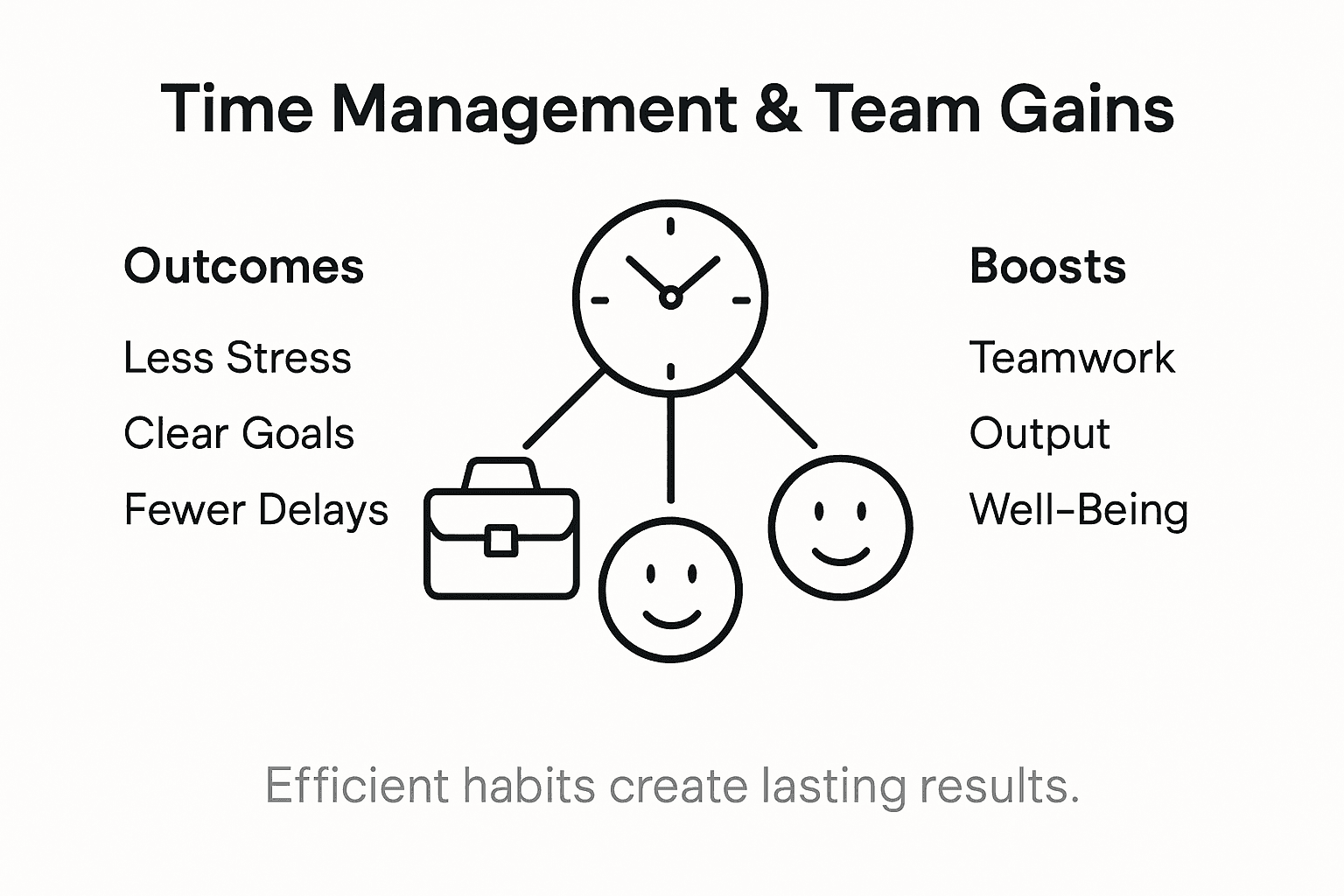
At the psychological level, effective time management acts as a powerful stress reduction mechanism. When professionals develop structured approaches to planning, prioritization, and task completion, they experience significantly reduced feelings of time pressure and cognitive overwhelm. This reduction in perceived stress directly translates to improved mental resilience, enhanced decision-making capabilities, and greater emotional regulation. The ability to control one’s workflow creates a sense of agency that counteracts the helplessness often associated with overwhelming workloads, thereby promoting a more balanced and sustainable approach to professional challenges.
Productivity gains from robust time management extend beyond individual performance to broader organizational outcomes. By implementing systematic planning techniques, goal-setting frameworks, and clear prioritization methods, teams can dramatically improve their collective output while simultaneously reducing individual stress levels. These strategies create predictable work environments where team members understand expectations, can allocate their cognitive resources more efficiently, and maintain higher levels of motivation. The cumulative effect is a workplace culture that values both performance and personal well-being, recognizing that sustainable productivity requires a holistic approach to managing professional demands.
Pro Tip: Implement a weekly 30-minute personal time audit to identify energy-draining activities and strategically reallocate your time and attention.
Unlock Global Team Potential With Expert Time Management Coaching
Struggling to boost productivity and reduce stress across your multinational team The challenges of managing priorities, cultural differences, and efficient workflows can feel overwhelming. This article highlighted how mastering planning, goal-setting, and prioritization directly impacts team success. If your team needs a tailored strategy to turn these challenges into strengths, our Agile Coaching Archives – Tariq Juneja provide proven frameworks that align with modern time management principles discussed here.
Take control of your team’s productivity and well-being now by partnering with a transformational coach who understands the complexities of global collaboration. Visit https://tariqjuneja.com to explore personalized coaching programs designed to embed effective time and change management. Join countless professionals who have regained focus and momentum through expert guidance available at Change Management Archives – Tariq Juneja. Don’t wait let your team thrive with actionable strategies starting today.
Frequently Asked Questions
How can I improve my team’s time management skills?
Implement flexible time management strategies that include planning, goal-setting, prioritization, and task organization. Encourage team members to adopt techniques like the Pomodoro Technique to maintain focus and minimize distractions.
What are some effective tools for managing time in multinational teams?
Digital collaboration platforms, smart calendar systems, project management tools, and messaging apps are essential for effective time management in multinational teams. They streamline communication and enhance task tracking across different geographic locations.
How does effective time management reduce stress for team members?
Effective time management provides structured approaches to planning and prioritization, leading to reduced feelings of time pressure and cognitive overwhelm. This creates a sense of control and agency, which in turn enhances mental resilience and emotional regulation.
What common pitfalls should teams avoid in time management?
Teams should avoid multitasking, unclear project priorities, inefficient meeting structures, and poor communication channels. Fostering single-task concentration and establishing transparent systems for tracking progress can significantly enhance productivity.