

Nearly 82 percent of people do not follow a dedicated time management strategy, which means most of us struggle to keep up with daily demands. Balancing multiple goals can quickly lead to stress and missed deadlines if you lack the right approach. Understanding the fundamentals of time management can help you use every minute more effectively, achieve meaningful progress, and reduce unnecessary pressure in both your personal and professional life.
Table of Contents
- Defining Time Management And Its Principles
- Types Of Time Management Techniques
- Key Benefits For Professionals And Teams
- Essential Tools And Technology Solutions
- Common Mistakes And How To Avoid Them
Key Takeaways
| Point | Details |
|---|---|
| Effective Time Management | Involves strategic planning, prioritizing tasks, and setting clear goals to enhance productivity and reduce stress. |
| Key Techniques | Techniques such as the Pomodoro Technique and Eisenhower Matrix help in optimizing time allocation and task prioritization. |
| Benefits for Professionals | Improves productivity, reduces stress, and fosters better work-life balance through structured approaches to task management. |
| Common Pitfalls | Professionals should avoid procrastination, multitasking, and lack of planning to maintain efficiency and effectiveness in their work. |
Defining Time Management And Its Principles
Time management is a strategic approach to organizing, planning, and controlling how you spend your time to maximize productivity and achieve personal and professional goals. According to Bowdoin, effective time management requires setting clear goals, prioritizing tasks, and allocating time appropriately to enhance productivity and reduce stress.
At its core, time management is about making conscious choices about how you invest your most limited resource: time. It involves understanding your priorities, recognizing potential time-wasters, and developing systematic strategies to optimize your daily activities. This means learning to distinguish between urgent tasks and truly important ones, and creating structures that help you focus on activities that align with your long-term objectives.
The fundamental principles of time management include:
- Goal Setting: Establishing clear, specific, and measurable objectives
- Prioritization: Identifying and focusing on high-impact tasks
- Planning: Creating structured schedules and action plans
- Self-Awareness: Understanding personal productivity patterns and energy cycles
- Adaptability: Remaining flexible while maintaining overall strategic direction
Successful time management is not about cramming more activities into your day, but about creating meaningful progress toward your most significant personal and professional goals. 7 Effective Time Management Practices for Success can provide deeper insights into implementing these principles effectively.
Types Of Time Management Techniques
Time management techniques are structured approaches designed to help individuals optimize their productivity and effectively allocate their limited time resources. According to Spica, several powerful techniques have emerged that can transform how professionals organize and execute their work, including the Pomodoro Technique, Eisenhower Matrix, and time blocking.
The Pomodoro Technique represents a popular method for maintaining focus and preventing burnout. This approach involves working in concentrated 25-minute intervals followed by short 5-minute breaks, helping individuals maintain high productivity while preventing mental fatigue. By breaking work into manageable segments, professionals can maintain consistent energy and concentration throughout their workday.

Other prominent time management techniques include:
- Eisenhower Matrix: Prioritizing tasks based on urgency and importance
- Time Blocking: Scheduling specific tasks during designated time slots
- ABC Method: Categorizing tasks by their critical nature and potential impact
- Two-Minute Rule: Immediately completing tasks that take less than two minutes
- Eat That Frog: Tackling the most challenging task first thing in the morning
7 Essential Time Management Techniques and Tools can provide additional insights into implementing these strategies effectively. As USA highlights, these methods are designed to enhance productivity by structuring work periods and helping professionals prioritize their most important activities.
Here’s a comparison of popular time management techniques and their key characteristics:
| Technique | Key Focus | How It Works |
|---|---|---|
| Pomodoro Technique | Sustained focus | 25-min work blocks 5-min breaks |
| Eisenhower Matrix | Task prioritization | Urgency/importance quadrant sorting |
| Time Blocking | Structured scheduling | Assign tasks to specific time slots |
| ABC Method | Task categorization | Rank tasks: A (crucial), B, or C |
| Two-Minute Rule | Quick wins | Instantly complete tasks under 2 minutes |
| Eat That Frog | Tackling hardest task | Do most challenging task at day’s start |
Key Benefits For Professionals And Teams
Time management is a critical skill that delivers transformative benefits for both individual professionals and collaborative team environments. According to Libguides, effective time management leads to increased productivity, reduced stress, and improved work quality across organizational settings.
For individual professionals, time management techniques unlock significant personal and career advantages. By implementing strategic planning and prioritization, professionals can dramatically enhance their performance, reduce workplace anxiety, and create a more balanced approach to work responsibilities. This includes gaining greater control over daily tasks, minimizing procrastination, and developing a more proactive approach to professional challenges.
Key benefits of effective time management include:
- Increased Productivity: Accomplishing more meaningful work in less time
- Reduced Workplace Stress: Better control over workload and expectations
- Improved Work Quality: More focused and deliberate task completion
- Enhanced Professional Reputation: Consistently meeting deadlines and commitments
- Better Work-Life Balance: Creating space for personal development and relaxation
Understanding the Role of Coaching in Productivity can provide additional insights into how professionals can leverage time management strategies to achieve peak performance. Teams that embrace these principles create a culture of efficiency, mutual respect, and continuous improvement, transforming potential chaos into structured, purposeful collaboration.
Essential Tools And Technology Solutions
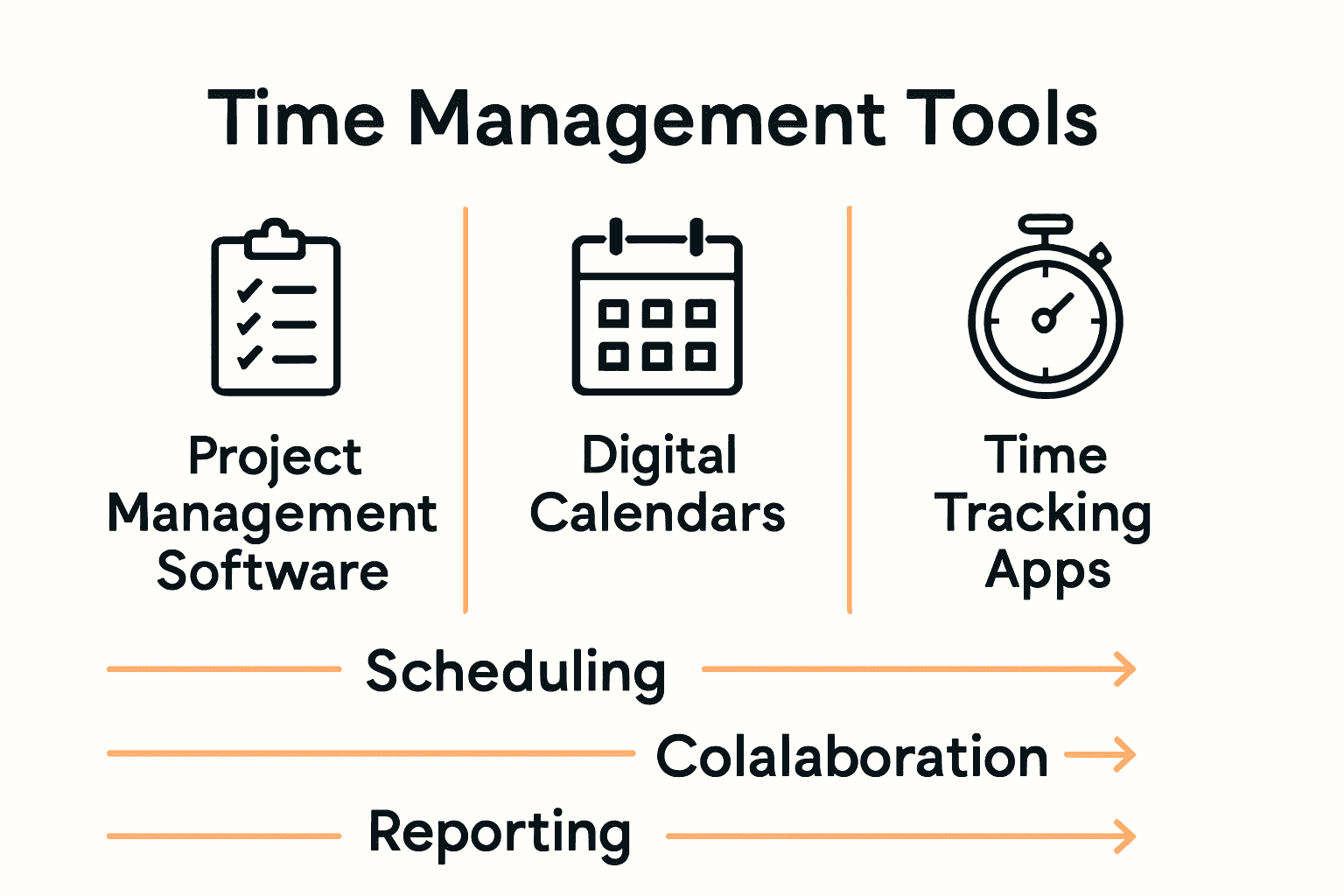
Modern technology has revolutionized time management by providing powerful digital solutions that help professionals organize, track, and optimize their workflow. According to Spica, various digital tools support time management, including digital calendars, task management apps, and time tracking software that aid in scheduling and monitoring tasks with unprecedented precision.
Digital productivity tools have transformed how professionals approach time management, offering sophisticated features that go beyond traditional planning methods. These technologies enable real-time collaboration, automated task tracking, and intelligent prioritization, allowing individuals and teams to maximize their efficiency and reduce administrative overhead. From cloud-based project management platforms to intelligent scheduling assistants, technology has made time management more accessible and data-driven.
Key technology solutions for effective time management include:
- Project Management Software: Comprehensive platforms for task allocation and tracking
- Digital Calendars: Integrated scheduling with automatic reminder systems
- Time Tracking Applications: Detailed insights into time spent on specific tasks
- Productivity Dashboards: Visual representations of work progress and efficiency
- Collaboration Tools: Real-time communication and task management platforms
7 Essential Tips for Your Time Management Checklist provides additional guidance on leveraging these technological solutions. As USA highlights, technology solutions like project management software, calendar applications, and productivity apps are crucial in helping professionals organize tasks and manage time effectively in an increasingly complex work environment.
Common Mistakes And How To Avoid Them
Time management is fraught with potential pitfalls that can derail even the most well-intentioned professionals. According to USA, procrastination, multitasking, and lack of planning are frequent time management errors that significantly impact productivity and personal effectiveness.
Multitasking is perhaps the most deceptive productivity trap. While it might seem efficient to juggle multiple tasks simultaneously, research consistently shows that divided attention reduces overall performance and increases the likelihood of errors. Professionals often mistakenly believe they can effectively handle several responsibilities at once, when in reality, our brains are designed to focus on one complex task at a time. This cognitive limitation means that multitasking actually decreases efficiency and increases stress.
Common time management mistakes to watch out for include:
- Procrastination: Delaying important tasks and creating unnecessary pressure
- Ineffective Prioritization: Failing to distinguish between urgent and important tasks
- Overcommitment: Taking on more responsibilities than can be realistically managed
- Perfectionism: Spending excessive time on minor details
- Lack of Boundaries: Allowing interruptions and non-essential activities to consume productive time
7 Essential Tips for Your Time Management Checklist offers practical strategies for overcoming these common challenges. The key to avoiding these mistakes lies in developing self-awareness, creating structured plans, and consistently focusing on one task at a time. By recognizing these potential pitfalls, professionals can develop more effective time management strategies that enhance both productivity and personal well-being.
Take Control of Your Time and Transform Your Life Today
Struggling with procrastination and feeling overwhelmed by endless tasks is a common challenge highlighted in the article. If you find yourself caught in the trap of ineffective prioritization or battling multitasking that drains your energy, you are not alone. The key to lasting change lies in applying proven strategies like goal setting, prioritization, and adaptable planning to unlock your productivity and reduce stress.

Experience transformational change guided by expert coaching tailored to your unique needs at Tariq Juneja’s coaching platform. Learn how to overcome common time management pitfalls and embrace techniques that ensure meaningful progress toward your goals. Start now by booking a free consultation and gain access to powerful resources that will help you build better habits and achieve work-life balance. Discover more about the 7 Essential Tips for Your Time Management Checklist and understand how coaching can boost your productivity in Understanding the Role of Coaching in Productivity. Your time is valuable. Take the first step to managing it effectively at https://tariqjuneja.com.
Frequently Asked Questions
What is time management?
Time management is a strategic approach to organizing, planning, and controlling how you spend your time to maximize productivity and achieve personal and professional goals. It involves setting clear goals, prioritizing tasks, and effectively allocating your time.
What are some effective time management techniques?
Some effective time management techniques include the Pomodoro Technique, Eisenhower Matrix, Time Blocking, ABC Method, Two-Minute Rule, and Eat That Frog. Each of these techniques focuses on different aspects of productivity and task prioritization.
How can technology help with time management?
Technology can significantly enhance time management through the use of digital tools such as project management software, digital calendars, time tracking applications, productivity dashboards, and collaboration tools. These solutions help organizations and professionals streamline their workflow and track time efficiently.
What are common mistakes in time management?
Common mistakes in time management include procrastination, ineffective prioritization, multitasking, overcommitment, perfectionism, and lack of boundaries. Recognizing and addressing these pitfalls can help improve productivity and efficiency.
Recommended
- 7 Essential Time Management Techniques and Tools – Tariq Juneja
- 7 Effective Time Management Practices for Success – Tariq Juneja
- Essential Executive Time Management Tips for Productivity – Tariq Juneja
- 7 Essential Tips for Your Time Management Checklist – Tariq Juneja
- The Best Time Management Tools for Students in 2025: Stay Organized and Stress Less