

Most executives spend nearly half their week on low-value tasks, leaving little time for real strategic decisions. Time slips away fast in leadership roles, yet your impact depends on how you spend every hour. Learning to focus on what matters most, delegate the right way, and use smart tools can completely shift your results. These time management strategies show how top CEOs turn daily chaos into meaningful progress and consistent wins.
Table of Contents
- Step 1: Identify Critical Priorities For Maximum Impact
- Step 2: Design Customized Schedules Aligned With Core Goals
- Step 3: Delegate Effectively To Empower Your Team
- Step 4: Implement Proven Tools To Automate Tasks
- Step 5: Review Results And Optimize Performance
Quick Summary
| Key Point | Explanation |
|---|---|
| 1. Focus on Critical Priorities | Use the Eisenhower Matrix to categorize tasks based on urgency and importance for effective prioritization. |
| 2. Personalize Your Schedule | Apply the Pareto Principle to identify and prioritize the 20% of tasks that will yield 80% of your results. |
| 3. Delegate Tasks Strategically | Use the Eisenhower Matrix to assign tasks according to team strengths, allowing for growth and focus on high-impact work. |
| 4. Automate Repetitive Tasks | Implement project management and calendar tools to streamline operations and reduce time spent on administrative tasks. |
| 5. Regularly Review Performance | Establish a monthly dashboard to track productivity and adjust strategies, ensuring continuous improvements in effectiveness. |
Step 1: Identify Critical Priorities for Maximum Impact
Successful CEOs understand that not all tasks are created equal. Your ability to identify and focus on critical priorities determines your organizational effectiveness and personal productivity. This section will teach you a strategic approach to zeroing in on what truly matters.
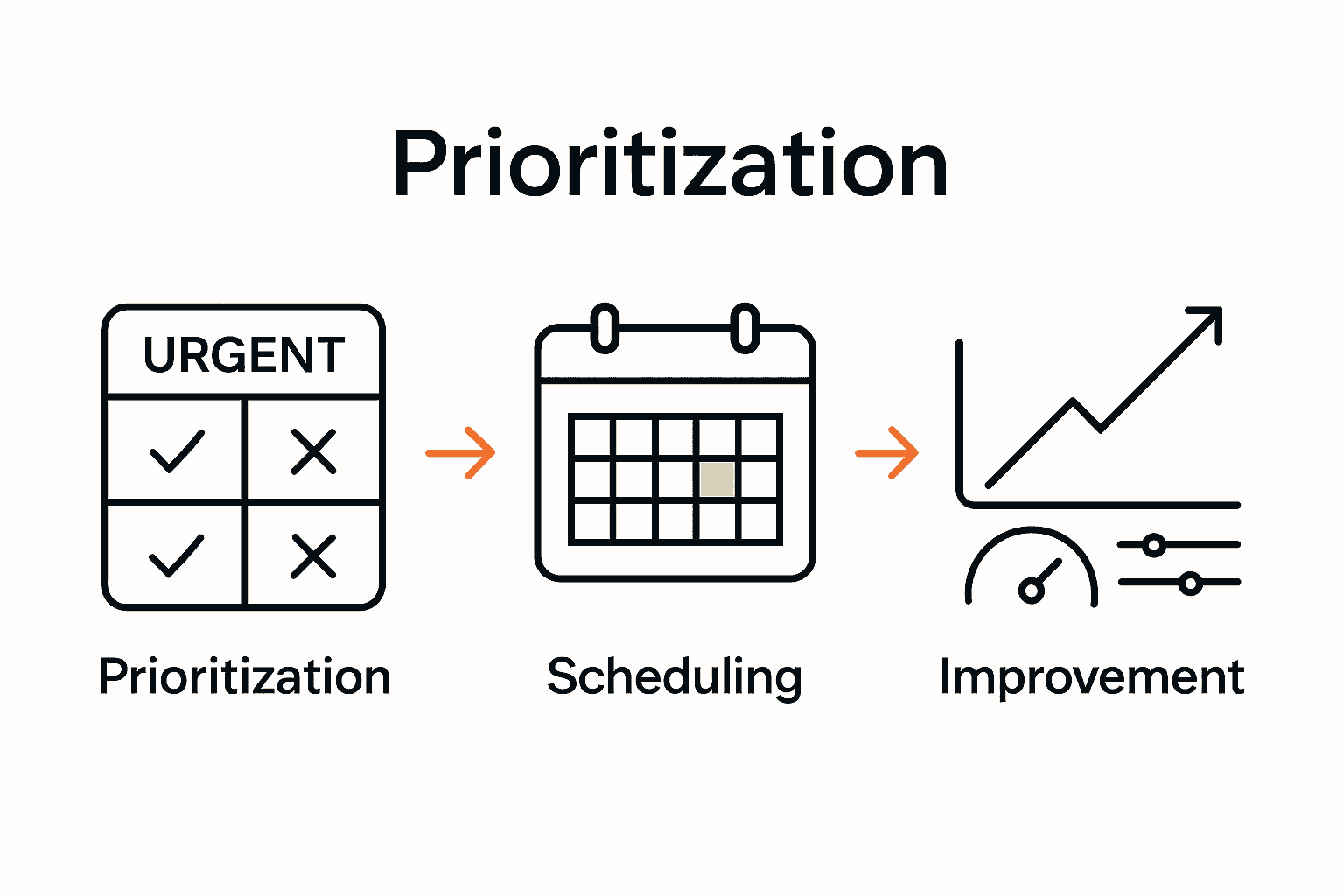
Start by conducting a comprehensive priority assessment using the Eisenhower Matrix method. This powerful technique helps you categorize tasks into four distinct quadrants: urgent and important, important but not urgent, urgent but not important, and neither urgent nor important. Draw a simple 2×2 grid and map out your current responsibilities. Tasks falling in the “urgent and important” quadrant demand your immediate attention these are mission critical activities directly tied to your organization strategic goals.
To refine your prioritization strategy, implement a scoring system that evaluates each potential task against three key criteria: strategic alignment, potential impact, and resource requirements. Assign numerical scores from 1 to 10 for each criterion. Tasks scoring high across all three dimensions become your primary focus. This methodical approach transforms priority setting from a subjective guessing game into a data driven decision making process.
Warning: Beware of the “busy work” trap. Many executives mistake activity for productivity. Just because a task feels urgent does not mean it deserves your personal attention. Learn to delegate effectively and reserve your energy for high leverage activities that generate meaningful organizational transformation.
For additional insights into executive time management, check out our guide on essential executive time management tips. Your next step is to create a strategic execution plan that transforms these identified priorities into actionable outcomes.
Step 2: Design Customized Schedules Aligned With Core Goals
Transforming your time management strategy requires creating a schedule that reflects your most critical organizational objectives. The key is developing a personalized planning approach that maximizes your productivity and strategic impact.
ZonaPlus recommends applying the Pareto Principle when designing your schedule. This means identifying the 20% of tasks that generate 80% of your organizational results and structuring your time around these high leverage activities. Start by blocking out dedicated time slots for your most important strategic initiatives. Use time blocking techniques where you allocate specific hours exclusively to mission critical work that drives meaningful organizational progress.
Create a tiered scheduling system that categorizes activities into three priority levels: strategic core work, operational necessities, and administrative tasks. Allocate your peak energy hours to strategic core work that directly impacts your companys long term objectives. Schedule operational tasks during your moderate energy periods and reserve administrative work for times when your mental bandwidth is lowest.
Warning: Rigidity kills productivity. While structure is essential, build flexibility into your schedule to accommodate unexpected challenges and emerging opportunities. Leave small buffer zones between major work blocks that allow you to adapt without completely derailing your planned workflow.
For more comprehensive goal setting strategies that complement this scheduling approach, explore our guide on setting goals for lasting success. Your next step is to implement and consistently refine this customized scheduling framework.
Step 3: Delegate Effectively to Empower Your Team
Mastering delegation is the hallmark of exceptional leadership. Your ability to distribute tasks strategically allows you to focus on high impact work while developing your teams potential and organizational capabilities.
Aaron Hall recommends using the Eisenhower Matrix as a strategic delegation framework. By categorizing tasks into urgent and important quadrants, you can systematically assign responsibilities that align with each team members strengths and developmental goals. Focus on delegating urgent but not important tasks to capable team members. This approach accomplishes two critical objectives: freeing up your strategic bandwidth and providing growth opportunities for your team.
Develop a robust delegation process that goes beyond simply assigning tasks. Create clear communication protocols that include detailed expectations, specific outcome metrics, and defined support mechanisms. When delegating, provide context about why the task matters and how it connects to broader organizational objectives. This approach transforms delegation from a transactional activity into a meaningful leadership development strategy.

Warning: Effective delegation is not abdication. Maintain accountability through regular check ins and progress reviews. Set up brief weekly touchpoints that allow you to monitor progress without micromanaging. These sessions should focus on coaching and supporting your teams success.
To further enhance your leadership capabilities, explore our guide to transformational leadership. Your next step is to implement a systematic delegation approach that empowers your team while maintaining strategic oversight.
Step 4: Implement Proven Tools to Automate Tasks
Automation is the secret weapon for modern executives seeking to maximize productivity and minimize manual administrative overhead. By strategically implementing the right technological tools, you can transform how your organization operates and reclaim countless hours of productivity.
Aaron Hall recommends leveraging project management platforms like Asana and Trello to streamline team collaboration and maintain strategic alignment. These tools allow you to create automated workflows that track project progress, assign responsibilities, and provide real time visibility into team performance. Simultaneously, integrate calendar management solutions such as Calendly to automatically handle meeting scheduling. This approach eliminates the time consuming back and forth of coordinating appointments and creates seamless communication channels.
Develop a comprehensive automation strategy that covers multiple operational domains. Start with communication tools that integrate email scheduling, task management, and communication platforms. Look for solutions that offer API integrations allowing different software systems to communicate and share data automatically. Prioritize tools that provide robust reporting features enabling you to track productivity metrics and identify potential optimization opportunities.
Warning: Automation is not about replacing human interaction but enhancing it. Select tools that complement your teams working style and provide intuitive user experiences. Over automation can lead to disconnection and reduced team engagement.
To expand your technical productivity toolkit, explore our guide on time management techniques and tools. Your next step is to systematically evaluate and implement automation solutions that align with your organizational objectives.
Step 5: Review Results and Optimize Performance
Performance optimization is an ongoing journey that requires consistent reflection, measurement, and strategic adjustment. Your ability to critically analyze your time management strategies will determine your long term success and organizational effectiveness.
Establish a comprehensive performance review framework that goes beyond surface level metrics. Create a monthly dashboard that tracks key productivity indicators such as task completion rates, strategic goal alignment, time spent on high impact activities, and team efficiency. Develop a scoring system that assigns weighted values to different performance dimensions. This approach transforms performance review from a subjective exercise into a data driven optimization process.
Implement a continuous improvement cycle that includes quarterly strategic reviews. During these sessions, conduct a thorough analysis of your time management strategies. Identify patterns of success and areas requiring modification. Look for bottlenecks in your workflow, examine where automation can be expanded, and assess how delegation strategies are performing. Create actionable improvement plans that address specific productivity gaps and leverage your teams strengths.
Warning: Avoid the trap of analysis paralysis. Performance optimization is about incremental progress not perfection. Set realistic improvement targets and celebrate small wins that demonstrate meaningful advancement in your productivity approach.
To further enhance your leadership development journey, explore our guide on setting goals for lasting success. Your next step is to turn these performance insights into strategic action plans that continuously elevate your organizational effectiveness.
Master Your Time and Lead with Purpose
Every CEO knows the pressure of juggling endless tasks while striving for real impact. This article’s insights on prioritizing critical goals, effective delegation, and smart automation highlight the challenge you face: how to break free from the “busy work” trap and focus your energies where they truly move the needle. Feeling overwhelmed and stretched too thin is common but avoidable when you adopt proven strategies that foster clarity and control.
If you are ready to transform your leadership with personalized time management and agile practices, dive deeper into Agile Coaching Archives – Tariq Juneja for expert approaches that align with your strategic priorities.

Take charge now by exploring how Tariq Juneja’s transformational coaching can help you cut through complexity, boost productivity, and empower your team. Visit https://tariqjuneja.com to discover tailored coaching programs, client success stories, and free resources designed to accelerate your CEO journey. Begin with practical tools and strategies featured in our Mind Mapping Archives – Tariq Juneja to organize your priorities and make confident decisions. Don’t wait to unlock your full leadership potential—start your transformation today.
Frequently Asked Questions
How can I use the Eisenhower Matrix to improve my time management as a CEO?
To improve your time management, start by mapping your tasks onto the Eisenhower Matrix to identify which are urgent and important. Focus your immediate attention on tasks that fall into the ‘urgent and important’ quadrant, ensuring alignment with your organization’s strategic goals.
What are effective techniques for designing a personalized schedule that enhances productivity for CEOs?
An effective technique is to apply the Pareto Principle, focusing on the 20% of tasks that yield 80% of your results. Structure your schedule to allocate dedicated time blocks for these high-impact tasks to maximize productivity.
How do I delegate tasks without losing control over project outcomes?
Delegate by categorizing tasks using the Eisenhower Matrix and assign them based on your team members’ strengths. Maintain accountability through regular check-ins, setting up brief progress reviews to guide and support without micromanaging.
What tools should I consider to automate my daily tasks effectively?
Consider using a project management tool to streamline collaboration and monitor progress. Start implementing automation in communication and scheduling tasks to save time, potentially cutting administrative overhead by up to 30%.
How can I track my productivity improvements over time?
Establish a monthly dashboard to monitor key productivity indicators such as task completion rates and time spent on essential activities. Regularly review your results to identify trends and set actionable improvement targets to optimize performance continuously.
What steps can I take to ensure my time management strategies remain effective?
Implement a continuous improvement cycle, involving quarterly reviews of your time management strategies. Identify areas for enhancement and celebrate progress, which helps reinforce positive changes in your productivity approach.