

Pressure builds quickly when your tech firm must balance growth, rapid market shifts, and organizational change. Strategic planning coaching offers more than a template—it becomes your anchor for making complex decisions, growing as a leader, and driving real transformation. Understanding the foundational principles of strategic planning coaching helps you cut through chaos, align teams, and manage both performance and stress as you guide your organization forward.
Table of Contents
- Defining Strategic Planning Coaching Principles
- Types of Strategic Planning Coaching Methods
- Integrating Agile Practices Into Strategic Coaching
- Strategic Planning Applications In Tech Firms
- Common Pitfalls And How To Avoid Them
Key Takeaways
| Point | Details |
|---|---|
| Strategic Planning Coaching Focus | This coaching emphasizes leadership development and organizational transformation tailored for tech executives, enabling them to execute strategies that yield measurable outcomes amidst complexity. |
| Agility in Strategy Development | Integrating agile practices allows for continuous feedback and adaptation, transforming strategy from a static plan into a dynamic framework that evolves with real-time insights. |
| Collaboration is Key | Involving technical leaders in the strategic planning process ensures alignment with on-ground realities, enhancing decision-making and organizational buy-in. |
| Mindset Shift Required | Leaders must transition from viewing strategy as fixed to seeing it as a hypothesis to test, fostering faster decision-making and resilience in adapting to market changes. |
Defining Strategic Planning Coaching Principles
Strategic planning coaching operates at the intersection of leadership development and organizational transformation. Unlike generic coaching models, strategic planning coaching specifically focuses on helping tech executives build and execute plans that drive measurable business outcomes while managing the internal complexity that comes with scaling teams, technologies, and organizational structures. This approach recognizes that mid-sized tech firms face unique pressures: rapid market changes, talent competition, and the constant need to balance innovation with operational efficiency. Understanding the core principles underlying this coaching model gives you a framework for making better strategic decisions and leading your organization through change more effectively.
At its foundation, strategic planning coaching rests on several interconnected principles that distinguish it from other leadership development approaches. Research on coaching culture effectiveness reveals that successful coaching integrates principles, evidence-based interventions, organizational context awareness, and clear evaluation metrics. For tech leaders specifically, this means your coaching engagement must address three critical dimensions:
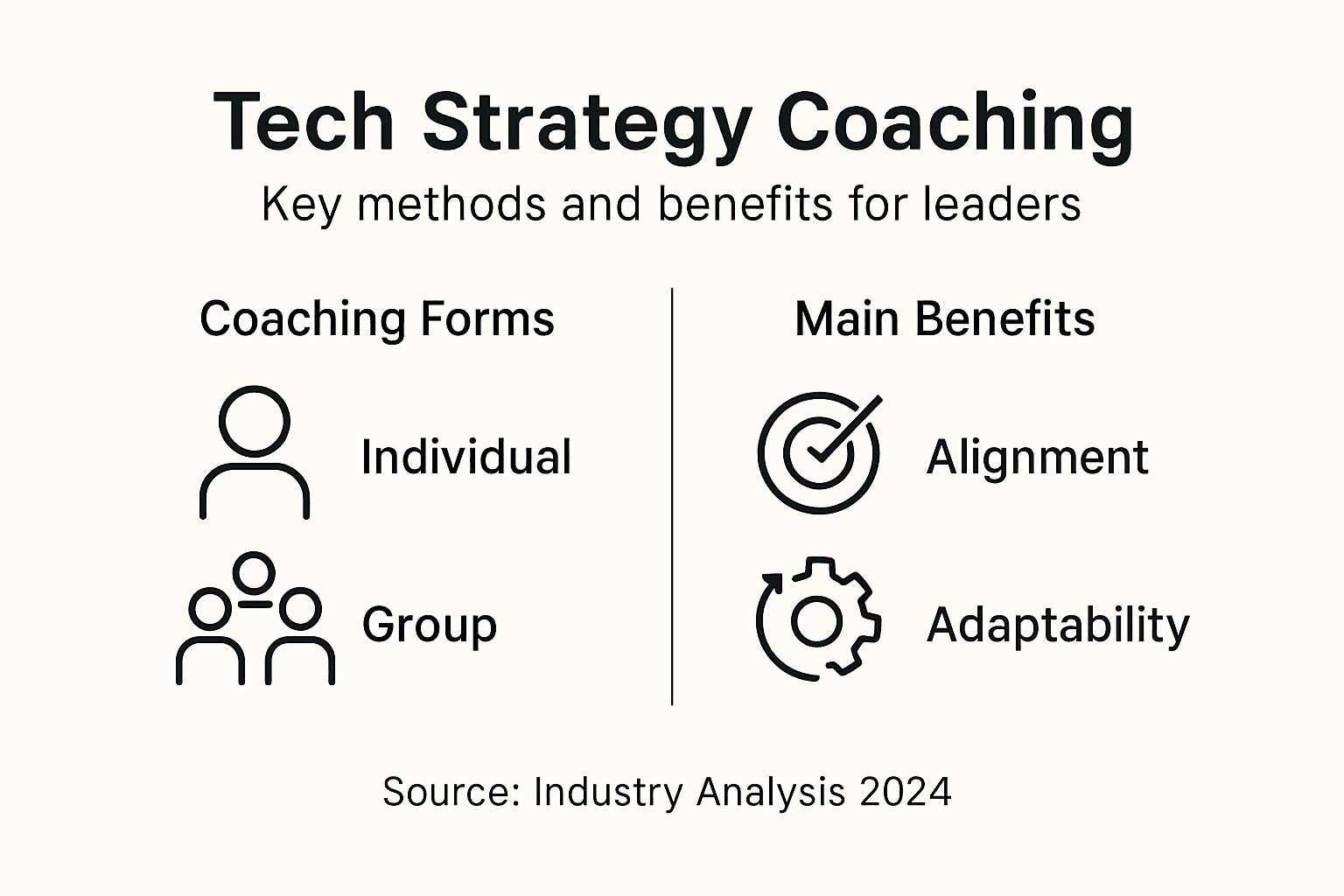
- Organizational alignment: Your strategic plans must connect directly to company values, mission, and capability. Coaching helps you identify gaps between where your organization is and where it needs to be, then builds realistic pathways between these positions.
- Individual leadership capacity: Strategic planning coaching develops your personal abilities in areas like systems thinking, stakeholder management, and decision-making under uncertainty. These skills become increasingly important as your organization grows and decisions become more complex.
- Adaptability as a core competency: Tech leaders operate in environments where yesterday’s strategy may be obsolete by next quarter. Executive coaching effectiveness studies emphasize that adaptability, evidence-based methods, and continuous alignment with evolving business goals are essential principles defining modern strategic coaching.
What makes this different from strategy consulting is the focus on your development as a leader, not just on generating a plan. A consultant delivers recommendations and moves on. A strategic planning coach works with you to strengthen the decision-making capabilities that let you adapt those recommendations to your specific context, make better choices about what to prioritize, and execute more effectively when unexpected obstacles appear. This distinction matters enormously in tech environments where execution speed and flexibility determine competitive advantage. Your coach becomes a thinking partner who helps you see blind spots in your reasoning, challenges assumptions that may no longer serve you, and holds you accountable to the strategic commitments you make.
The principles also emphasize the relationship between coach and executive as essential to effectiveness. When you’re working under intense pressure to deliver quarterly results while managing organizational change, the coaching relationship provides something you cannot get from your board, your investors, or your executive team: an independent, confidential space where you can think out loud, explore difficult decisions, and work through the stress and isolation that often accompanies senior leadership in tech. This psychological safety within the coaching relationship directly enables clearer thinking about strategy.
Pro tip: When beginning any strategic planning coaching engagement, ask your potential coach explicitly how they measure whether the coaching is actually working. Effective coaches can connect coaching conversations to concrete business outcomes like improved decision velocity, better team alignment on priorities, or measurable improvements in execution metrics.
Types of Strategic Planning Coaching Methods
Strategic planning coaching is not one-size-fits-all. Different situations call for different approaches, and understanding the various methods available helps you choose the right fit for your organization’s specific challenges and culture. The primary methods used in strategic planning coaching fall into distinct categories based on coaching style, delivery format, and the depth of intervention needed. Research on workplace coaching methods identifies developmental, performance-focused, and hybrid coaching styles, each serving different organizational needs and leadership scenarios.
The first major distinction is between individual coaching and group coaching formats. Individual strategic planning coaching works best when you need focused attention on your specific leadership challenges, decision-making patterns, or organizational situations that are too sensitive or complex to address in a group setting. This one-on-one format allows your coach to deeply understand your personal style, the nuances of your business context, and the particular obstacles you face. It’s especially valuable when you are managing significant organizational change, navigating high-stakes strategic decisions, or working through leadership blind spots that directly impact your team. Group coaching, by contrast, brings together multiple leaders facing similar challenges. This approach leverages collective intelligence and peer learning. When your tech firm has several executives who need to align on strategic priorities or improve cross-functional collaboration, group coaching creates accountability through shared experience and often generates creative solutions faster than individual coaching alone.

Beyond format, coaching methods vary by style and approach. Directive coaching provides clear guidance and specific recommendations. Your coach tells you what to do based on their expertise and observation. This works well when you need quick decisions, when you face a crisis requiring immediate action, or when you lack experience in a particular domain. Non-directive coaching takes the opposite approach, using powerful questions to draw out your own thinking and help you discover solutions. This method builds your problem-solving muscles and works exceptionally well for experienced leaders who need to think through complex strategic questions but benefit from structured reflection. Directive, non-directive, and collaborative coaching approaches each have distinct advantages depending on your maturity level and the nature of the challenge. Collaborative coaching blends both styles, creating a partnership where coach and executive work together to analyze situations, test assumptions, and develop strategies. This hybrid approach often proves most effective in tech leadership contexts because it honors your expertise while bringing external perspective and coaching skills.
Technology-enabled coaching represents a growing method, especially relevant for distributed tech teams. This includes video-based coaching, asynchronous feedback through digital platforms, and coaching apps that guide reflection between sessions. While it lacks the full richness of in-person coaching, technology-enabled methods increase accessibility and allow for more frequent touchpoints. Some organizations use this for ongoing reinforcement between intensive individual coaching sessions.
The method you choose depends on several factors. Start by clarifying what you need to achieve through coaching. Are you working through a specific strategic decision? Building capacity for long-term leadership effectiveness? Improving team alignment? Are you facing immediate performance gaps or investing in sustainable leadership development? Your coach should help you select the appropriate method and style based on your goals, your organization’s readiness for change, and your personal learning preferences. What matters most is that the method feels aligned with how you actually learn and work best.
Here’s a comparison of key strategic planning coaching methods and their optimal use cases:
| Coaching Method | Ideal For | Strengths |
|---|---|---|
| Directive | Crisis decisions, inexperienced leaders | Fast action, clear recommendations |
| Non-directive | Seasoned executives, complex problems | Fosters independent problem-solving |
| Collaborative | Tech teams, evolving strategy | Blends guidance with expertise |
| Technology-enabled | Distributed teams, frequent feedback | Scalable, increases accessibility |
Pro tip: Start with one coaching method for 3-4 sessions before deciding if you need to switch approaches; initial discomfort with a particular style often resolves as you build trust and understand the coach’s methodology.
Integrating Agile Practices Into Strategic Coaching
Traditional strategic planning often feels rigid. You spend months developing a comprehensive strategy, present it to stakeholders, and then watch market conditions shift before you finish executing the first quarter’s initiatives. This approach creates frustration and wasted effort. Integrating agile practices into your strategic coaching fundamentally changes how you develop, communicate, and adapt your strategy. Rather than treating strategy as a static document created annually, agile integration treats it as a living framework that evolves through continuous feedback, rapid iteration, and real-world learning. For tech leaders managing rapidly changing markets and technologies, this shift is not just beneficial; it becomes essential for staying competitive.
Agile strategic coaching operates on several core principles that directly address the complexity you face in mid-sized tech firms. First, agile and iterative strategic approaches enable ongoing feedback and real-time adjustment, allowing you to course-correct quickly when circumstances change. Instead of waiting until annual strategy reviews, you build feedback loops into your coaching process. Your coach helps you establish regular check-ins where you assess what’s working, what assumptions have proven wrong, and where you need to shift direction. This might mean adjusting your quarterly roadmap in week six instead of waiting until Q4 to acknowledge that your original plan no longer fits market reality. Second, agile integration emphasizes continuous learning. Your coach works with you to extract insights from both successes and failures, turning execution experience into strategic wisdom. This accelerates your development as a leader because you are not just talking about strategy in coaching sessions; you are actively testing hypotheses, observing outcomes, and refining your thinking based on evidence.
The practical integration looks like this. Rather than coaching sessions focused entirely on planning future direction, you alternate between planning cycles and reflection cycles. In planning cycles, you and your coach define strategic priorities, identify key assumptions, and establish metrics to test those assumptions. In reflection cycles, you examine what actually happened. Did your assumptions prove correct? What surprised you? What early signals suggest your strategy is working or failing? What should you learn and apply to the next iteration? Coaching for leaders driving agile transformation specifically addresses how to integrate these cycles into your leadership practice. This rhythm keeps your strategy fresh and grounded in reality rather than locked into plans made months ago when you had less information.
Agile strategic coaching also changes how you involve your team. Traditional coaching often happens privately between you and your coach. Agile integration incorporates team perspectives into your thinking. Your coach might facilitate sessions where your leadership team shares observations about what’s working and what is not, or reviews quarterly results to extract strategic insights. This creates psychological safety around adapting strategy. When teams understand that strategy is designed to evolve based on learning, they stop viewing mid-course corrections as failures. Instead, they see adjustment as smart leadership. This proves especially powerful in tech environments where engineering teams often have earlier visibility into market signals than executives do. By integrating their voice into strategic conversations, you access frontline intelligence that traditional strategic planning misses.
The shift to agile strategic coaching requires a different mindset from you as a leader. You must move from viewing strategy as a document to be followed to viewing strategy as a hypothesis to be tested. Your coach helps you develop comfort with ambiguity and disciplined iteration. Rather than demanding perfect information before deciding, you make decisions with seventy percent certainty, move quickly, observe results, and adjust. This feels risky initially. But it actually reduces risk because you catch problems faster and adapt before small issues become large failures. The agile coaching relationship becomes a container where you build confidence in this iterative approach while maintaining strategic rigor.
Pro tip: Establish a monthly “learning agenda” in your coaching sessions where you identify one major strategic assumption to test that month, define how you will gather evidence about whether that assumption holds true, and commit to revisiting findings in your next session.
Strategic Planning Applications in Tech Firms
Strategic planning looks fundamentally different in tech firms than in traditional industries. Your competitive advantage depends on how quickly you innovate, how effectively you attract and retain engineering talent, and how well you navigate technological disruption. A manufacturing company might update its strategy annually and execute it methodically. A tech firm that waits a year to reconsider its direction has likely missed entire market cycles. Strategic planning coaching in tech contexts must account for this velocity and uncertainty while creating enough structure that your organization can actually execute. This means applying strategic planning principles through a tech-specific lens that honors both the need for direction and the reality of rapid change.
One critical application in tech firms is collaborative strategy development that actively incorporates technical perspectives into planning conversations. Research on strategic planning practices in corporate technology contexts emphasizes that dynamic approaches require leveraging innovation and technological agility aligned with leadership coaching. In practice, this means your strategic planning process cannot operate exclusively at the executive level. Your engineering leaders, product managers, and technical architects see market signals and technological opportunities that executives often miss. When your coach helps you design strategic planning processes that genuinely incorporate these voices, you make better decisions and build organizational buy-in simultaneously. For instance, a tech firm might establish quarterly strategic reviews where engineers present technical debt assessments and capability gaps alongside traditional financial reviews. This ensures your strategy stays grounded in what is actually possible and what your teams are actually experiencing.
Another key application involves translating strategy into technology roadmaps and product priorities. Strategy means nothing if your engineering teams cannot connect it to their daily work. Your coach helps you develop the translation mechanisms that bridge executive strategy and team execution. This might include establishing clear frameworks that show how product development roadmaps align with strategic goals, or creating mechanisms that allow teams to propose strategic pivots based on technical discoveries. Many tech firms struggle here. Leadership declares a strategic direction, then teams work on whatever they perceive as most urgent, and the two diverge completely. Strategic planning coaching addresses this by helping you design governance structures and communication cadences that keep strategy and execution synchronized. You establish mechanisms for strategic adjustment when technical realities suggest your original plan will not work.
Stress management and sustainable leadership become critical applications in tech environments. Leadership coaching that drives sustained behavioral change and effectiveness recognizes that tech leaders face unique pressures: rapid market changes, intense competitive talent markets, burnout among teams, and constant pressure to do more with less. Strategic planning coaching addresses not just what your organization should do but how you sustain that effort without burning out yourself and your teams. Your coach helps you make strategic choices that reflect realistic capacity, not aspirational fantasies. This might mean deciding to enter fewer markets more deeply rather than spreading resources thin across many opportunities. It might mean explicitly planning for technical debt paydown rather than treating it as something to handle later. It might mean building in organizational recovery time after major product launches. These decisions feel risky because they involve saying no to opportunities. But they are actually strategic because they increase your organization’s ability to execute consistently over years, not just sprints.
Final application centers on resilience and adaptation planning. Tech markets shift. Competitors emerge. Technologies become obsolete. Your strategic planning coaching should explicitly build in mechanisms for recognizing when your strategy is no longer working and adjusting it before you face crisis. This involves establishing leading indicators that signal when assumptions are breaking down, creating psychological safety around strategy revision, and building regular forums where your leadership team assesses whether to persist with current strategy or pivot. Your coach helps you distinguish between temporary setbacks that warrant patience and fundamental shifts that require strategic change. This proves invaluable in tech because the pressure to maintain course is intense even when circumstances suggest you should adjust.
Pro tip: Establish a quarterly “Strategy Fitness Check” where you review three things: one assumption from your strategy that proved correct and should guide next quarter, one assumption that needs revision, and one emerging signal you should watch carefully for strategic implications.
Common Pitfalls and How to Avoid Them
Strategic planning coaching fails when certain predictable patterns emerge. Understanding these pitfalls before you encounter them dramatically increases your success. The most damaging pitfall is treating strategy development as something that happens in a conference room and then gets filed away. Executives spend weeks crafting a beautiful strategic plan, present it with confidence, then watch it languish as teams focus on day-to-day firefighting. The strategy was created without sufficient input from those who must execute it, so it never felt real or urgent to anyone but the planning committee. When your coach helps you involve stakeholders throughout the strategic planning process rather than presenting a finished plan, you transform how your organization receives and executes strategy. People support what they help create.
Another critical pitfall involves setting goals so ambitious they become demotivating. Tech leaders often fall into this trap. You want to grow revenue 300%, enter three new markets, rebuild your engineering culture, and ship a complete platform rewrite simultaneously. On paper this looks like boldness and vision. In execution it looks like chaos and failure. Common strategic planning pitfalls including overambitious goal-setting specifically identify that unrealistic objectives undermine strategy effectiveness and organizational confidence. Your coach helps you distinguish between inspiring stretch goals and fantasy goals that waste energy and create cynicism. The question to ask is this: if we execute flawlessly on this plan, do we have the capacity to actually deliver? If the answer involves hoping for miraculous productivity gains or assuming you will suddenly attract unlimited top talent, you know your plan is fantasy. Better to set fewer, more achievable priorities and exceed them than to set ten priorities and achieve none.
Poor alignment between strategy and execution represents another widespread pitfall. Your leadership team agrees on strategy during a two day offsite. Everyone leaves energized. Then on Monday, teams default to whatever they were already working on. Engineering continues prioritizing features that generate the most customer complaints. Sales continues pursuing deals that fit existing capabilities rather than strategic targets. Operations continues optimizing current processes rather than building new capabilities the strategy requires. This happens because strategy feels abstract while current operational pressures feel immediate. Your coach helps you establish the translation mechanisms that make strategy concrete. This means translating strategic goals into quarterly objectives that teams can actually work on. It means establishing governance forums where teams report progress against strategic objectives, not just against operational metrics. It means helping leaders make the hard trade-off decisions that strategy requires. You cannot do everything. Strategy means explicitly not doing some things so you can excel at strategic priorities.
Inflexible plans create another common failure mode. You commit to a strategy with complete confidence, then market conditions shift. A competitor launches something unexpected. A key technology proves less viable than anticipated. Your largest customer signals they are reconsidering the relationship. Rigid leaders stick with the plan because admitting the need for adjustment feels like failure. Your coach creates psychological safety around strategy revision. The goal is not to prove your original plan was perfect. The goal is to make the best possible decisions based on current information. This means establishing regular review cycles where you explicitly assess whether your strategy still makes sense. It means creating processes where teams can surface signals that suggest strategy adjustment is needed. It means distinguishing between temporary setbacks that warrant patience and fundamental shifts that require strategic change.
Lack of clear communication about strategy represents a final major pitfall. You understand why the strategy matters. Your executive team understands. But the rest of your organization is confused about priorities or skeptical about the direction. Communication about strategy cannot happen once during an all-hands meeting. It must be continuous. Your coach helps you develop communication discipline around strategy. This might mean monthly forums where you discuss progress and obstacles. It might mean incorporating strategy into one-on-one conversations between managers and their teams. It might mean creating simple visual representations of strategy that help people remember priorities. Many tech leaders undercommunicate about strategy because they assume that once they have said something, everyone has internalized it. People need to hear strategic priorities multiple times, in multiple formats, connected to their specific work, before strategy becomes real to them.
Below is a summary of common strategic planning pitfalls in tech firms and how coaching helps avoid them:
| Pitfall | Impact on Tech Firms | Coaching Solution |
|---|---|---|
| Strategy not executed | Plans remain unused or ignored | Involve stakeholders early and often |
| Overambitious goal-setting | Teams become overwhelmed and demotivated | Refine priorities to achievable targets |
| Poor strategy-execution alignment | Operations diverge from strategy | Translate strategy into quarterly objectives |
| Rigid planning | Slow adaptation to market changes | Schedule regular review and adjustment |
| Weak strategy communication | Confusion and skepticism among teams | Develop monthly strategic forums |
Pro tip: Build a “strategy checkpoint” process where every two months you gather your leadership team for 90 minutes to review: one thing working better than expected about strategy execution, one area performing worse than planned, and one market signal worth watching for strategic implications.
Elevate Your Tech Leadership with Strategic and Agile Coaching
Struggling to translate your tech firm’s bold strategic visions into actionable, flexible plans that keep pace with rapid market changes? This article highlights the common challenges tech leaders face such as balancing operational execution with adaptable strategy, avoiding overambitious goals, and integrating diverse team perspectives. If you want to build your leadership capacity for agility, create alignment between strategy and execution, and sustain your organization through constant change, you need coaching that goes beyond traditional frameworks.
Harness the power of agile coaching to transform your strategic planning into a continuous learning cycle. Join other tech leaders who have benefited from a customized approach combining leadership development, strategic alignment, and resilience building.
Take the next step toward strengthening your decision-making and executing with confidence. Explore how targeted coaching at Tariq Juneja’s site can help you break down complex strategic challenges, manage risk through iteration, and improve team engagement. Visit the Mind Mapping Archives for innovative tools to visualize your strategy clearly. Start your transformation today with a free consultation and unlock your potential as a visionary tech leader.
Frequently Asked Questions
What is strategic planning coaching?
Strategic planning coaching is a specialized approach that helps tech executives build and implement strategies aimed at achieving measurable business outcomes while navigating the complexities of scaling teams and technologies.
How does strategic planning coaching differ from traditional consulting?
Unlike traditional consulting, which provides recommendations and strategies without ongoing support, strategic planning coaching focuses on developing the executive’s decision-making skills and the ability to adapt strategies to specific organizational contexts.
What are the key principles behind effective strategic planning coaching?
Effective strategic planning coaching is built on three key principles: organizational alignment, individual leadership capacity, and adaptability as a core competency, which together enhance strategic decision-making in dynamic tech environments.
How can agile practices enhance strategic planning coaching?
Integrating agile practices into strategic planning coaching allows for ongoing feedback and real-time adjustments to strategy, transforming it from a static document into a flexible framework that evolves based on continuous learning and market changes.
Recommended
- Why Coaching Matters for Transformational IT Leaders – Tariq Juneja
- Coaching Mindset Explained: Driving Change in Tech Teams – Tariq Juneja
- Coaching for Leaders: Driving Agile Transformation – Tariq Juneja
- Purpose Life Coaching: Transform Productivity in Tech – Tariq Juneja
- Role of Sales Leadership: Complete Guide for Growth – Ahead of Sales