

Most people never realize that a simple change in mindset can drive dramatic improvements in learning, performance, and even personal resilience. Our mental frameworks influence every decision, shaping how we interpret challenges and opportunities. Understanding mindset shifts opens doors to stronger problem-solving skills and more adaptive responses to setbacks. This guide reveals how powerful mental shifts work, why they matter, and how you can harness them to unlock lasting transformation.
Table of Contents
- Defining Mindset Shifts And Core Concepts
- Types Of Mindset Shifts In Transformation
- How Mindset Shifts Impact Behavior And Performance
- Practical Applications In Leadership And Change
- Common Challenges And Overcoming Resistance
Key Takeaways
| Point | Details |
|---|---|
| Mindset Shifts | Transforming cognitive patterns is essential for personal growth and involves recognizing limiting beliefs. |
| Types of Shifts | Key archetypes include perspective, capability, emotional regulation, and relationship shifts, each vital for development. |
| Impact on Performance | Mindset shifts enhance cognitive flexibility and emotional resilience, improving problem-solving and learning agility. |
| Overcoming Resistance | Strategies like narrative reframing and psychological safety are crucial for addressing cognitive inertia and fostering change. |
Defining Mindset Shifts and Core Concepts
A mindset represents more than just a collection of thoughts – it’s the fundamental lens through which individuals perceive and interpret their entire world. Wikipedia defines mindset as “an established set of attitudes held by an individual or group, influencing their perceptions and behaviors.” This definition highlights how deeply our mental frameworks shape our understanding of experiences, challenges, and opportunities.
At its core, a mindset shift involves deliberately transforming these deeply ingrained cognitive patterns that govern our responses and interpretations. Unlike simple behavioral changes, mindset shifts represent profound internal recalibrations that fundamentally alter how we process information, react to setbacks, and envision potential outcomes. These shifts emerge from conscious recognition that our current mental models might be limiting our growth and potential.
Drawing from Three Principles Psychology, mindset transformations fundamentally involve understanding three critical psychological elements: Mind, Consciousness, and Thought. These interconnected principles suggest that our psychological experience isn’t just about external circumstances, but about how we internally construct and interpret our reality. By recognizing these principles, individuals can:
- Develop greater self-awareness
- Challenge limiting belief systems
- Create more empowering interpretations of life experiences
- Cultivate resilience in facing complex challenges
A powerful mindset shift isn’t about positive thinking, but about developing a more nuanced, adaptive approach to understanding oneself and the world. It requires intellectual humility, emotional intelligence, and a willingness to examine and potentially redesign our most deeply held assumptions. Mindset Matters: Complete Guide to Lasting Transformation offers deeper insights into this transformative process, providing practical strategies for those committed to personal growth and psychological flexibility.
Types of Mindset Shifts in Transformation
Mindset shifts represent complex psychological transformations that fundamentally reshape an individual’s approach to challenges, learning, and personal growth. Frameworks Institute identifies these shifts as occurring across multiple dimensions, ranging from incremental changes to profound reorientations that dramatically alter one’s perception and engagement with the world.
One of the most significant mindset shifts involves transitioning from a fixed mindset to a growth mindset. According to Rajeev Ranjan, this transformation involves moving from viewing abilities as static to recognizing them as developable through dedicated effort and intentional practice. This shift is particularly powerful because it directly influences an individual’s resilience, learning potential, and approach to challenges.
Different types of mindset shifts can be categorized into several key archetypes:
- Perspective Shift: Reframing challenges as opportunities rather than obstacles
- Capability Shift: Believing in one’s ability to learn and grow beyond current limitations
- Emotional Regulation Shift: Developing more adaptive responses to stress and uncertainty
- Relationship Shift: Transforming how one perceives and interacts with others
Understanding these mindset shifts becomes crucial for personal and professional development.
 What is Mindset Coaching? provides deeper insights into how targeted coaching can facilitate these transformative psychological changes, helping individuals unlock their full potential and create more meaningful, purposeful life experiences.
How Mindset Shifts Impact Behavior and Performance
Mindset shifts profoundly influence human behavior and performance by fundamentally rewiring how individuals perceive challenges, opportunities, and personal capabilities. Frameworks Institute highlights that these shifts can dramatically transform both personal and systemic behaviors, demonstrating how a change in perspective can motivate individuals to take innovative actions and advocate for broader transformational change.
At the neurological level, mindset shifts trigger complex cognitive recalibrations that directly impact problem-solving strategies and performance outcomes. ArXiv Research suggests that the interplay between generative and evaluative thinking modes can significantly enhance creative performance. This means individuals who successfully shift their mindset can more effectively navigate complex challenges by seamlessly transitioning between imaginative ideation and critical analysis.
The transformative power of mindset shifts manifests through several key behavioral and performance dimensions:
- Cognitive Flexibility: Enhanced ability to adapt to changing circumstances
- Emotional Resilience: Improved capacity to manage stress and setbacks
- Problem-Solving: More innovative and comprehensive approach to challenges
- Learning Agility: Increased openness to new information and skill development
By understanding and intentionally cultivating these shifts, professionals can unlock remarkable potential. What is a Coaching Mindset? provides deeper insights into how strategic mindset coaching can systematically support these transformative psychological processes, enabling individuals to consistently perform at higher levels of effectiveness and personal achievement.
Practical Applications in Leadership and Change
Leadership transformation requires more than traditional management approaches. Embodied Cognition offers a groundbreaking perspective, suggesting that physical experiences and actions directly shape cognitive processes and organizational change. This means leaders can intentionally design workplace environments and interactions that physically reinforce desired mental shifts and behavioral patterns.
Second-Wave Positive Psychology introduces a holistic approach to organizational development, emphasizing that true transformation encompasses both challenges and opportunities. By integrating complex human experiences into change management strategies, leaders can create more resilient and adaptive organizational cultures that embrace continuous growth and learning.
Practical leadership applications of mindset shifts include:
- Cognitive Alignment: Synchronizing individual and organizational mental models
- Adaptive Communication: Developing flexible communication strategies
- Experiential Learning: Creating immersive environments that promote psychological flexibility
- Systemic Empowerment: Encouraging bottom-up innovation and collaborative problem-solving
Leaders seeking to implement these transformative approaches can gain deeper insights through Transformational Leadership Overview, which provides comprehensive strategies for effectively navigating organizational change and developing high-performance team cultures.
Common Challenges and Overcoming Resistance
Mindset transformation is inherently challenging due to cognitive inertia, the psychological tendency to maintain established thought patterns. Cognitive Inertia research reveals that individuals naturally resist changing deeply ingrained mental frameworks, creating significant barriers to personal and organizational growth. This resistance manifests as unconscious defense mechanisms that protect existing beliefs, even when those beliefs no longer serve an individual’s or organization’s best interests.
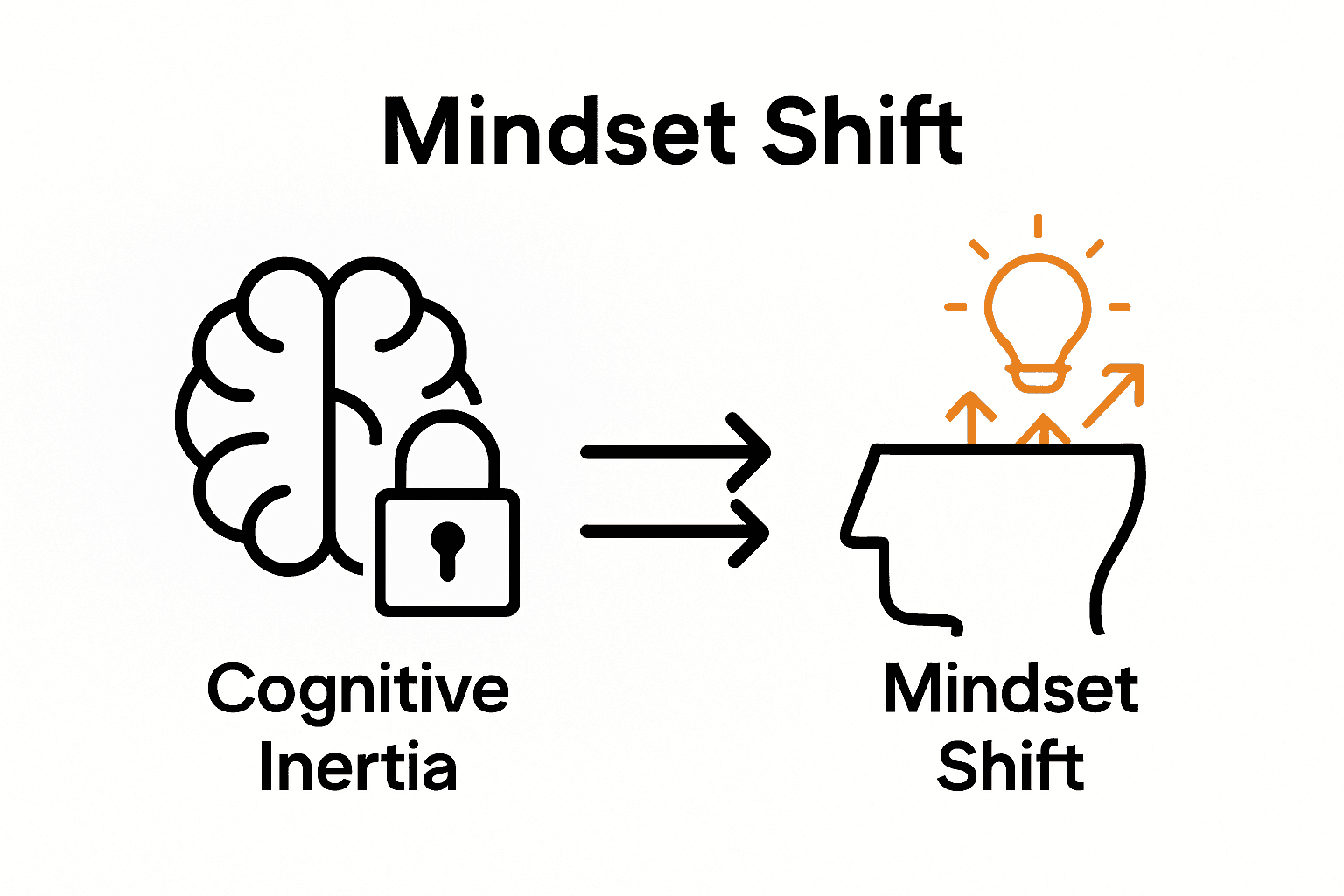
Cognitive Emotional Pedagogy offers innovative strategies for overcoming these psychological barriers by emphasizing the critical role of emotional engagement in learning and transformation. By associating new perspectives with emotionally compelling experiences, individuals can more effectively rewire their cognitive patterns and become more receptive to alternative viewpoints and innovative approaches.
Key strategies for addressing mindset resistance include:
- Narrative Reframing: Transforming personal and organizational stories
- Incremental Exposure: Gradually introducing new perspectives
- Psychological Safety: Creating environments that support vulnerable exploration
- Experiential Learning: Designing immersive experiences that challenge existing beliefs
For professionals seeking practical guidance in navigating these complex psychological dynamics, Understanding Why Embrace Change provides comprehensive insights into transformational strategies that can help individuals and organizations overcome deeply entrenched resistance to change.
Take Control of Your Transformation Journey with Expert Mindset Coaching
Understanding the vital role of mindset shifts is a crucial step but navigating through the challenges of cognitive inertia and emotional resistance can feel overwhelming. If you are ready to break free from limiting beliefs and develop a growth mindset that fuels resilience and breakthroughs, you are not alone. Many face the pain of feeling stuck despite knowing change is needed. This is where tailored guidance makes a difference. Tariq Juneja’s coaching solutions are designed to help you overcome those barriers with proven strategies in personal development and organizational change. Dive deeper into techniques that cultivate emotional regulation, cognitive flexibility, and transformative leadership through our Life Coaching Archives – Tariq Juneja and Change Management Archives – Tariq Juneja.

Don’t wait for resistance to control your potential. Visit https://tariqjuneja.com now to explore coaching programs and start your journey toward lasting transformation. Book a free consultation today to experience firsthand how a shift in mindset can unlock your highest performance and fulfillment.
Frequently Asked Questions
What is a mindset shift?
A mindset shift is a deliberate transformation of ingrained cognitive patterns that fundamentally alters how individuals perceive challenges, opportunities, and their own capabilities.
How can mindset shifts enhance personal growth?
Mindset shifts enhance personal growth by promoting greater self-awareness, challenging limiting beliefs, and enabling individuals to frame challenges as opportunities instead of obstacles.
What are the common types of mindset shifts?
Common types of mindset shifts include perspective shifts (reframing challenges), capability shifts (believing in personal growth), emotional regulation shifts (adaptive stress responses), and relationship shifts (improving interactions with others).
What strategies can help overcome resistance to mindset shifts?
Strategies to overcome resistance include narrative reframing, incremental exposure to new ideas, fostering psychological safety in discussions, and creating experiential learning opportunities that challenge existing beliefs.
Recommended
- Mindset Matters: Complete Guide to Lasting Transformation – Tariq Juneja
- What is Mindset Coaching? Understanding Its Impact – Tariq Juneja
- What is a Coaching Mindset? Understanding Its Impact – Tariq Juneja
- What is Transformative Coaching? Understanding Its Impact – Tariq Juneja
- Basketball Player Mindset: Complete Coach’s Guide – Hoop Mentality