

Nearly 70 percent of professionals say personal leadership coaching directly improved their job performance. As organizations face rapid changes, leaders need strategies that go beyond basic management. Personal leadership coaching gives individuals the tools to understand their strengths, tackle challenges, and grow into the leaders their teams need. Discover how personalized coaching methods spark meaningful development and drive real impact at every level.
Table of Contents
- Defining Personal Leadership Coaching and Its Impact
- Types of Personal Leadership Coaching Approaches
- Core Methods and Success Factors Explained
- Real-World Applications and Typical Outcomes
- Common Pitfalls and How to Overcome Them
Key Takeaways
| Point | Details |
|---|---|
| Personal Leadership Coaching | A transformative one-on-one process that enhances leadership capabilities through tailored approaches and self-discovery. |
| Coaching Approaches | Effective coaching includes democratic, laissez-faire, holistic, and mindfulness methods tailored to individual needs. |
| Core Methodologies | Key techniques such as solution-focused, transformational, and strengths-based coaching promote significant personal and professional growth. |
| Common Challenges | Communication barriers and resistance to change can hinder coaching effectiveness; addressing these through active listening and personalized strategies is essential. |
Defining Personal Leadership Coaching and Its Impact
Personal leadership coaching is a transformative one-on-one professional development process designed to empower individuals in expanding their leadership capabilities and potential. According to research from k-state, this approach builds an individual’s capacity to exercise leadership through powerful questioning, reflective practices, and creating dedicated space for working through complex leadership challenges.
At its core, personal leadership coaching focuses on helping professionals discover their unique leadership strengths, overcome performance barriers, and develop strategic approaches to personal and organizational growth. The process involves deep, structured conversations that enable leaders to gain profound insights into their leadership style, emotional intelligence, and potential blind spots. Insights from arxiv highlight that effective leadership coaching significantly correlates with enhanced emotional intelligence, which directly impacts team dynamics and organizational performance.
Key outcomes of personal leadership coaching typically include:
- Improved self-awareness and emotional intelligence
- Enhanced decision-making capabilities
- Stronger interpersonal communication skills
- Increased confidence and strategic thinking
- Better conflict resolution and team management techniques
By investing in personal leadership coaching, professionals can transform their approach to leadership, moving from reactive management to proactive, purpose-driven strategic development. This personalized approach ensures that leadership growth is tailored to individual strengths, organizational context, and specific career aspirations.
Types of Personal Leadership Coaching Approaches
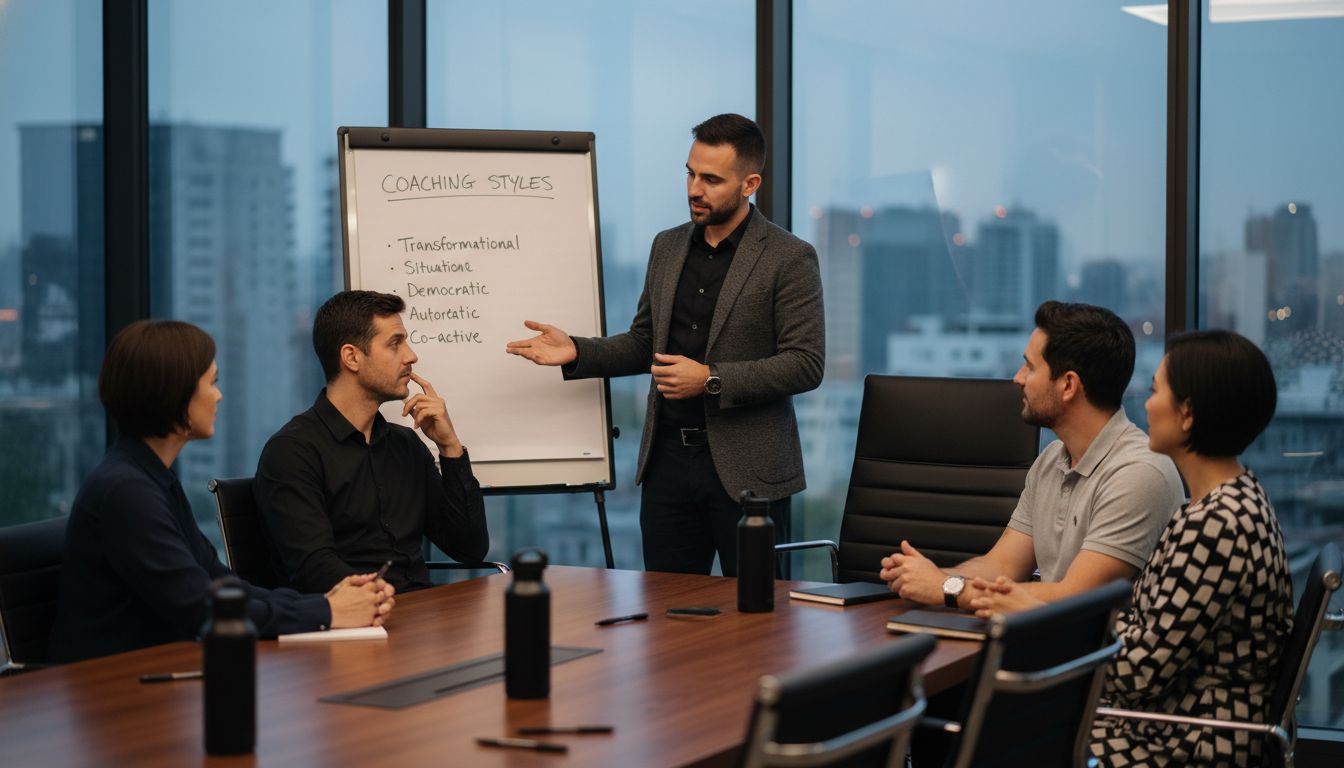
Personal leadership coaching encompasses diverse approaches tailored to individual growth and organizational needs. According to centreofexcellence, these approaches range from collaborative democratic styles to more autonomous methodologies that empower professionals to drive their own development.
Four primary coaching approaches stand out in the leadership development landscape:
Here’s a comparison of the primary personal leadership coaching approaches:
| Coaching Approach | Key Characteristics | Ideal For |
|---|---|---|
| Democratic | Collaborative Shared decision-making |
Leaders seeking teamwork |
| Laissez-Faire | Hands-off Self-directed |
Highly motivated individuals |
| Holistic | Multi-dimensional Focuses on whole person |
Leaders wanting well-being |
| Mindfulness | Incorporates mindfulness Promotes awareness |
Leaders needing clarity |
-
Democratic Coaching: Emphasizes collaboration and shared decision-making, where coaches work alongside leaders to co-create strategies and solutions. This approach builds mutual trust and encourages active participation in the leadership development process.
-
Laissez-Faire Coaching: Characterized by a hands-off approach that relies heavily on an individual’s intrinsic motivation and self-directed initiative. Coaches provide resources and guidance but allow leaders significant autonomy in exploring their leadership potential.
-
Holistic Coaching: A comprehensive approach that addresses leadership development across multiple dimensions – emotional, physical, spiritual, and mental. This method recognizes that effective leadership transcends professional skills and requires integrated personal growth.
-
Mindfulness Coaching: Integrates traditional coaching techniques with mindfulness practices, helping leaders cultivate present-moment awareness, emotional regulation, and conscious decision-making aligned with personal and organizational values.
By understanding and selecting the appropriate coaching approach, professionals can unlock targeted strategies for leadership growth that resonate with their unique strengths, challenges, and aspirational goals.
 For leaders seeking deeper insights into transformative coaching methodologies, our guide on coaching techniques offers comprehensive exploration of these dynamic approaches.
Core Methods and Success Factors Explained
Personal leadership coaching relies on sophisticated methodological approaches that transform professional development. According to batdacademy, effective coaching techniques center on three fundamental skills: active listening, powerful questioning, and reflective feedback.
Research from k-state highlights that successful coaching practices are characterized by a custom-tailored developmental process with one-on-one engagement focused on sustained behavior development. The core methodological approaches include:
- Solution-Focused Coaching: Concentrates on identifying and implementing practical solutions rather than dwelling on past challenges
- Transformational Coaching: Aims to create profound personal and professional shifts in leadership perspective
- Cognitive Behavioral Coaching: Helps leaders recognize and modify thinking patterns that limit their potential
- Positive Psychology Coaching: Emphasizes strengths, motivation, and psychological well-being
- Strengths-Based Coaching: Identifies and leverages an individual’s inherent talents and capabilities
Key success factors in leadership coaching involve creating a trusting environment where leaders can explore vulnerabilities, challenge existing mindsets, and develop actionable strategies for growth. For professionals seeking deeper insights into coaching strategies, our coaching process overview provides comprehensive guidance on navigating transformational leadership development.
Real-World Applications and Typical Outcomes
Personal leadership coaching translates theoretical concepts into tangible organizational transformation. According to ccl, executive coaching creates a supportive environment that fundamentally reshapes how professionals think, act, and influence their organizational ecosystem, ultimately driving significant business results.
Research from phoenix reveals that coaching leadership styles profoundly impact workplace dynamics by empowering employees through enhanced accountability and personalized development. The real-world applications span multiple professional domains:
Typical Outcomes of Leadership Coaching:
- Increased employee engagement and motivation
- Enhanced decision-making capabilities
- Improved interpersonal communication skills
- Higher organizational adaptability
- More effective conflict resolution strategies
- Accelerated professional growth trajectories
Integrated coaching approaches go beyond traditional training by embedding developmental sessions directly into leadership programs. This method ensures that learned skills are not just theoretical concepts but practical tools that can be immediately applied in real-world professional contexts. Professionals interested in exploring deeper transformation can discover more in our corporate coaching strategies guide, which offers comprehensive insights into leveraging coaching for organizational excellence.
Common Pitfalls and How to Overcome Them
Personal leadership coaching is not without its challenges. According to k-state, the most significant pitfalls stem from a lack of customization and insufficient focus on sustained behavioral development.
Research from batdacademy highlights three primary obstacles in leadership coaching:
Key Challenges and Strategic Solutions:
- Communication Barriers
- Challenge: Ineffective communication and misaligned expectations
- Solution: Implement active listening and powerful questioning techniques
- Resistance to Change
- Challenge: Leaders reluctant to modify existing behaviors
- Solution: Create personalized, empathetic development strategies
- Misaligned Coaching Methods
- Challenge: Coaching approaches that don’t match individual needs
- Solution: Develop flexible, adaptive coaching frameworks
Overcoming these pitfalls requires a nuanced approach that prioritizes individual growth, maintains open communication, and remains adaptable to each leader’s unique developmental journey. For professionals seeking additional guidance on navigating these challenges, our personal goal-setting guide offers practical strategies for personal and professional transformation.
Unlock Your Leadership Potential with Personalized Coaching
Struggling to overcome leadership challenges like communication barriers and resistance to change can hold you back from achieving your full potential. This article highlights how personal leadership coaching helps you build emotional intelligence, enhance decision-making skills, and adopt powerful new mindsets. If you want a tailored approach that matches your unique needs and transforms how you lead, exploring coaching options is a crucial next step.
Take charge of your growth today by discovering expert coaching insights at Life Coaching Archives – Tariq Juneja. Dive deeper into transformational leadership methods and strategies that have helped professionals like you embrace change and boost productivity. Start your journey toward effective leadership by visiting https://tariqjuneja.com. Don’t wait to become the confident and strategic leader your organization needs.
Frequently Asked Questions
What is personal leadership coaching?
Personal leadership coaching is a one-on-one professional development process aimed at enhancing leadership capabilities and personal growth through structured conversations, reflective practices, and powerful questioning.
What are the key benefits of personal leadership coaching?
Key benefits include improved self-awareness, enhanced decision-making, stronger communication skills, increased confidence, and better conflict resolution techniques.
What are the different coaching approaches in personal leadership coaching?
The primary coaching approaches include democratic coaching, laissez-faire coaching, holistic coaching, and mindfulness coaching, each tailored to individual needs and growth.
What are common challenges faced in personal leadership coaching?
Common challenges include communication barriers, resistance to change, and misaligned coaching methods. Strategies to overcome these involve active listening, creating empathetic development strategies, and adaptable coaching frameworks.
Recommended
- Understanding What is Self-Coaching for Personal Growth – Tariq Juneja
- Complete Guide to Executive Coaching Explained – Tariq Juneja
- What is a Coaching Mindset? Understanding Its Impact – Tariq Juneja
- Understanding Why Coaching Works: Keys to Growth – Tariq Juneja
- Master the Personal Growth Process for Lasting Change – Wisdom