

Most American IT managers rely on technical skills but overlook the role of personal evolution coaching in sustained professional growth. This approach matters because more than 80 percent of leaders worldwide struggle with self-awareness and team building. By understanding coaching strategies rooted in evidence-based psychology, you gain practical insights for boosting leadership effectiveness and transforming team dynamics.
Table of Contents
- Defining Personal Evolution Coaching and Core Concepts
- Variations in Personal Evolution Coaching Approaches
- How Coaching Enhances Leadership and Team Dynamics
- Qualifications and Process for Effective Coaching
- Common Pitfalls and How to Avoid Them
Key Takeaways
| Point | Details |
|---|---|
| Personal Evolution Coaching | This coaching method focuses on unlocking intrinsic potential through collaborative partnerships, emphasizing deep psychological understanding and intentional personal development. |
| Coaching Approaches | Various methodologies including solution-focused, psychodynamic, and existential coaching provide tailored strategies for professional growth and leadership enhancement. |
| Leadership and Team Dynamics | Coaching cultivates essential leadership skills such as emotional intelligence and communication, fostering high-performing and adaptive teams. |
| Common Pitfalls | To avoid coaching challenges, establish clear objectives, maintain consistent engagement, and track progress throughout the coaching journey. |
Defining Personal Evolution Coaching and Core Concepts
Personal evolution coaching represents a strategic approach to professional development that goes beyond traditional mentorship or consulting. Emerging from evidence-based psychological frameworks, this specialized form of coaching focuses on unlocking an individual’s intrinsic potential through deliberate, reflective processes.
At its core, personal evolution coaching is a collaborative partnership between a coach and client designed to facilitate transformative growth. Unlike generic performance consulting, this approach emphasizes deep psychological understanding and intentional personal development. The methodology integrates principles from positive psychology, solution-focused strategies, and cognitive-behavioral techniques to help professionals identify and overcome personal limitations while cultivating enhanced leadership capabilities.
Key characteristics of personal evolution coaching include a goal-oriented methodology, individualized strategy development, and a strong emphasis on self-reflection. Coaches work closely with clients to deconstruct existing mental models, challenge ingrained behavioral patterns, and construct more adaptive approaches to personal and professional challenges. Theoretical approaches span psychodynamic to solution-focused frameworks, providing a comprehensive toolkit for meaningful personal transformation.
Pro Tip: Begin your personal evolution coaching journey by conducting an honest self-assessment of your current leadership strengths and developmental areas to create a targeted growth strategy.
Variations in Personal Evolution Coaching Approaches
Personal evolution coaching encompasses a diverse range of philosophical and methodological approaches, each tailored to address unique individual developmental needs. Coaching methodologies span multiple theoretical frameworks, including existential, solution-focused, psychodynamic, and developmental models that provide nuanced strategies for professional growth.
These varied approaches differ fundamentally in their core principles and intervention strategies. Solution-focused coaching emphasizes identifying and leveraging existing strengths, while psychodynamic approaches delve into underlying psychological patterns that might impede personal development. Existential coaching challenges individuals to explore deeper meanings and purpose, encouraging profound self-reflection and intentional life design. Innovative coaching approaches adapt techniques from multiple helping professions, creating flexible methodologies that can be customized to specific client needs and contexts.
The primary coaching approaches can be broadly categorized into goal-oriented, therapeutic, and transformational models. Goal-oriented coaching focuses on specific performance outcomes, therapeutic approaches address underlying psychological barriers, and transformational models aim to create comprehensive personal and professional metamorphosis. Each approach offers unique tools and perspectives, allowing coaches to create highly personalized development strategies that resonate with individual client requirements and aspirations.
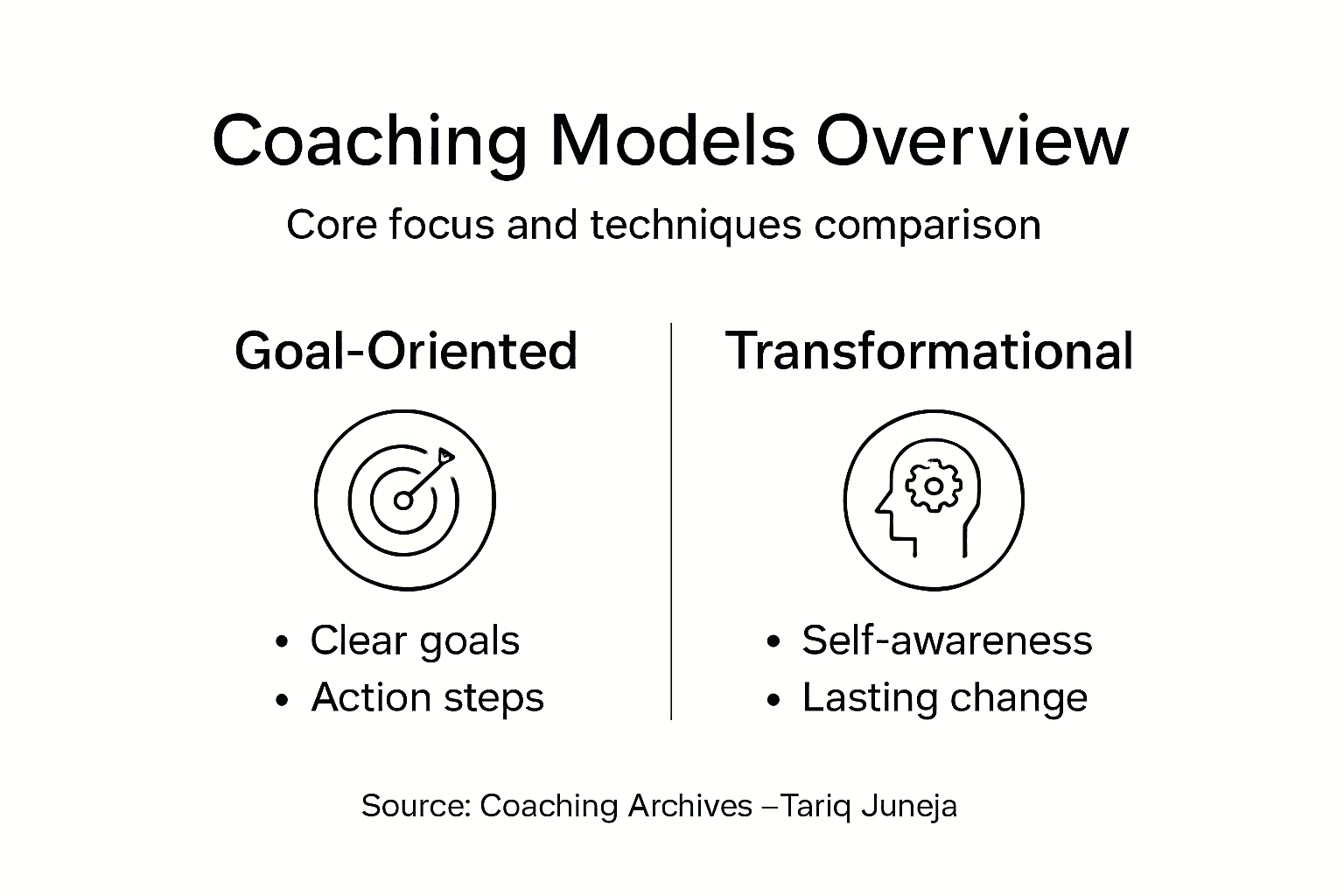
Here’s a quick comparison of key personal evolution coaching approaches and their primary focus:
| Coaching Approach | Core Focus | Typical Techniques |
|---|---|---|
| Solution-Focused | Leveraging strengths | Goal setting, action planning |
| Psychodynamic | Exploring deeper patterns | Reflective dialogue, pattern review |
| Existential | Discovering meaning | Deep questioning, life design |
| Transformational | Comprehensive change | Feedback, mindset shift guidance |
Pro Tip: When selecting a personal evolution coaching approach, prioritize alignment between the coaching methodology and your specific personal and professional growth objectives.
How Coaching Enhances Leadership and Team Dynamics
Coaching psychology offers powerful mechanisms for transforming leadership capabilities by systematically developing interpersonal skills, emotional intelligence, and strategic decision-making abilities. Modern leadership requires more than traditional management techniques, demanding a holistic approach that integrates personal growth with team performance enhancement.

The core of coaching’s impact on leadership lies in its ability to develop nuanced social and psychological competencies. Coaches help leaders understand complex team dynamics, improve communication strategies, and create environments that foster collaboration and innovation. By addressing individual psychological patterns and organizational cultural elements, coaching enables leaders to build more resilient, adaptive, and high-performing teams. Systematic approaches to coaching culture create transformative organizational environments that fundamentally reshape how teams interact, communicate, and achieve collective goals.
Effective leadership coaching focuses on several key dimensions of team dynamics. These include developing emotional intelligence, enhancing conflict resolution skills, creating transparent communication channels, and building trust-based relationships. Coaches work with leaders to identify and dismantle systemic barriers that prevent teams from reaching their full potential, providing targeted interventions that address both individual and collective performance challenges.
Pro Tip: Integrate regular reflective practices and feedback mechanisms into your leadership approach to continuously evolve your team’s dynamic capabilities.
Qualifications and Process for Effective Coaching
Global coaching standards establish rigorous professional qualifications that ensure practitioners deliver high-quality, transformative coaching experiences. Professional coaches must demonstrate extensive training, specialized credentials, and a comprehensive understanding of psychological and organizational development principles that enable meaningful client growth.
The coaching process involves multiple strategic stages designed to facilitate personal and professional evolution. Coaches typically begin with comprehensive client assessments, identifying individual strengths, psychological patterns, and developmental objectives. Transformative learning models guide coaching interactions through structured dialogue, reflective practices, and targeted feedback mechanisms that help clients unlock their potential and overcome performance barriers.
Key qualifications for effective coaches include advanced degrees in psychology, organizational behavior, or related fields, professional certifications from recognized coaching institutions, and demonstrated expertise in areas like emotional intelligence, communication strategies, and leadership development. Beyond academic credentials, successful coaches possess exceptional interpersonal skills, deep empathy, and the ability to create safe, supportive environments that encourage genuine personal transformation and growth.
Pro Tip: Prioritize coaches with verified credentials, demonstrable client success stories, and a transparent approach to measuring coaching outcomes.
Common Pitfalls and How to Avoid Them
Coaching encounters numerous systemic challenges that can undermine the effectiveness of personal evolution processes. These pitfalls often emerge from misaligned expectations, inadequate preparation, and insufficient understanding of individual developmental needs, potentially derailing the transformative potential of coaching relationships.
One critical challenge is the lack of clear, measurable objectives at the coaching engagement’s outset. Without precise goal definition, coaches and clients risk wandering through unfocused conversations that produce minimal tangible results. Developmental challenges in coaching psychology frequently stem from inconsistent methodological approaches, highlighting the importance of establishing structured frameworks and transparent communication protocols.
Successful coaching requires ongoing commitment from both coach and client. Common pitfalls include resistance to vulnerability, lack of consistent engagement, and unrealistic expectations about personal transformation speed. Effective coaches mitigate these challenges by creating psychologically safe environments, maintaining professional boundaries, and implementing regular progress assessments that keep clients accountable and motivated throughout their personal evolution journey.
The following table summarizes common pitfalls in coaching and practical strategies to prevent them:
| Pitfall | Example Scenario | Prevention Strategy |
|---|---|---|
| Unclear objectives | Vague coaching expectations | Set SMART goals at the outset |
| Inconsistent engagement | Missed sessions or follow-up | Schedule regular check-ins |
| Resistance to vulnerability | Avoiding honest discussions | Build rapport and psychological safety |
| Overlooking progress tracking | No review of goal attainment | Implement periodic progress reviews |
Pro Tip: Establish clear, measurable coaching objectives and conduct periodic performance reviews to ensure continued alignment and momentum.
Unlock Your Leadership Potential with Personal Evolution Coaching
Struggling to break through leadership barriers or foster deeper team connections is a common challenge explored in the article Personal Evolution Coaching Unlocking Leadership Growth. You want to cultivate emotional intelligence overcome ingrained behavioral patterns and create lasting transformational change that elevates both you and your organization. By embracing tailored coaching approaches you can develop clear goals enhance self-reflection and unlock new dimensions of leadership effectiveness.
Discover how Life Coaching Archives – Tariq Juneja and Agile Coaching Archives – Tariq Juneja offer powerful tools designed to meet your unique growth needs. 
Take the next step toward transformation with expert guidance that aligns with the proven techniques of personal evolution coaching. Visit https://tariqjuneja.com today to explore coaching programs seminars and workshops that help you reduce stress increase productivity and achieve breakthrough results. Book a free consultation now to start your leadership growth journey with confidence.
Frequently Asked Questions
What is personal evolution coaching?
Personal evolution coaching is a strategic approach that focuses on unlocking an individual’s intrinsic potential through collaborative partnerships between a coach and a client, emphasizing transformative growth and self-reflection.
How does personal evolution coaching impact leadership development?
Personal evolution coaching enhances leadership by developing interpersonal skills, emotional intelligence, and strategic decision-making, allowing leaders to improve team dynamics and foster collaboration and innovation.
What are the key coaching approaches in personal evolution coaching?
Key coaching approaches include solution-focused, psychodynamic, existential, and transformational models, each offering unique strategies to address individual developmental needs and facilitate personal growth.
What qualifications should I look for in a personal evolution coach?
An effective personal evolution coach should have advanced degrees in psychology or related fields, professional certifications from recognized coaching institutions, and strong interpersonal skills to create a supportive coaching environment.