

More than 60 percent of Agile transformations stall because teams focus on tools while ignoring mindset. For american IT managers guiding international teams, understanding the human side of Agile can be the deciding factor between static performance and breakthrough progress. This introduction clarifies the core elements of mindset development in Agile environments and highlights how cultural shifts drive lasting productivity and adaptability.
Table of Contents
- Defining Mindset Development In Agile Teams
- Types Of Mindsets Relevant To Agile Success
- Core Principles And Features Of Growth Mindset
- Roles And Responsibilities In Mindset Transformation
- Risks, Pitfalls, And Common Mistakes
Key Takeaways
| Point | Details |
|---|---|
| Agile Mindset Importance | Developing an Agile mindset focuses on human factors that drive team dynamics beyond traditional methods. |
| Types of Mindsets | Distinguishing between fixed, growth, and adaptive mindsets is crucial for enhancing team effectiveness and innovation. |
| Leadership Role | Leaders must model vulnerability and foster psychological safety to encourage a culture of learning and collaboration. |
| Avoiding Pitfalls | Organizations often fail in Agile transformations by treating it as a process rather than a fundamental cultural shift, leading to superficial changes. |
Defining Mindset Development in Agile Teams
Mindset development in Agile teams represents a critical human factor that transcends traditional process-driven approaches. At its core, Agile transformation success hinges on understanding the psychological and behavioral dimensions of team dynamics. Unlike conventional management strategies that focus solely on tools and procedures, an effective Agile mindset requires deep cultural and interpersonal shifts.
The Agile mindset is fundamentally about embracing a set of core principles that prioritize adaptability, continuous learning, and collaborative problem solving. Research demonstrates that organizations frequently struggle with Agile adoption because they overlook the essential human factors underlying successful transformation. This mindset encompasses several key characteristics: openness to change, willingness to experiment, commitment to transparent communication, and a collective approach to problem resolution.
Successful mindset development in Agile teams involves intentional cultivation of psychological safety, trust, and mutual respect. Team members must feel empowered to share ideas, acknowledge mistakes, and collaborate without fear of judgment. This requires leadership that models vulnerability, encourages experimentation, and creates an environment where learning is valued more than perfection. By focusing on individual and collective growth, teams can develop the resilience and adaptability necessary to navigate complex project landscapes.
Pro tip: Start your mindset development journey by conducting regular team retrospectives that explicitly discuss psychological safety and encourage open, non-judgmental dialogue about team dynamics and individual experiences.
Types of Mindsets Relevant to Agile Success
Mindset types play a pivotal role in determining an Agile team’s effectiveness and adaptability. Research reveals four critical mindset dimensions that directly influence organizational performance and innovation: learning spirit, collaborative exchange, self-guidance, and customer co-creation. These dimensions distinguish high-performing Agile teams from those struggling with traditional, rigid approaches to project management.
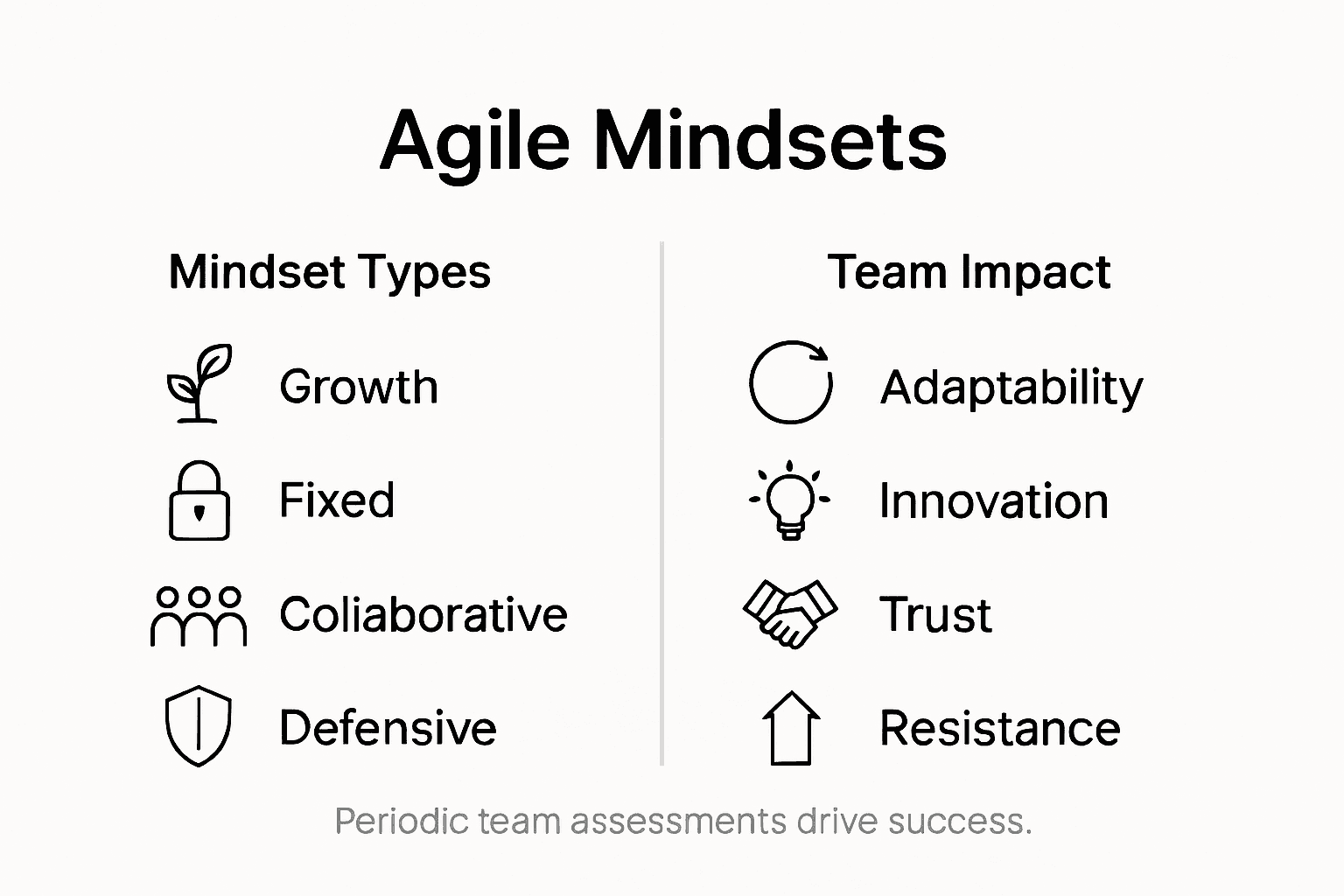
Organizational success in Agile environments depends significantly on understanding the different mindset patterns team members exhibit. The primary mindset categories include the fixed mindset, growth mindset, and adaptive mindset. Individuals with a fixed mindset tend to resist change and view their skills as static, while those with a growth mindset embrace challenges, see failures as learning opportunities, and continuously seek personal and professional development. The adaptive mindset goes a step further, combining growth principles with rapid responsiveness to changing project dynamics.
Successful Agile teams cultivate a collective mindset that transcends individual approaches. This involves creating an environment that actively promotes continuous learning, encourages experimentation, and values team collaboration over individual achievements. Leaders play a crucial role in shaping this collective mindset by modeling openness, demonstrating vulnerability, and creating psychological safety that allows team members to take calculated risks and learn from their experiences.
Pro tip: Conduct periodic team assessments to understand individual mindset tendencies and design targeted development interventions that help team members transition from fixed to growth-oriented thinking patterns.
Here’s a quick comparison of mindset types relevant to Agile transformation:
| Mindset Type | Key Characteristics | Impact on Agile Teams |
|---|---|---|
| Fixed | Resists change, avoids challenges | Limits collaboration and innovation |
| Growth | Embraces learning, persists through setbacks | Promotes creativity and improvement |
| Adaptive | Responds quickly to change, blends growth traits | Enables rapid problem-solving and flexibility |
Core Principles and Features of Growth Mindset
The growth mindset represents a transformative approach to learning and development that fundamentally challenges traditional perspectives on individual capabilities. At its core, this mindset is predicated on the fundamental belief that intelligence, skills, and abilities are not fixed traits, but dynamic capacities that can be intentionally cultivated through dedicated effort, strategic learning, and persistent practice. Unlike fixed mindsets that view talents as predetermined, growth mindsets empower individuals to see challenges as opportunities for expansion and personal transformation.
Agile environments particularly benefit from growth mindset principles that emphasize adaptability, continuous learning, and collaborative problem solving. The key features of a growth mindset include radical openness to change, a commitment to ongoing skill development, resilience in the face of setbacks, and a fundamental belief that personal and professional capabilities can be systematically enhanced. Team members with growth mindsets approach complex challenges with curiosity rather than fear, viewing failures as essential feedback mechanisms that provide critical insights for future improvement.

Cultivating a growth mindset requires intentional strategies and organizational support. Leaders play a pivotal role in creating environments that reward learning, encourage experimentation, and normalize the process of continuous improvement. This involves establishing psychological safety, providing constructive feedback mechanisms, celebrating learning journeys over mere outcomes, and demonstrating personal vulnerability by sharing their own growth experiences. By modeling these behaviors, leaders can systematically transform organizational culture from a performance-oriented mindset to a genuine learning ecosystem.
Pro tip: Implement quarterly personal development workshops that help team members reframe challenges as learning opportunities and develop concrete strategies for transforming setbacks into growth experiences.
Roles and Responsibilities in Mindset Transformation
Successful mindset transformation requires a strategic distribution of responsibilities across multiple organizational levels, creating a comprehensive approach to cultural change. Each role within an Agile team plays a critical part in cultivating and sustaining a transformative mindset, with leadership, coaches, and team members each contributing unique perspectives and actions that drive meaningful organizational evolution.
Agile teams operate through a dynamic, cross-functional model where traditional hierarchical boundaries are deliberately blurred. Key stakeholders like product owners, scrum masters, developers, and testers share collective accountability for mindset development. Leadership’s primary responsibility involves creating psychological safety, removing systemic barriers to change, and modeling the adaptive behaviors they wish to see. Agile coaches serve as critical change agents, providing targeted guidance, facilitating workshops, and helping teams recognize and overcome deeply ingrained fixed mindset patterns.
Team members themselves bear significant responsibility in mindset transformation. This involves cultivating personal awareness, embracing vulnerability, actively seeking feedback, and demonstrating a genuine commitment to continuous learning. Individual contributors must develop the courage to challenge existing processes, experiment with new approaches, and view setbacks as valuable learning opportunities. By taking ownership of their personal and collective growth, team members become active participants in organizational transformation rather than passive recipients of change initiatives.
Pro tip: Create a “mindset transformation dashboard” that visually tracks team learning experiences, celebrates growth milestones, and provides transparent metrics on individual and collective development progress.
To clarify how different Agile team roles support mindset transformation, review the summary below:
| Role | Main Responsibilities | Influence on Mindset |
|---|---|---|
| Leadership | Models vulnerability, sets safety standards | Shapes culture, inspires change |
| Agile Coach | Guides mindset shifts, facilitates workshops | Accelerates learning and adaptation |
| Team Members | Seek feedback, experiment, learn from mistakes | Drive personal and team growth |
Risks, Pitfalls, and Common Mistakes
Agile mindset transformations frequently encounter systemic challenges that can derail organizational change efforts, undermining the potential for meaningful cultural evolution. Organizations often stumble by treating Agile as a superficial methodology rather than a fundamental shift in thinking and working. The most critical risks emerge from misunderstanding Agile’s core principles, approaching transformation as a prescriptive process, and failing to address the deep-seated cultural dynamics that sustain existing work patterns.
Common pitfalls typically stem from leadership misconceptions and inadequate change management strategies. Key mistakes include limiting Agile adoption to isolated pilot projects, treating transformation as a top-down mandate, and neglecting the essential psychological components of organizational change. Many teams inadvertently create resistance by implementing Agile practices mechanically without understanding the underlying mindset shifts required. This approach leads to superficial compliance rather than genuine cultural transformation, resulting in teams that perform Agile rituals without embodying Agile principles.
Successful mindset transformation demands a nuanced, holistic approach that recognizes the complexity of organizational change. Leaders must move beyond theoretical frameworks and invest in comprehensive training, ongoing coaching, and creating environments that genuinely support experimentation and learning. This involves dismantling existing hierarchical structures, encouraging transparent communication, and developing mechanisms that reward adaptive thinking and collaborative problem solving. Critical to this process is acknowledging that mindset transformation is not a one-time event, but a continuous journey of individual and collective growth.
Pro tip: Conduct periodic “mindset health checks” that assess team psychological safety, adaptability, and willingness to embrace change, using anonymous feedback mechanisms to capture genuine insights.
Elevate Your Agile Team’s Mindset for Lasting Success
Struggling with embedding a true Agile mindset within your teams can stall your transformation journey. This article highlights key challenges like overcoming fixed mindsets and fostering psychological safety that are essential for Agile team success. If you aim to cultivate adaptability, continuous learning, and collaborative problem solving, then focusing on mindset development is critical. Our expert coaching can help you do exactly that by addressing these human factors head on and driving sustainable change.

Discover how targeted Agile Coaching Archives – Tariq Juneja can guide your teams beyond mechanical adoption toward genuine cultural transformation. Explore strategies in Change Management Archives – Tariq Juneja to foster trust and resilience during your Agile evolution. Start your journey toward empowered teams and breakthrough performance by visiting Tariq Juneja’s website today. Book your free consultation and transform your organization’s mindset now.
Frequently Asked Questions
What is mindset development in Agile teams?
Mindset development in Agile teams is the intentional cultivation of psychological and behavioral dimensions that prioritize adaptability, continuous learning, and collaboration, which are essential for Agile transformation success.
How can I promote a growth mindset within my Agile team?
To promote a growth mindset, focus on creating an environment that values continuous learning, encourages experimentation, and recognizes mistakes as learning opportunities. Implement regular team retrospectives and personal development workshops to help team members reframe challenges positively.
What common pitfalls should organizations avoid during Agile transformation?
Organizations should avoid treating Agile as a superficial methodology, confining it to isolated pilot projects, or failing to address cultural dynamics. Successful transformation requires an understanding of core Agile principles and an ongoing commitment to mindset shifts.
How does leadership influence mindset transformation in Agile teams?
Leadership plays a crucial role in mindset transformation by modeling vulnerability, setting standards for psychological safety, and fostering an environment that encourages open communication and collaborative problem solving. This helps inspire change across the organization.