

Over 80 percent of american companies now invest in management coaching as a way to drive lasting organizational growth. With modern workplaces demanding more collaboration, adaptability, and leadership development, understanding how coaching actually works becomes essential. This guide unpacks the strategies and benefits behind management coaching, revealing the key skills that help leaders unlock greater performance and long-term success in today’s rapidly changing business world.
Table of Contents
- Defining Management Coaching And Its Purpose
- Core Types Of Management Coaching Approaches
- Key Skills And Methods Used By Coaches
- Practical Benefits And Real-World Applications
- Common Mistakes And Pitfalls To Avoid
Key Takeaways
| Point | Details |
|---|---|
| Management Coaching Enhances Performance | Structured conversations between leaders and employees foster knowledge sharing and skills development, improving organizational performance. |
| Transformational Development Focus | Effective coaching prioritizes personal growth and self-reflection rather than directive instruction, creating an environment for employee empowerment. |
| Diverse Coaching Approaches | Successful management coaching adapts to individual and organizational needs through various styles, including Democratic, Holistic, and Performance Coaching. |
| Common Pitfalls in Coaching | Coaches should avoid prescriptive methods and ensure clear boundaries, while maintaining empathy and active listening to foster genuine growth. |
Defining Management Coaching and Its Purpose
Management coaching represents a strategic leadership approach designed to elevate organizational performance through targeted professional development. According to jiemar, it is defined as a structured conversation between supervisors and individuals or teams, aimed at enhancing performance by sharing knowledge, skills, and professional experiences.
At its core, management coaching goes beyond traditional supervision by creating a collaborative environment where leaders actively support employee growth. icecreamtutor emphasizes that this approach involves improving problem-solving capabilities, empowering employees to exceed previous performance levels, and providing constructive guidance that demonstrates genuine respect and individual value.
The fundamental purpose of management coaching centers on transformational development. This approach is not about dictating instructions, but facilitating personal and professional growth through:
- Personalized feedback and strategic guidance
- Skill enhancement and performance optimization
- Encouraging self-reflection and independent thinking
- Building confidence and leadership potential
- Creating a supportive organizational learning environment
Effective management coaching transforms traditional hierarchical relationships into dynamic partnerships where leaders become facilitators of human potential. By prioritizing individual strengths and addressing developmental opportunities, organizations can unlock unprecedented levels of employee engagement, productivity, and innovative thinking.
For professionals seeking to understand more about advanced coaching strategies, our guide to management coaching services offers comprehensive insights into implementing these transformative practices within your organization.
Core Types of Management Coaching Approaches
Management coaching is not a one-size-fits-all approach, but rather a dynamic field with multiple distinct styles tailored to different organizational needs and individual contexts. According to centreofexcellence, several core coaching approaches emerge that help leaders effectively support and develop their teams.
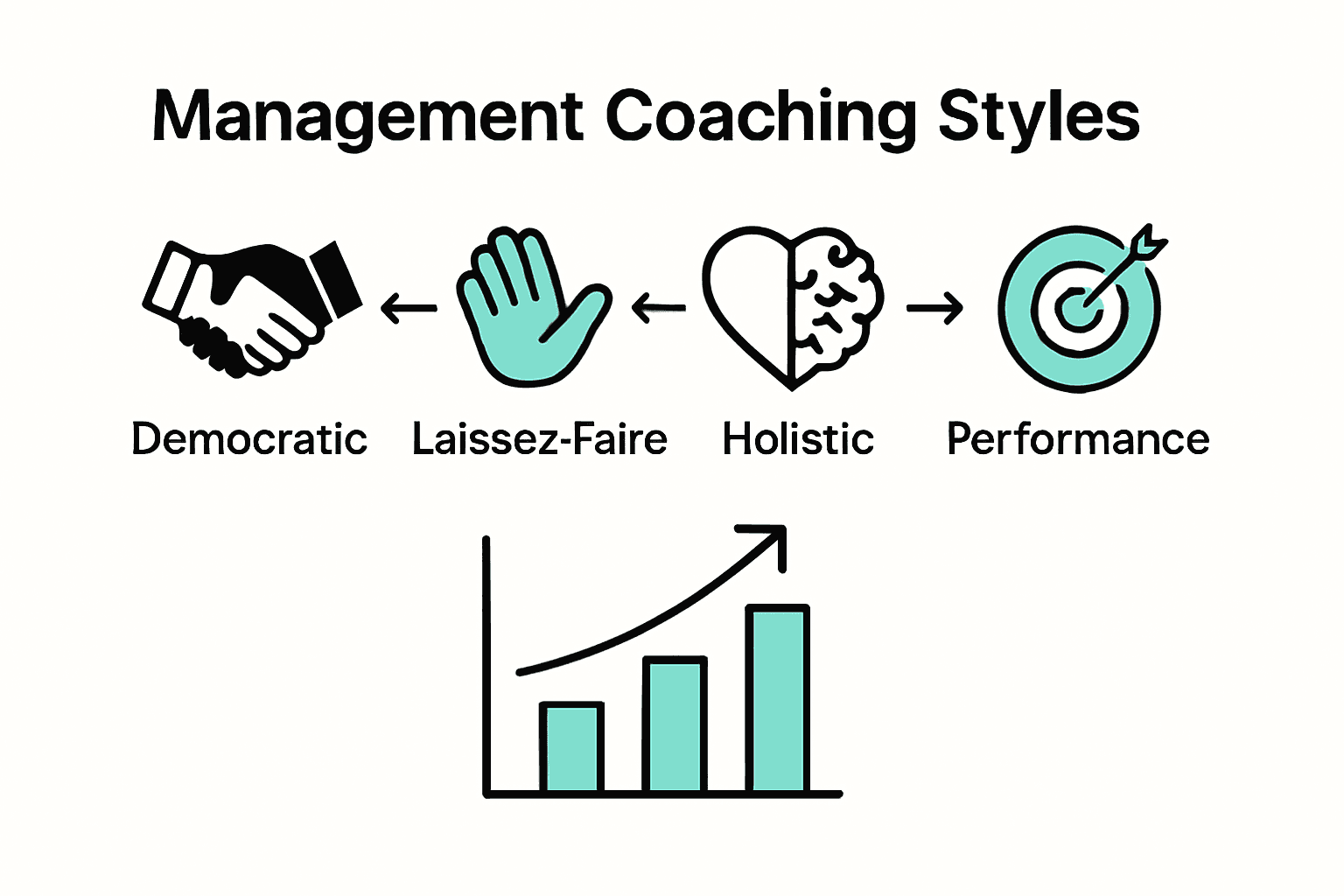
Democratic Coaching represents a collaborative approach where managers and team members work together to establish goals, solve problems, and create shared strategies. In this model, input is actively sought from team members, fostering a sense of ownership and engagement. Conversely, Laissez-Faire Coaching operates on high trust principles, providing minimal direct intervention while empowering individuals to take primary responsibility for their professional development.
Another significant approach is Holistic Coaching, which transcends traditional performance metrics by focusing on an individual’s overall well-being and personal growth. This style recognizes that professional effectiveness is intrinsically linked to personal satisfaction, mental health, and work-life balance. Performance Coaching, by contrast, maintains a laser-focused orientation on achieving specific, measurable results and driving organizational objectives.
These diverse coaching approaches are not mutually exclusive. Skilled managers often blend multiple styles strategically, adapting their technique to individual team members’ needs, organizational culture, and specific developmental goals. For professionals looking to deepen their understanding of advanced coaching methodologies, our corporate coaching strategies guide provides comprehensive insights into implementing these transformative practices.
Key characteristics of effective management coaching approaches include:
- Flexibility in technique and approach
- Deep understanding of individual team member’s strengths and challenges
- Clear, constructive communication
- Commitment to continuous learning and improvement
- Genuine respect for individual potential
Ultimately, the most successful management coaching transcends rigid methodologies, embracing a nuanced, empathetic approach that recognizes each individual’s unique potential and organizational context.
Key Skills and Methods Used by Coaches
Management coaching requires a sophisticated toolkit of interpersonal and strategic skills that enable profound professional transformation. Active listening stands as the foundational skill, allowing coaches to truly understand the nuanced challenges, motivations, and potential of their clients beyond surface-level interactions.
Effective coaches employ multiple powerful methods to drive meaningful change. Powerful questioning techniques help uncover deep insights, challenging existing mental frameworks and encouraging individuals to explore alternative perspectives. These questions are not interrogative, but provocative – designed to stimulate critical thinking and self-reflection. Complementing this approach, reflective feedback provides structured observations that help professionals understand their behaviors, strengths, and potential growth areas with remarkable clarity.

The most advanced coaching methodologies integrate several key techniques:
- Goal Setting and Alignment: Creating precise, measurable objectives
- Performance Mapping: Tracking progress through strategic benchmarks
- Emotional Intelligence Assessment: Understanding psychological dynamics
- Contextual Problem-Solving: Addressing challenges within specific organizational environments
- Strengths-Based Development: Focusing on amplifying individual capabilities
Psychological techniques like cognitive reframing play a crucial role, helping professionals transform limiting beliefs into empowering narratives. Coaches skilled in communication skills coaching understand that true transformation happens when individuals can reimagine their potential and develop actionable strategies for growth.
Ultimately, exceptional coaches blend scientific understanding with profound human empathy. They create safe, challenging environments where professionals can deconstruct existing patterns, develop new competencies, and unlock extraordinary personal and organizational potential.
Practical Benefits and Real-World Applications
Management coaching transcends theoretical concepts, delivering tangible organizational and individual transformations across diverse professional environments. According to uk, the strategic application of coaching styles yields significant workplace benefits, including enhanced decision-making capabilities, increased employee satisfaction, and substantial improvements in overall productivity.
Developmental coaching emerges as a powerful approach for long-term organizational growth. By focusing on individual potential and strategic skill development, this method helps employees recognize and systematically pursue career objectives. Teams experiencing consistent coaching interventions demonstrate remarkable improvements in collaboration, communication, and adaptive problem-solving skills.
The real-world impact of management coaching can be observed across multiple dimensions:
- Accelerated leadership development
- Reduced employee turnover rates
- Enhanced organizational resilience
- Improved interpersonal workplace dynamics
- More effective change management processes
Holistic coaching approaches address not just professional performance, but also individual well-being, stress management, and personal growth. This comprehensive strategy recognizes that employee effectiveness is intrinsically linked to mental health, work-life balance, and psychological safety. For professionals seeking deeper insights into implementing transformative coaching strategies, our coaching techniques guide provides comprehensive strategies and practical frameworks.
Ultimately, management coaching represents a sophisticated investment in human potential. By creating supportive, growth-oriented environments, organizations can unlock unprecedented levels of individual and collective performance, transforming traditional workplace dynamics into innovative, adaptive ecosystems of continuous learning and development.
Common Mistakes and Pitfalls to Avoid
Management coaching, while powerful, can be derailed by several critical missteps that undermine its effectiveness and potential for transformative change. Prescriptive coaching represents one of the most significant pitfalls, where coaches mistakenly adopt a directive approach that tells individuals exactly what to do, rather than guiding them to discover their own solutions.
Another common error is failing to establish clear boundaries between coaching and other professional interactions. Coaches must maintain a delicate balance between supportive guidance and professional distance, avoiding the temptation to become a friend, therapist, or direct problem-solver. This boundary confusion can rapidly erode the coaching relationship’s credibility and impact.
The most prevalent mistakes in management coaching include:
- Neglecting to set specific, measurable coaching objectives
- Overlooking individual learning and communication styles
- Providing generic, one-size-fits-all advice
- Rushing the process without allowing genuine reflection
- Avoiding difficult or uncomfortable conversations
- Lacking genuine empathy and active listening skills
- Failing to track and measure coaching outcomes
Psychological projection and unconscious bias can significantly undermine coaching effectiveness. Coaches who project their own experiences, expectations, or unresolved personal challenges onto clients create substantial barriers to genuine growth. For professionals seeking to develop more nuanced coaching approaches, our communication skills coaching guide offers comprehensive strategies for avoiding these common pitfalls.
Ultimately, exceptional coaching demands continuous self-awareness, humility, and a commitment to personal growth. The most effective coaches recognize that their role is not to have all the answers, but to create transformative spaces where individuals can discover their own extraordinary potential.
Unlock the Full Potential of Management Coaching for Your Team
Are you ready to transform leadership challenges into powerful growth opportunities? This article highlights the need for clear communication, personalized feedback, and strategic coaching approaches that boost employee engagement and productivity. If you are facing hurdles like ineffective coaching styles or lack of measurable progress, understanding proven management coaching methods can be your breakthrough.
Explore how tailored coaching strategies foster real change and help build resilient leaders who inspire innovation and collaboration. Dive into effective agile coaching techniques by visiting the Agile Coaching Archives – Tariq Juneja to see how these principles can be applied in dynamic business environments. For robust organizational transformation, the Change Management Archives – Tariq Juneja offers practical insights.
Take the next step toward creating a culture of continuous improvement and growth. Visit https://tariqjuneja.com today to discover coaching programs and consultations tailored to your leadership and team development needs. Act now to unlock new levels of potential within your organization.
Frequently Asked Questions
What is management coaching?
Management coaching is a strategic leadership approach designed to enhance organizational performance through structured conversations between supervisors and individuals or teams, aimed at improving knowledge, skills, and professional experiences.
What are the core types of management coaching approaches?
Core types of management coaching approaches include Democratic Coaching, Laissez-Faire Coaching, Holistic Coaching, and Performance Coaching, each tailored to different organizational needs and individual contexts.
What key skills should a management coach possess?
Key skills for effective management coaching include active listening, powerful questioning, reflective feedback, goal setting, performance mapping, and emotional intelligence assessment, among others.
What are some common mistakes in management coaching?
Common mistakes in management coaching include prescriptive coaching, failing to establish clear boundaries, neglecting specific coaching objectives, providing generic advice, and avoiding difficult conversations.
Recommended
- Complete Guide to Management Coaching Services – Tariq Juneja
- Understanding the Coaching Process Overview for Growth – Tariq Juneja
- 7 Key Differences Between Coaching vs Mentoring for Leaders – Tariq Juneja
- Corporate Coaching Explained: Strategies, Types, Impact – Tariq Juneja
- Wisdom – Your AI Guide to Love, Success & Self-Mastery