

Over half of American professionals say workplace stress affects their productivity each week. For IT specialists facing constant change, finding effective ways to adapt can feel challenging. Discover how coaching supports American IT professionals who want personal growth, sharper focus, and practical tools to handle career transitions with greater confidence and clarity.
Table of Contents
- What Does A Life Coach Do?
- Types Of Life Coaching And Approaches
- How Life Coaching Empowers Professionals
- Key Responsibilities And Ethics In Coaching
- Choosing A Qualified Life Coach
Key Takeaways
| Point | Details |
|---|---|
| Life Coaching Overview | Life coaching empowers individuals to achieve personal and professional goals through structured strategies and focused guidance. |
| Types of Coaching | Various coaching types exist, including executive, career, and health coaching, each targeting specific development needs. |
| Empowerment Through Coaching | Life coaching enhances emotional intelligence and resilience, leading to improved workplace dynamics and professional growth. |
| Choosing a Coach | Selecting a qualified life coach involves assessing certifications, experience, and compatibility to align with personal goals. |
What Does a Life Coach Do?
Life coaching is a dynamic professional service focused on empowering individuals to achieve personal and professional transformation. Unlike traditional therapy, life coaches help clients develop actionable strategies for progress by identifying specific goals and creating structured pathways toward achievement.
A life coach serves as a strategic partner who guides clients through systematic personal development. These professionals utilize targeted conversations and evidence-based techniques to help individuals overcome internal barriers, clarify their vision, and design practical roadmaps for success. For IT professionals navigating complex workplace dynamics, a life coach can provide crucial support in managing career transitions, improving leadership skills, and developing resilience against organizational stress.

The coaching process typically involves comprehensive assessments, goal setting, accountability mechanisms, and personalized interventions. Coaching partnerships are built on mutual trust and collaborative exploration, where coaches create confidential spaces for clients to examine their challenges, uncover hidden potential, and develop sustainable performance strategies. Coaches are trained to ask powerful questions, challenge limiting beliefs, and help clients tap into their inherent strengths.
Professional Insight: Schedule quarterly personal strategy sessions with your life coach to proactively align your professional development with evolving career objectives.
Types of Life Coaching and Approaches
Life coaching encompasses a diverse range of specialized approaches designed to address unique professional and personal development needs. Coaching methodologies have evolved to include various targeted interventions across multiple domains, allowing practitioners to customize their strategies to specific client objectives and contexts.
The primary types of life coaching include individual coaching, team coaching, business coaching, executive coaching, career coaching, and health coaching. Each specialization focuses on distinct areas of personal and professional growth. For instance, executive coaching targets leadership development and organizational performance, while career coaching helps professionals navigate complex career transitions, explore new opportunities, and align their professional trajectories with personal goals.
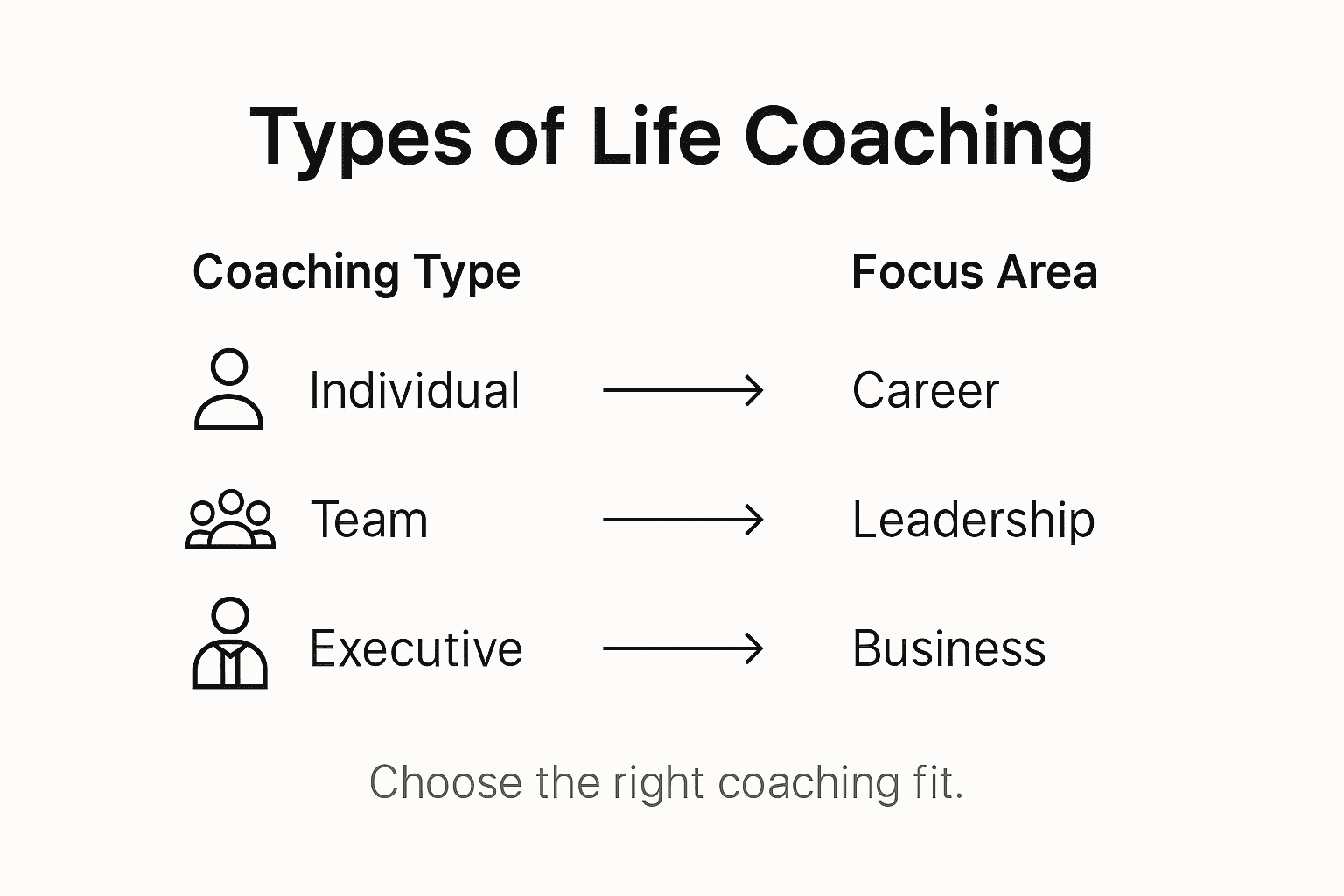
Here’s an overview of common life coaching types and their key focus areas:
| Coaching Type | Main Focus | Ideal For |
|---|---|---|
| Individual Coaching | Personal development strategies | People seeking personal growth |
| Executive Coaching | Leadership and management skills | Senior leaders, executives |
| Career Coaching | Career planning, transitions | Professionals changing careers |
| Health Coaching | Wellness and lifestyle changes | Individuals prioritizing health |
| Team Coaching | Group performance enhancement | Work teams seeking better results |
| Business Coaching | Organizational success | Entrepreneurs, business owners |
Positive Psychological Coaching (PPC) represents an advanced evidence-based approach that integrates psychological principles with coaching techniques. This methodology emphasizes strengths-based development, utilizing strategies like motivational interviewing, active listening, and cognitive behavioral techniques. PPC follows a structured five-phase model that systematically guides clients through personal transformation, focusing on well-being, sustainable growth, and unlocking individual potential.
Pro Tip: Assess your specific goals and challenges before selecting a life coaching approach to ensure the most aligned and effective intervention strategy.
How Life Coaching Empowers Professionals
Professional empowerment through life coaching represents a strategic approach to personal and organizational growth. Workplace coaching has emerged as a powerful intervention that positively transforms employee performance and organizational dynamics, enabling professionals to develop critical skills and adaptive capabilities in rapidly changing work environments.
Life coaching delivers transformative benefits by helping professionals enhance their emotional intelligence, leadership capabilities, and professional resilience. Through targeted interventions, coaches assist individuals in identifying personal strengths, addressing performance barriers, and developing strategic approaches to career development. This process involves comprehensive skill assessments, goal setting, and personalized strategies that empower professionals to navigate complex workplace challenges with confidence and clarity.
The impact of professional coaching extends beyond individual growth, creating ripple effects throughout organizational ecosystems. By developing more self-aware, emotionally intelligent, and strategically minded professionals, coaching contributes to improved team dynamics, enhanced communication, and more agile organizational responses to changing business landscapes. Professionals who engage in coaching often experience increased self-confidence, improved decision-making capabilities, and a more proactive approach to personal and professional challenges.
Pro Tip: Invest in regular coaching sessions and maintain a growth mindset to continuously transform your professional capabilities and resilience.
Key Responsibilities and Ethics in Coaching
Ethical coaching represents a profound commitment to professional integrity and client welfare. Coaches must develop sophisticated ethical competence that extends far beyond simple adherence to standard codes of conduct, requiring continuous reflection, relational awareness, and nuanced decision-making in complex interpersonal dynamics.
Key ethical responsibilities in coaching center on maintaining rigorous professional boundaries, ensuring client confidentiality, and protecting client autonomy. This involves transparent communication about the coaching relationship, clear documentation of expectations, and a commitment to avoiding conflicts of interest. Coaches must carefully navigate personal and professional value systems, ensuring that their guidance remains objective, unbiased, and fundamentally focused on the client’s best interests.
Professional coaching ethics demand an active and evolving ethical mindset, particularly in regions with limited formal regulatory frameworks. This requires ongoing professional development, adherence to recognized industry standards from organizations like the International Coach Federation (ICF), and a commitment to continuous learning and self-assessment. Ethical coaches must remain transparent about their qualifications, maintain professional boundaries, and prioritize client welfare above personal or financial considerations.
Pro Tip: Develop a personal ethics review process that includes regular self-reflection, peer consultation, and professional supervision to maintain the highest standards of coaching practice.
Choosing a Qualified Life Coach
Selecting a qualified life coach is a critical decision that requires careful evaluation of multiple professional credentials and personal compatibility. Certification serves as a fundamental indicator of a coach’s professional competence, with recognized organizations like the International Coaching Federation (ICF) and the National Board for Health & Wellness Coaching providing rigorous standards for professional preparation.
When evaluating potential life coaches, professionals should focus on several key criteria. These include verifying the coach’s specific certifications, assessing their professional experience, understanding their specialized expertise, and examining their track record of successful client outcomes. Coaches with credentials from reputable institutions demonstrate a commitment to ongoing learning, ethical practice, and professional development. For IT professionals seeking targeted career coaching, this means finding a coach with specific experience in technology sector transitions and leadership development.
Choosing the right coach involves a comprehensive assessment of professional qualifications and personal alignment, beyond simply reviewing credentials. Potential clients should request initial consultations, review client testimonials, and evaluate the coach’s communication style and approach. Transparency about coaching methodologies, clear communication about expectations, and a demonstrable ability to understand the client’s unique professional context are essential factors in making an informed selection.
Use this quick reference to compare key elements when selecting a qualified life coach:
| Selection Factor | Why It Matters | What to Look For |
|---|---|---|
| Certification | Validates professional status | ICF or NBHWC credentials |
| Industry Experience | Ensures sector knowledge | Years coaching in relevant field |
| Coaching Methodology | Aligns with personal goals | Transparent, structured approach |
| Client Outcomes | Evidence of effectiveness | Documented success stories |
| Communication Style | Supports productive relationship | Responsive and clear interaction |
Pro Tip: Schedule preliminary interviews with at least three coaches, preparing specific questions about their experience and approach to validate their professional compatibility with your goals.
Unlock Your Professional Growth with Expert Life Coaching
If you are facing challenges in managing career transitions, enhancing leadership skills, or building resilience in today’s fast-paced work environments this article shows how a life coach can guide your transformational journey. Common pain points like overcoming internal barriers and developing actionable strategies are exactly where personalized life coaching excels. By focusing on ethical, strengths-based approaches you can build confidence, clarity, and sustainable performance.
Explore how tailored coaching solutions at Life Coaching Archives – Tariq Juneja empower professionals like you to unlock potential and accelerate growth. Benefit from Tariq Juneja’s expertise in agile and change management practices to embrace transformation with clarity and resilience.

Take the next step in your professional development by visiting https://tariqjuneja.com and discover coaching programs designed to help you increase productivity and reduce stress. Book your free consultation now and begin your path to lasting change. Learn more about incorporating agility into your growth journey at Agile Coaching Archives – Tariq Juneja and optimize your ability to thrive in evolving professional landscapes.
Frequently Asked Questions
What is the role of a life coach in professional growth?
A life coach empowers individuals to achieve personal and professional transformation by helping them identify specific goals and create actionable strategies for success.
How does life coaching impact workplace dynamics?
Life coaching enhances emotional intelligence and leadership capabilities, which leads to improved team dynamics, better communication, and a more agile response to organizational changes.
What types of life coaching are available for professionals?
Common types of life coaching include executive coaching, career coaching, and business coaching, each focusing on different aspects of personal and professional growth.
What should I look for when choosing a life coach?
When selecting a life coach, consider their certifications, industry experience, coaching methodology, documented client outcomes, and communication style to ensure compatibility with your professional goals.
Recommended
- Understanding What is Self-Coaching for Personal Growth – Tariq Juneja
- Mindset Coach: Transforming Growth for Lasting Change – Tariq Juneja
- Understanding Why Coaching Works: Keys to Growth – Tariq Juneja
- What Does a Mindset Coach Do: Transforming Growth – Tariq Juneja
- Förstå roll av arbetsmiljöcoach och dess betydelse – DISTANSUTBILDNING