

Feeling uncertain about where to start on your journey to become a certified life coach is common for ambitious professionals worldwide. With high standards set by organizations like the National Board for Health & Wellness Coaching, the right guidance helps you transform self-reflection and practical skills into lasting impact. This step-by-step guide empowers you to assess your readiness, choose respected programs, and create a structured roadmap for meaningful career growth and personal transformation.
Table of Contents
- Step 1: Assess Readiness And Define Coaching Goals
- Step 2: Research Accredited Life Coach Certification Programs
- Step 3: Complete Required Training And Coursework
- Step 4: Fulfill Practice Coaching And Evaluation Requirements
- Step 5: Submit Certification Application And Verify Credentials
Quick Summary
| Key Point | Explanation |
|---|---|
| 1. Assess Your Readiness Thoroughly | Reflect on your motivations and evaluate your skills to design a tailored coaching path aligned with your goals. |
| 2. Research Verified Certification Programs | Ensure the program is accredited and meets your professional standards by comparing various options and formats. |
| 3. Engage in Comprehensive Training | Actively participate in coursework and apply learned skills to build a solid foundation for effective coaching. |
| 4. Complete Supervised Practice Coaching | Gain hands-on experience and feedback through supervised sessions to refine your coaching techniques. |
| 5. Organize Application Documentation Effectively | Carefully compile and track necessary documents to streamline the certification application process and ensuring accuracy. |
Step 1: Assess Readiness and Define Coaching Goals
Mastering life coaching certification begins with a critical self-assessment of your personal and professional readiness. Understanding your motivations, strengths, and potential growth areas will help you design a targeted coaching journey that aligns with your unique aspirations.
To effectively assess your readiness, consider these essential elements:
- Evaluate your current skills: Analyze your communication abilities, emotional intelligence, active listening skills, and interpersonal capabilities
- Identify personal motivations: Reflect on why you want to become a life coach and what impact you hope to create
- Review professional experience: Assess how your background in counseling, psychology, business, or related fields can enhance your coaching approach
Defining clear coaching goals requires strategic thinking and introspection. Start by creating a comprehensive understanding of the coaching process that will guide your certification path. Map out specific objectives such as target client demographics, preferred coaching niches, and desired professional outcomes.
Develop a structured roadmap that includes short-term milestones and long-term career vision. This approach transforms your certification journey from a generic process into a personalized transformation strategy.
Professional readiness is not just about credentials – it’s about your genuine commitment to facilitating meaningful change in others’ lives.
Pro tip: Schedule monthly self-reflection sessions to track your progress, reassess your goals, and maintain alignment with your coaching vision.
Step 2: Research Accredited Life Coach Certification Programs
Navigating the world of life coach certification requires strategic research to ensure you select a program that meets professional standards and aligns with your career goals. Your certification is more than a credential – it’s a foundational investment in your professional development.
When researching certification programs, focus on these critical evaluation criteria:
- Verify accreditation status: Check for approved training programs recognized by national coaching boards
- Examine curriculum depth: Assess the comprehensiveness of course content, including coaching techniques, ethical standards, and practical skills
- Investigate instructor qualifications: Review the professional backgrounds and credentials of program educators
- Compare program formats: Evaluate online, in-person, and hybrid learning options that match your learning style and schedule
Not all certification programs are created equal. Seek out programs that offer robust training covering essential coaching competencies, including communication strategies, emotional intelligence, goal-setting techniques, and professional ethics. Look for programs that provide opportunities for practical experience, such as supervised coaching hours or mentorship components.
Choosing the right certification program is a pivotal decision that will shape your entire coaching career trajectory.
Pro tip: Create a comprehensive spreadsheet to compare different certification programs, tracking key details like accreditation, cost, duration, and learning outcomes for systematic decision-making.
Compare the most common types of life coach certification program formats:
| Format | Flexibility | Interaction | Typical Duration |
|---|---|---|---|
| Online | High | Video calls, forums | 3–12 months |
| In-person | Fixed schedule | Face-to-face | 2–6 months |
| Hybrid | Moderate | Mix of both | 4–10 months |
Step 3: Complete Required Training and Coursework
Your life coach certification journey transforms theoretical knowledge into practical expertise through comprehensive training and structured coursework. This critical phase bridges your aspirations with professional competence, equipping you with essential skills to become an effective coach.
Focus on mastering key components of your certification program, including:
- Theoretical foundations: Study coaching philosophies, psychological frameworks, and communication strategies
- Technical skills: Learn coaching techniques through live sessions and interactive training modules
- Practical application: Engage in role-playing, supervised coaching scenarios, and peer feedback exercises
- Specialized methodologies: Explore tools like Neuro-linguistic Programming (NLP) and advanced communication techniques
Successful completion requires dedicated engagement with course materials, active participation in learning activities, and consistent practice of coaching skills. Approach your training as an opportunity for personal transformation alongside professional development. Pay close attention to curriculum requirements, tracking your progress and ensuring you meet all necessary competency standards.
Comprehensive training is the cornerstone of becoming a truly impactful and credible life coach.
Pro tip: Create a structured study schedule and learning journal to document your progress, insights, and skill development throughout the certification process.

Step 4: Fulfill Practice Coaching and Evaluation Requirements
The practice coaching phase transforms your theoretical knowledge into tangible coaching skills, providing a critical opportunity to apply learned techniques in real-world scenarios. This crucial stage bridges academic learning with professional performance, allowing you to demonstrate your emerging coaching capabilities.
To successfully complete your practice coaching requirements, focus on these key elements:
- Supervised coaching sessions: Conduct multiple coaching interactions under expert guidance
- Documentation: Maintain detailed records of practice-based coaching experiences
- Feedback collection: Gather comprehensive input from supervisors, peers, and simulated clients
- Skill demonstration: Showcase competency across various coaching scenarios and communication styles
During this evaluation process, expect rigorous assessment of your coaching techniques, communication skills, ethical standards, and ability to facilitate client transformation. Your supervisors will typically observe your sessions, providing constructive feedback to help refine your approach and identify areas for improvement. Approach each practice session as a learning opportunity, remaining open to critique and committed to continuous professional development.
Effective coaching is about consistent growth, reflection, and intentional skill refinement.
Pro tip: Record and review your coaching sessions whenever permitted, using these recordings as powerful self-assessment tools to accelerate your skill development.
Step 5: Submit Certification Application and Verify Credentials
The final stage of your life coaching certification journey involves meticulously preparing and submitting your professional credentials, transforming your hard-earned skills into an official recognition of your coaching expertise. This critical process requires precision, attention to detail, and strategic documentation of your professional development.
When submitting your certification application, organize and compile these essential components:
- Academic documentation: Gather all training certificates, course completion records, and educational transcripts
- Practice coaching logs: Compile detailed records of supervised coaching hours and client interactions
- Recommendation letters: Collect professional endorsements from mentors, supervisors, and training program leaders
- Personal statement: Craft a compelling narrative highlighting your coaching philosophy and professional growth
Carefully review each application requirement, ensuring you meet every specification set by your certifying organization. Double-check that all submitted documents are current, professionally formatted, and accurately represent your coaching journey. Anticipate potential requests for additional information and maintain open communication with certification administrators.
Your certification application is more than paperwork – it’s a professional testament to your coaching commitment and potential.
Pro tip: Create a dedicated digital and physical folder to track and organize all certification-related documents, making the application process streamlined and stress-free.
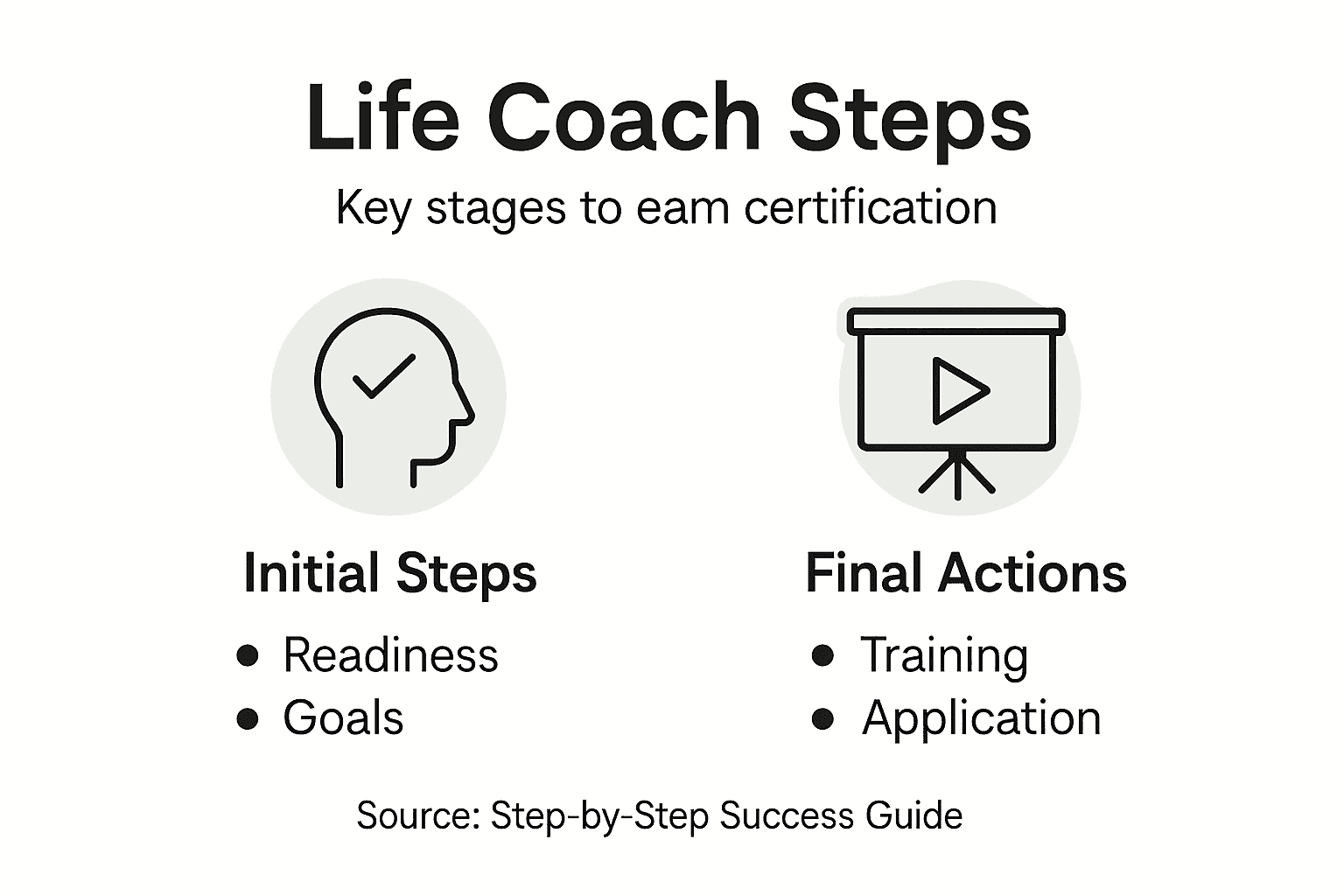
Here’s an overview of how each certification step advances your coaching journey:
| Step | Main Focus | Key Outcome |
|---|---|---|
| Assess Readiness | Self-evaluation and goal setting | Personalized growth plan |
| Research Programs | Find accredited training | Aligned certification path |
| Training & Coursework | Learn and practice skills | Coaching competence |
| Practice & Evaluation | Supervised coaching | Demonstrated proficiency |
| Application & Verification | Submit credentials | Official certification |
Unlock Your Full Potential with Expert Life Coaching Support
Mastering life coach certification demands clear goals, extensive training, and real-world practice. If you find yourself navigating challenges like assessing readiness, choosing accredited programs, or fulfilling practical coaching hours, you are not alone. Many aspiring coaches struggle with transforming their passion into effective coaching competence and official certification. By embracing structured coaching strategies and continuous self-reflection, you can overcome these hurdles and accelerate your path to becoming a transformational coach.
Explore proven tools and insights through Life Coaching Archives – Tariq Juneja to deepen your understanding of coaching techniques and ethical standards. Integrate these learnings with agile methods found in the Agile Coaching Archives – Tariq Juneja to enhance your adaptability in varied coaching environments. Trust the expertise showcased at Tariq Juneja to guide you with personalized leadership and transformation programs designed to boost confidence, reduce stress, and build professional credibility.

Ready to transform your coaching certifications into impactful careers Today is the time to take the next step. Visit https://tariqjuneja.com to book your free consultation and access free resources that will empower you to advance your coaching journey with clarity and confidence.
Frequently Asked Questions
What are the first steps to prepare for life coach certification?
To prepare for life coach certification, start by assessing your personal and professional readiness. Evaluate your skills, identify your motivations, and define specific coaching goals to create a targeted growth plan.
How do I choose the right life coach certification program?
To choose the right program, verify the accreditation status of potential certification programs, examine the depth of their curriculum, and investigate instructor qualifications. Create a comparison chart to evaluate different programs based on these criteria, aiding your decision-making process.
What skills are essential in my life coach training?
Essential skills in life coach training include effective communication, emotional intelligence, and active listening. Focus on mastering these skills during your coursework and seek opportunities for practical application through role-playing and supervised coaching sessions.
How can I effectively complete my practice coaching requirements?
To complete your practice coaching requirements, conduct multiple supervised sessions and maintain detailed documentation of each interaction. Incorporate feedback from supervisors and peers to refine your techniques and demonstrate your emerging coaching proficiency.
What should I include in my certification application?
Your certification application should include academic documentation, logs of your practice coaching hours, recommendation letters, and a personal statement. Organize these components into a dedicated folder to ensure a streamlined application process.
How long does the entire life coach certification process take?
The life coach certification process typically takes 3 to 12 months, depending on the program format and your pace of study. Define a structured timeline with short-term milestones to keep your progress on track and ensure timely completion.