

Coaching often sparks debate among IT leaders who question whether it really delivers measurable results for technology teams. For those managing global teams and driving agile adoption, understanding the true influence of coaching is more than a theoretical exercise—it is about achieving lasting productivity gains and smoother organizational transitions. Backed by research showing a moderate effect size of 0.59 for workplace coaching on leadership and personal outcomes, this article unpacks the real-world impact of coaching for IT teams facing rapid change.
Table of Contents
- Influence Of Coaching Defined And Debunked
- Types Of Coaching In Modern IT Teams
- Key Processes And Success Factors In Coaching
- Impact On Team Productivity And Change Resistance
- Common Pitfalls And How To Avoid Them
Key Takeaways
| Point | Details |
|---|---|
| Coaching Effectiveness | Coaching significantly enhances team productivity and individual performance, supported by robust meta-analyses showing moderate effect sizes. |
| Tailored Approaches | Effective coaching requires personalized interventions that align with individual and team dynamics, emphasizing a customized approach rather than a one-size-fits-all method. |
| Key Success Factors | Establishing clear objectives, building trust, and maintaining continuous assessment are crucial for successful coaching relationships and outcomes. |
| Common Pitfalls | Organizations should avoid unclear objectives and inadequate coach training to ensure meaningful coaching results, promoting a culture of accountability and support. |
Influence of Coaching Defined and Debunked
Coaching has emerged as a powerful strategy for transforming team productivity, moving far beyond traditional management approaches. At its core, coaching represents a personalized development process focused on unlocking individual and collective potential within organizational settings.
Recent meta-analyses have provided robust scientific validation for coaching’s effectiveness. Comprehensive workplace coaching studies revealed statistically significant impacts on leadership and personal outcomes, demonstrating a moderate effect size of 0.59. This empirical evidence challenges skeptical perspectives and confirms coaching’s tangible value.
The evolving landscape of workplace coaching encompasses several critical dimensions:
- Personalized performance enhancement
- Individual skill development
- Organizational culture transformation
- Leadership capability improvement
- Strategic problem-solving support
Understanding coaching requires recognizing its multifaceted nature. Unlike traditional training programs, coaching provides nuanced, individualized interventions tailored to specific team dynamics and personal growth trajectories. Impact of organizational coaching techniques suggests that modern coaching approaches integrate advanced assessment techniques and technology-driven delivery modes.
Pro Tip: Always evaluate a coach’s qualifications and track record before engaging their services to ensure maximum organizational impact.
Types of Coaching in Modern IT Teams
Modern IT teams require sophisticated coaching approaches that address the complex, dynamic nature of technology-driven environments. Organizational coaching strategies have evolved to provide targeted interventions that support individual and collective growth within technology-focused teams.
The primary types of coaching in IT environments include:
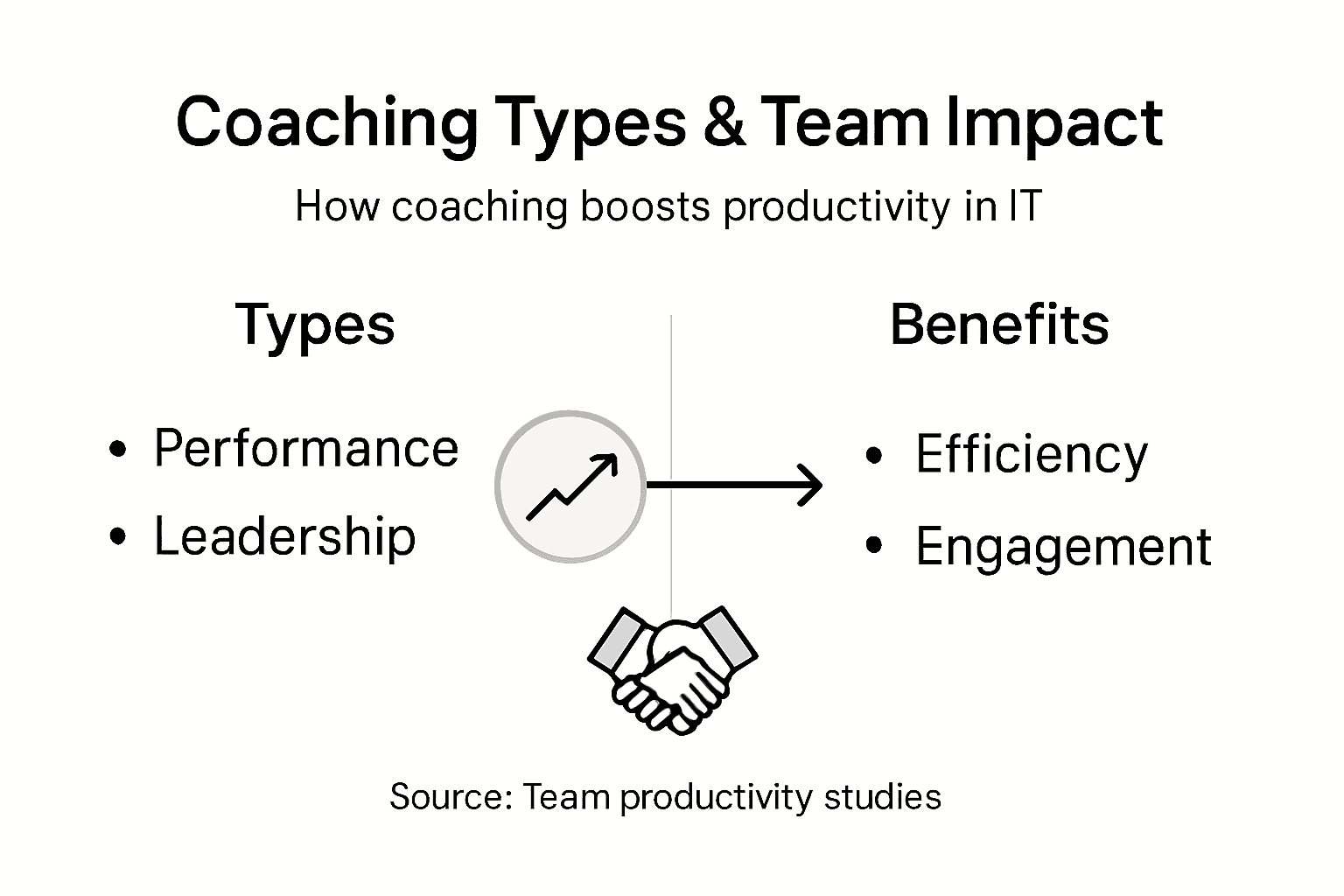
- Performance Coaching: Focused on improving individual and team technical performance
- Leadership Coaching: Developing management capabilities and strategic thinking
- Skills Development Coaching: Addressing technical skill gaps and emerging technology competencies
- Agile Transformation Coaching: Supporting teams through organizational change and process improvement
- Emotional Intelligence Coaching: Enhancing interpersonal dynamics and team collaboration
Each coaching type serves a unique purpose in addressing the multifaceted challenges of modern IT teams. Performance coaching targets specific skill improvements, while leadership coaching develops broader organizational capabilities. The impact of coaching modalities demonstrates how tailored interventions can drive significant organizational transformation.
Successful coaching in IT requires a nuanced understanding of technology team dynamics, individual learning styles, and organizational goals. Coaches must balance technical expertise with interpersonal skills, creating adaptive approaches that respond to the rapid evolution of technology and team structures.
Here’s how different coaching types contribute to IT team success:
| Coaching Type | Typical Focus Area | Key Benefit for IT Teams |
|---|---|---|
| Performance Coaching | Technical execution | Increases project quality |
| Leadership Coaching | Management development | Improves decision-making |
| Skills Development Coaching | Emerging tech skills | Boosts innovation capability |
| Agile Transformation Coaching | Organizational change | Enhances adaptability |
| Emotional Intelligence Coaching | Team collaboration | Reduces conflict and improves morale |
Pro Tip: Select coaching approaches that align specifically with your team’s current challenges and growth objectives to maximize impact and engagement.
Key Processes and Success Factors in Coaching
Successful coaching requires a strategic approach that goes beyond conventional training methodologies. Coaching effectiveness model demonstrates that organizational coaching success depends on multiple interconnected factors.
Key processes for effective coaching include:
- Establishing Clear Objectives: Defining specific, measurable goals
- Building Trust: Creating a safe, supportive coaching relationship
- Continuous Assessment: Regular performance and skill evalueval tracking
- Personalized Intervention: Tailoring approaches to individual learning styles
- Feedback Mechanisms: Implementing structured reflection and improvement cycles
The coaching relationship emerges as a critical success factor, serving as the foundation for meaningful professional development. Coaching session structure plays a crucial role in creating meaningful interactions that drive tangible organizational improvements.

Organizations must recognize that effective coaching is not a one-size-fits-all solution. Successful implementations require nuanced understanding of individual team dynamics, organizational culture, and specific performance objectives. Coaches must demonstrate both technical expertise and exceptional interpersonal skills to navigate complex professional environments.
Pro Tip: Invest in coaches who combine deep technical knowledge with strong emotional intelligence to maximize coaching effectiveness.
Impact on Team Productivity and Change Resistance
Workplace coaching impact demonstrates a powerful approach to transforming team dynamics and overcoming organizational resistance. Coaching emerges as a strategic intervention that simultaneously addresses performance challenges and psychological barriers to change.
Key mechanisms of coaching influence include:
- Performance Enhancement: Directly improving individual and team capabilities
- Communication Improvement: Breaking down organizational silos
- Psychological Safety: Creating environments where team members feel supported
- Skill Development: Addressing competency gaps systematically
- Change Readiness: Building organizational adaptability
The research highlights critical dimensions of coaching’s transformative potential. Coaching federation insights confirm that effective coaching goes beyond traditional training by empowering team members to embrace change proactively.
Successful organizations recognize that change resistance is not a barrier but an opportunity for deeper engagement. Coaching provides a nuanced approach to managing transitions, helping teams navigate complex organizational shifts by addressing individual concerns, aligning personal goals with organizational objectives, and creating a collaborative environment of continuous learning and adaptation.
Pro Tip: Design coaching interventions that balance individual development with collective team goals to minimize change resistance.
Common Pitfalls and How to Avoid Them
Coaching effectiveness research reveals critical challenges that can undermine organizational coaching efforts. Understanding these potential pitfalls is essential for designing robust coaching interventions that drive meaningful performance improvements.
Common coaching challenges include:
- Unclear Objectives: Failing to establish specific, measurable goals
- Inadequate Coach Training: Deploying coaches without proper certification
- Misaligned Organizational Culture: Implementing coaching without systemic support
- Superficial Engagement: Treating coaching as a transactional process
- Limited Accountability: Neglecting continuous performance tracking
The research highlights the importance of strategic implementation. Coaching relationship dynamics demonstrate that successful interventions require deep understanding of organizational contexts and individual team member needs.
Organizations must adopt a holistic approach to coaching, recognizing it as a sophisticated developmental strategy rather than a quick-fix solution. This involves rigorous coach selection, comprehensive training programs, clear performance metrics, and ongoing evaluation to ensure coaching initiatives deliver tangible value and drive meaningful organizational transformation.
Below is a summary of common coaching challenges and how to overcome them:
| Challenge | Impact on Organization | Recommended Solution |
|---|---|---|
| Unclear Objectives | Wasted resources | Set measurable coaching goals |
| Inadequate Coach Training | Poor engagement | Prioritize certified, skilled coaches |
| Misaligned Organizational Culture | Resistance to coaching | Foster supportive leadership commitment |
| Superficial Engagement | Minimal performance change | Promote a culture of deep accountability |
| Limited Accountability | Lack of sustained results | Use ongoing feedback and performance metrics |
Pro Tip: Implement a structured feedback mechanism that allows continuous assessment and refinement of coaching approaches to maximize organizational impact.
Unlock Your Team’s True Potential with Expert Coaching Support
Many teams struggle with unclear objectives and resistance to change that hinder productivity and growth. This article highlights the power of coaching to transform these challenges into opportunities through personalized development, building trust, and enhancing leadership capabilities. If your team faces similar obstacles in performance or adapting to organizational shifts, it is time to embrace proven coaching strategies that create lasting impact.
Discover how tailored approaches like performance, leadership, and agile coaching can elevate your team’s effectiveness and reduce change resistance. Learn actionable insights from the Change Management Archives – Tariq Juneja and explore specialized methods through the Agile Coaching Archives – Tariq Juneja.

Take the next step toward transforming your organization today. Visit https://tariqjuneja.com to book a free consultation and access valuable resources that will help you increase productivity, reduce stress, and embrace change with confidence.
Frequently Asked Questions
What is the primary purpose of coaching in modern organizations?
Coaching in modern organizations focuses on unlocking individual and collective potential, promoting personalized development, enhancing performance, and driving organizational transformation.
What are the main types of coaching for IT teams?
The main types of coaching for IT teams include performance coaching, leadership coaching, skills development coaching, agile transformation coaching, and emotional intelligence coaching. Each type addresses specific needs and challenges within technology-driven environments.
How can organizations ensure the effectiveness of coaching interventions?
Organizations can ensure coaching effectiveness by establishing clear objectives, building trust in the coaching relationship, continuously assessing progress, personalizing interventions, and implementing structured feedback mechanisms.
What are common pitfalls in organizational coaching, and how can they be avoided?
Common pitfalls include unclear objectives, inadequate coach training, misalignment with organizational culture, superficial engagement, and limited accountability. These can be avoided by setting measurable goals, prioritizing certified coaches, fostering supportive leadership, and ensuring continuous assessment of coaching effectiveness.
Recommended
- Understanding Coaching for Productivity: Key Concepts Explained – Tariq Juneja
- Understanding Why Productivity Coaching Enhances Success – Tariq Juneja
- Understanding the Role of Coaching in Productivity – Tariq Juneja
- How to Improve Team Productivity for Lasting Results – Tariq Juneja
- INUSUAL | 7 tipos de coaching empresarial para potenciar tu liderazgo