

Feeling stuck between endless meetings and lofty team targets is a familiar challenge for IT managers everywhere. With constant changes in technology and leadership demands, defining what truly motivates you is more than a soft skill—it is the backbone of lasting achievement. By aligning goals with both intrinsic and extrinsic motivations, you create meaningful goals that drive engagement and accountability. This guide walks through practical steps for setting, clarifying, and acting on your intentions so you can foster growth, focus, and stability for both yourself and your team.
Table of Contents
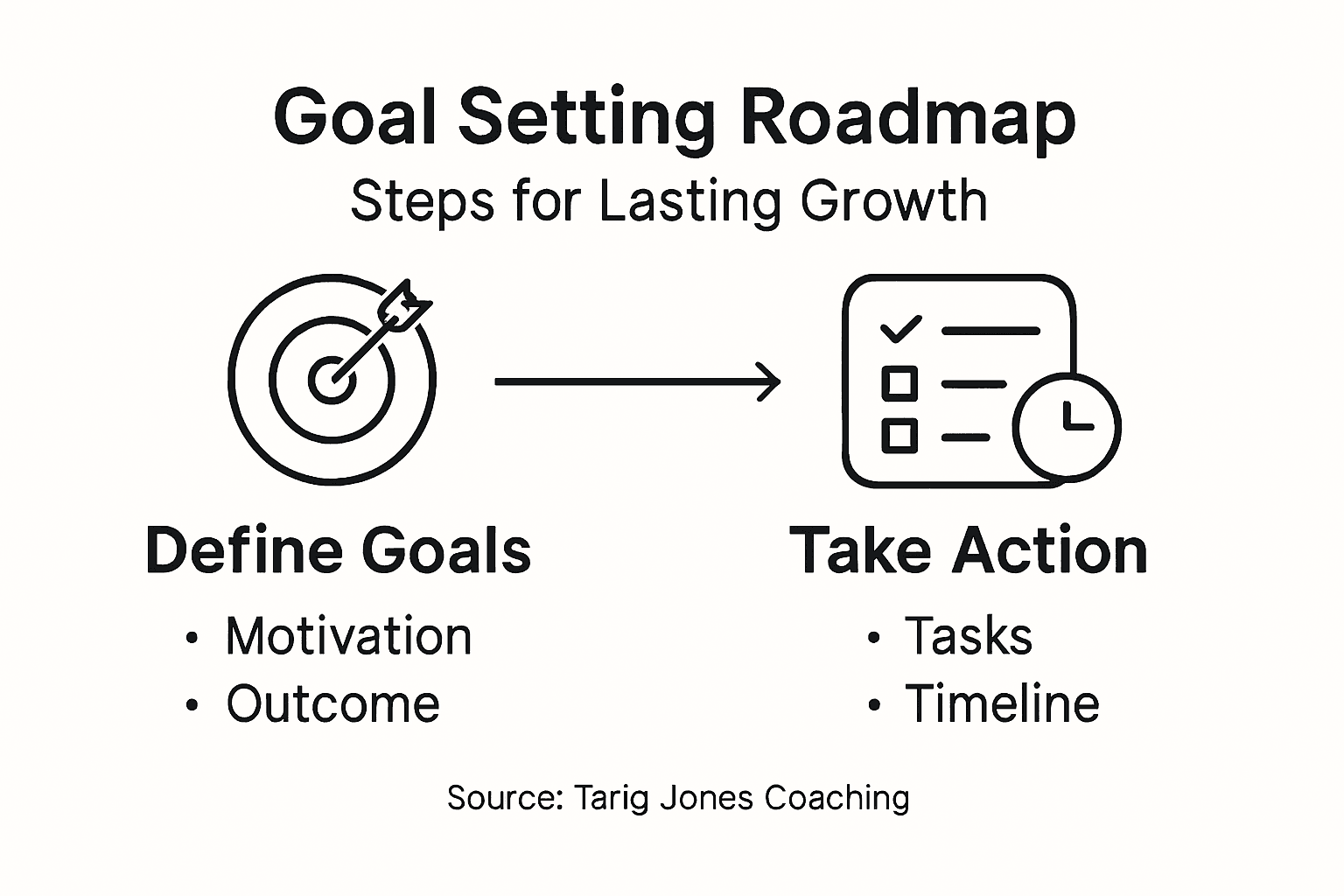
- Step 1: Define Your Core Motivations
- Step 2: Clarify Your Desired Outcomes
- Step 3: Break Down Goals Into Actionable Tasks
- Step 4: Establish Realistic Timelines And Checkpoints
- Step 5: Review Progress And Adjust Strategies
Quick Summary
| Key Point | Explanation |
|---|---|
| 1. Identify Core Motivations | Understand what drives you to create meaningful goals that resonate with your values and ambitions. |
| 2. Define Specific Outcomes | Use SMART criteria to set clear, measurable, and concrete objectives that guide your actions effectively. |
| 3. Break Goals into Tasks | Divide major outcomes into actionable, specific tasks that you can consistently work on to avoid overwhelm. |
| 4. Set Realistic Timelines | Establish achievable deadlines based on your current capacity and build in flexibility to adapt as needed. |
| 5. Review and Adjust Regularly | Continuously assess your progress, learning from what works, and adjust strategies to stay aligned with your goals. |
Step 1: Define your core motivations
Before you set any goals, you need to understand what actually drives you. This is the foundation for everything that follows. Your core motivations are the reasons you get out of bed in the morning, the values that matter most to you, and what you genuinely want from your career and life. Without clarity here, your goals become hollow tasks that feel like obligations rather than meaningful pursuits.
Start by distinguishing between two types of motivation that shape your behavior. Intrinsic motivation comes from within: the satisfaction of solving a complex technical problem, the pride of mentoring a junior developer who finally gets it, or the fulfillment of shipping a project that genuinely improves how your team works. Extrinsic motivation comes from external rewards: the promotion, the salary increase, the recognition at the company meeting. Both matter, but here’s what research shows: intrinsic motivation creates lasting engagement while extrinsic motivation provides that initial spark to get started. As an IT manager, you probably feel both. You might want the promotion (extrinsic), but you also want to build a team that trusts you and delivers quality work (intrinsic). The real power comes from aligning your goals with both types so they reinforce each other.
Now dig deeper into what shapes how you approach your work. Autonomous motivation is when you choose something willingly because it connects to your values. Controlled motivation is when you feel pressured or obligated to do something. Think about your current role. Are you driven to improve team productivity because you genuinely believe it reduces stress and creates a better workplace, or are you doing it because leadership expects quarterly metrics? The difference matters enormously for your persistence and well-being. Your personality, your experiences, and the people around you all influence which motivations resonate most strongly. An IT manager who thrives on building relationships will have different core motivations than one who finds deep satisfaction in technical architecture. Both are valid. Your job is to identify your specific motivations, not adopt someone else’s.
Write down three to five motivations that feel true to you. Not what sounds impressive. Not what you think you should care about. What actually moves you. For an IT manager, this might look like: delivering solutions that make my team’s work easier, developing people and watching them grow, staying current with technology because learning energizes me, reducing operational chaos and creating predictable systems, or building trust with stakeholders. Once you have these written down, look at them. Do they feel authentic? Do they make you slightly more energized just reading them? If not, you’re not there yet. Keep digging. This clarity becomes the filter through which you’ll evaluate every goal you set. A goal that aligns with your core motivations will pull you forward. One that contradicts them will drain you no matter how important it looks on paper.
Here’s a comparison of motivation types and their impact in an IT manager’s role:
| Motivation Type | Definition | Common Examples | Impact on Engagement |
|---|---|---|---|
| Intrinsic | Driven by internal satisfaction | Solving complex problems, team growth | Long-term sustained focus |
| Extrinsic | Motivated by external rewards and outcomes | Promotions, salary increases, recognition | Initial drive to act |
| Autonomous | Motivation aligned with true values | Pursuing personal learning, trusted relationships | Enhances persistence |
| Controlled | Motivation stemming from obligation/pressure | Meeting leadership metrics, compliance | Leads to faster burnout |
Pro tip: Review your core motivations every quarter as your role and circumstances evolve. What drove you six months ago might shift as you take on new responsibilities or face different challenges, and that’s completely normal. Periodic clarity checks prevent you from pursuing stale goals that no longer matter.
Step 2: Clarify your desired outcomes
Now that you understand what drives you, it’s time to translate those motivations into concrete outcomes. Vague aspirations like “improve my team” or “grow as a leader” feel good but won’t guide your actions. You need outcomes so clear that you could explain them to someone else in thirty seconds and they would instantly understand what success looks like.
The most effective way to define outcomes is using SMART goals: Specific, Measurable, Achievable, Relevant, and Time-bound. Let’s break this down in the context of your role as an IT manager. Instead of “reduce team stress,” try “implement automated deployment pipelines for three key services by September 30th to eliminate manual release procedures that consume fifteen hours per week.” Instead of “develop my team,” try “ensure all five direct reports complete one professional certification relevant to their role by next December and lead monthly technical knowledge-sharing sessions.” See the difference? One is a direction. The other is a target.
Start by writing down what you want to achieve. Make it specific enough that you can picture it. Then ask yourself: Can I measure this? How would I know when I’ve succeeded? If you can’t answer that question, keep refining. Measurable outcomes keep you honest. They also combat one of the biggest killers of motivation: that creeping sense of overwhelm where you’re not sure if you’re making progress. When you can point to concrete evidence that you’ve moved the needle, motivation naturally follows.

Now connect these outcomes across different timeframes. Short, medium, and long-term goals create a roadmap instead of disconnected wishes. Your long-term outcome might be “become the go-to technical leader who vendors and architects trust to evaluate new solutions.” Your medium-term outcome (six months to one year) could be “develop expertise in cloud architecture and lead the evaluation of at least two major platform migrations.” Your short-term outcome (next three months) might be “complete the AWS Solutions Architect certification and present findings to leadership.” Each level feeds into the next. This structure prevents your goals from feeling abstract or overwhelming.
Here’s what makes this work for IT managers specifically: tie your outcomes back to what matters to your organization. A goal to “improve code quality” is relevant. A goal to “reduce production incidents by forty percent in the next two quarters, which directly impacts customer satisfaction scores” is relevant and creates urgency. That urgency is what moves your goal from the back of your mind to the top of your priority list. You stop seeing it as something nice to have and start seeing it as something you must do.
Write down your outcomes using this approach: Start with one major long-term outcome connected to your core motivations. Then identify two to three medium-term milestones that would prove progress toward that long-term goal. Finally, commit to one short-term outcome you can accomplish in the next ninety days. This pyramid structure gives you clarity without drowning you in a hundred different initiatives.
Pro tip: Share your clarified outcomes with your manager or a trusted peer and ask them to challenge your measurability. If they can’t understand exactly what success looks like, your outcome needs more work. External eyes catch vagueness you might miss on your own.
Step 3: Break down goals into actionable tasks
You’ve defined your core motivations and clarified your desired outcomes. Now comes the part that separates people who achieve their goals from people who abandon them by February: breaking those big outcomes into actual tasks you can do today, this week, and this month. A goal without tasks is still just a wish. Tasks are what move you from intention to action.
Start by looking at your major goal and asking yourself a simple question: What would have to happen for me to achieve this? If your goal is to reduce production incidents by forty percent in two quarters, what has to change? Maybe you need better monitoring. Maybe your team needs training on new deployment practices. Maybe you need to establish a post-incident review process. Each of these becomes a milestone. Breaking down large goals into smaller milestones transforms what feels overwhelming into a series of achievable steps. Now take each milestone and break it down further. If your milestone is “establish post-incident review process,” your tasks might be: research industry best practices, draft a review template, present it to the team, run three trial reviews, refine based on feedback. Suddenly you have concrete things to do instead of a vague intention.
Here’s what most people miss: your tasks need to be specific enough that someone else could understand exactly what you’re doing. Not “improve team communication.” Instead, “schedule weekly thirty-minute standup meetings every Tuesday at nine AM and document decisions in shared Slack channel.” Not “develop cloud skills.” Instead, “complete two AWS certification practice exams by end of month and document three lessons learned in team wiki.” The specificity does the heavy lifting. It removes the gray area where procrastination hides. When a task is crystal clear, you either do it or you don’t. There’s no ambiguity.
Now prioritize your tasks. You probably have more to do than you have time for. That’s normal. The mistake is treating everything as equally urgent. Look at your tasks and ask: Which ones create momentum? Which ones unlock other work? Which ones directly impact your core motivation? An IT manager might rank “implement continuous integration pipeline” higher than “document deployment process” because the automation creates immediate relief for the team and directly addresses reducing manual work (connecting back to the core motivation of reducing stress). Prioritization is not about doing everything. It’s about doing the right things first.
The final piece is monitoring progress and celebrating milestones. Every time you complete a task, mark it done. This sounds obvious, but your brain needs that feedback loop. Checking something off your list creates momentum. It proves you’re making progress. Without this, you can work for weeks and feel like you’re standing still because you’re not pausing to acknowledge what you’ve actually accomplished. When you hit a milestone, stop and recognize it. This might mean a quick message to your manager, a celebration with your team, or simply taking five minutes to reflect on how far you’ve come. That acknowledgment is what keeps you pushing forward when the goal still feels distant.
Create a simple tracking system. This could be a spreadsheet, a project management tool, a notebook, or whatever you’ll actually use consistently. List your major goal at the top. Below that, list your milestones with target dates. Below each milestone, list the specific tasks. As you complete tasks, mark them done. Review this document weekly. Adjust as needed. You’re not trying to predict the future perfectly. You’re creating a living roadmap that keeps you focused and moving.
Pro tip: Break your most urgent goal into just the first ten tasks and stop there. Trying to map out every single task from now until next year creates decision fatigue and overwhelm. Once you finish those first ten, you’ll have momentum and clarity to plan the next batch. This rolling approach keeps your planning fresh and lets you adjust course as circumstances change.
Step 4: Establish realistic timelines and checkpoints
You’ve broken your goals into tasks. Now you need to anchor those tasks in time. A timeline transforms a task list into a commitment. Without dates, tasks have a way of sliding backward indefinitely. You keep saying you’ll start next week, then next month, then next quarter. Before you know it, a year has passed and nothing has changed.
Start by being honest about your capacity. This is where most people fail. They look at their goal, get excited, and create a timeline based on what they wish they could do rather than what they can actually do given their current reality. You’re managing a team. You have meetings. You have firefighting. You have competing priorities from leadership. Setting realistic goals requires awareness of your personal skills, resources, and constraints while still pushing yourself to grow. If you typically have ten hours per week of uninterrupted focus time, don’t pretend you suddenly have twenty. If you know your team is understaffed for the next quarter, don’t commit to launching two major initiatives during that period. Ambition matters, but it only works when it’s grounded in reality.
Now build your timeline backward from your goal deadline. If your goal is to reduce incidents by forty percent by the end of Q3, work backward. When do you need the post-incident review process fully operational? Probably by week eight of the quarter to give it time to show results. When do you need to have trained the team on it? Week six. When do you need to have drafted and tested the template? Week four. When do you need to start researching best practices? This week. This backward planning ensures your timeline is actually achievable rather than overly optimistic.
Create checkpoints at logical intervals. These are not the same as your tasks. A checkpoint is a moment where you stop and assess whether you’re on track. For a three-month goal, monthly checkpoints make sense. For a six-month goal, consider checkpoints every six to eight weeks. At each checkpoint, ask yourself three questions: Did I complete what I planned to accomplish? If not, why? What needs to adjust going forward? This is where many people get stuck. They miss a checkpoint deadline and feel like failures. But checkpoints aren’t about perfection. They’re about reality checking. Sometimes you’ll discover your timeline was too aggressive. Sometimes you’ll discover something changed in your environment. Both are valuable information that lets you adjust rather than abandon the goal entirely.
Here’s what separates successful managers from perpetually stressed ones: they build flexibility into their timelines. Maintaining flexibility within timelines is crucial to accommodate unpredictability without losing long-term focus. This doesn’t mean changing your deadline every time something comes up. It means acknowledging that unexpected things will happen. A critical production issue. A team member leaving. A vendor delaying a solution you were counting on. When these things happen, you don’t panic. You look at your timeline, move some tasks around, adjust your checkpoint dates if needed, and keep moving. The goal stays the same. The path to get there adjusts. This resilience is what keeps you moving forward instead of frozen by perfectionism.
Create a simple visual timeline. This could be a Gantt chart, a calendar with milestones marked, a spreadsheet with dates, whatever you’ll actually look at regularly. Include your major goal, your milestones, the tasks needed for each milestone, the deadline for each task, and your checkpoint dates. Share this with your manager or a trusted peer so you have external accountability. When you know someone else is aware of your timeline, you’re more likely to keep yourself honest.
Pro tip: Build in a ten to fifteen percent buffer on every timeline you create. If you think a task will take five hours, plan for six. If you think a milestone will take four weeks, schedule six. This buffer absorbs the inevitable surprises without throwing your entire timeline off track, and it prevents the chronic stress of always running behind schedule.
The following table summarizes how to structure goal timelines for maximum effectiveness as an IT manager:
| Timeline Element | Best Practice | Reason for Approach | Example Application |
|---|---|---|---|
| Goal Deadline | Start planning from end date backward | Ensures every prerequisite is scheduled | Achieve 40% incident reduction by Q3 |
| Checkpoints | Insert monthly or bi-monthly reviews | Allows realistic course corrections | Monthly review of milestones |
| Task Deadlines | Allocate buffer time for each deliverable | Prevents overwhelm, absorbs disruptions | Schedule 6 weeks for a 4-week task |
| Flexibility | Adjust timelines as circumstances change | Maintains progress despite unpredictability | Reschedule due to system failure |
Step 5: Review progress and adjust strategies
You have your goals defined, your tasks broken down, and your timelines set. Now comes the part that separates managers who achieve lasting results from those who burn out chasing goals that no longer fit their reality: regular review and honest adjustment. Progress review is not a one-time event at the end of the quarter. It’s an ongoing conversation you have with yourself about what’s working and what needs to change.
Schedule your reviews at the checkpoints you established earlier. If you set monthly checkpoints, review monthly. Quarterly checkpoints mean quarterly reviews. During each review, pull out your original goal and your tracking system. Look at what you’ve completed. Look at what you haven’t. Don’t judge yourself yet. Just observe. Did you finish the tasks you planned? If yes, great. If no, ask why. Was it because the timeline was unrealistic? Because something unexpected came up? Because you deprioritized it in favor of something more urgent? Each reason points to a different adjustment.
Continuous review of progress allows adjustments tailored to your individual needs and context. This is critical. Your circumstances change. Your team changes. Your organization’s priorities shift. A strategy that made perfect sense three months ago might no longer apply today. Maybe you planned to spend twenty percent of your time on team development, but a critical system failure consumed that time for eight weeks. That’s not failure. That’s reality. The adjustment is recognizing that your development timeline needs to shift, not abandoning the goal entirely.
When you review, ask yourself three specific questions. First: Am I still moving toward my goal? Track the actual metrics if you set them. If your goal was to reduce incidents by forty percent and you’re at thirty percent with four weeks left, you’re on track. If you’re at five percent, something needs to change. Second: Are my tactics still working? Maybe the post-incident review process you implemented isn’t capturing the insights you expected. Maybe your team training approach isn’t sticking. These tactical failures don’t mean the goal is wrong. They mean the path needs adjustment. Third: Has something shifted that changes my goal’s relevance? Perhaps a merger, a new executive, or a market shift makes your original goal less critical. Sometimes your goal remains important but needs different timing.
Here’s where many managers get stuck: they confuse reviewing progress with beating themselves up. Review is not judgment. It’s data gathering. Regularly reviewing what works and what doesn’t empowers you to overcome obstacles and stay motivated. This matters because every time you adjust your strategy and move forward anyway, you build confidence. You prove to yourself that obstacles aren’t stops. They’re course corrections.
Make your adjustments visible. When you adjust a timeline, update your tracking system. When you shift a tactic, note why. When you realize a goal needs to change, communicate that change to your manager. You’re not failing if you adjust. You’re being intelligent. Most successful leaders adjust their strategies quarterly. Some adjust monthly. None of them pretend their original plan is perfect.
Crate a simple review template you use at each checkpoint. Write down: what you planned, what you accomplished, what you didn’t accomplish and why, what you’ve learned about what works, what tactics you’ll keep, what tactics you’ll change, and your adjusted plan for the next period. This practice takes thirty minutes. It saves months of wasted effort chasing strategies that aren’t working.
Pro tip: Do your progress reviews in writing, not just in your head. Writing forces clarity. You can’t fudge numbers on a spreadsheet the way you can in mental calculation. You also create a record that shows your thinking over time, which helps you spot patterns. After six months of reviews, you’ll see exactly what strategies work best in your context, and that intelligence becomes invaluable.
Unlock Your Full Potential with Expert Coaching for Lasting Growth
Setting personal goals is just the beginning. If you find it challenging to define motivations, break down complex goals into actionable steps, or maintain momentum amid competing demands, you are not alone. This article highlights key pain points like aligning your goals with intrinsic motivation, creating measurable outcomes, and establishing realistic timelines that can be overwhelming without the right support.
Harness proven strategies and personalized guidance to overcome these obstacles and accelerate your progress. At Tariq Juneja, we specialize in transformational coaching and agile leadership development tailored for professionals ready to embrace change and achieve lasting success.

Ready to transform your goal-setting approach and sustain meaningful growth? Explore our insights through the Agile Coaching Archives and discover coaching programs designed to increase your productivity, reduce stress, and bring clarity to your professional journey. Take the first step today by visiting https://tariqjuneja.com and book a free consultation to start turning your aspirations into actionable success.
Frequently Asked Questions
How can I effectively define my core motivations for personal growth?
Understanding your core motivations involves reflecting on what genuinely drives you. Start by identifying what you are passionate about and what values are important to you. Write down three to five motivations that resonate deeply with you and ignite your energy. This clarity will serve as the foundation for your personal goals.
What are SMART goals, and how can I apply them to my personal success?
SMART goals are Specific, Measurable, Achievable, Relevant, and Time-bound objectives. To apply them, rephrase your aspirations into clear, concrete outcomes, like “complete a professional certification by December” instead of “improve my skills.” This specificity will make it easier to track your progress.
How should I break down my goals into actionable tasks?
To turn your goals into actionable tasks, start by posing the question, “What must happen to achieve this?” Then, outline each milestone and the specific steps needed to reach them. For example, if your goal is to finish a certification, your tasks could include researching resources, completing practice exams, and scheduling study sessions.
What strategies can I use to establish realistic timelines for my goals?
Establish realistic timelines by first assessing your current commitments and available time. Then, create a timeline that allows you to work backward from your goal deadline, building in checkpoints for assessing progress along the way. This approach ensures that your timelines are both achievable and adjustable as needed.
How often should I review my progress toward my personal goals?
You should review your progress regularly at predetermined checkpoints, such as monthly or quarterly. During each review, evaluate your accomplishments and any adjustments needed based on what’s working or not. Aim for a 30-minute reflection session to recalibrate your strategies and maintain momentum.
What should I do if I find my goals are no longer relevant to my circumstances?
If your goals have lost relevance, assess what has changed in your environment or priorities. Adjustments are not failures; they simply reflect growth and adaptability. Revisit your original motivations and redefine your goals to align more closely with your current context.
Recommended
- How to Set Goals for Lasting Success: A Step-by-Step Guide – Tariq Juneja
- 7 Personal Goals to Set for Yourself for Lasting Success – Tariq Juneja
- Understanding Why Set Personal Goals for Success – Tariq Juneja
- 7 Powerful Personal Development Goals Examples for Growth – Tariq Juneja
- Aligning Cybersecurity Investments with Long-Term Organizational Goals for Strategic Success – Heights Consulting Group