

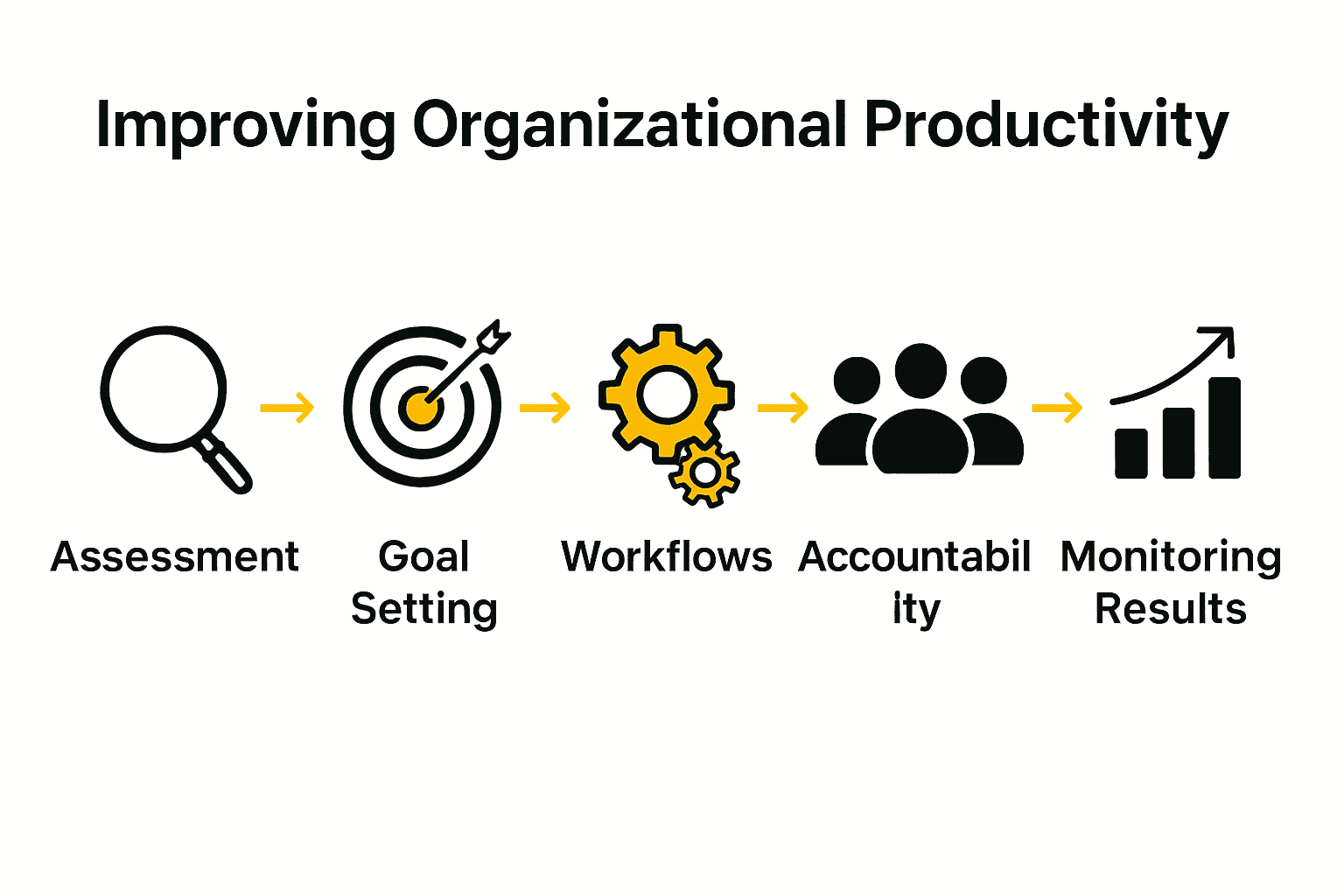
Did you know that businesses can lose up to 20 percent of their annual productivity due to overlooked workflow barriers and unclear goals? Identifying and resolving these hidden obstacles can unlock significant growth and improve team satisfaction. By taking a systematic approach to assessment, goal setting, and workflow design, organizations create a stronger foundation for sustained performance and a culture that encourages both accountability and engagement.
Table of Contents
- Step 1: Assess Current Productivity Barriers
- Step 2: Define Clear And Measurable Goals
- Step 3: Implement Agile And Efficient Workflows
- Step 4: Foster A Culture Of Accountability And Engagement
- Step 5: Monitor Results And Adjust Strategies
Quick Summary
| Key Point | Explanation |
|---|---|
| 1. Assess productivity barriers systematically | Begin with a detailed evaluation of your team’s obstacles to identify key areas needing improvement. |
| 2. Set SMART goals for clarity | Implement Specific, Measurable, Achievable, Relevant, Time-bound goals to guide team efforts effectively. |
| 3. Implement agile workflows | Create flexible systems that adapt to change, improving productivity and reducing friction within teams. |
| 4. Foster accountability and engagement | Build a culture that encourages ownership and values employee contributions to enhance commitment. |
| 5. Monitor and adjust strategies regularly | Use performance data to make informed adjustments, fostering a responsive and continuously improving organization. |
Step 1: Assess current productivity barriers
Understanding where your organization’s productivity bottlenecks exist is the critical first step toward meaningful transformation. This process involves systematic evaluation of performance obstacles that might be hindering your team’s efficiency and output.
Start by conducting a comprehensive organizational diagnostic. According to the OECD overview on digital transformation, key productivity barriers often include limited digital infrastructure, insufficient skill sets, low technological awareness, and financial constraints.
Begin your assessment through multiple strategic approaches:
Here’s a summary of common productivity barriers and suggested assessment methods:
| Productivity Barrier | Assessment Method | Example Focus Area |
|---|---|---|
| Limited digital infrastructure | Technology Capability Assessment | Evaluate software/hardware gaps |
| Insufficient skill sets | Employee Feedback Surveys | Identify training needs |
| Low technological awareness | Process Mapping | Document workflow inefficiencies |
| Financial constraints | Performance Data Analysis | Review cost-effectiveness metrics |
- Performance Data Analysis: Review existing productivity metrics, project completion rates, and individual team member output.
- Employee Feedback Surveys: Directly gather insights about workflow challenges, communication barriers, and resource limitations.
- Process Mapping: Visually document current workflows to identify unnecessary steps, redundancies, and potential optimization points.
- Technology Capability Assessment: Evaluate current digital tools and determine gaps between existing capabilities and required technological infrastructure.
Pro Tip: Approach this assessment without blame. Frame it as a collaborative improvement opportunity where everyone contributes to understanding organizational challenges.
While examining productivity barriers, pay special attention to communication channels, technological limitations, and skill development opportunities. The goal is not just identifying problems but creating a roadmap for strategic improvements.
As you complete this diagnostic phase, you will transition into developing targeted strategies for addressing the uncovered productivity obstacles. Your next step involves prioritizing these findings and creating an actionable implementation plan.
Step 2: Define clear and measurable goals
Defining clear and measurable goals transforms organizational aspirations into actionable strategies. This critical step provides a roadmap that aligns team efforts and creates a quantifiable framework for success.
Research from the McKinsey 7S Framework suggests approaching goal setting through a comprehensive lens that integrates strategy, structure, systems, skills, staff, style, and shared values. According to the McKinsey 7S Framework, organizational goals must reflect holistic alignment across multiple dimensions.
When defining organizational goals, implement these strategic practices:
- SMART Goal Methodology: Ensure each goal is Specific, Measurable, Achievable, Relevant, and Time-bound.
- Quantitative Metrics: Establish precise numerical targets that can be tracked and evaluated.
- Cascading Goal Alignment: Connect individual team member objectives with broader organizational outcomes.
- Regular Review Intervals: Schedule periodic assessments to validate goal relevance and progress.
Pro Tip: Involve team members in goal development to increase engagement and collective ownership.
The OECD working paper recommends creating multi-dimensional goals that consider broader impacts such as skill development, job quality, and inclusive growth.
By establishing clear and measurable goals, you create a strategic blueprint that transforms organizational potential into tangible performance improvements.
 Your next step involves developing implementation strategies that will turn these goals into reality.
Step 3: Implement agile and efficient workflows
Implementing agile and efficient workflows transforms organizational performance by creating flexible, responsive systems that adapt quickly to changing business environments. This critical step enables your team to maximize productivity and minimize operational friction.
According to the Input-Process-Output model, understanding how organizational inputs and processes impact outputs is fundamental to developing effective workflows.
Key strategies for implementing agile workflows include:
- Modular Work Structures: Break complex projects into manageable, iterative segments.
- Cross Functional Collaboration: Encourage communication and knowledge sharing across different team units.
- Continuous Feedback Mechanisms: Establish regular check ins and performance review processes.
- Technology Integration: Utilize digital tools that support seamless communication and task management.
Research on technostress highlights a critical consideration. As revealed in academic studies, technological integration must be strategically managed to prevent potential performance disruptions caused by workplace stress.
Pro Tip: Introduce technological changes gradually and provide comprehensive training to ensure smooth adoption.
Successful workflow implementation requires balancing structure with flexibility. Monitor your processes continuously, remain open to refinement, and prioritize team adaptability.
With efficient workflows established, you will be prepared to move forward in optimizing organizational productivity through targeted performance management strategies.
Step 4: Foster a culture of accountability and engagement
Fostering a culture of accountability and engagement transforms workplace dynamics by creating an environment where employees feel valued, motivated, and personally invested in organizational success. This critical step bridges individual performance with collective organizational goals.
Research highlights the complex interplay between work environments and employee commitment. According to studies on stakeholder engagement, understanding individual motivations is key to building a robust accountability framework.
Strategic approaches to cultivate accountability and engagement include:
- Transparent Communication: Create open channels where expectations and outcomes are clearly articulated.
- Recognition Programs: Develop meaningful ways to acknowledge individual and team achievements.
- Personal Development Opportunities: Invest in training and growth pathways that demonstrate organizational commitment.
- Balanced Workload Management: Design systems that prevent employee burnout and support sustainable performance.
Research on presenteeism reveals a critical insight. According to studies, excessive workloads can undermine genuine engagement, suggesting that accountability must be balanced with employee wellbeing.
Pro Tip: Accountability is not about punishment but about creating a supportive environment where team members feel empowered to take ownership of their work.
Organizational psychology research emphasizes that work-family balance significantly impacts employee commitment. By recognizing employees as whole individuals with complex lives, you create a more authentic and responsive workplace culture.
With a strong foundation of accountability and engagement established, you are now prepared to implement performance measurement and continuous improvement strategies that will further elevate organizational productivity.
Step 5: Monitor results and adjust strategies
Monitoring results and adjusting strategies is the critical final step in creating a dynamic and responsive organizational productivity framework. This process transforms performance data into actionable insights that drive continuous improvement and sustainable growth.
The OECD Compendium of Productivity Indicators provides a comprehensive approach to tracking organizational performance across multiple dimensions.
Key strategies for effective monitoring and adjustment include:
- Performance Dashboards: Create visual representations of key performance indicators.
- Regular Data Review Sessions: Schedule consistent intervals for comprehensive performance analysis.
- Adaptive Feedback Mechanisms: Develop systems that allow rapid response to emerging trends.
- Comparative Benchmarking: Compare internal performance against industry standards and best practices.
Research highlights the importance of reducing administrative barriers. According to OECD surveys, organizations should focus on streamlining procedures and embracing digital transformation to maintain productivity momentum.
Pro Tip: View performance monitoring as a collaborative process, not a punitive exercise. Involve team members in interpreting results and designing improvements.
Successful strategy adjustment requires a balance between data driven insights and human intuition. Be prepared to experiment, learn, and pivot quickly as new information emerges.
By establishing a robust monitoring and adjustment framework, you create an organizational culture of continuous learning and incremental excellence that adapts to changing business landscapes.
Unlock Your Organization’s True Productivity Potential Today
Feeling overwhelmed by productivity barriers like unclear goals, inefficient workflows, or low team engagement? This article highlights the key challenges many organizations face when trying to improve productivity effectively. Common pain points such as limited digital infrastructure, the need for agile work processes, and fostering accountability can stall your progress and lead to frustration.
Take action now to transform these challenges into opportunities. With expert guidance through focused strategies like agile coaching and transformational change, you can empower your teams to embrace flexibility, improve collaboration, and sustain high performance. Discover how personalized coaching can help you define clear, measurable goals and implement workflows that reduce stress while boosting output.
Start your journey with proven insights and hands-on support by exploring Agile Coaching Archives – Tariq Juneja to see how agile practices drive real results.
Ready to overcome productivity blockers and accelerate your organizational growth? Visit https://tariqjuneja.com to schedule a free consultation or access exclusive resources designed to help you and your team thrive right now.
Frequently Asked Questions
How can I assess productivity barriers in my organization?
To assess productivity barriers, conduct an organizational diagnostic that examines technological capabilities, employee skill sets, and communication inefficiencies. Gather insights through employee feedback surveys and performance data analysis to identify specific areas needing improvement.
What steps should I take to define clear productivity goals?
Define clear productivity goals by using the SMART methodology: ensure that each goal is Specific, Measurable, Achievable, Relevant, and Time-bound. Involve your team in this process to foster ownership and align individual objectives with organizational outcomes.
How do I implement efficient workflows in my organization?
Implement efficient workflows by breaking down projects into manageable modules and fostering cross-functional collaboration. Establish continuous feedback mechanisms to refine processes, ensuring your team can adapt quickly to changing needs.
What strategies can foster a culture of accountability and engagement?
Foster a culture of accountability by promoting transparent communication and recognizing individual achievements. Invest in personal development opportunities to show commitment to employee growth, which can ultimately increase overall engagement.
How should I monitor results and adjust productivity strategies?
Monitor results by creating performance dashboards and scheduling regular review sessions. Use adaptive feedback mechanisms to quickly respond to trends, allowing your team to make data-driven adjustments to improve productivity continuously.
What is the importance of involving team members in goal setting?
Involving team members in goal setting increases engagement and enhances their commitment to organizational success. When employees participate in defining goals, they are more likely to feel a sense of ownership and contribute effectively to achieving those objectives.
Recommended
- How to Improve Employee Productivity: Boost Performance Effectively – Tariq Juneja
- How Can a Business Increase Productivity: Proven Steps – Tariq Juneja
- Understanding Why Productivity Coaching Enhances Success – Tariq Juneja
- Understanding Coaching for Productivity: Key Concepts Explained – Tariq Juneja
- Just in Time Delivery: Essential Guide for 2025 Success – ORNER
- Workplace Automation Tutorial: Streamline Your Business Today