

Setting goals might sound simple, yet most people never turn their dreams into reality. Statistics reveal that over 92 percent of people fail to achieve their New Year’s goals. Surprising, right? The real unlock is not just about choosing goals. It’s about building a process that takes you step by step from vague hope to genuine achievement.
Table of Contents
- Step 1: Define Your Dreams And Goals
- Step 2: Create A Strategic Plan
- Step 3: Prioritize And Break Down Tasks
- Step 4: Execute Your Plan Consistently
- Step 5: Monitor Progress And Adapt Strategies
- Step 6: Celebrate Milestones And Reflect
Quick Summary
| Key Point | Explanation |
|---|---|
| 1. Define Specific Goals | Craft goals that are clear, measurable, and emotionally meaningful for better alignment with your values. |
| 2. Create a Flexible Plan | Develop a strategic plan with actionable milestones and adapt it as needed to overcome obstacles and seize opportunities. |
| 3. Prioritize Task Management | Break down goals into manageable tasks and prioritize them to create momentum and avoid feeling overwhelmed. |
| 4. Execute with Consistency | Establish daily routines that support your goals, focusing on discipline and accountability for sustained progress. |
| 5. Reflect and Celebrate Progress | Regularly celebrate milestones and reflect on growth, recognizing achievements provides motivation and maintains momentum. |
Step 1: Define Your Dreams and Goals
Defining your dreams and goals is the foundational step in transforming your aspirations from abstract thoughts into tangible achievements. This critical initial phase sets the trajectory for your entire personal and professional journey. Understanding how to set meaningful goals begins with deep self-reflection and honest assessment of what truly matters to you.
Successful goal setting requires more than simply writing down vague wishes. You need to craft goals that are specific, measurable, and emotionally resonant. Start by asking yourself profound questions: What would make you feel truly fulfilled? What achievements would provide genuine satisfaction? What impact do you want to create in your personal or professional life?
To effectively define your dreams, engage in a structured exploration of your inner motivations. Consider creating a vision board or journaling about your ideal future. Visualize yourself five or ten years from now. What does that version of yourself look like? What accomplishments have you realized? What challenges have you overcome? These visualization exercises help translate abstract desires into concrete objectives.
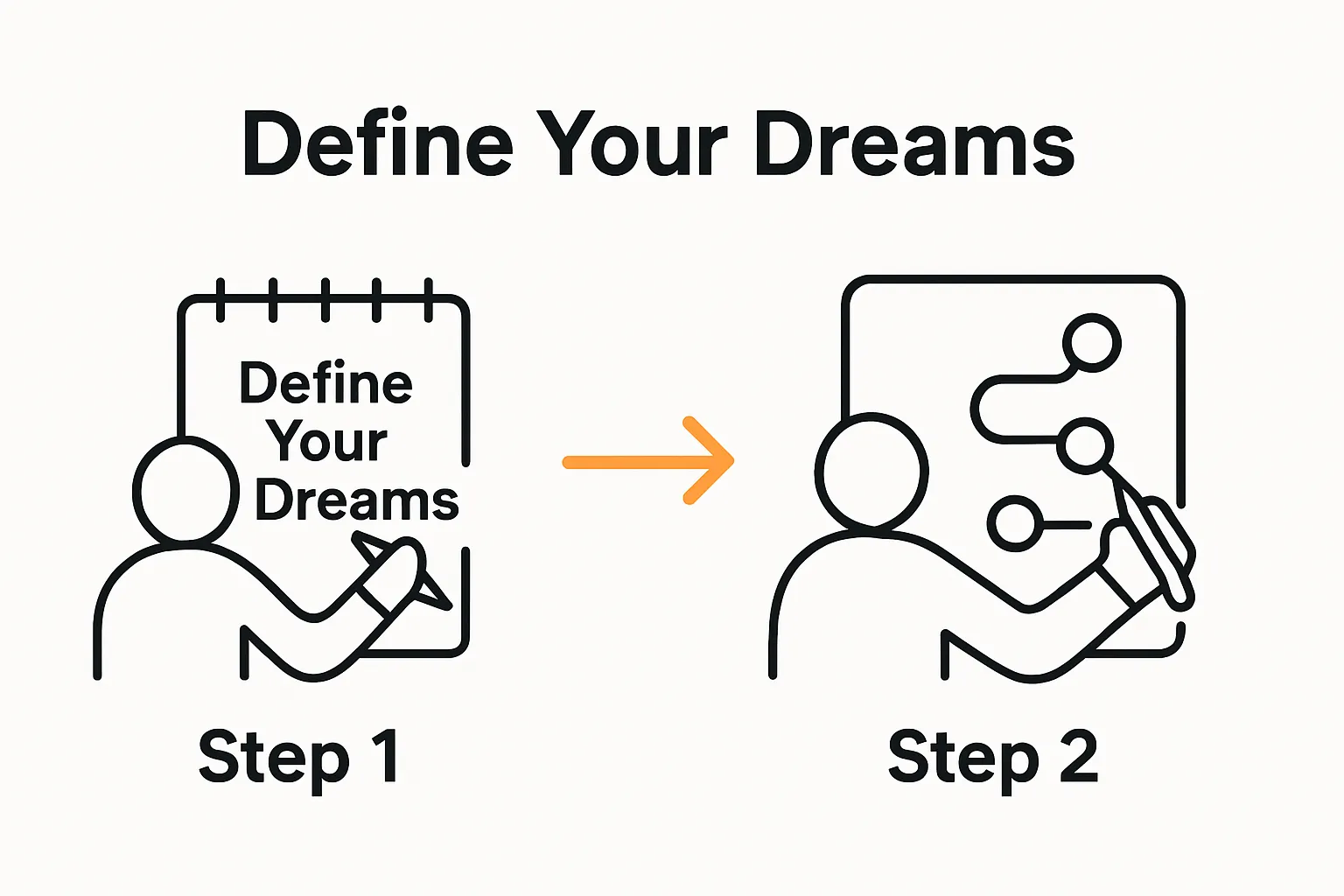
As you develop your goals, categorize them across different life domains personal growth, career, relationships, health, and financial well being. This comprehensive approach ensures you are creating a holistic vision that addresses multiple aspects of your life. Prioritize goals that align with your core values and have genuine meaning beyond surface level achievements.
Remember that goal setting is an iterative process. Your dreams will evolve as you grow and gain new perspectives. Be flexible and willing to reassess and adjust your goals periodically. The most successful individuals view their goals as dynamic roadmaps rather than rigid, unchangeable documents.
To verify you have effectively defined your dreams, ask yourself: Are my goals clear and specific? Do they excite and motivate me? Can I visualize myself achieving them? Have I written them down in a way that feels authentic and inspiring? If you can confidently answer yes to these questions, you have completed the crucial first step in your journey toward achieving your dreams.
Step 2: Create a Strategic Plan
Creating a strategic plan transforms your dreams from abstract concepts into actionable blueprints for success. This critical step bridges the gap between aspiration and achievement by providing a structured roadmap that breaks down complex goals into manageable components. Developing comprehensive goal strategies requires careful planning and intentional design.
A powerful strategic plan begins with reverse engineering your ultimate objective. Start by identifying your primary goal and then work backwards, breaking it down into smaller, interconnected milestones. This approach allows you to create a logical progression of actions that systematically move you toward your ultimate vision. Consider each milestone as a strategic checkpoint that provides momentum and validates your progress.
Design your plan with flexibility and adaptability in mind. Strategic planning is not about creating a rigid framework but developing a dynamic roadmap that can evolve as you encounter new opportunities and challenges. Map out potential obstacles and create contingency strategies for each potential scenario. This proactive approach ensures you remain resilient and focused, even when unexpected challenges arise.
Time management becomes crucial in strategic planning. Assign realistic timelines to each milestone, understanding that some goals require incremental progress. Use tools like digital calendars, project management applications, or traditional planners to track your progress. Color code your milestones, set reminders, and create visual representations of your journey that keep you motivated and accountable.
Incorporate measurable metrics into your strategic plan. Define specific indicators that will help you track progress and evaluate your performance. These metrics might include quantifiable benchmarks like completion percentages, financial targets, skill acquisition levels, or personal growth indicators. Regular self assessment against these metrics provides clarity and helps you make informed adjustments to your strategy.
To verify the effectiveness of your strategic plan, ask yourself: Have I broken down my ultimate goal into clear, actionable milestones? Do I have a realistic timeline for each stage? Have I identified potential obstacles and created backup strategies? Can I visualize each step of my journey? If you can confidently answer yes to these questions, you have successfully created a robust strategic plan that transforms your dreams into an executable roadmap.
Step 3: Prioritize and Break Down Tasks
Prioritizing and breaking down tasks is the critical bridge between strategic planning and actual execution. This step transforms your overarching goals into manageable, actionable components that prevent overwhelm and create clear forward momentum. Mastering effective time management techniques becomes essential in transforming complex objectives into achievable milestones.
The art of task prioritization requires a strategic approach that balances urgency, importance, and personal energy levels. Begin by categorizing your tasks using a systematic framework that distinguishes between high impact activities and low value distractions. Consider using the Eisenhower Matrix approach, which segments tasks into four quadrants: urgent and important, important but not urgent, urgent but not important, and neither urgent nor important.
Breaking down larger goals into smaller, incremental tasks creates a psychological advantage by making progress feel more attainable. Each small task completed generates momentum and builds confidence. Think of your goal as a complex puzzle where each task represents a specific piece.
By focusing on assembling these pieces systematically, you gradually reveal the complete picture of your ultimate objective.
Consider implementing a digital or physical tracking system that allows you to visualize your progress. Utilize project management tools, digital planners, or traditional notebooks to document and monitor your tasks. Color coding, checkboxes, and progress bars can transform task management from a mundane administrative function into an engaging and motivating process.
Develop a realistic understanding of your personal energy rhythms and schedule tasks accordingly. Some individuals are more productive in the morning, while others peak in the afternoon or evening. Align your most challenging tasks with your peak performance windows and reserve less demanding activities for periods of lower energy.
To verify you have effectively prioritized and broken down tasks, ask yourself these critical questions: Have I segmented my goal into clear, actionable steps? Can I realistically accomplish these tasks within my current constraints? Do I have a systematic method for tracking progress? Are my tasks aligned with my peak performance periods? If you can confidently answer yes to these questions, you have successfully transformed your strategic plan into an executable roadmap primed for achievement.
Step 4: Execute Your Plan Consistently
Consistent execution represents the critical bridge between planning and actual achievement, transforming theoretical strategies into tangible results. This step demands unwavering commitment and disciplined action, turning your carefully crafted plans into lived experiences. Developing robust execution strategies requires more than motivation it demands a systematic approach to daily progress.
The foundation of consistent execution lies in creating sustainable daily routines that align with your broader goals. Develop a structured approach that integrates your task list seamlessly into your everyday life. This means establishing non negotiable time blocks dedicated to your most important objectives, treating these commitments with the same level of importance as critical professional responsibilities.
Psychological preparation plays a crucial role in maintaining consistency. Recognize that motivation fluctuates, but discipline remains constant. Create mental frameworks that push you forward even when enthusiasm wanes. Visualize your end goal during challenging moments, connecting your current actions to the larger vision you are working to achieve. Develop a resilient mindset that views obstacles as opportunities for growth rather than insurmountable barriers.
Implement accountability mechanisms that keep you on track. Consider finding an accountability partner someone who understands your goals and can provide honest feedback and support. Alternatively, use digital tracking tools that document your progress and highlight areas requiring additional attention. Regular self reflection and progress assessment help you stay aligned with your original objectives while remaining flexible enough to adjust your approach as needed.
Address potential execution challenges proactively. Anticipate potential roadblocks and develop contingency strategies before they emerge. This might involve creating backup plans, building buffer time into your schedule, or developing alternative approaches when initial strategies prove ineffective. Resilience comes from preparation and the ability to adapt quickly when circumstances change.
To verify your execution effectiveness, ask yourself these critical questions: Am I consistently taking action toward my goals? Have I maintained my planned routine for at least 80% of the time? Can I demonstrate measurable progress toward my objectives? Do I have a system for tracking and adjusting my approach? If you can confidently answer yes to these questions, you are successfully transforming your dreams from concepts into tangible realities through consistent, intentional action.

Step 5: Monitor Progress and Adapt Strategies
Monitoring progress and adapting strategies represents the critical intelligence mechanism of your goal achievement journey. This step transforms your approach from rigid execution to dynamic, responsive progress tracking. Developing effective performance tracking techniques allows you to transform potential setbacks into opportunities for strategic refinement.
Establish a comprehensive tracking system that goes beyond simple numerical measurements. Create a holistic approach that captures both quantitative progress and qualitative insights. This might involve maintaining a detailed journal documenting not just achievements, but also emotional responses, challenges encountered, and unexpected learnings. By capturing a 360-degree view of your journey, you gain deeper understanding of your progress and personal growth.
Regular self assessment becomes crucial in this stage. Schedule consistent review periods weekly, monthly, or quarterly where you comprehensively evaluate your strategies. During these reviews, critically examine what is working, what is not, and why. Be brutally honest with yourself, recognizing that adaptation is not failure but intelligent navigation. Treat your original plan as a living document subject to continuous refinement based on real world experiences and emerging insights.
Develop multiple indicators of progress that provide a nuanced view of your advancement. These might include objective metrics like task completion rates, subjective measures like personal satisfaction levels, and intermediate milestone achievements. Understanding progress through diverse lenses prevents you from becoming discouraged by temporary setbacks or overly complacent with initial successes.
Cultivate a growth mindset that views challenges as opportunities for learning and improvement. When strategies are not producing desired results, approach the situation with curiosity rather than judgment. Ask yourself constructive questions: What can I learn from this experience? How can I adjust my approach? What skills or resources do I need to develop to overcome this obstacle?
To verify the effectiveness of your progress monitoring and adaptation, ask yourself these critical questions: Have I established a consistent review process? Can I demonstrate meaningful adjustments based on my insights? Am I tracking progress across multiple dimensions? Do I approach challenges with curiosity and flexibility? If you can confidently answer yes to these questions, you are successfully transforming your goal achievement from a linear process to a dynamic, intelligent journey of continuous improvement.
Step 6: Celebrate Milestones and Reflect
Celebrating milestones and engaging in deep reflection represents the critical psychological fuel that sustains long term motivation and personal growth. This step transforms achievement from a purely mechanical process into a meaningful, emotionally resonant journey. Developing effective personal coaching strategies helps individuals understand that recognition and introspection are as important as the goals themselves.
Establish a deliberate celebration framework that acknowledges both significant achievements and incremental progress. Create a personal ritual that marks your milestones meaningfully whether through a special meal, a dedicated journal entry, or a small personal reward. These celebrations are not about extravagance but about genuine acknowledgment of your commitment and hard work.
Reflection goes beyond simple congratulations it involves deep, honest introspection about your journey. Develop a structured reflection practice that examines not just what you accomplished, but how you grew during the process. Consider the challenges you overcame, the skills you developed, and the personal transformations you experienced. Write detailed accounts of your progress, capturing both the external achievements and the internal shifts in perspective, confidence, and understanding.
Understand that celebrations and reflections serve multiple psychological purposes. They replenish your motivational energy, provide perspective on your progress, and create positive reinforcement mechanisms. By intentionally recognizing your achievements, you build emotional momentum that propels you toward future goals. This process helps prevent burnout and maintains your enthusiasm for continued personal development.
Approach your reflection with compassionate objectivity. Acknowledge both your successes and areas for improvement without harsh self judgment. View each milestone as a learning opportunity, understanding that growth is rarely linear. Your reflection should balance honest self assessment with genuine appreciation for your efforts and resilience.
To verify the effectiveness of your milestone celebration and reflection process, ask yourself these critical questions: Have I created a meaningful way to acknowledge my achievements? Can I articulate specific lessons learned from my journey? Do I feel energized and motivated by my reflection process? Am I able to connect my past achievements to future aspirations? If you can confidently answer yes to these questions, you have successfully transformed goal achievement from a purely mechanical process into a deeply personal, transformative experience.
Below is a checklist table to help you verify whether you have effectively completed each main step as outlined in the guide.
| Step | Verification Questions | Completion Criteria |
|---|---|---|
| Define Dreams and Goals | Are my goals clear and specific? Do they excite and motivate me? Can I visualize them? | Goals are written, specific, and inspiring |
| Create a Strategic Plan | Have I broken down my ultimate goal into milestones? Do I have realistic timelines? | A strategic plan with milestones and timelines |
| Prioritize and Break Down Tasks | Have I segmented the goal into actionable steps? Do I have a progress tracking system? | Tasks are broken down, prioritized, and trackable |
| Execute Plan Consistently | Am I taking regular action? Have I stuck to my routine at least 80% of the time? | Consistent execution with measurable progress |
| Monitor Progress and Adapt | Do I review progress regularly? Have I adjusted strategies based on my insights? | Regular self-assessment and adaptation |
| Celebrate and Reflect | Do I acknowledge my achievements? Can I articulate lessons learned from my journey? | Milestones are celebrated and reflections documented |
Ready to Turn Your Dreams Into Achievable Success?
Are you feeling overwhelmed by the challenge of transforming your goals into reality? This step-by-step guide has shown how difficult it can be to break down dreams, craft actionable strategies, and maintain momentum. If you struggle with keeping on track, adapting to setbacks, or simply want expert support to stay focused, you are not alone. Our specialized Life Coaching resources help you overcome common roadblocks like lost motivation and unclear priorities, and guide you to develop the mindset and structure you need for progress.

Take the next step in your personal transformation now. Visit https://tariqjuneja.com to discover practical programs, coaching support, and proven techniques that can help you put these strategies into practice. Explore more success tools in our Mind Mapping section, or book a free consultation to start your journey today. Your breakthrough is just a click away.
Frequently Asked Questions
How do I effectively define my dreams and goals?
To define your dreams and goals, engage in self-reflection by asking profound questions about what fulfillment means to you, and visualize your ideal future through techniques like vision boards or journaling.
What is a strategic plan, and why do I need one?
A strategic plan is a structured roadmap that breaks your goals into manageable milestones, allowing you to transition from abstract ideas to actionable steps. It is essential for maintaining focus and direction.
How can I prioritize my tasks to stay on track?
Prioritize tasks by categorizing them based on urgency and importance, using frameworks like the Eisenhower Matrix to differentiate between high-impact activities and low-value distractions.
Why is it important to celebrate milestones in my goal achievement process?
Celebrating milestones is crucial as it provides motivation, allows for reflection on your journey, and helps to replenish your energy for future goals, making the achievement process more meaningful.