

Did you know that inefficient workflows can drain up to 30 percent of an organization’s productive time each year? Small process gaps might seem harmless, but together they stall projects, frustrate teams, and slow business growth. Addressing workflow inefficiencies can unlock hidden potential for your company, revealing opportunities to work smarter and achieve more with the resources you already have.
Quick Summary
| Key Point | Explanation |
|---|---|
| 1. Assess workflows for inefficiencies | Map out all processes to uncover bottlenecks and delays. This can guide targeted improvements across the organization. |
| 2. Set specific productivity goals | Define clear, measurable objectives that align with business goals to enhance team commitment and focus. |
| 3. Implement Agile methodologies | Use Agile to break projects into manageable pieces, allowing teams to adapt and improve continuously while enhancing productivity. |
| 4. Empower teams with training and tools | Provide comprehensive training and user-friendly technology to enable employees to perform efficiently and feel supported. |
| 5. Continuously monitor and optimize performance | Establish real-time tracking and feedback loops for ongoing improvement, fostering an adaptive and responsive organizational culture. |
Table of Contents
- Step 1: Assess Current Workflows For Inefficiencies
- Step 2: Set Clear Productivity Goals And Metrics
- Step 3: Streamline Processes With Agile Methodologies
- Step 4: Empower Teams Through Training And Tools
- Step 5: Monitor And Optimize Performance Continuously
Step 1: Assess Current Workflows for Inefficiencies
Workflow assessment is your strategic first move toward dramatically increasing business productivity. You will uncover hidden bottlenecks, identify process gaps, and create a roadmap for systematic improvement.
Start by mapping out every single process in your organization. Grab a large whiteboard or digital mapping tool and visually track each workflow from start to finish. Pay close attention to where tasks get delayed, where communication breaks down, or where unnecessary steps consume valuable time.
According to a 2023 academic survey from advanced data science research, process analytics can reveal critical insights about workflow inefficiencies. By analyzing execution data, you can understand variation across different process instances and pinpoint exact areas needing improvement.
As you map workflows, ask critical questions: How many handoffs occur between team members? Where do bottlenecks consistently emerge? What steps could potentially be automated or streamlined? Document everything meticulously.
Lean principles offer powerful guidance in this assessment. A 2020 case study demonstrated how systematic process mapping can uncover waste and create targeted improvements. Look for these common workflow inefficiency indicators:
Here’s a summary of workflow inefficiency indicators and their common impacts:
| Indicator | Common Impact | Example Scenario |
|---|---|---|
| Repetitive manual tasks | Wasted time, errors | Manual data entry |
| Unclear communication | Delays, misunderstandings | Missing task updates |
| Redundant approval processes | Slowed decisions | Multiple managers sign-off |
| Unnecessary paperwork | Increased workload | Printed forms for simple tasks |
| Extended waiting times | Project bottlenecks | Tasks idle between phases |
- Repetitive manual tasks
- Unclear communication channels
- Redundant approval processes
- Unnecessary paperwork
- Extended waiting times between task completions
Pro Tip: Involve team members at every level during this assessment. Front line workers often have the most accurate understanding of daily workflow challenges.
Once you’ve completed your initial workflow assessment, you’ll be ready to move into the next critical phase of productivity optimization: designing strategic process improvements. Your detailed map will serve as a blueprint for transforming how work gets done.
Learn more about executive productivity strategies to complement your workflow assessment and drive meaningful organizational change.
Step 2: Set Clear Productivity Goals and Metrics
Setting clear productivity goals transforms abstract aspirations into measurable achievements. You will create a strategic roadmap that turns organizational potential into tangible performance outcomes.
Begin by defining specific measurable objectives that align directly with your business vision. Instead of vague statements like “increase productivity” craft precise targets such as “reduce project completion time by 22 percent” or “minimize communication delays by implementing weekly collaborative check ins.”
According to Microsoft research in 2023, successful goal setting requires meaningful employee involvement. When team members participate in defining metrics and goals, they develop a deeper commitment to achieving them.
 This collaborative approach ensures metrics feel authentic and achievable rather than externally imposed.
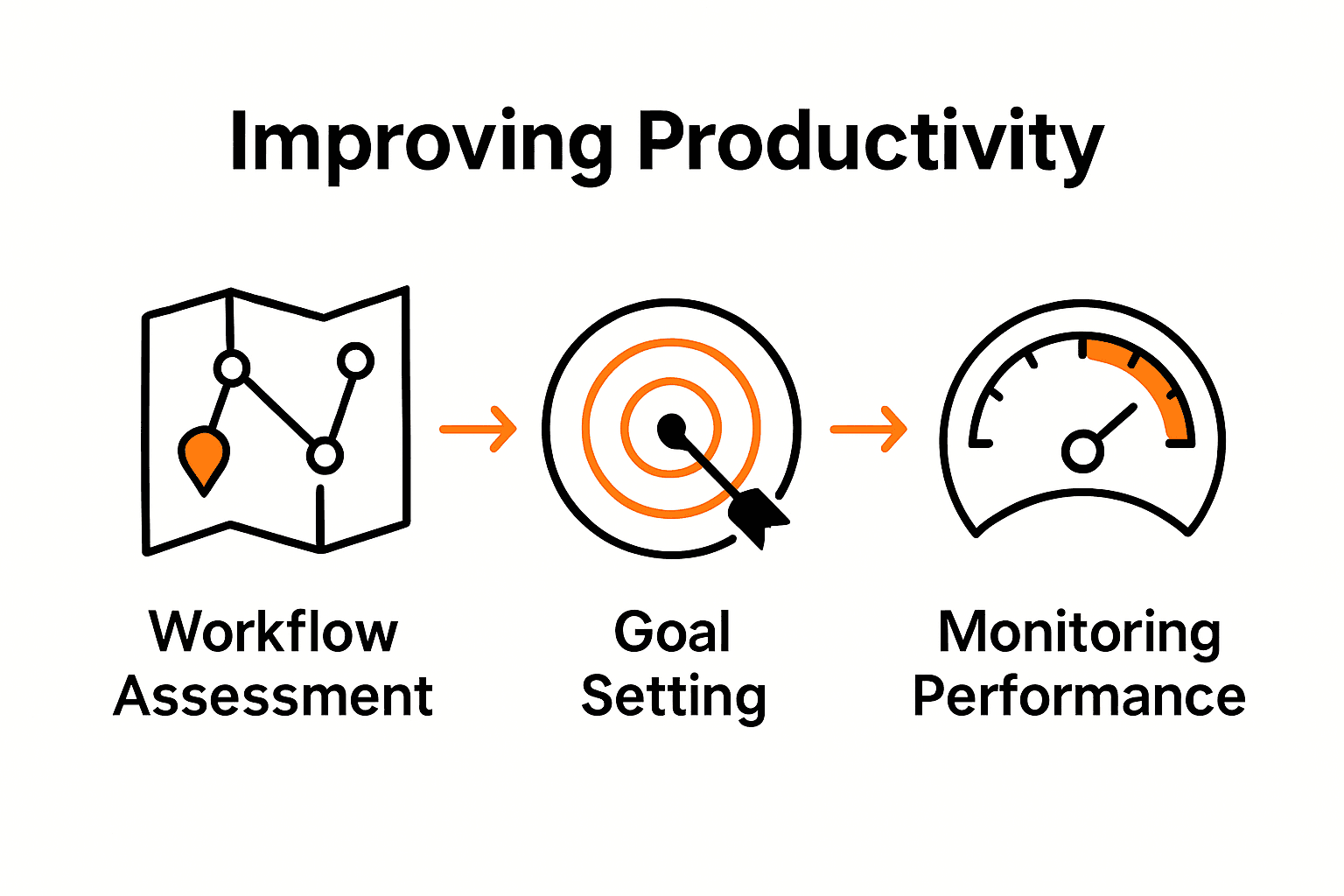
Select metrics that offer genuine insight into your workflow performance. A 2025 research article suggests tracking key indicators like cycle time and delivery frequency can provide powerful performance benchmarks. Companies using data driven metrics consistently outperform competitors by 5 to 6 percent in overall productivity.
Consider establishing metrics across multiple dimensions:
- Quantitative performance indicators
- Qualitative team engagement measurements
- Individual and collective achievement tracking
- Process efficiency measurements
- Time and resource utilization rates
Pro Tip: Balance hard numerical metrics with softer engagement measurements to maintain a holistic view of productivity.
Ensure your chosen metrics are:
- Specific and clearly defined
- Measurable and trackable
- Realistic and attainable
- Relevant to your core business objectives
- Time bound with clear evaluation periods
Explore our comprehensive guide on understanding performance metrics to deepen your approach to goal setting and measurement.
With your metrics established, you are now prepared to implement strategic tracking mechanisms that will transform your organizational productivity.
Step 3: Streamline Processes with Agile Methodologies
Agile methodologies transform how organizations approach work by breaking complex projects into manageable pieces and creating adaptive workflow strategies. You will learn to implement a system that dramatically improves team efficiency and project outcomes.
Start by understanding the core principles of Agile. This approach is not just a methodology it is a mindset that prioritizes flexibility customer collaboration and continuous improvement. Break large projects into smaller iterative cycles called sprints where teams can quickly adapt and respond to changing requirements.
Research from April 2025 reveals powerful insights about Agile implementation. According to a comprehensive study implementing Scrum dramatically improved project visibility for 93 percent of organizations. Moreover iterative development cycles and continuous integration led to fewer project failures and up to 25 percent productivity gains.
Consider combining Lean thinking with Agile practices a strategy highlighted in a January 2025 article. Lean Agile approaches help strip away unnecessary workflows optimize processes and deliver value faster by aligning every action with customer needs. This means constantly asking critical questions like “Does this step truly add value?”
Implement key Agile practices:
- Daily stand up meetings
- Sprint planning sessions
- Regular retrospective reviews
- Continuous feedback loops
- Transparent progress tracking
Pro Tip: Success in Agile requires cultural transformation not just process change. Encourage open communication and a learning mindset across your entire organization.
Adopt tools that support Agile workflows such as digital kanban boards project management software and collaborative platforms that enable real time communication and transparent progress tracking.
Learn more about digital transformation and process optimization to complement your Agile implementation strategy.
With these Agile methodologies in place you are now prepared to create a more responsive adaptive and efficient organizational workflow.
Step 4: Empower Teams Through Training and Tools
Empowering your team means providing the right skills training and technological tools that transform individual potential into collective performance. You will create an environment where employees feel supported equipped and motivated to excel.
Training is not just about transferring knowledge it is about creating adaptive learning experiences that help team members grow and innovate. Design comprehensive training programs that go beyond traditional classroom methods and incorporate multiple learning modalities such as interactive workshops online courses and peer to peer knowledge sharing.
According to a Microsoft 2023 study collaborative platforms and low code/no code tools are game changers in employee empowerment. When staff are equipped with intuitive technological solutions they can automate repetitive tasks innovate more freely and take genuine ownership of their work. The majority of employees reported increased job fulfillment and productivity when given such empowering tools.
Look for Electronic Performance Support Systems (EPSS) which are sophisticated software tools designed to help employees perform tasks with minimal external training. These systems dramatically reduce learning curves and enable staff to work more quickly and accurately by providing real time guidance and support.
Consider implementing the following empowerment strategies:
- Personalized skill development plans
- Mentorship and coaching programs
- Accessible online learning platforms
- Regular skill assessment and feedback sessions
- Technology tools that simplify complex tasks
Pro Tip: Balance technological tools with human connection. Technology should enhance not replace meaningful team interactions.
Foster a culture of continuous learning where employees are encouraged to acquire new skills experiment with innovative approaches and share knowledge across the organization.
Explore our guide on developing a coaching mindset to further support your team’s growth and empowerment journey.
With your team equipped with the right training and tools you are now prepared to unlock unprecedented levels of organizational productivity and innovation.
Step 5: Monitor and Optimize Performance Continuously
Continuous performance monitoring transforms good organizations into exceptional ones by creating a dynamic feedback loop of improvement and adaptation. You will develop a systematic approach to tracking measuring and enhancing organizational productivity in real time.
Implement robust monitoring mechanisms that go beyond traditional performance tracking. Instead of static quarterly reviews create living dashboards that provide instant insights into team and individual performance metrics. These tools should capture nuanced data points that reveal not just what happened but why and how performance fluctuates.
According to a 2023 academic survey on process oriented data science continuous monitoring of running process instances enables predictive behavior analysis and workflow optimization. By leveraging data driven decision making you can anticipate potential bottlenecks before they significantly impact productivity.
Utilize built in reporting features from your project management systems to track performance granularly. Professional research suggests these integrated analytics can help identify workflow constraints track performance trends and make precise operational adjustments that incrementally boost productivity.
Focus on collecting and analyzing these key performance indicators:
- Cycle time for critical tasks
- Resource utilization rates
- Error and rework percentages
- Team collaboration efficiency
- Individual and collective output metrics
Pro Tip: Create a culture of transparent performance review where data serves as a collaborative tool for improvement not a punitive measurement.
Establish regular review intervals weekly or biweekly where teams collectively examine performance data discuss insights and collaboratively develop optimization strategies. This approach transforms performance monitoring from a top down exercise to a collaborative growth opportunity.
Discover more about performance metrics and optimization strategies to deepen your continuous improvement approach.
By implementing these continuous monitoring practices you will create an agile responsive organization that consistently improves and adapts to changing business landscapes.
Turn Workflow Roadblocks into Results with Our Expert Agile Coaching
Are you frustrated by bottlenecks, stalled communication, and time-wasting manual processes in your business? The article “How Can a Business Increase Productivity: Proven Steps” highlights the real pain of inefficiencies and missed performance goals. Many businesses struggle to turn workflow mapping, agile strategies, and continuous improvement from theory into measurable outcomes. If these challenges feel all too familiar, now is the moment to get support from industry leaders in agile transformation.
Explore our Agile Coaching solutions to discover how you can quickly streamline workflows, empower your teams, and implement proven methodologies that drive lasting productivity gains.
Do not let another week pass battling the same frustrations. Visit Tariq Juneja’s professional coaching platform to connect with a transformational coach who specializes in boosting organizational efficiency and team morale. Take the next step to book a free consultation or tap into our exclusive resources and client success stories. Your path to measurable productivity and business transformation starts right here.
Frequently Asked Questions
How can I assess current workflows to find inefficiencies?
Start by mapping out every process in your organization on a large whiteboard or digital tool. Focus on identifying delays, communication breakdowns, and unnecessary steps to uncover hidden bottlenecks.
What specific productivity goals should I set for my team?
Define clear, measurable objectives that align with your business vision, like “reduce project completion time by 20% within the next quarter.” Ensure these goals are specific, realistic, and time-bound to maintain focus and accountability.
How can I implement Agile methodologies to improve my team’s productivity?
Begin by breaking projects into smaller, manageable cycles known as sprints. Encourage regular feedback and communication to adapt to changing requirements, which can lead to a noticeable increase in efficiency.
What training strategies enhance team performance?
Design comprehensive training programs that include interactive workshops and online courses tailored to your team’s needs. Consider personalized development plans to ensure each team member has the opportunity to grow their skills effectively.
How do I continuously monitor and optimize performance?
Establish robust monitoring mechanisms like living dashboards that provide real-time insights into team performance metrics. Set regular review intervals to discuss these insights and collaboratively develop strategies for improvement, transforming performance tracking into a growth opportunity.