

Over 80 percent of high-performing american leaders attribute their success to strong emotional intelligence skills. In today’s fast-paced work environment, the ability to manage emotions and strengthen relationships is more than just a soft skill—it is a proven driver of personal and professional growth. Understanding the true purpose of EQ coaching can give you a clear advantage, revealing how focused emotional development turns everyday challenges into lasting achievement.
Table of Contents
- Defining EQ Coaching Core Purpose
- Types Of EQ Coaching Approaches
- How EQ Coaching Actually Works
- Key Emotional Intelligence Assessments
- Real‑World EQ Coaching Applications
- Common Pitfalls In EQ Coaching
Key Takeaways
| Point | Details |
|---|---|
| Emotional Intelligence (EI) Coaching | EI coaching fosters emotional awareness and interpersonal effectiveness, essential for personal and organizational success. |
| Types of Coaching Approaches | Various approaches, including one-on-one and digital coaching, cater to different emotional skill development needs. |
| Assessment Methods | Assessments like the Emotional Intelligence Appraisal identify strengths and areas for growth, guiding personalized development strategies. |
| Common Pitfalls | Successful EQ coaching requires a tailored approach, avoiding oversimplifications and recognizing individual emotional complexities. |
Defining EQ Coaching Core Purpose
Emotional intelligence (EI) coaching represents a strategic approach to personal and professional development focused on enhancing an individual’s emotional awareness, regulation, and interpersonal effectiveness. According to research from arxiv, emotional intelligence competencies are fundamental to building high-performing teams and driving leadership success.
At its core, EQ coaching aims to help individuals develop critical emotional skills that enable more effective communication, relationship management, and self-understanding. The primary objectives include improving self-awareness, developing emotional self-regulation, cultivating empathy, and strengthening social interaction capabilities. What is Transformative Coaching? Understanding Its Impact – Tariq Juneja provides deeper insights into how targeted coaching can transform personal and professional dynamics.
The key components of EQ coaching typically involve:
- Identifying emotional patterns and triggers
- Learning strategies for emotional self-management
- Developing advanced interpersonal communication skills
- Building resilience and stress management techniques
- Enhancing leadership and team collaboration capabilities
By focusing on emotional intelligence development, EQ coaching empowers individuals to navigate complex personal and professional environments with greater adaptability, self-confidence, and relational effectiveness. The ultimate goal is not just understanding emotions, but strategically leveraging emotional insights to drive personal growth and organizational success.
Types Of EQ Coaching Approaches
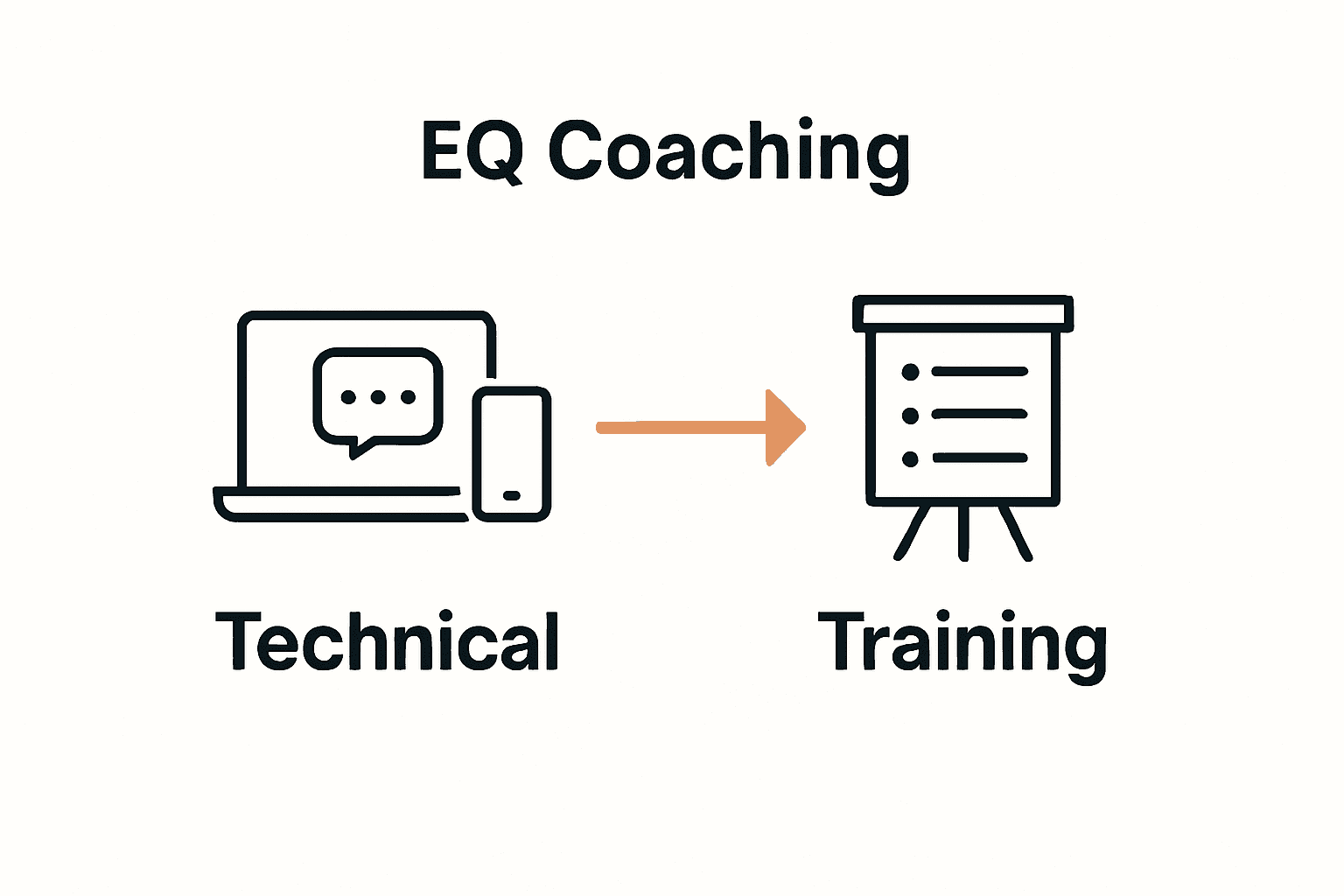
Emotional intelligence coaching encompasses diverse approaches tailored to meet individual and organizational needs. Malque identifies two primary methodological frameworks: the technical approach and the training approach, which provide distinct strategies for developing emotional competencies.
The technical approach leverages digital tools and online resources to optimize coaching interactions. As highlighted by arxiv, technological innovations like stress monitoring assistants and machine learning platforms are increasingly instrumental in delivering personalized coaching experiences. Coaching Techniques Explained: Understanding Their Impact – Tariq Juneja offers additional insights into these sophisticated coaching methodologies.
Key EQ coaching approaches include:
- One-on-One Coaching: Personalized, individualized emotional skill development
- Group Coaching: Collaborative learning environments focusing on collective emotional intelligence
- Digital/E-Coaching: Technology-enabled remote coaching platforms
- Performance-Based Coaching: Targeted interventions addressing specific professional challenges
- Developmental Coaching: Long-term strategic emotional skill enhancement
The training approach emphasizes systematic skill development, focusing on structured programs that progressively build emotional awareness, self-regulation, empathy, and interpersonal communication capabilities. By integrating multiple coaching techniques, professionals can create comprehensive EQ development strategies that address unique personal and organizational requirements.

How EQ Coaching Actually Works
EQ coaching operates through a structured, personalized process designed to develop emotional intelligence capabilities. According to research from arxiv, the core mechanism involves systematically enhancing key emotional competencies such as self-awareness, self-regulation, empathy, and social skills that fundamentally shape leadership and interpersonal effectiveness.
The coaching process typically begins with a comprehensive emotional intelligence assessment, which helps identify an individual’s current emotional strengths and developmental areas. Understanding the Coaching Process Overview for Growth – Tariq Juneja provides deeper insights into how coaches create tailored development strategies. Coaches then collaborate with clients to establish specific emotional intelligence goals, designing targeted interventions that address unique personal and professional challenges.
Key stages of the EQ coaching process include:
- Initial emotional intelligence assessment
- Goal setting and strategy development
- Skill-building workshops and exercises
- Real-world practice and implementation
- Continuous feedback and progress tracking
- Periodic reassessment and strategy refinement
Ultimately, EQ coaching works by creating a supportive, structured environment that enables individuals to develop critical emotional skills.
Through personalized guidance, reflective practices, and actionable strategies, coaches help clients transform emotional insights into tangible personal and professional growth, enhancing their ability to navigate complex interpersonal dynamics with greater resilience and effectiveness.
Key Emotional Intelligence Assessments
Emotional intelligence assessments provide critical insights into an individual’s emotional capabilities, enabling targeted development strategies. Wikipedia highlights the Emotional Intelligence Appraisal as a comprehensive skill-based measurement tool, featuring 28 items that generate a total EQ score across four primary emotional competency scales derived from Daniel Goleman’s influential emotional intelligence model.
The Empathy Quotient (EQ) represents another significant assessment method, specifically designed to measure both cognitive and affective dimensions of empathy. What Is Leadership Coaching? Complete Overview – Tariq Juneja provides complementary insights into how these assessments connect with leadership development. These evaluations typically explore key emotional intelligence domains including self-awareness, self-regulation, social awareness, and relationship management.
Primary emotional intelligence assessment approaches include:
- Self-report questionnaires
- 360-degree feedback assessments
- Behavioral observation techniques
- Situational judgment tests
- Performance-based emotional skill evaluations
- Neuropsychological measurement tools
By systematically measuring emotional intelligence through these sophisticated assessment methods, coaches can create personalized development strategies that address specific emotional skill gaps. The ultimate goal is to transform individual emotional intelligence from a theoretical concept into a practical, actionable framework for personal and professional growth.
Real‑World EQ Coaching Applications
Emotional intelligence coaching has demonstrated significant practical impact across diverse professional environments. PRC highlights a compelling quasi-experimental study revealing how targeted emotional intelligence training interventions can dramatically enhance professional effectiveness, particularly among educators by improving academic performance and teaching capabilities.
Professional domains leverage EQ coaching to address critical organizational challenges. Communication Skills Coaching: Complete Expert Guide – Tariq Juneja provides insights into how emotional intelligence development transforms workplace dynamics. Organizations strategically implement EQ coaching to improve leadership communication, team collaboration, conflict resolution, and overall interpersonal effectiveness.
Key real-world EQ coaching applications include:
- Leadership development programs
- Team building and collaboration initiatives
- Conflict management and resolution strategies
- Employee engagement and retention efforts
- Professional communication skill enhancement
- Stress management and resilience training
- Customer relationship management
The transformative potential of EQ coaching extends beyond individual skill development, creating ripple effects that reshape organizational culture. By systematically addressing emotional intelligence competencies, professionals can unlock more authentic, empathetic, and effective approaches to personal and professional interactions, ultimately driving meaningful organizational and individual growth.
Common Pitfalls In EQ Coaching
Emotional intelligence coaching presents complex challenges that can undermine its effectiveness if not carefully managed. arxiv warns that overemphasizing certain emotional intelligence competencies without maintaining a balanced approach can lead to significant leadership and organizational risks, potentially causing ethical lapses or mismanagement of team dynamics.
One critical developmental trap involves coaches who adopt a one-size-fits-all methodology, failing to recognize the unique emotional landscape of individual clients. Create an Effective Coaching Session Plan for 2025 Success – Tariq Juneja highlights the importance of personalized coaching strategies. Coaches must remain adaptable and attentive to each client’s specific emotional context, avoiding rigid interpretations of emotional intelligence frameworks.
Common pitfalls in EQ coaching include:
- Oversimplifying emotional complexity
- Neglecting individual variation in emotional responses
- Forcing emotional vulnerability without establishing trust
- Misinterpreting emotional intelligence as a fixed trait
- Relying too heavily on generic assessment tools
- Failing to provide actionable, contextual strategies
- Ignoring the cultural and personal nuances of emotional expression
Successful EQ coaching requires a nuanced, empathetic approach that respects individual differences while providing structured guidance. Coaches must balance theoretical frameworks with practical, personalized interventions, ensuring that emotional intelligence development remains a dynamic, growth-oriented process tailored to each client’s unique needs and potential.
Unlock Your Emotional Intelligence Potential with Expert Coaching
Are you ready to master emotional awareness and regulation to boost your leadership and personal growth? This article highlights the challenges many face in managing emotional complexity and leveraging emotional intelligence strategically. If improving self-awareness, empathy, and social skills resonate with you, exploring tailored coaching methods can make all the difference. Tariq Juneja’s transformational coaching integrates proven EQ development techniques designed to help you overcome common pitfalls like oversimplification and one-size-fits-all approaches.

Take control of your emotional intelligence journey today by exploring personalized coaching options in the Life Coaching Archives – Tariq Juneja. Discover how agile, adaptive coaching strategies can elevate your personal and professional life at Tariq Juneja’s main site. For those navigating change in their leadership or organizational roles, see how emotional intelligence intersects with change management in the Change Management Archives – Tariq Juneja. Don’t wait to turn emotional insight into real growth. Visit https://tariqjuneja.com now to book your free consultation and start transforming your EQ skills.
Frequently Asked Questions
What is EQ coaching?
Emotional intelligence (EQ) coaching focuses on developing an individual’s emotional awareness, regulation, and interpersonal effectiveness, enhancing skills for effective communication and relationship management.
How does EQ coaching work?
EQ coaching involves a structured process starting with an emotional intelligence assessment, followed by goal setting, skill-building workshops, and continuous feedback to help individuals improve their emotional competencies.
What types of approaches are used in EQ coaching?
Common approaches include one-on-one coaching, group coaching, digital/e-coaching, performance-based coaching, and developmental coaching, each tailored to specific individual or organizational needs.
What are the common applications of EQ coaching in the workplace?
EQ coaching is applied in leadership development, team building, conflict resolution, employee engagement, stress management, and improving professional communication skills.