

More than half of American leaders admit they struggle to decide whether coaching or consulting will deliver real results. With both methods promising growth but taking completely different routes, the differences can leave any professional uncertain about the best approach. This guide unpacks how each path works, clarifies key distinctions, and empowers you to make the smartest choice for your personal or organizational success.
Table of Contents
- Coaching and Consulting Defined Clearly
- Key Differences in Process and Outcomes
- When to Choose Coaching Versus Consulting
- Roles and Responsibilities for Each Approach
- Common Mistakes and How to Avoid Them
Key Takeaways
| Point | Details |
|---|---|
| Coaching vs. Consulting | Coaching focuses on empowering clients to self-discover solutions, while consulting provides expert-driven recommendations for organizational challenges. |
| Process and Outcomes | Coaching emphasizes personal exploration for long-term behavioral change, whereas consulting delivers immediate, measurable results through structured intervention. |
| Choosing the Right Approach | Select coaching for personal development and leadership enhancement, and opt for consulting when facing systemic operational challenges requiring technical expertise. |
| Common Mistakes | Avoid misalignment between intervention strategies and establish realistic expectations for both coaching and consulting engagements to ensure effective outcomes. |
Coaching and Consulting Defined Clearly
Understanding the nuanced differences between coaching and consulting requires a clear examination of their core purposes and methodologies. While both disciplines aim to drive professional growth and organizational improvement, they approach challenges through distinctly different lenses. Coaching vs Consulting: Complete Guide for Leaders reveals that the primary distinction lies in how guidance and solutions are delivered.
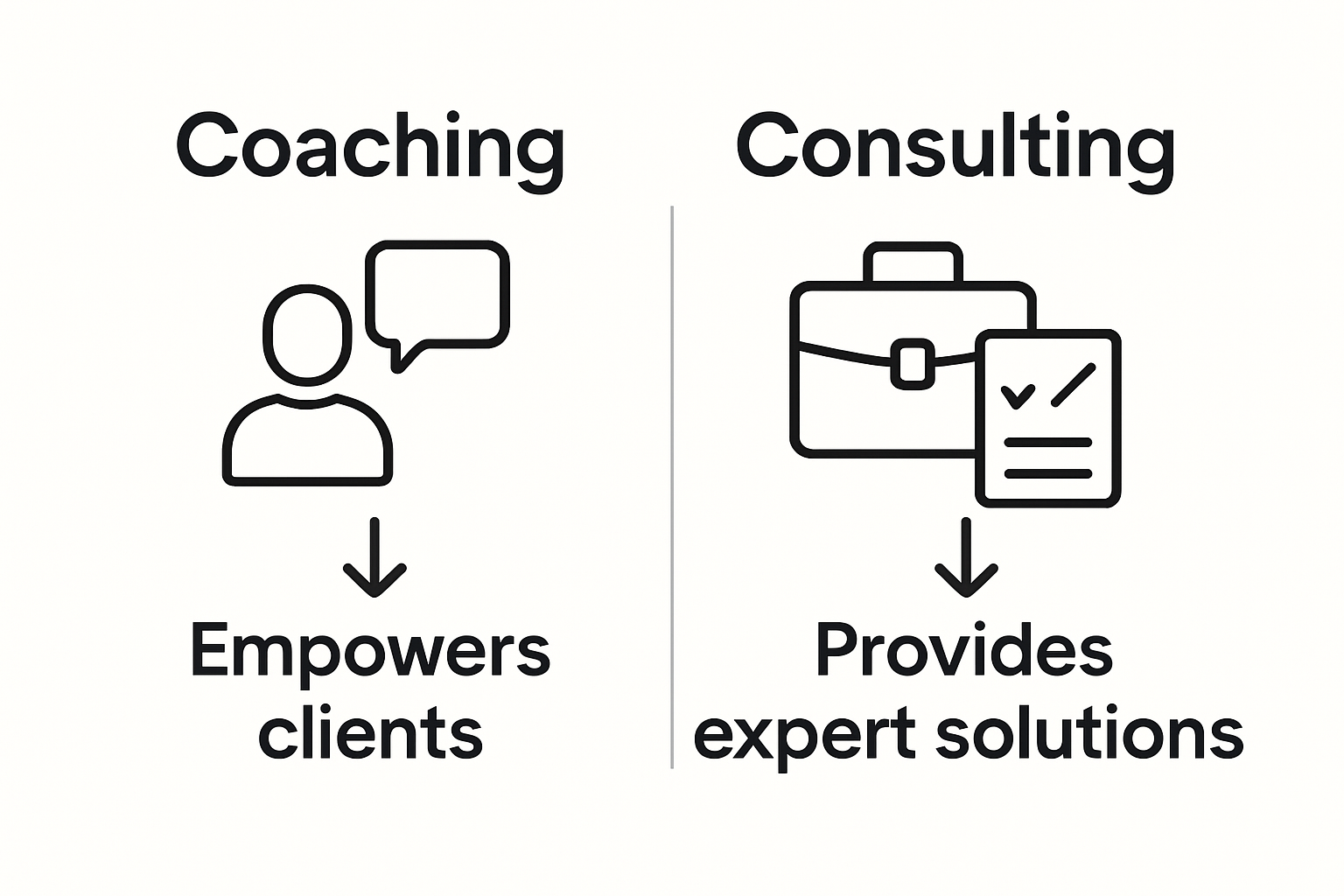
Coaching is fundamentally a collaborative, client-centered approach where professionals help individuals or teams unlock their inherent potential. Unlike consulting, which often provides direct solutions, coaching focuses on empowering clients to discover their own answers. A coach acts as a strategic partner, asking powerful questions, offering reflective insights, and supporting personal and professional development. The coach’s role is not to prescribe specific actions but to facilitate self-discovery, helping clients identify barriers, develop actionable strategies, and cultivate the skills necessary for achieving their goals.
Consulting, by contrast, operates as an expert-driven model where professionals leverage specialized knowledge to diagnose organizational challenges and recommend specific interventions. Consultants typically bring external expertise, industry insights, and structured methodologies to solve complex business problems. They analyze current systems, identify inefficiencies, and propose targeted solutions based on their professional experience and technical understanding. While coaching emphasizes client-led transformation, consulting provides structured, expert-driven recommendations that organizations can directly implement to drive performance, streamline processes, and achieve strategic objectives.
The choice between coaching and consulting depends on the specific context, organizational needs, and desired outcomes. Some situations might benefit from a hybrid approach that combines the reflective, empowerment-focused nature of coaching with the strategic, solution-oriented perspective of consulting. Ultimately, both disciplines share a fundamental commitment to facilitating positive change and supporting professional growth.
Key Differences in Process and Outcomes
The process and outcomes of coaching and consulting differ significantly, reflecting their fundamentally distinct approaches to professional development and organizational transformation. Understanding these nuanced variations becomes critical for leaders seeking targeted interventions. 7 Key Differences Between Coaching vs Mentoring for Leaders provides insights that can be extended to understanding coaching and consulting dynamics.
In the coaching process, the primary focus is on personal exploration and self-discovery. Coaches use powerful questioning techniques, active listening, and reflective dialogue to help clients uncover their internal resources, challenge limiting beliefs, and develop sustainable personal growth strategies. The outcome is typically long-term behavioral change, increased self-awareness, and enhanced personal agency. Coaches do not provide direct solutions but instead facilitate a journey of self-understanding, empowering clients to generate their own insights and actionable strategies.
Consulting processes, conversely, are structured around diagnostic analysis, expert recommendation, and implementation support. Consultants conduct comprehensive organizational assessments, identify systemic inefficiencies, and propose targeted interventions based on their specialized knowledge. The outcomes are more immediately tangible: improved operational efficiency, strategic realignment, performance optimization, and measurable business results. Unlike coaching’s introspective approach, consulting delivers explicit roadmaps and actionable recommendations designed to address specific organizational challenges.

The critical distinction lies in the nature of transformation. Coaching drives internal change through personal empowerment, while consulting orchestrates external change through strategic intervention. Some advanced professionals now blend these approaches, recognizing that sustainable organizational growth requires both individual development and systemic optimization. The most effective interventions often emerge from understanding when to apply coaching’s reflective techniques versus consulting’s strategic expertise.
When to Choose Coaching Versus Consulting
Deciding between coaching and consulting requires a strategic assessment of organizational needs, individual challenges, and desired outcomes. Understanding the Role of Coaching in Business Growth illuminates the nuanced considerations that guide this critical decision. According to research, organizations must carefully evaluate their specific context to determine the most appropriate professional intervention.
Coaching is ideal when the primary goal involves personal development, leadership enhancement, and internal capacity building. Organizations should choose coaching when facing challenges that require deep personal transformation, such as improving communication skills, developing emotional intelligence, navigating career transitions, or addressing leadership blind spots. The coaching approach works best for professionals seeking self-directed growth, increased self-awareness, and sustainable behavioral change. Typical scenarios include executive leadership development, team dynamic improvements, and individual performance optimization where the focus is on unlocking potential rather than implementing predefined solutions.
Consulting becomes the preferred approach when organizations require specialized expertise, structured problem-solving, and direct intervention to address complex systemic challenges. Leaders should opt for consulting when confronting specific operational inefficiencies, strategic misalignments, technological implementations, or performance bottlenecks that demand expert technical knowledge and immediate actionable recommendations. Consulting delivers tangible, measurable outcomes through diagnostic assessments, strategic planning, and implementation support, making it optimal for situations requiring external perspectives and specialized technical interventions.
The most effective organizational development strategies often involve a hybrid approach, strategically combining coaching and consulting methodologies. This integrated model recognizes that sustainable transformation requires both individual empowerment and systematic optimization. By understanding the distinct strengths of each approach, leaders can design comprehensive interventions that simultaneously address personal growth and organizational performance, creating a holistic framework for meaningful and lasting change.
Roles and Responsibilities for Each Approach
Navigating the distinct roles and responsibilities of coaching and consulting requires a nuanced understanding of each professional’s core function and expected contribution. Stakeholder Management: Complete Guide for Professionals highlights the importance of clearly defining professional boundaries and expectations.
In coaching, the primary responsibility centers on facilitating client-driven discovery. As research indicates, coaches are fundamentally responsible for creating a supportive environment that enables clients to generate their own insights and solutions. The coach’s role involves asking powerful questions, providing reflective feedback, and helping clients uncover their inherent capabilities. Unlike consultants who provide direct recommendations, coaches focus on empowering individuals to develop self-awareness, challenge limiting beliefs, and create personalized strategies for personal and professional growth. Their responsibilities include active listening, maintaining a non-judgmental stance, offering constructive observations, and supporting clients through transformational processes.
Consultants, by contrast, bear the responsibility of delivering expert-driven solutions to specific organizational challenges. Their primary duty involves conducting comprehensive diagnostic assessments, identifying systemic inefficiencies, and proposing targeted interventions based on specialized technical knowledge. Consultants are expected to bring external perspectives, industry best practices, and structured methodological approaches to problem-solving. Their responsibilities include analyzing complex business scenarios, developing strategic recommendations, creating implementation roadmaps, and providing technical expertise that directly addresses organizational performance gaps.
Ultimately, both coaching and consulting professionals share a fundamental commitment to driving positive change, albeit through distinctly different approaches. The most effective practitioners understand the complementary nature of these roles, recognizing that sustainable organizational transformation often requires a holistic strategy that integrates personal development with systematic optimization. By clearly defining and respecting the unique responsibilities of each approach, leaders can design more comprehensive and impactful professional development interventions.
Common Mistakes and How to Avoid Them
Navigating the complex terrain of professional development requires a strategic approach to avoiding common pitfalls in coaching and consulting engagements. Key Differences Between Coaching and Consulting highlights the critical importance of understanding nuanced professional boundaries.
One of the most significant mistakes organizations make is misaligning their intervention strategy. Leaders frequently choose coaching when they require systematic problem-solving or select consulting when what they truly need is individual transformation. This misalignment can result in wasted resources, minimal impact, and frustrated stakeholders. To avoid this, organizations must conduct a thorough diagnostic assessment that clearly identifies whether the primary need involves personal development, technical expertise, or a combination of both. Effective intervention selection requires honest evaluation of current challenges, desired outcomes, and the specific skills required to drive meaningful change.
Another critical mistake involves unrealistic expectations about the scope and timeline of coaching or consulting interventions. Many leaders expect immediate, dramatic results without understanding the inherent complexity of organizational and personal transformation. Coaching is a gradual process of self-discovery and skill development, while consulting requires careful implementation and systematic change management. Successful engagements demand patience, commitment, and a willingness to embrace incremental progress. Organizations should establish clear, measurable objectives, create realistic timelines, and maintain open communication channels to track progress and adjust strategies as needed.
The most sophisticated approach recognizes that coaching and consulting are not mutually exclusive but complementary methodologies. Sophisticated leaders understand that sustainable transformation often requires a hybrid model that integrates personal development with strategic intervention. By avoiding rigid categorical thinking and remaining adaptable, organizations can design more nuanced, comprehensive approaches that address both individual capabilities and systemic challenges. The key lies in maintaining flexibility, conducting continuous assessment, and remaining committed to holistic, long-term growth strategies.
Choose the Right Path for Your Transformation Journey
Deciding between coaching and consulting involves understanding your unique challenges and goals. Whether you seek personal empowerment to unlock your potential or expert-driven strategies to solve complex organizational issues, making the right choice can be overwhelming. This article highlights how coaching focuses on self-discovery and long-term growth while consulting delivers targeted, actionable solutions to operational challenges. If you want to avoid common mistakes and align your approach with your needs, it is essential to partner with a seasoned professional who understands these key differences.
Discover how Agile Coaching Archives – Tariq Juneja and Change Management Archives – Tariq Juneja offer tailored solutions that bridge personal development with strategic transformation. 
Take control of your growth today by exploring expert coaching and consulting services at https://tariqjuneja.com. Book a free consultation to identify the best approach for your goals and begin your journey toward lasting transformation.
Frequently Asked Questions
What is the main difference between coaching and consulting?
Coaching focuses on empowering individuals to unlock their potential through self-discovery, while consulting involves providing expert-driven solutions and recommendations to address specific organizational challenges.
When should an organization choose coaching over consulting?
Organizations should choose coaching when the goal is personal development, leadership enhancement, and internal capacity building, particularly in areas like improving communication skills or navigating career transitions.
What outcomes can be expected from coaching?
The outcomes of coaching typically include long-term behavioral change, increased self-awareness, and enhanced personal agency, as clients develop their own strategies for personal and professional growth.
Can coaching and consulting be used together?
Yes, a hybrid approach can be effective, combining the reflective nature of coaching with the structured, solution-oriented perspective of consulting to address both individual development and organizational performance.