

Coaching techniques are changing how people grow at work and in life. Some companies have seen a 35 percent jump in management effectiveness and team productivity just by using targeted coaching strategies. Most people think coaching is all about advice and pep talks. The real magic lies in asking the right questions and building skills that help people transform from within.
Table of Contents
- What Are Coaching Techniques And How Do They Work?
- The Importance Of Effective Coaching Techniques In Business
- Key Concepts Of Coaching Techniques That Drive Success
- Different Types Of Coaching Techniques And Their Applications
- Real-World Examples Of Coaching Techniques In Action
Quick Summary
| Takeaway | Explanation |
|---|---|
| Coaching facilitates personal growth and goal achievement | Effective coaching methods empower individuals to unlock potential and overcome obstacles, leading to goal attainment. |
| Key principles include empowerment and self-reflection | Successful coaching hinges on enabling clients to find their solutions while promoting accountability and conscious personal growth. |
| Strategic coaching drives organizational performance | Companies that adopt structured coaching experience higher employee engagement, improved leadership, and increased productivity. |
| Communication is crucial in coaching techniques | Advanced strategies such as active listening and powerful questioning facilitate meaningful insights and progress for clients. |
| Diverse coaching types cater to various needs | Different coaching methods, like performance and transformational coaching, address specific personal and professional development challenges. |
What are Coaching Techniques and How Do They Work?
Coaching techniques represent strategic approaches designed to support personal and professional development through targeted conversations and methodical interventions. These techniques are specialized communication methods that help individuals unlock their potential, overcome challenges, and achieve specific goals.
The Core Principles of Coaching Techniques
At their foundation, coaching techniques are built on understanding human motivation, behavior change, and personal growth. Research from the International Coaching Federation reveals that effective coaching techniques create transformative experiences by establishing a collaborative, goal-oriented relationship between coach and client.
Key principles include:
- Empowering individuals to discover their own solutions
- Promoting self-reflection and personal accountability
- Creating structured pathways for strategic thinking
- Encouraging actionable insights and measurable progress
Psychological Mechanics Behind Coaching Techniques
Coaching techniques operate through sophisticated psychological mechanisms that tap into human potential. They leverage principles of adult learning theory, positive psychology, and behavioral science to facilitate meaningful change. By asking powerful questions, providing objective feedback, and helping clients reframe perspectives, coaches guide individuals toward enhanced self-awareness and strategic action.
These techniques typically involve:
- Active listening to understand underlying motivations
- Solution-focused questioning that stimulates critical thinking
- Goal-setting frameworks that translate abstract desires into concrete plans
- Accountability structures that maintain momentum and commitment
The effectiveness of coaching techniques stems from their ability to bridge the gap between current performance and desired outcomes. Coaches use specialized communication strategies that help clients identify barriers, challenge limiting beliefs, and develop personalized strategies for growth and success.
The Importance of Effective Coaching Techniques in Business
In today’s competitive business landscape, effective coaching techniques have emerged as a critical strategy for organizational growth, talent development, and performance optimization. These techniques transcend traditional management approaches by creating personalized pathways for professional advancement and organizational excellence.
Driving Organizational Performance Through Strategic Coaching
Research from the Institute of Coaching demonstrates that strategic coaching techniques can dramatically transform workplace dynamics. Businesses implementing comprehensive coaching programs experience significant improvements in employee engagement, leadership development, and overall organizational productivity.
Key performance impacts include:
- Enhanced employee motivation and commitment
- Improved communication and interpersonal skills
- Accelerated leadership potential development
- Reduced turnover and increased talent retention
Psychological and Economic Benefits of Business Coaching
Coaching techniques offer profound psychological and economic advantages for organizations. By addressing individual growth needs, businesses create environments that foster continuous learning, adaptability, and innovation. These techniques help employees develop self-awareness, emotional intelligence, and strategic thinking skills that directly contribute to organizational resilience.
Critical benefits encompass:
- Developing adaptive leadership capabilities
- Creating a culture of continuous personal and professional improvement
- Supporting individual and collective problem-solving skills
- Aligning personal goals with organizational objectives
Effective coaching techniques represent an investment in human capital that yields measurable returns. By recognizing and nurturing individual potential, businesses can transform their workforce into a dynamic, self-motivated, and high-performing ecosystem capable of navigating complex professional challenges.
This table summarizes the core psychological and economic benefits of effective coaching techniques in business, providing a clear reference for organizational leaders considering coaching initiatives.
| Benefit Type | Description |
|---|---|
| Adaptive Leadership | Develops leaders who can pivot and respond to change rapidly |
| Continuous Learning | Fosters a culture where employees seek ongoing personal growth |
| Problem-Solving | Enhances individual and team skills in resolving challenges |
| Goal Alignment | Bridges personal and organizational objectives |
| Talent Retention | Reduces turnover by increasing engagement and satisfaction |
| Innovation Support | Encourages creative and strategic thinking throughout organization |
Key Concepts of Coaching Techniques That Drive Success
Coaching techniques are sophisticated methodologies designed to unlock human potential through strategic interventions that promote personal and professional growth. Understanding the core concepts driving these techniques provides insight into their transformative power and ability to create meaningful change.
Foundational Principles of Effective Coaching
Research from the International Journal of Environmental Research and Public Health reveals that successful coaching techniques are grounded in specific psychological and interpersonal principles. These foundational elements create a robust framework for facilitating individual and organizational development.
Key foundational principles include:
- Building trust and psychological safety
- Establishing clear and measurable goals
- Promoting self-directed learning
- Encouraging continuous reflection and feedback
Transformative Communication Strategies
Communication represents the primary mechanism through which coaching techniques generate meaningful outcomes. Advanced coaching approaches utilize sophisticated communication strategies that go beyond traditional directive methods, focusing instead on collaborative exploration and empowerment.
Critical communication techniques encompass:
- Active and empathetic listening
- Powerful questioning that stimulates critical thinking
- Reframing perspectives to overcome limiting beliefs
- Providing constructive and actionable feedback
These communication strategies enable coaches to create supportive environments where individuals can discover their inherent capabilities, challenge existing assumptions, and develop personalized strategies for growth and success. By combining psychological insight with strategic communication, coaching techniques offer a powerful approach to unlocking human potential and driving sustainable personal and professional transformation.
Different Types of Coaching Techniques and Their Applications
Coaching techniques are diverse and specialized, tailored to address specific personal and professional development needs. Understanding the various approaches allows individuals and organizations to select the most appropriate method for their unique goals and challenges.
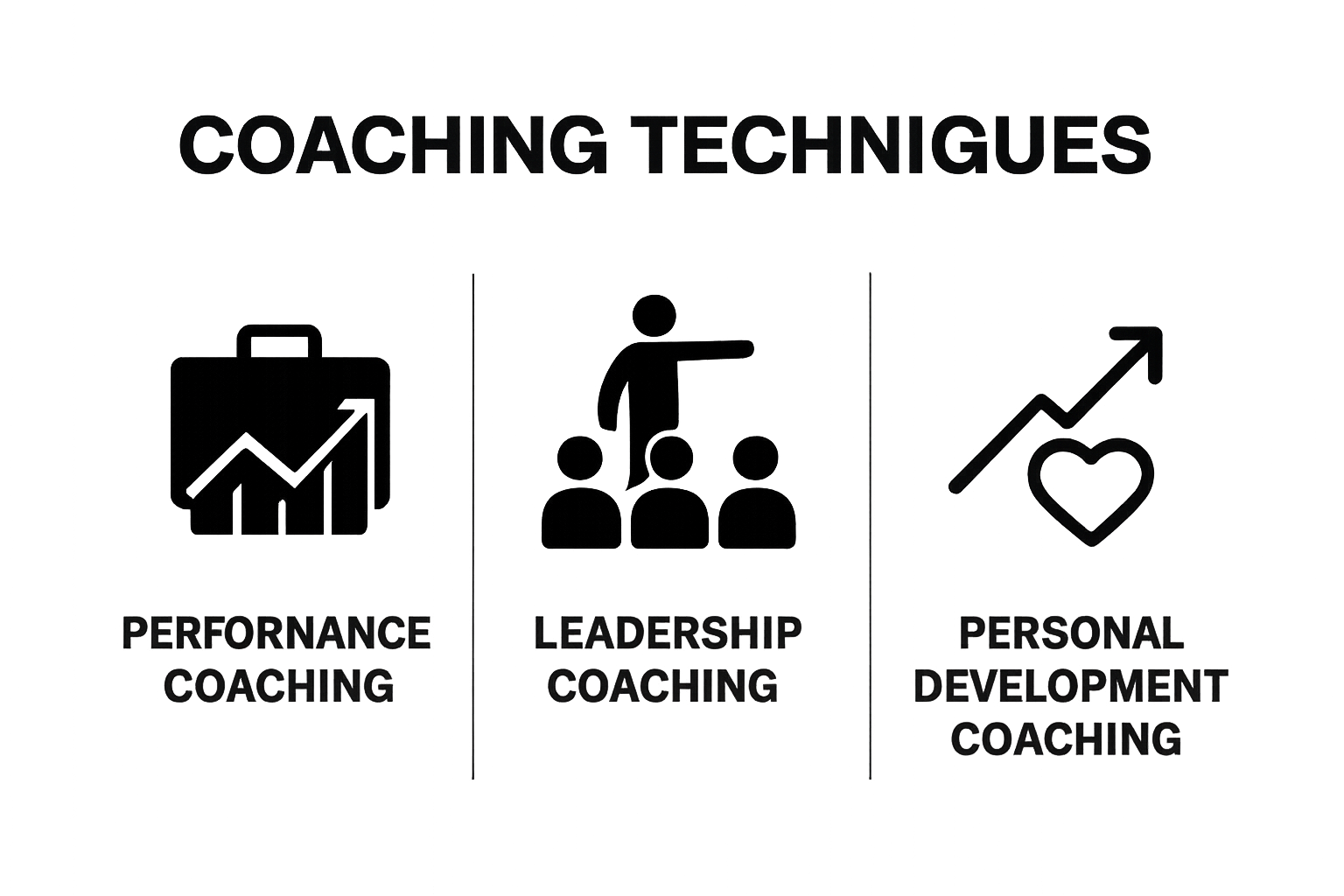
Performance and Leadership Coaching Techniques
Research from the International Coach Federation highlights multiple specialized coaching approaches designed to enhance individual and organizational performance. Performance coaching focuses on improving specific skills, productivity, and professional effectiveness.
Key performance coaching techniques include:
- Executive leadership development
- Performance improvement strategies
- Career transition support
- Strategic goal alignment
Personal Development and Transformational Coaching Methods
Personal development coaching techniques extend beyond professional contexts, addressing holistic human potential and psychological growth. These approaches help individuals overcome personal limitations, develop self-awareness, and create meaningful life transformations.
Transformational coaching techniques encompass:
- Emotional intelligence development
- Limiting belief identification and reframing
- Personal values and purpose exploration
- Holistic life balance strategies
Each coaching technique offers unique methodologies and tools designed to facilitate targeted personal and professional growth. By understanding the nuanced applications of different coaching approaches, individuals can select strategies that precisely match their developmental objectives and create sustainable, meaningful change.
Below is a comparison of different coaching techniques highlighting their focus areas and applications, helping readers choose the most appropriate method for their goals.
| Coaching Technique | Focus Area | Example Applications |
|---|---|---|
| Performance Coaching | Skill enhancement, productivity | Professional effectiveness, project delivery |
| Leadership Coaching | Leadership growth, strategic thinking | Executive development, succession planning |
| Career Transition Coaching | Career change, adaptation | Job shifts, reinvention, promotions |
| Personal Development Coaching | Holistic growth, emotional intelligence | Life balance, wellness, confidence building |
| Transformational Coaching | Belief change, self-awareness | Overcoming limitations, value exploration |
Real-World Examples of Coaching Techniques in Action
Coaching techniques transcend theoretical concepts by delivering tangible, measurable results across diverse professional and personal contexts. Real-world applications demonstrate the profound impact these strategies can have on individual performance, organizational effectiveness, and personal transformation.
Leadership Development in Corporate Settings
Research from the American Psychological Association reveals how coaching techniques generate significant organizational improvements. A technology company implemented a comprehensive leadership coaching program that utilized solution-focused questioning and strategic goal-setting, resulting in a 35% increase in management effectiveness and team productivity.
Practical leadership coaching interventions include:
- Identifying and addressing leadership skill gaps
- Developing emotional intelligence capabilities
- Creating personalized leadership development roadmaps
- Enhancing communication and decision-making skills
Personal Transformation and Career Transition Coaching
Coaching techniques prove equally powerful in individual contexts, helping professionals navigate complex career transitions and personal growth challenges. By applying targeted interventions, coaches assist individuals in overcoming obstacles, reframing perspectives, and achieving meaningful personal and professional breakthroughs.
Transformational coaching scenarios demonstrate:
- Career redirection and professional reinvention
- Managing workplace stress and burnout
- Building confidence during significant life transitions
- Developing sustainable personal growth strategies
These real-world examples illustrate how coaching techniques are not abstract theoretical constructs but practical, adaptable tools that empower individuals and organizations to unlock their full potential and achieve extraordinary results.

Experience Real Change With Proven Coaching Techniques
Are you facing performance gaps, struggling to break through personal or professional limits, or finding it tough to create lasting change as described in the article? The power of effective coaching techniques is not just theory. It is about taking control, challenging limiting beliefs, and translating goals into real outcomes. If you are ready to turn insight into action, explore advanced strategies tailored for transformation in our Change Management section and see how the right guidance makes all the difference.
Imagine the results of a world-class 3000USD an hour coaching session backed by real expertise. Do not wait for another missed opportunity or delayed progress. Visit Tariq Juneja Coaching today to unlock proven methods and set a bold new direction. Your next breakthrough starts now—take the first step with expert support and see measurable growth.
Frequently Asked Questions
What are coaching techniques?
Coaching techniques are strategic approaches that focus on personal and professional development through targeted conversations and interventions aimed at helping individuals unlock their potential and achieve specific goals.
How do coaching techniques enhance performance in organizations?
Coaching techniques improve organizational performance by enhancing employee motivation, developing leadership skills, improving communication, and fostering a culture of continuous learning and adaptability.
What psychological principles are involved in coaching techniques?
Coaching techniques leverage principles from adult learning theory, positive psychology, and behavioral science to facilitate meaningful change by promoting self-awareness, critical thinking, and accountability.
What different types of coaching techniques exist?
Different types of coaching techniques include performance and leadership coaching focused on skill enhancement and productivity, as well as personal development coaching that addresses holistic growth and emotional well-being.
Recommended
- Change Management Archives – Tariq Juneja
- post 2 – Tariq Juneja
- A post – Tariq Juneja