

Every agile transformation effort can stall when coaching pitfalls quietly take root in your organization. For IT managers and business leaders, these obstacles often hide beneath standard ceremonies and reports, sapping productivity and derailing cultural change. By understanding the difference between surface compliance and real agile adoption, you can address the most damaging pitfalls early and set your teams up for lasting success. Agile coaching pitfalls reduce motivation, increase misunderstandings, and perpetuate dysfunctional dynamics, making awareness and prevention crucial for sustainable transformation.
Table of Contents
- Defining Coaching Pitfalls In Agile Environments
- Major Types Of Coaching Pitfalls
- How Pitfalls Impact Team Productivity
- Common Misconceptions About Coaching Success
- Practical Strategies To Avoid Pitfalls
- Building Sustainable Coaching Practices
Key Takeaways
| Point | Details |
|---|---|
| Understand Coaching Pitfalls | Recognizing pitfalls like unclear roles and resistance helps tailor coaching to your team’s context and needs. |
| Focus on Genuine Transformation | Measure coaching success by team autonomy and psychological safety rather than mere process compliance. |
| Secure Leadership Commitment | Leadership buy-in is crucial for effective coaching and alignment with agile principles throughout the organization. |
| Develop Internal Coaching Capacity | Sustainable coaching practices involve training internal leaders to foster growth and reduce dependency on external coaches. |
Defining Coaching Pitfalls in Agile Environments
Agile coaching pitfalls are specific failures in how coaches guide teams through organizational transformation. Unlike general coaching mistakes, these pitfalls directly undermine the cultural and practical shifts required for genuine agile adoption. A pitfall occurs when a coach’s actions, mindset, or approach actively works against the team’s ability to embrace agile principles, even when the coach believes they’re helping. The distinction matters because you might be implementing agile practices flawlessly on paper while simultaneously preventing your teams from developing the adaptability and collaboration that agile actually demands.
These pitfalls typically emerge from three interconnected sources. First, coaches often lack a deep understanding of their actual role within your organization. Many treat coaching as delivering answers rather than facilitating discovery. Second, cultural resistance and misalignment with organizational realities create friction that coaches fail to address. Your team might resist agile methods because the coaching approach doesn’t match how your company actually operates or thinks. Third, pitfalls compound when leaders lack commitment or when communication breaks down between coaches and stakeholders. The result is that agile principles never truly embed themselves into organizational culture. Instead, teams perform the motions while maintaining their original mindsets.
For IT managers and business leaders, recognizing these pitfalls means understanding that coaching challenges arise when agile principles fail to align with your specific organizational environment. Your team’s resistance might not indicate a coaching failure but rather a coaching approach that hasn’t accounted for your unique context. A coach working with a distributed, high-autonomy engineering team needs a completely different strategy than one working with a compliance-heavy department. The failure happens when coaches apply generic playbooks without understanding your organizational DNA, existing power structures, or the actual barriers your teams face daily.
Pro tip: Before evaluating your coaching effectiveness, map out where your teams actually resist agile adoption and whether that resistance stems from the practices themselves or from how the coaching addresses your specific organizational culture and constraints.
Major Types of Coaching Pitfalls
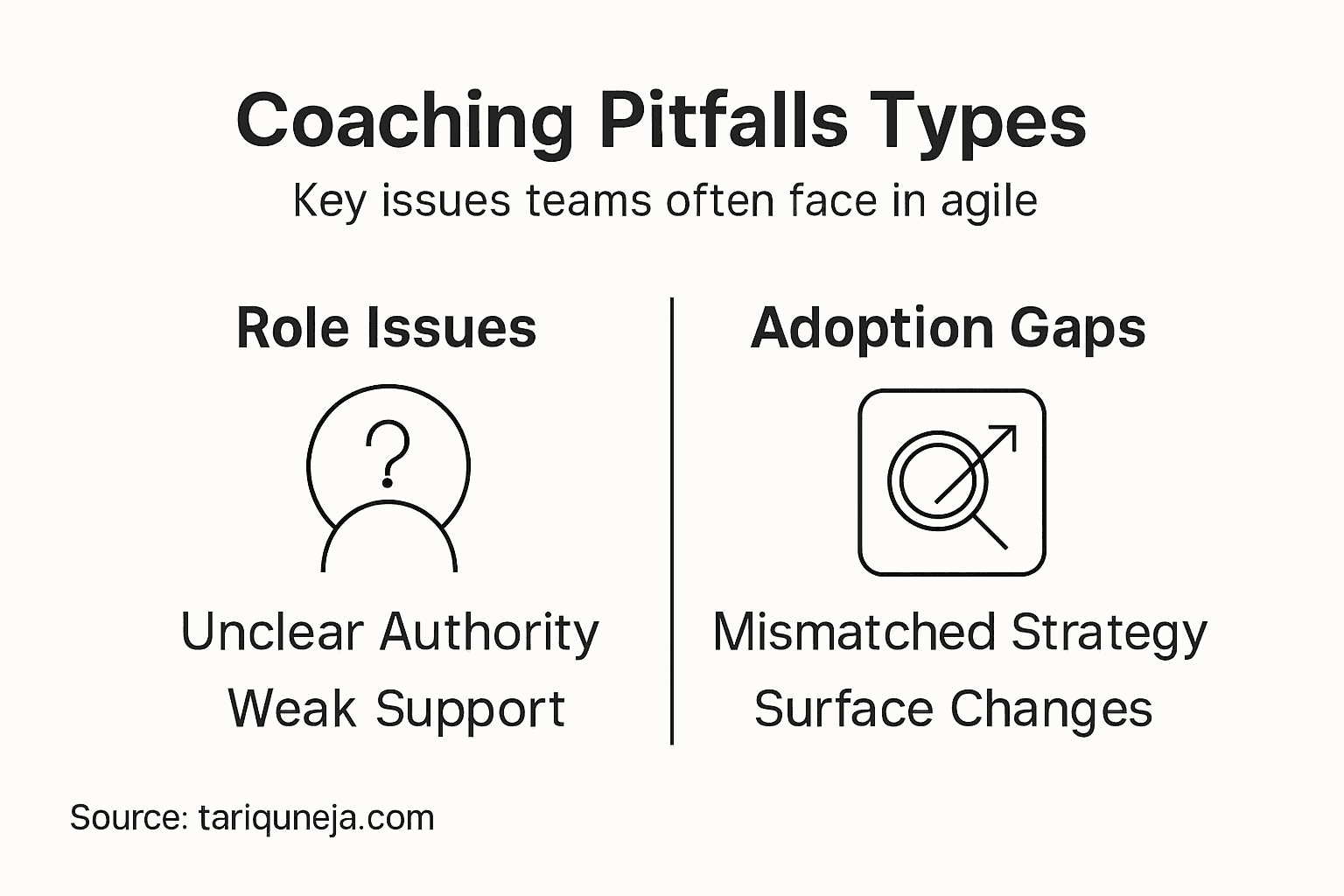
Coaching pitfalls in agile environments fall into distinct categories, and understanding each type helps you identify what’s actually going wrong in your transformation efforts. The first major category centers on role clarity and authority. A coach who doesn’t understand their actual scope of influence becomes either ineffective or overreaching. You might bring in a coach who treats themselves as a decision-maker rather than a facilitator, or conversely, someone who lacks enough organizational credibility to drive meaningful change. When a coach operates without clear boundaries about what they can and cannot do, teams become confused about whether to follow the coach’s guidance or defer to their managers. This ambiguity paralyzes decision-making and erodes trust.
The second category involves misalignment between coaching strategies and team readiness. Coaching approaches that fail to match team maturity levels create frustration on both sides. A newly formed team needs different support than a mature team with years of agile experience. If your coach treats everyone identically, advanced teams feel patronized while struggling teams feel abandoned. You might also see coaches applying cookie-cutter solutions without understanding your team’s specific technical constraints, industry regulations, or existing skill gaps. This one-size-fits-all approach ignores the reality that a financial services team cannot adopt agile practices the same way a software startup does.
The third pitfall involves inadequate handling of resistance and superficial adoption. Resistance isn’t always wrong. Your teams might resist certain agile practices for legitimate reasons your coach hasn’t bothered to understand. When coaches dismiss resistance instead of exploring it, they push teams toward surface-level compliance that never becomes genuine behavioral change. You end up with standups that feel like reporting sessions, retrospectives that lack honesty, and ceremonies that teams tolerate rather than value. The transformation looks successful on dashboards while actually struggling beneath the surface.
The fourth category is insufficient organizational support and leadership misalignment. Even a brilliant coach cannot overcome leadership that doesn’t actually believe in agile transformation. If executives cut budgets mid-transformation, schedule mandatory projects that contradict agile principles, or reward individual heroics over collaboration, the coach’s best efforts become irrelevant. Teams notice these contradictions immediately and respond by outwardly adopting agile while maintaining traditional mindsets.

Pro tip: Audit your coaching relationship by asking whether your coach truly understands your team’s maturity level, organizational constraints, and leadership’s actual commitment to transformation before expanding their scope or extending their engagement.
Here’s a summary of common agile coaching pitfalls and their primary negative impacts:
| Pitfall Category | How It Harms Teams | Typical Symptoms |
|---|---|---|
| Unclear Role/Authority | Creates confusion and distrust | Indecision, mixed messages |
| Strategy-Team Misalignment | Frustrates team growth | Patronizing or abandoned teams |
| Dismissing Resistance | Drives shallow adoption | Rituals without engagement |
| Weak Organizational Support | Undermines transformation | Outward compliance, cynicism |
How Pitfalls Impact Team Productivity
Coaching pitfalls don’t just slow down transformation efforts. They actively damage the conditions teams need to perform at their best. When coaches create misalignment or operate without clear authority, you see immediate drops in output. Teams spend energy navigating confusion instead of building features. They second-guess decisions because they’re unsure whether to follow the coach’s guidance or their manager’s direction. This constant friction consumes cognitive resources that should go toward solving business problems. You might notice deadlines slipping, quality issues increasing, or sprint velocity declining without understanding why.
The productivity impact compounds when coaching interventions misalign with team maturity or organizational readiness, fostering dependency rather than autonomy. A coach who solves problems for the team instead of helping them solve problems creates a dangerous pattern. Teams become passive, waiting for the coach to tell them what to do. When that coach leaves, productivity collapses because the team never developed judgment. Worse, teams become frustrated watching themselves treated like they cannot think independently. This breeds resentment toward agile itself, not the coaching approach.
One of the most damaging impacts involves psychological safety and motivation. Coaching pitfalls reduce motivation, increase misunderstandings, and perpetuate dysfunctional dynamics, creating environments where teams hesitate to speak up, share concerns, or challenge ideas. A team lacking psychological safety stays quiet in retrospectives instead of identifying real problems. They don’t voice concerns about technical decisions. They don’t suggest improvements. They perform surface compliance while maintaining the status quo. The result looks like steady output on paper, but it’s hollow. Teams are exhausted, disengaged, and resistant to change. You see burnout emerge as people try harder to meet expectations in an environment that doesn’t support actual growth.
The timeline impact matters too. Coaching pitfalls prolong your agile adoption curve significantly. What should take 6 months stretches into 18 months because teams keep relearning lessons. Resistance grows rather than diminishes. People become cynical about transformation initiatives. By the time you realize coaching isn’t working, you’ve already invested months and built negative momentum that becomes harder to reverse.
Pro tip: Measure team productivity not just by sprint output, but by psychological safety indicators, decision-making speed, and whether teams are becoming more autonomous or more dependent on external guidance.
Common Misconceptions About Coaching Success
Many organizations measure coaching success by the wrong metrics, which leads them to declare victory prematurely or continue investing in ineffective coaching relationships. The most dangerous misconception is that successful coaching looks like rapid process adoption. You implement standups, create sprint boards, run retrospectives, and suddenly you think transformation is working. Your teams are executing the mechanics. But mechanics are not transformation. A team can do all the agile ceremonies perfectly while maintaining command and control decision-making, avoiding accountability, and resisting genuine collaboration. You see the checkbox completion and miss the cultural stagnation underneath.
Another widespread misconception assumes that coaching success means the coach becomes indispensable. Organizations often measure coach impact by how many decisions the coach influences, how many problems the coach solves, or how much the team depends on the coach’s expertise. This is backward. Effective coaching requires fostering a coaching mindset rather than merely enforcing Agile mechanics, which means your teams should become progressively more independent, not more dependent. Real success looks like your coach gradually stepping back because the team no longer needs daily guidance. If your teams still check with the coach before making decisions six months into engagement, that is coaching failure disguised as coaching involvement. You have created a bottleneck, not a transformation.
A third misconception treats coaching as a quick fix with a defined endpoint. Organizations bring in a coach expecting that 12 weeks of coaching will permanently resolve organizational dysfunction that took years to develop. Sustainable behavioral and cultural change requires time, repetition, and consistent reinforcement. When expectations for rapid transformation collide with reality, leaders often conclude the coach failed rather than recognizing that the timeframe was unrealistic. Worse, this creates pressure on coaches to show quick wins, which incentivizes surface level changes that look impressive in reports but lack staying power. Teams revert to old patterns the moment external pressure eases because the underlying culture never shifted.
A fourth misconception assumes that coaching success and process compliance are the same thing. You might have teams running all the agile processes correctly while experiencing zero cultural shift. They attend standups but don’t collaborate genuinely. They hold retrospectives but don’t challenge dysfunction honestly. They plan sprints without team buy-in. Compliance creates the appearance of success without the substance. This distinction matters enormously because compliant teams that lack genuine buy-in will eventually rebel, resist future changes, or quietly sabotage initiatives they were forced to adopt.
Pro tip: Define coaching success by team autonomy growth, psychological safety improvement, and reduced dependency on external guidance rather than by process conformance or activity level.
Compare these agile coaching success metrics for deeper evaluation of transformation:
| Metric Type | What It Measures | Why It Matters |
|---|---|---|
| Team Autonomy | Independent decision-making | Shows lasting change |
| Psychological Safety | Willingness to speak up | Enables honest feedback |
| Dependency Level | Reliance on coach | Reveals true self-sufficiency |
| Process Compliance | Checklist task completion | Risks surface transformation |
Practical Strategies to Avoid Pitfalls
Avoiding coaching pitfalls requires deliberate action before, during, and after you engage a coach. Start with establishing absolute clarity around coaching scope and authority. Before hiring, write down exactly what decisions your coach can influence, what areas they cannot touch, and how they interact with your existing management structure. Does the coach report to the CTO or the VP of People? Can they make recommendations about architecture, or only about team dynamics? Can they attend leadership meetings, or do they operate only with individual teams? This clarity prevents the ambiguity that paralyzes teams later. Your coach needs this definition as much as your organization does. A coach who understands their boundaries can operate confidently within them.
Second, establishing clear role definitions and aligning coaching approaches with organizational context is non-negotiable. Your coach needs to understand your organizational DNA before suggesting practices. Are you a startup where people expect autonomy, or a regulated industry where compliance drives decisions? Do you have distributed teams across time zones, or colocated teams? Is your technical debt severe, or is infrastructure relatively healthy? A coach who ignores these realities will apply generic solutions that create friction. Spend time helping your coach understand your context, constraints, and culture before expecting them to guide transformation.
Third, secure genuine leadership buy-in before coaching begins. When executives understand coaching scope and support the transformation genuinely, coaching becomes possible. When leadership is skeptical or distracted, coaching becomes theater. Your coach cannot overcome leadership that contradicts agile principles through their own actions. Ensure leaders understand they cannot schedule mandatory projects mid-sprint, reward individual heroics over collaboration, or cut transformation budgets when quarterly results tighten. Transparent communication and stakeholder engagement help address change resistance and build the organizational support coaching needs.
Fourth, implement continuous feedback loops. Your coach should solicit feedback from teams, managers, and leaders regularly. This feedback should shape how coaching evolves. Teams might need different support in month three than they needed in month one. A coach responsive to feedback adapts their approach rather than rigidly executing a predetermined playbook. This responsiveness prevents coaching from becoming disconnected from team reality.
Finally, define success metrics that reflect actual transformation, not just activity. Track team autonomy, psychological safety, decision-making speed, and whether teams still depend on the coach six months in. These metrics reveal whether transformation is genuine or superficial.
Pro tip: Before engaging a coach, create a written agreement specifying scope, authority, reporting structure, and success metrics so both parties understand expectations and can adjust course if reality diverges from assumptions.
Building Sustainable Coaching Practices
Sustainable coaching does not mean having a coach on staff forever. It means developing your organization’s internal capacity to sustain agile principles after external coaching ends. This shift requires treating coaching as a vehicle for cultural transformation rather than a dependency. Organizations that build sustainable practices ask different questions than those seeking quick fixes. Instead of asking what the coach can do for us, they ask what capabilities we need to develop internally so we no longer need the coach. This mindset creates lasting change.
Start by developing a coaching mindset throughout your leadership team. Sustainable coaching practices focus on long-term cultural transformation and institutional support through ongoing training rather than short-term process enforcement. This means your managers, team leads, and senior engineers should be trained in coaching skills themselves. They learn how to ask powerful questions, how to foster psychological safety, and how to develop team members rather than solve problems for them. When coaching becomes distributed across your organization instead of concentrated in one external person, the practice becomes sustainable. A single coach leaving creates a void. A coaching-oriented leadership culture maintains momentum regardless of personnel changes. You might bring in external coaches to strengthen and certify this internal capability, but the foundation lives within your people.
Second, establish communities of practice that nurture knowledge sharing. Create forums where teams discuss agile challenges, share solutions, and learn from each other’s experiments. These communities become the social infrastructure that sustains agile principles. Teams realize they are not alone in struggling with specific challenges. They discover that another team found a pragmatic solution to a problem they face. This peer learning reduces dependency on any single coach and creates collective problem-solving capacity. Communities of practice also surface emerging challenges early before they become systemic problems.
Third, align coaching efforts with strategic organizational goals explicitly. Effective practices focus on developing leadership capabilities and aligning coaching efforts with strategic organizational goals so coaching becomes woven into how the organization operates. This means coaching is not a separate initiative but rather the operating model itself. When leaders evaluate strategy, they ask how coaching and continuous learning support strategic execution. When teams plan work, they consider what coaching moments exist within the work. Coaching becomes how you operate, not something you do.
Finally, measure and celebrate progress toward autonomy. Track whether teams are making more decisions independently, whether psychological safety is increasing, and whether team members are developing each other. Recognize managers who develop talent effectively. Create career paths that reward mentorship and coaching capability. These signals tell your organization that sustainable coaching is valued and expected.
Pro tip: Establish a 12-18 month transition plan where external coaching intensity decreases systematically while internal coaching capacity increases, with clear milestones for team autonomy and reduced dependency on the external coach.
Overcome Agile Coaching Pitfalls to Transform Your Team’s Success
Facing uncertainty from unclear coaching roles or struggling with superficial agile adoption can leave your teams frustrated and productivity stalled. This article highlights the critical coaching pitfalls that cause confusion, resistance, and dependency instead of fostering autonomy and real transformation. If your organization is wrestling with these challenges you are not alone—many teams suffer from misaligned coaching strategies and lack of leadership support that slows down progress and builds cynicism.
Take control of your agile transformation today by exploring expert guidance in Agile Coaching Archives – Tariq Juneja designed to help you bridge these gaps.

Discover practical strategies and personalized coaching solutions at https://tariqjuneja.com that clarify coaching roles, build team autonomy, and align leadership commitment. Avoid costly delays and burnout by acting now to empower your teams with sustainable agile practices. Start your transformational journey with Tariq Juneja’s proven methods to boost productivity and embed psychological safety within your organization. Learn more through Change Management Archives – Tariq Juneja and take your next step toward lasting change.
Frequently Asked Questions
What are common coaching pitfalls in agile environments?
Common coaching pitfalls include unclear role authority, misalignment between coaching strategies and team readiness, inadequate handling of resistance, and insufficient organizational support. These issues can lead to confusion, frustration, and a lack of genuine agile adoption.
How do coaching pitfalls impact team productivity?
Coaching pitfalls can decrease productivity by creating confusion over decision-making, fostering dependency on the coach instead of encouraging team autonomy, and diminishing psychological safety, which ultimately leads to disengagement and burnout.
What misconceptions exist around coaching success in agile environments?
Some common misconceptions include equating rapid process adoption with success, believing that a coach should be indispensable, viewing coaching as a quick fix, and considering compliance with processes as a sign of transformation. True success lies in developing team autonomy and fostering a coaching culture.
What strategies can organizations implement to avoid coaching pitfalls?
Organizations can avoid coaching pitfalls by establishing clear coaching scope and authority, aligning coaching approaches with organizational context, securing genuine leadership buy-in, implementing continuous feedback loops, and defining success metrics that reflect true transformation rather than mere activity.