

Over 60 percent of American tech leaders report that adopting a coaching mindset leads to measurable improvements in team engagement and innovation. As the pace of digital transformation accelerates, mid-level managers face mounting pressure to support change while maintaining productivity. This article highlights actionable strategies for integrating a coaching mindset with agile methods, helping you navigate complex team dynamics and drive consistent results in today’s global tech environments.
Table of Contents
- Defining The Coaching Mindset In Organizations
- Types Of Coaching Mindsets And Key Differences
- Core Traits Of Effective Coaching Approaches
- Integrating Coaching Mindset With Agile Methods
- Common Pitfalls And How To Avoid Them
Key Takeaways
| Point | Details |
|---|---|
| Coaching Mindset | A coaching mindset empowers individuals and teams, focusing on collaborative growth rather than directive management. |
| Types of Coaching | Understanding different coaching types, such as performance, developmental, and transformational, is crucial for addressing specific organizational needs. |
| Effective Coaching Traits | Successful coaching hinges on emotional intelligence, active listening, and adaptive communication, fostering a culture of trust and continuous learning. |
| Integration with Agile | Merging coaching with agile methodologies enhances team adaptability and performance, promoting autonomy and collective intelligence. |
Defining the Coaching Mindset in Organizations
A coaching mindset represents more than a professional technique – it’s a transformative approach to leadership and organizational development. At its core, coaching is about empowering individuals and teams to unlock their potential through intentional, structured guidance. Unlike traditional management models, a coaching mindset shifts from directive instruction to collaborative growth.
Research indicates that organizational coaching has become a critical performance enhancement strategy, with workplace coaching interventions emerging as one of the fastest-growing professional development approaches. This approach is fundamentally about creating an environment of continuous learning, where leaders view their role as facilitators of individual and collective potential rather than mere task managers.
Within tech teams specifically, a coaching mindset translates into practical behaviors: active listening, asking powerful questions, providing constructive feedback, and creating psychological safety. These elements enable team members to experiment, learn from mistakes, and develop innovative solutions. Organizational coaching culture remains dynamic and relational, focusing on developing self-awareness, promoting behavioral change, and supporting talent management.
Pro tip: Start implementing a coaching mindset by dedicating 15 minutes per week to individual team member check-ins, focusing on their personal development goals and potential obstacles.
Types of Coaching Mindsets and Key Differences
Coaching has evolved into a sophisticated discipline with multiple specialized approaches tailored to diverse organizational needs. Coaching types range from individual to team-based interventions, each designed to address unique performance and developmental challenges within professional contexts. Coaching methodologies have expanded to include specific formats like individual, team, executive, intercultural, life, health, and career coaching.
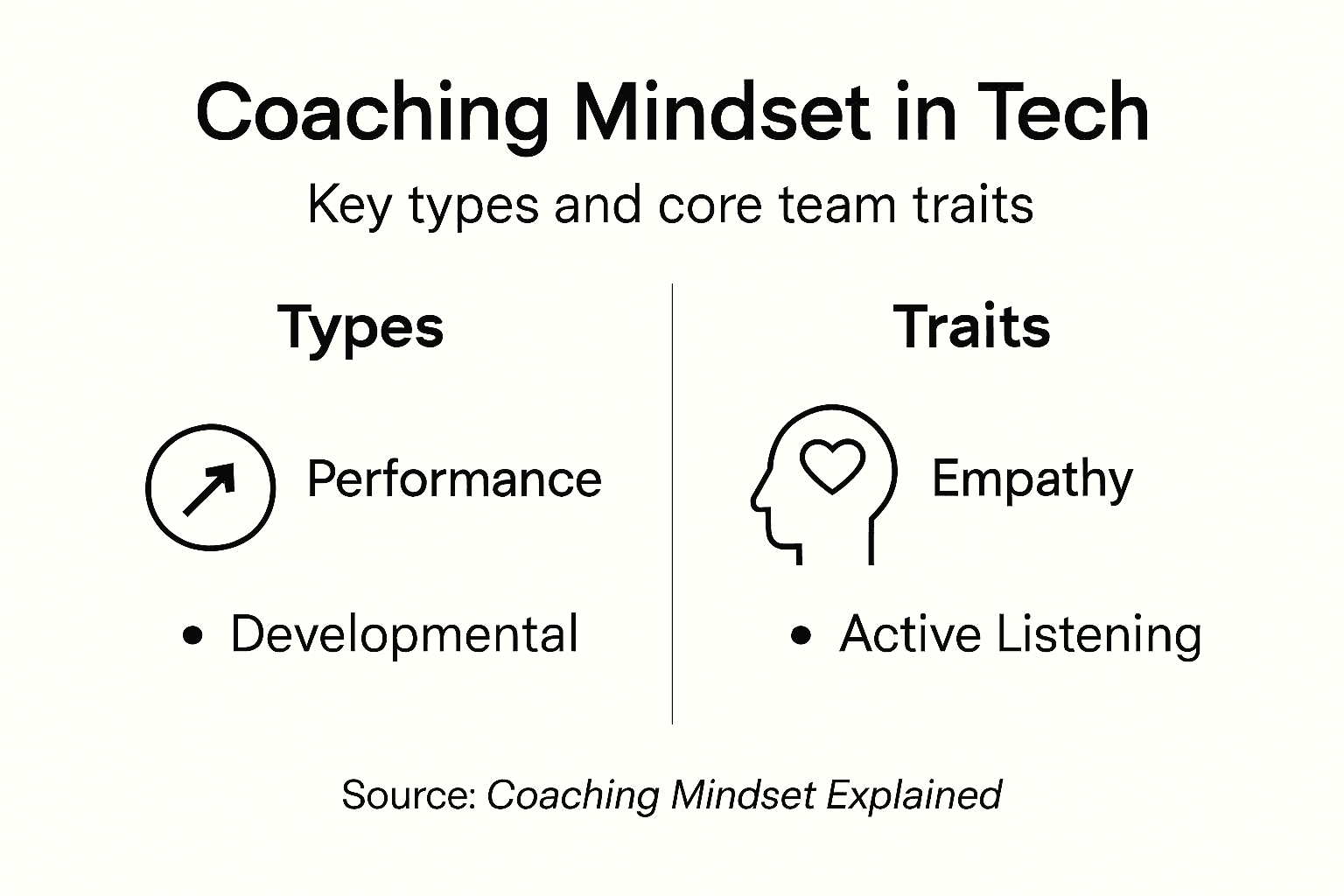
Within tech environments, the most prevalent coaching mindsets include performance coaching, developmental coaching, and transformational coaching. Performance coaching focuses on immediate skill improvement and goal achievement, emphasizing tactical skill enhancement. Developmental coaching takes a more holistic approach, concentrating on long-term professional growth, self-awareness, and strategic capability building. Professional coaching approaches differ fundamentally in their primary objectives and methodological frameworks.
Tech leaders must understand the nuanced differences between these coaching types. Performance coaching typically involves direct skill intervention, using specific metrics and targeted feedback. Developmental coaching, conversely, explores underlying thought patterns, emotional intelligence, and systemic barriers to personal and professional advancement. Transformational coaching goes even deeper, challenging fundamental assumptions and supporting profound behavioral and mindset shifts that enable comprehensive organizational change.
Here’s a quick comparison of prevalent coaching mindsets used in tech environments:
| Coaching Mindset | Primary Focus | Typical Application |
|---|---|---|
| Performance Coaching | Immediate skill improvement | Developing specific competencies |
| Developmental Coaching | Long-term professional growth | Building strategic capability |
| Transformational Coaching | Profound mindset shifts | Enabling major organizational change |
Pro tip: Assess your team’s specific needs by mapping individual coaching requirements against organizational objectives, creating a customized coaching strategy that balances immediate performance improvements with long-term developmental goals.
Core Traits of Effective Coaching Approaches
Effective coaching approaches transcend traditional management techniques, requiring a sophisticated blend of interpersonal skills, psychological insight, and strategic thinking. Workplace coaching effectiveness hinges on a coach’s ability to create transformative learning environments that foster individual and collective growth. The most impactful coaches demonstrate a remarkable capacity to balance empathy, critical analysis, and actionable guidance.

The core traits of successful coaching methodologies center on emotional intelligence, active listening, and adaptive communication. Coaches must possess the ability to read subtle interpersonal dynamics, ask powerful questions, and create psychological safety that enables team members to explore vulnerability and potential. Research reveals that coaching effectiveness stems more from relational qualities than from rigid methodological frameworks, emphasizing the importance of genuine human connection and trust-building.
In tech environments, these traits translate into specific behavioral competencies. Effective coaches demonstrate deep technical understanding while maintaining an outsider’s perspective, allowing them to challenge existing thought patterns without alienating team members. They excel at communication skills coaching, using nuanced feedback mechanisms that provide clear direction without diminishing individual autonomy. The most successful approaches blend data-driven insights with empathetic understanding, creating a holistic approach to performance improvement.
Below is a summary of key traits that define highly effective coaching in technical teams:
| Trait | How It Drives Team Success | Distinctive Advantage |
|---|---|---|
| Emotional Intelligence | Builds trust and rapport | Enhances communication and empathy |
| Active Listening | Uncovers hidden challenges | Promotes honest feedback |
| Adaptive Communication | Adjusts to team dynamics | Encourages innovation and learning |
Pro tip: Develop your coaching effectiveness by practicing reflective listening techniques, recording your coaching interactions, and systematically analyzing your communication patterns to identify areas of potential improvement.
Integrating Coaching Mindset With Agile Methods
The integration of coaching mindset with agile methodologies represents a transformative approach to team performance and organizational adaptability. Agile leadership coaching fundamentally challenges traditional hierarchical structures, replacing command-and-control models with collaborative, empowering leadership strategies. This approach recognizes that sustainable innovation emerges from teams equipped with psychological safety, continuous learning, and adaptive thinking.
In practice, integrating a coaching mindset with agile methods requires deliberate cultural transformation. Agile coaching goes beyond project management techniques, focusing on developing team members’ intrinsic motivation, problem-solving capabilities, and collective intelligence. Tech leaders must create environments that encourage experimentation, embrace failure as a learning opportunity, and support individual growth within the context of team objectives. Mindset development becomes a critical mechanism for driving sustainable performance and organizational resilience.
Successful integration demands specific behavioral shifts. Coaches must transition from directive instruction to facilitating self-organization, helping teams develop autonomy while maintaining alignment with strategic goals. This involves mastering communication techniques that promote transparency, encourage open dialogue, and build trust. The most effective agile coaches view their role as catalysts for team evolution, using powerful questioning, active listening, and contextual feedback to unlock collective potential.
Pro tip: Create a monthly reflection ritual where team members openly discuss learning experiences, challenges overcome, and personal growth insights to reinforce the coaching mindset within your agile framework.
Common Pitfalls and How to Avoid Them
Coaching in tech environments involves navigating complex interpersonal dynamics that can easily derail even the most well-intentioned efforts. Common coaching mistakes often stem from misunderstanding the fundamental role of a coach – which is to guide, not dictate. The most frequent error is treating coaching as a top-down directive process, rather than a collaborative journey of mutual discovery and growth.
Tech teams frequently encounter specific coaching challenges that can undermine effective development. These include confusing coaching with performance management, focusing exclusively on technical skills while neglecting emotional intelligence, and establishing unclear boundaries between mentorship and coaching. Coaches must carefully distinguish between providing direct solutions and facilitating self-directed problem-solving. Coaching ethical boundaries become critically important in maintaining the integrity of the coaching relationship and preventing potential psychological harm.
To mitigate these risks, coaches must develop sophisticated communication strategies that prioritize transparency, active listening, and genuine curiosity. This involves creating psychological safety where team members feel empowered to explore vulnerabilities without fear of judgment. Successful coaches recognize that their primary role is not to solve problems, but to help individuals and teams develop the capacity to solve their own challenges. This requires a delicate balance of supportive guidance and strategic questioning that promotes self-reflection and personal accountability.
Pro tip: Implement a quarterly coaching effectiveness review where both coach and coachee provide honest, anonymous feedback to continuously refine and improve the coaching approach.
Unlock the Power of a Coaching Mindset to Drive Real Change in Your Tech Team
Struggling to move beyond traditional management and unlock your tech team’s full potential The article highlights the need for a coaching mindset that empowers teams through active listening, developmental growth, and transformational shifts. Many tech leaders face challenges like balancing immediate performance goals with long-term growth or creating psychological safety that fosters innovation. If you want to lead change that sticks you need strategies grounded in agile coaching and focused on mindset development.
Discover how to transform your leadership approach by visiting Agile Coaching Archives – Tariq Juneja where you can explore techniques designed specifically for empowering agile teams. Our practical frameworks help you integrate coaching behaviors that encourage autonomy and continuous learning while aligning with organizational goals. Plus, explore key strategies for sustainable organizational transformation at Change Management Archives – Tariq Juneja to elevate your team’s resilience.

Take the next step toward cultivating a coaching mindset that produces measurable impact in your tech environment. Visit https://tariqjuneja.com today and book your free consultation to begin your journey of transformational leadership. Start unlocking your team’s hidden potential now and create lasting change that drives productivity and engagement.
Frequently Asked Questions
What is a coaching mindset in organizations?
A coaching mindset is an approach to leadership that focuses on empowering individuals and teams through structured guidance, promoting collaborative growth rather than directive instruction.
How does a coaching mindset benefit tech teams?
A coaching mindset enhances tech teams by fostering psychological safety, encouraging experimentation, and enabling members to develop innovative solutions through active listening, constructive feedback, and professional development support.
What are the different types of coaching mindsets?
There are several coaching mindsets, including performance coaching, which targets immediate skill enhancement; developmental coaching, which focuses on long-term growth; and transformational coaching, which supports profound mindset shifts for comprehensive change.
How can I implement a coaching mindset within my tech team?
Start by dedicating time for individual check-ins to discuss personal development goals, encourage open dialogue, and create a culture of continuous learning and feedback within your team.