

Over 80 percent of business leaders report that unclear goals slow down their teams and hurt bottom lines. When objectives lack sharp focus, organizations struggle to measure real progress or inspire the right actions. Pinpointing company priorities sets the stage for every major success and turns ambition into results. By mastering clear goal setting, you can help your business stay aligned, track growth, and ultimately outperform the competition.
Table of Contents
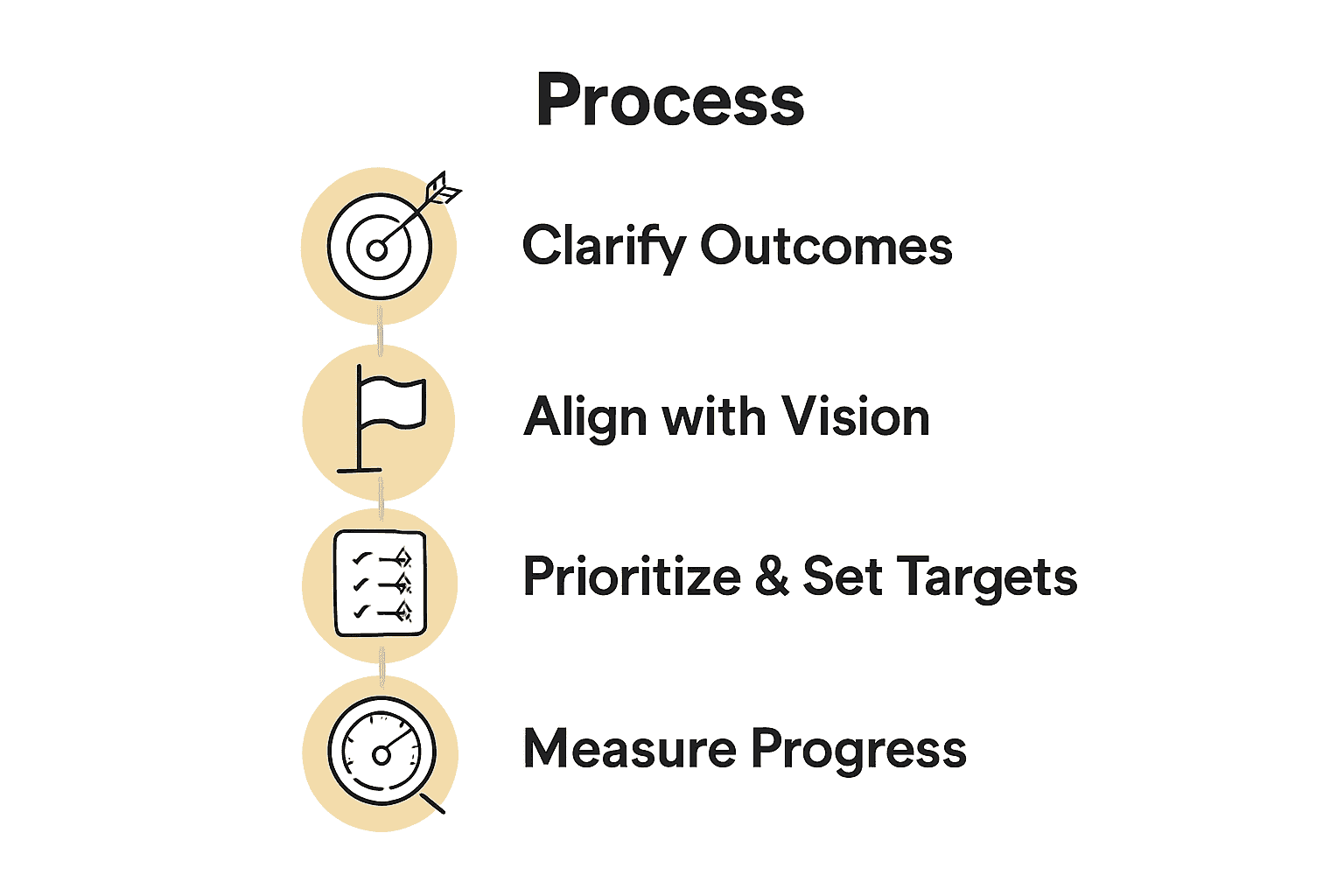
- Step 1: Clarify Desired Business Outcomes
- Step 2: Align Goals With Organizational Vision
- Step 3: Prioritize and Set Achievable Targets
- Step 4: Implement Measurable Progress Indicators
- Step 5: Review Progress and Optimize Strategies
Quick Summary
| Key Point | Explanation |
|---|---|
| 1. Define Specific Business Outcomes | Transform vague goals into concrete, measurable targets for organizational progress. |
| 2. Align Goals With Organizational Vision | Ensure individual and team objectives connect with the company’s broader mission to foster unity and clarity. |
| 3. Prioritize Achievable Targets | Rank goals based on strategic impact and realistic achievability to enhance focus and effectiveness. |
| 4. Implement Measurable Progress Indicators | Create key performance indicators (KPIs) that track strategic progress without overwhelming metrics. |
| 5. Regularly Review and Optimize Strategies | Conduct consistent evaluations to adapt goals and improve organizational performance based on data-driven insights. |
 |
Step 1: Clarify Desired Business Outcomes
Successful business goal setting starts with crystal clear outcome definition. In this critical first step, you will transform vague aspirations into precise strategic targets that drive meaningful organizational progress.
According to research from iosrjournals.org, organizational goal clarity requires comprehensive commitment and strategic alignment. This means breaking down complex objectives into specific measurable outcomes that every team member can understand and actively pursue.
To clarify your desired business outcomes, start by asking strategic questions: What specific results will demonstrate success? What metrics will prove we have achieved our goals? What tangible changes must occur in our organization? Write down precise numerical or percentage targets rather than fuzzy statements. For example, instead of saying “increase sales,” specify “increase quarterly revenue by 22% within nine months.”
The key is transforming abstract dreams into concrete, actionable targets. GQM+Strategies suggests aligning these outcomes across all organizational levels to ensure everyone understands and works toward the same strategic direction. This approach creates powerful momentum and shared understanding.

Warning: Avoid setting goals that sound impressive but lack substance. Your outcomes must be specific, measurable, achievable, relevant, and time-bound. Generic statements create confusion and prevent meaningful progress.
Step 2: Align Goals with Organizational Vision
Successful goal setting requires more than individual targets. You must strategically connect personal and team objectives with your organization’s broader mission and strategic direction.
Research from uofkej.edu reveals significant barriers in aligning employee objectives with organizational goals. These typically include communication gaps and insufficient employee involvement. To overcome these challenges, create a clear pathway that demonstrates how individual goals directly contribute to the company’s overarching vision.
Start by revisiting your organization’s mission statement. Break down each strategic element into actionable components. Ask yourself and your team critical questions: How do our individual and departmental goals support the core mission? What specific outcomes will prove we are moving in the right direction?
According to cyfar.org, successful alignment requires intentionally structuring programs and objectives to reflect the stated organizational vision.
This means creating a transparent connection between day-to-day work and long-term strategic goals.
Warning: Do not treat this alignment as a one-time exercise. Regularly review and adjust goals to maintain relevance and momentum. Goals that remain static quickly become irrelevant in our rapidly changing business environment.
For deeper insights into effective goal setting, check out our guide on setting goals for lasting success.
Step 3: Prioritize and Set Achievable Targets
Prioritizing goals transforms ambitious dreams into realistic accomplishments. In this critical step, you will learn how to strategically rank and design targets that are not just impressive on paper but genuinely attainable.
According to research from online.suu.edu, effective goal setting requires a cascading approach that moves systematically from executive level objectives down through the entire organizational structure. This means creating a hierarchical system where each level understands its specific role in achieving broader strategic outcomes.
To prioritize effectively, start by mapping out all potential goals and then apply a strategic filtering process. Evaluate each target based on three key criteria: strategic impact, resource requirements, and realistic achievability. Not every goal deserves equal attention. Some objectives will move your organization forward significantly more than others.
Umatechnology.org recommends using frameworks like Objectives and Key Results (OKRs) to create a clear roadmap. This method helps you break down large strategic goals into specific measurable targets that can be tracked and adjusted.
Warning: Avoid the common trap of setting too many goals simultaneously. Spreading your team’s energy too thin guarantees mediocre results. Focus is your greatest ally in achieving meaningful progress.
For comprehensive strategies on goal achievement, check out our guide on essential tips for business and personal goals.
Step 4: Implement Measurable Progress Indicators
Measurable progress indicators transform abstract goals into tangible, trackable outcomes. In this crucial step, you will design a systematic approach to monitoring and evaluating your organization’s performance with precision and clarity.
According to cs.umd.edu, the GQM+Strategies4 methodology emphasizes the critical role of measurement in aligning organizational goals. This means creating indicators that are not just numbers on a dashboard but meaningful reflections of your strategic progress.
Start by identifying key performance indicators (KPIs) that directly connect to your strategic objectives. These should be specific quantifiable metrics that answer three fundamental questions: What are we trying to achieve? How will we know we are making progress? What specific numbers demonstrate success?
Balancedscorecard.org recommends using a balanced scorecard approach that cascades measurement across multiple organizational levels. This means creating a comprehensive system that tracks financial performance customer satisfaction internal processes and learning and growth potential.
Warning: Avoid the trap of measuring everything. Select indicators that truly drive strategic value. Too many metrics create noise that obscures meaningful insights.
To dive deeper into performance tracking strategies, explore our guide on understanding performance metrics.
Step 5: Review Progress and Optimize Strategies
Successful goal achievement requires consistent evaluation and strategic adaptation. In this pivotal step, you will learn how to transform performance data into actionable insights that drive continuous organizational improvement.
Umatechnology.org emphasizes the importance of conducting regular reviews and strategic catch-ups. These systematic assessments allow you to monitor progress detect potential roadblocks and recalibrate your approach in real time.
Implement a structured review process that goes beyond surface level metrics. Schedule quarterly performance reviews where teams can transparently discuss achievements challenges and necessary adjustments. Create a safe environment where honest feedback is encouraged and data driven insights guide decision making.
During these review sessions focus on three key areas: what worked well what did not meet expectations and what specific actions can be taken to improve performance. Use these insights to refine your goals reallocate resources and adjust strategies proactively.
Warning: Avoid falling into the trap of viewing reviews as punitive exercises. These sessions should be collaborative opportunities for learning and growth not blame allocation.
To explore more strategies for organizational productivity, check out our guide on boosting employee performance.
Unlock Lasting Business Success with Expert Coaching
Setting clear and measurable business goals can often feel overwhelming. The struggle to prioritize objectives, align them with your company vision, and track meaningful progress can stall even the most driven teams. You are not alone if you face these challenges. Balancing ambition with achievable targets requires guidance grounded in proven strategies like those outlined in the article such as GQM+Strategies and cascading goal frameworks.
Discover how tailored agile coaching and transformational guidance empower you to break down complex goals into actionable steps.

Take control of your organizational progress today. Visit https://tariqjuneja.com to explore coaching programs designed for lasting impact. Dive deeper into techniques that improve focus and productivity on our Mind Mapping Archives. Start your journey toward empowered goal achievement with life coaching expertise. Don’t wait to turn your business aspirations into measurable success—book your free consultation now and transform your goal setting approach.
Frequently Asked Questions
What are the essential steps for setting effective business goals?
To set effective business goals, start by clarifying your desired outcomes, aligning them with your organization’s vision, prioritizing them based on impact and feasibility, implementing measurable progress indicators, and regularly reviewing your progress. Begin by defining specific and measurable objectives within the next few weeks to guide your team.
How can I ensure my team understands our business goals?
To ensure your team understands the business goals, communicate clearly by linking individual and team objectives to the overall organizational mission. Host a meeting within the next month to outline how each goal contributes to the larger vision and encourage questions for clarity.
What metrics should I use to measure the success of our business goals?
Use specific key performance indicators (KPIs) that relate directly to each goal, such as revenue targets, customer satisfaction scores, or conversion rates. Identify these metrics early in the goal-setting process to track progress effectively and adjust strategies as needed within quarterly reviews.
How often should we review our progress towards business goals?
Regularly review progress towards business goals at least quarterly to assess performance and make necessary adjustments. Schedule these reviews to discuss what’s working, what isn’t, and how to optimize efforts moving forward.
How can I prioritize multiple business goals effectively?
Prioritize business goals by evaluating each one based on its strategic impact, resource requirements, and how achievable it is. Create a ranking system within a week to focus your team’s efforts and avoid spreading resources too thin across too many projects.
What should I do if my business goals are not being met?
If your business goals are not being met, conduct a thorough review to identify specific challenges or roadblocks. Implement constructive feedback sessions within two weeks to discuss these obstacles and adapt your strategies or resources to foster improvement.