

Nearly 80 percent of American organizations cite effective coaching as a top driver for successful transformation, yet most teams still struggle with applying the right frameworks. For mid-level managers in IT and agile sectors, the pressure to cultivate adaptive teams and accelerate productivity has never been greater. This article breaks down the latest business coaching frameworks, uncovering strategic approaches that help leaders solve complex performance challenges and build resilient teams capable of thriving in global markets.
Table of Contents
- Defining Business Coaching Frameworks Today
- Popular Frameworks And Their Key Differences
- How Frameworks Drive Team And Organizational Change
- Implementing Coaching Frameworks In Agile Environments
- Common Pitfalls And Keys To Effective Use
Key Takeaways
| Point | Details |
|---|---|
| Business Coaching Frameworks are Essential | Modern frameworks are crucial for sustainable growth, emphasizing holistic development rather than just skill enhancement. |
| Tailor Frameworks to Fit Context | Select coaching models that align with your unique organizational culture and strategic goals for effective implementation. |
| Prioritize Psychological Safety | Create environments that foster open communication and continuous learning to maximize coaching effectiveness. |
| Adopt an Adaptive Approach | Treat coaching frameworks as flexible tools that evolve with your organization rather than rigid guidelines for execution. |
Defining Business Coaching Frameworks Today
Business coaching frameworks represent strategic methodologies designed to elevate organizational performance by systematically developing leadership capabilities, team dynamics, and individual potential. In today’s rapidly evolving professional landscape, these frameworks are not mere supplementary tools but critical infrastructures for sustainable business growth. Emerging leadership coaching approaches increasingly integrate emotional intelligence, digital transformation strategies, and adaptive learning techniques to address complex organizational challenges.
Modern business coaching frameworks fundamentally differ from traditional performance management models by emphasizing holistic development. They recognize that effective coaching transcends simple skill enhancement, focusing instead on creating psychologically safe environments where professionals can explore innovative problem solving strategies. These frameworks typically incorporate multiple interconnected elements: diagnostic assessments, personalized development plans, continuous feedback mechanisms, and measurable performance benchmarks.
The most sophisticated coaching frameworks are grounded in evidence-based practices that blend scientific research with practical expertise. Comprehensive coaching competency models now require practitioners to demonstrate not just technical skills, but deep contextual understanding of organizational dynamics, learning theories, and human potential. This approach transforms coaching from a transactional interaction to a transformative leadership intervention that drives meaningful organizational change.
Pro Tip: When implementing a business coaching framework, prioritize creating a culture of psychological safety and continuous learning over rigid performance metrics.
Popular Frameworks and Their Key Differences
Business coaching frameworks have evolved to address increasingly complex organizational challenges, with several prominent models emerging as industry standards. Popular coaching models like GROW, CLEAR, and OSKAR provide structured approaches that guide professional development and organizational transformation. Each framework offers unique perspectives on achieving performance excellence, targeting different aspects of individual and team potential.
The GROW model represents a goal-oriented approach, breaking down coaching interactions into four critical stages: Goal setting, current Reality assessment, Options exploration, and Will or Way forward. In contrast, the CLEAR framework emphasizes communication and reflection, focusing on Contract establishment, Listening deeply, Exploring alternatives, Action planning, and Review. The OSKAR model takes a solution-focused approach, highlighting Outcome vision, Scaling current performance, Know-how and resources, Action commitments, and Review of progress.
These frameworks are not one-size-fits-all solutions but adaptive methodologies that can be customized to specific organizational contexts. Successful implementation requires understanding each model’s unique strengths and potential limitations. Coaches must carefully select and modify frameworks to align with their team’s specific development needs, organizational culture, and strategic objectives. The most effective practitioners blend elements from multiple frameworks, creating integrated approaches that address complex human performance dynamics.
Here’s a comparison of leading business coaching frameworks and their unique organizational impacts:
| Framework | Key Focus | Distinctive Feature | Business Impact |
|---|---|---|---|
| GROW | Goal-setting and action | Structured four-stage process | Drives accountability and clarity |
| CLEAR | Communication and reflection | Emphasizes deep listening and review | Enhances team trust and insight |
| OSKAR | Solution-focused coaching | Visioning and scaling achievements | Promotes innovation and progress |
Pro Tip: Select a coaching framework that matches your organization’s specific cultural and performance needs rather than adopting a rigid, prescriptive model.
How Frameworks Drive Team and Organizational Change
Business coaching frameworks are transformative mechanisms that fundamentally reshape organizational culture and performance dynamics. Coaching frameworks enable systematic organizational change by embedding leadership development strategies directly into workplace interactions, creating environments of continuous learning and adaptive capacity.

These frameworks operate through multiple interconnected mechanisms. First, they establish psychological safety by creating structured dialogue processes that encourage open communication and vulnerability. Team members learn to view challenges as collaborative opportunities rather than individual threats. Second, coaching frameworks systematically develop leadership capabilities at every organizational level, moving beyond traditional hierarchical development models to create adaptive, resilient teams capable of navigating complex business environments.
The most effective organizational change approaches integrate coaching frameworks as core operational strategies rather than peripheral interventions. This means embedding coaching principles into performance management, talent development, and strategic planning processes. By doing so, organizations create self-sustaining ecosystems of continuous improvement where individual growth directly contributes to collective organizational capability. Successful implementation requires committed leadership, clear communication of framework objectives, and ongoing measurement of both qualitative and quantitative transformation indicators.
Pro Tip: Design your coaching framework implementation as a comprehensive change management strategy, not just a training program.
Implementing Coaching Frameworks in Agile Environments
Agile environments demand dynamic coaching approaches that seamlessly integrate leadership development with rapid organizational adaptation. Coaching strategies in agile leadership emphasize servant leadership principles, focusing on empowering teams through continuous learning and self-directed problem solving.
Successful implementation requires a nuanced approach that transforms traditional coaching models into flexible, responsive frameworks. Agile coaching frameworks typically involve three key transformational strategies: first, establishing psychological safety that encourages transparent communication and risk taking. Second, developing team members’ self-reflection capabilities to enhance collective problem solving. Third, creating adaptive feedback mechanisms that support rapid iteration and continuous improvement. These strategies move beyond traditional top-down management, instead cultivating environments where team members are active participants in their own development and organizational success.
Practical implementation demands strategic alignment between coaching frameworks and agile methodologies. This means integrating coaching principles directly into sprint planning, retrospectives, and daily stand-ups. Coaches must become facilitators of team learning, helping teams develop metacognitive skills that enable them to diagnose their own performance challenges, generate innovative solutions, and continuously evolve their collaborative practices. The most effective agile coaches view their role as catalysts of organizational learning, using frameworks not as rigid prescriptions but as flexible tools for navigating complex adaptive challenges.
Pro Tip: Treat coaching frameworks as living documents that evolve with your team, not as static implementation checklists.
Common Pitfalls and Keys to Effective Use
Business coaching frameworks are powerful tools for organizational transformation, but their effectiveness depends on nuanced implementation. Empirical challenges in coaching practice reveal critical pitfalls that can undermine even the most well-intentioned coaching efforts. The most significant risks include treating frameworks as rigid prescriptions rather than adaptive strategies, failing to align coaching with specific organizational contexts, and neglecting continuous measurement of coaching outcomes.
The primary pitfalls stem from fundamental misunderstandings about coaching’s role and implementation. Many organizations make the mistake of viewing coaching as a one-time intervention rather than an ongoing process of organizational learning. Coaches and leaders frequently overlook the importance of contextual adaptation, attempting to apply standardized approaches across diverse team environments. Successful implementation requires a sophisticated approach that balances structured methodology with flexible, context-specific application. This means developing coaches who can read organizational dynamics, adapt frameworks in real-time, and create customized approaches that resonate with specific team cultures and challenges.
Effective use of coaching frameworks demands a holistic, integrated approach. Organizations must invest in continuous professional development for coaches, establish clear measurement mechanisms, and create organizational cultures that genuinely support learning and transformation. This involves developing robust feedback loops, creating psychological safety for experimentation, and aligning coaching strategies with broader organizational goals. The most successful approaches treat coaching frameworks as living, evolving tools that grow and adapt alongside the organization, rather than static documents to be mechanically implemented.
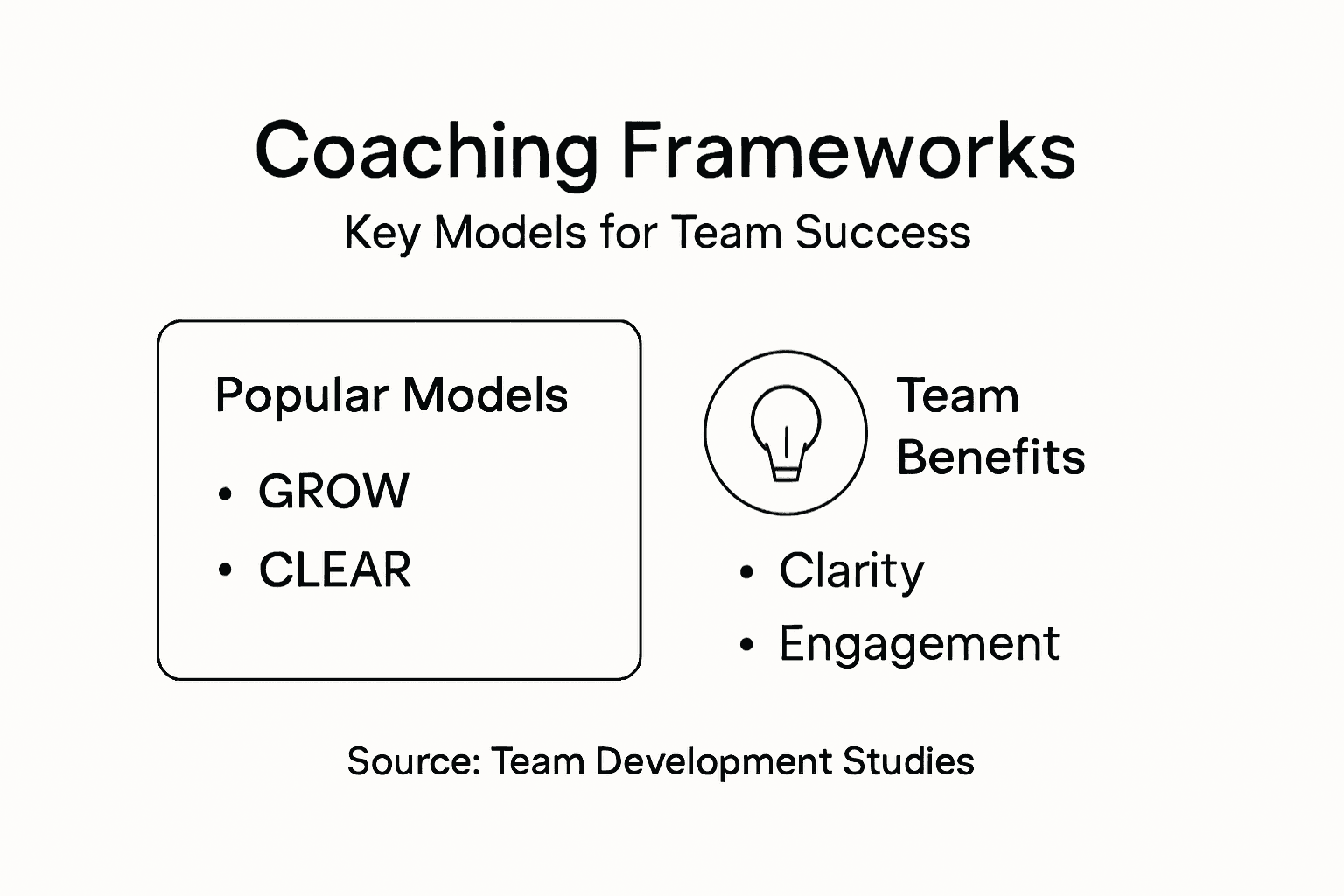
Summary of critical factors for effective coaching framework implementation:
| Success Factor | Organizational Benefit | Common Risk |
|---|---|---|
| Psychological safety | Fosters open dialogue | Resistance to change |
| Contextual adaptation | Tailors solutions for teams | Generic application fails |
| Continuous feedback | Enables rapid improvement | Lack of measurable progress |
| Leadership commitment | Drives sustained transformation | Inconsistent support |
Pro Tip: Develop coaching frameworks as flexible roadmaps, not rigid rulebooks, and continuously reassess their effectiveness in your specific organizational context.
Unlock Team Success with Proven Business Coaching Frameworks
Struggling to foster real change and sustained growth in your team or organization? This article highlights the need for adaptable and psychologically safe coaching frameworks that ignite continuous learning and leadership development. If your goal is to go beyond rigid coaching methods and instead embrace flexible strategies that truly resonate with your unique team culture and agile environment, it’s time to explore tailored solutions.
Discover how expert guidance can transform coaching frameworks into living tools that drive meaningful organizational progress. Start by exploring our Agile Coaching Archives – Tariq Juneja and Change Management Archives – Tariq Juneja for insights into dynamic approaches that empower teams through trust, adaptability, and actionable feedback.
Take the next step in elevating your team’s success by partnering with a transformational coach who understands the complexities of modern business coaching. Visit https://tariqjuneja.com today to book a free consultation and receive exclusive resources designed to help you build resilient, high-performing teams ready to thrive in an ever-changing landscape.
Frequently Asked Questions
What are business coaching frameworks?
Business coaching frameworks are structured methodologies designed to enhance organizational performance by developing leadership skills, team dynamics, and individual potential through various interconnected elements such as assessments, personalized development plans, and continuous feedback.
How do the GROW, CLEAR, and OSKAR coaching models differ?
The GROW model focuses on goal-setting with a four-stage process, CLEAR emphasizes communication and reflection, and OSKAR adopts a solution-focused approach aimed at scaling achievements. Each framework offers unique perspectives that can be customized for specific organizational contexts.
Why is psychological safety important in coaching frameworks?
Psychological safety fosters an environment where team members feel safe to communicate openly and take risks. This encourages collaboration and innovative problem-solving, essential for effective coaching and organizational change.
How can organizations effectively implement coaching frameworks?
Successful implementation involves treating coaching as an ongoing process rather than a one-time event. It requires establishing psychological safety, adapting frameworks to specific contexts, and investing in continuous feedback mechanisms and professional development for coaches.